
Comic Book Author Saladin Ahmed
Clip: Season 5 Episode 42 | 9m 6sVideo has Closed Captions
Comic Book Author Saladin Ahmed | Episode 542/Segment 1
Saladin Ahmed is an Eisner Award winning, Detroit-based but nationally-renowned comic book author, best known for Marvel's Black Bolt, Ms. Marvel, and Miles Morales: Spider-Man, as well as his original series Abbott, a supernatural mystery set in 1970s Detroit. Episode 542/Segment 1
Problems playing video? | Closed Captioning Feedback
Problems playing video? | Closed Captioning Feedback
One Detroit is a local public television program presented by Detroit PBS
Comic Book Author Saladin Ahmed
Clip: Season 5 Episode 42 | 9m 6sVideo has Closed Captions
Saladin Ahmed is an Eisner Award winning, Detroit-based but nationally-renowned comic book author, best known for Marvel's Black Bolt, Ms. Marvel, and Miles Morales: Spider-Man, as well as his original series Abbott, a supernatural mystery set in 1970s Detroit. Episode 542/Segment 1
Problems playing video? | Closed Captioning Feedback
Where to Watch One Detroit
One Detroit is available to stream on pbs.org and the PBS app.
Providing Support for PBS.org
Learn Moreabout PBS online sponsorshipAll right Marvel fans, this one's for you.
Saladin Ahmed is an Eisner award winning, Detroit based and nationally renowned comic book author.
He's best known for Marvel's Black Bolt, Ms.
Marvel and Miles Morales Spider-Man as well as his original series Abbott, a supernatural mystery set in 1970s Detroit.
One Detroit editor, Chris Jordan sat down with Saladin at Vault of Midnight Comics to discuss his brand new Marvel series, the Spine-Tingling Spider-Man and his recently launched comic website Copper Bottle.
He also talks about how he uses comics to spark important conversations about real-world social issues.
Take a look.
- [Chris] Spine-Tingling Spider-Man, brand new, first issue just dropped end of October.
You're writing three different iterations of that character.
What makes this one different?
- [Saladin] I've always loved Peter Parker.
I've, you know, grown a very powerful relationship with Miles Morales writing him the past few years, but of course, Peter was the Spider-Man I knew growing up.
And to me, he's always been at his most inspiring when he's got the toughest odds against him.
And then the fact that horror stories, which I also dabble in a lot, are really about the odds being against you sometimes overwhelmingly, right.
And that's where the sense of horror comes from.
I went to Marvel and basically was like, I have, I really want to do a horror book featuring Peter Parker and, you know, they were very supportive of it.
I've lucked out extremely by getting the artist, Juan Ferreyra, who's just astonishing talent.
And that's the thing that we always have to talk about when we talk about comics' art, you know, makes the comic.
I can have all the ideas in the world and it's just an idea until somebody draws it.
And Juan took the thing to another level.
It's super important to me to talk about the world around us, even whether I'm talking about aliens or elves or vampires, I'm still talking about our world in our time and I think we have a responsibility to do that as storytellers.
We're part of a larger world and dire things are happening in that world right now to a lot of people.
And if we don't talk about that stuff, as much as we're able to, in the arenas that we're able to, I think we're, you know, falling down on our duties as human beings.
- [Chris] In Abbott, the way that, you know, page 1 of that comic is, you know, Abbott breaking the story of, you know, the police killing of a black teenager.
It really hits home to our world now.
- [Saladin] Abbott was my first creator-owned comic and it's the story of a female black journalist in the 1970s working at a white newspaper, and it's a story about race.
It's a story about gender, as much as anything, it's a story about Detroit.
I'm from Dearborn, right.
I'm from Arab Enclave in Dearborn, from an immigrant community there that raised me, but I was always raised with a love for and respect for Detroit and also, I was raised with an awareness that Detroit had been slandered.
The kind of predominant narrative in the suburbs was sort of, "oh, Detroit is so dangerous and it's fallen apart, it used to be great."
And it's a transparently racist sort of take when you strip away just a layer of kind of why people felt that way about Detroit, and so, you know, to me, one of the most important things writers do is to expose lies and tell the truth.
It's why made a journalist the hero of my story rather than a police officer or a detective.
On the one hand Abbott is, you know, is a fun, scary story, hopefully about a woman using magic powers to hunt evil wizards in a darkness that is haunting the land but it's also very much a story about the history of Detroit and about, about the way in which Detroit in the seventies, even as people were saying, it was falling apart or was going to the dogs or whatever, was a place of Renaissance, of true cultural Renaissance, of emancipation.
- [Chris] Growing up in Dearborn and near Detroit, how does that translate over for you into these other stories that are, you know, set outside Detroit?
- I knew that I wanted to create Michigan heroes, Detroit heroes when I went to Marvel, so the first character that I created with Detroit roots was in Miles Morales Spider-Man and her name is Tiana Toomes, AKA Starling.
When I started to think about who this character was, Detroit called out to me, and so we got to do some really great scenes about in her origin issue with her practicing her wings, flying above the Detroit river and flying around the Renaissance center and stuff like that.
And then I did have to represent my own Dearborn, Michigan and Arab Americans and so I created there Fadi Fadlalah, also known as Amulet, in the pages of Ms.
Marvel.
And he's a kind of big, beefy, good, thick boy.
Who's a football player with a heart of gold and he comes to New Jersey, which is where Ms.
Marvel's adventures take place from Dearborn, Michigan.
- It is so important to have that representation on and off the page, and making comics like, just a more diverse medium.
- I appreciate the distinction between on and off the page, because they're definitely separate things.
I think that we've made strides not as many as we could have, but we've made strides representing better what our culture looks like, right?
There are Muslim characters on TV.
There are trans characters in video games.
There are, you know, things that when I was a kid just plain weren't there.
I can remember how desperate I was to latch onto characters that had any bit of Arab-ness or Muslim-ness, or no matter how cheesily and slightly stereotypically it might've been rendered, right.
My kids, when I talk to them about representation and I talk about how cool it is that character Xs of, of why racer, they're just sort of, well, yeah, of course it's not, it's not as big a deal to them, but the fact that it's not a big deal is the big deal.
And represents some progress that I think we've made.
We still live in a white supremacist country.
We still live in a country that is patriarchal.
We still live in a country where working people are, you know, treated like things rather than people.
And our stories are going to reflect that.
Some of us are working very hard to make the stories reflect a different reality and maybe try to, and try and shape us toward another reality but that will always be an uphill battle and so that brings up the kind of second part of the equation, which is what's happening behind the scenes.
And it's often pretty ugly.
Most of these fields are still incredibly male dominated.
Whether it's video games, whether it's TV, whether it's comics, I've been in those writing rooms, I've been in those meetings with executives and really seen what the real powers in these worlds look like and they look pretty much like they've always looked, you know, a few more women, you know, but not many and here and there a face of color, but not many.
We always also have to be pushing for different kinds of faces behind the scenes.
You know, the creators have to because it's a question of political power and of resources, right.
- And I know with Copper Bottle, kind of your mission statement with that is, you know, it's creator-owned, independent comics, kind of with really like a focus on a lot of creators of color and women.
- Copper Bottle is my pop-up imprint, as we're calling it, dedicated to my creator-owned comics.
Now I'm publishing a couple of titles, one called Star Signs and one that's called TerrorWar.
TerrorWar drawn by a local artist, Dave Acosta, Detroit's own.
And we are producing work that we own, is the simplest version of it.
We're trying to move toward comics where if you've drawn that comic, if you've written that comic, you'll have ownership of whatever that comic becomes so that people feel invested in the work that they're creating.
And to me, that's just, it's an extension of what I think we need to be doing as a culture, generally.
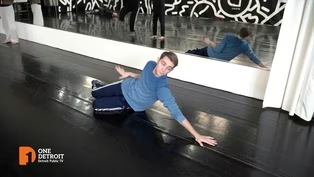
Video has Closed Captions
Clip: S5 Ep42 | 3m 52s | Artlab J Winter Gala | Episode 542/Segment 3 (3m 52s)
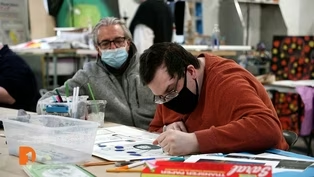
Friendship Circle Soul Studio Holiday Market
Video has Closed Captions
Clip: S5 Ep42 | 6m 27s | Friendship Circle Soul Studio Holiday Market | Episode 542/Segment 2 (6m 27s)
Providing Support for PBS.org
Learn Moreabout PBS online sponsorship New Episode
- News and Public Affairs

Top journalists deliver compelling original analysis of the hour's headlines.
 New Episode
- News and Public Affairs

Today's top journalists discuss Washington's current political events and public affairs.
 New Episode
 New Episode
 New Episode
 New Episode
 New Episode
 New Episode
 New Episode
 New Episode
Support for PBS provided by:
One Detroit is a local public television program presented by Detroit PBS