
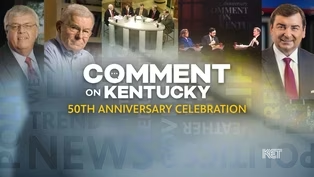
Comment on Kentucky 50th Anniversary Celebration
Clip | 7m 8sVideo has Closed Captions
Al Cross, Ferrell Wellman and Jamie Lucke look back at the history of Comment on Kentucky.
Al Cross, Ferrell Wellman and Jamie Lucke look back at the history of Comment on Kentucky.
Problems playing video? | Closed Captioning Feedback
Problems playing video? | Closed Captioning Feedback
Comment on Kentucky is a local public television program presented by KET
You give every Kentuckian the opportunity to explore new ideas and new worlds through KET.
Comment on Kentucky 50th Anniversary Celebration
Clip | 7m 8sVideo has Closed Captions
Al Cross, Ferrell Wellman and Jamie Lucke look back at the history of Comment on Kentucky.
Problems playing video? | Closed Captioning Feedback
How to Watch Comment on Kentucky
Comment on Kentucky is available to stream on pbs.org and the free PBS App, available on iPhone, Apple TV, Android TV, Android smartphones, Amazon Fire TV, Amazon Fire Tablet, Roku, Samsung Smart TV, and Vizio.
Providing Support for PBS.org
Learn Moreabout PBS online sponsorshipThere weren't very many state networks that had public affairs functions.
It was a very tricky thing.
You know, the Corporation for Public Broadcasting was only created in 1967.
And here in 1974, he and Lynn Press were starting a public affairs show.
And Bob Gable, the 1975 Republican nominee for governor, was on the board and objected roundly that he had no business of getting into any such thing.
But you have to remember that Kentucky is divided between ten television markets, and only one major market lies entirely within the state.
And a lot of these markets have to pay more attention to other states than they do to Kentucky.
And Katie and comment really helped give people a place to go for broadcast coverage.
Public affairs and comment led the way with it.
And now here is your host with this week's panel, Al Smith.
Good evening.
As we said, the Commonwealth has really never had anybody quite like Albert Smith Jr once he kicked liquor, he kicked himself into high gear and he became active in lots of various pursuits.
And he was the incoming president of the Kentucky Press Association.
When Lynn Prince decided that Katie needed a public affairs show and someone maybe al through a third party suggested that maybe Al would be the person to do that.
That was in the College Heights Herald newsroom in May of 1975.
The phone rang.
Mary Kay, still from Owensboro, answered it and announced to the room, It's Al Smith.
They want somebody to be on his TV show.
I said, Give me the phone.
And I came to Lexington with Al and his car.
I drove part of the way, actually, and we got to know each other very well and wound up working for him for almost three years.
Good evening.
Nearly a million seniors graduated from American colleges this month and last three of them from Kentucky are with us tonight, Al Cross from Western University, who was editor of the College.
Hi, Terrell.
And all my France first show I appeared on was three recent college graduates talking about their college careers and what it was like to go out into the world of work and what college had been like.
As my plans stand right now, I'm going to Monticello to work on a weekly newspaper there.
It didn't seem like much of a show, but, you know, well, he could make lemonade out of lemons.
In the late 1970s, Al was appointed the federal co-chair of the Appalachian Regional Commission, and he went to Washington for more than three years.
Glen Bastien, who was the news director US radio, and I took turns hosting comment.
We did it every other week and we did it for a little over three years.
So I hosted it in the late seventies and early eighties.
Follow on Phil Wellman filling in for Al Smith.
And then when Al came back home, returned as a fairly regular panelist or guest on the program.
Mark Cuban And I used to joke that our job on that program was to keep Al Smith from talking about banking every week and then I became the regular host in early 2008, and I kept that until 2014.
Legislators this week learned if they will have opposition for either the primary or the general election or maybe both.
When comment first started back in the seventies, there were people all over the state who were they were informed about what happened and who happened, but they didn't know the inside.
They're getting most of their news from accurate wire service stories primarily.
And, you know, once you get away from Lexington and Louisville, primarily in newspapers, and they were accurate stories, but they didn't give you the inside story.
So Al started having people on who were closest to the story.
He had occasionally have columnists and editorial writers on.
But what he wanted were the reporters who knew more about the story than anyone else, and now had an opportunity through this program to explain things that they couldn't work into the stories that were printed.
So you watch the news and you get an idea of what happened.
You could watch, comment and find out why it happened.
I was watching on a small black and white television in my apartment in Elizabeth Town, where I was a reporter for the news Enterprise and came across a comment and thought, Wow, I wonder if someday I could know enough to be on that show.
Comment is such an important institution to journalism in Kentucky.
Journalism maybe less so than it was in prior years, is very competitive.
And, you know, we work hard to break stories, to be the first to have a big story and comment.
We come together in a spirit of, you know, friendship and unity and fun to to to talk to Kentuckians about their government, their politics, the environment, health, the economy, all the things that really are so important in people's lives and to, you know, bring that kind of you know, we're in the Capitol every day.
We're there for your audience on comment.
We live in an era when it's really hard to tell what's real from what's not.
And there are forces out there that are cynically feeding the public misinformation and disinformation.
And it looks just like the real thing and the people who come on comment are dedicated to factual reporting and to to ferreting out the truth about what's going on in Kentucky.
I think the people of Kentucky ought to be very thankful that there is a comment on Kentucky, that there is a public affairs function on a state owned network, which is not the easiest thing to do.
And I am thankful every day that we have it.
And I wish every other Kentuckian was too.
I think comment is in good hands.
Bill.
Bill, Brian has a wonderful reputation.
He's an established journeyman journalist and it's an established show.
And I think now more than ever there's a place for comment.
I know that comment.
Viewers appreciate the program and Katie, and I'm hoping for another 50 years at least.
 Now Playing
Comment on Kentucky 50th Anniversary Celebration
Video has Closed Captions
Clip | 7m 8s | Al Cross, Ferrell Wellman and Jamie Lucke look back at the history of Comment on Kentucky. (7m 8s)
Providing Support for PBS.org
Learn Moreabout PBS online sponsorship
- News and Public Affairs

Top journalists deliver compelling original analysis of the hour's headlines.

- News and Public Affairs

FRONTLINE is investigative journalism that questions, explains and changes our world.












Support for PBS provided by:
Comment on Kentucky is a local public television program presented by KET
You give every Kentuckian the opportunity to explore new ideas and new worlds through KET.