You Gotta See This!
Communication Junction
Clip: Season 5 Episode 1 | 5m 6sVideo has Closed Captions
Meet a woman using sign language to empower parents and strengthen bonds with their children.
Meet a woman using sign language to empower parents and strengthen bonds with their children.
Problems playing video? | Closed Captioning Feedback
Problems playing video? | Closed Captioning Feedback
You Gotta See This! is a local public television program presented by WTVP
You Gotta See This!
Communication Junction
Clip: Season 5 Episode 1 | 5m 6sVideo has Closed Captions
Meet a woman using sign language to empower parents and strengthen bonds with their children.
Problems playing video? | Closed Captioning Feedback
How to Watch You Gotta See This!
You Gotta See This! is available to stream on pbs.org and the free PBS App, available on iPhone, Apple TV, Android TV, Android smartphones, Amazon Fire TV, Amazon Fire Tablet, Roku, Samsung Smart TV, and Vizio.
Providing Support for PBS.org
Learn Moreabout PBS online sponsorship(lively music) ♪ Hello friends ♪ It is time to sign with us - Yeah.
(applauding) (group applauding) What we do here at Communication Junction is we give parents the tools to help support their children's spoken language development.
And we do that using American Sign Language, fun games, rhymes, all of those kinds of things in a small group setting.
Three, peekaboo.
- I like how much they learn, and how much they're able to carry that over at home, and it helps keep it when they're really young and have trouble like verbalizing, or I have trouble understanding, they're able to communicate better, and there's less frustration and less fits.
So as a mom, I really like that.
- We use signs to help learn new concepts.
So we're teaching colors, we're teaching shapes, we're teaching about animals, we're teaching about the alphabet.
And so since kids are such visual and hands-on learners, using science to help support that new learning is super helpful.
♪ My hands say peekaboo First, in order for a little one to start talking, they have to imitate.
That is the number one fundamental skill that a little one has to have is imitation.
What does imitation mean?
It means I do something and you copy it.
And at first they're gonna start imitating just like silly motor movements, or they might start imitating your facial expressions, or you know, a child as young as like three months old might be giggling at you in response to you smiling.
That's imitation.
That's their first form of communication with you.
Then we look for them to be imitating gestures.
Gestures are things that people are familiar with.
Waving, clapping, playing peekaboo, reaching up for your parent, reaching out to grab something.
These are all things that people are comfortable with, people do understand.
And the science behind gestures is that by 16 months old, we want our kiddos to have 16 different gestures.
Then, after gestures, come our signs, and signs are a way to take gestures into a formal language.
So we use American Sign Language vocabulary.
We're not teaching the language, we're just teaching vocabulary to help families.
Once they're imitating gestures, then they start imitating signs.
These are gestures that have some really great meaning to them.
Once they're imitating signs, then they start imitating sounds, and then they start imitating words.
So there's this whole continuum before they get to that first word.
- My daughter was on the lower end of the communication stuff at the doctors when they have you fill out all the forms.
And so I was like, "Okay, we'll do something to help communication."
So then we started coming, and loved it.
- A Lot of families hear sign language, and they think that we only work with deaf and hard-of-hearing kiddos, or maybe we work with kiddos who are in special needs programs.
However, our program is mostly comprised, like 90% of families who are just wanting to support their little ones' spoken language development.
We have all kinds of families who join us, but you do not have to have a child who has special needs, or who is deaf or hard-of-hearing, to join us.
Yeah.
- With my toddler, I can't always understand what he's saying, and he really, really wants to communicate it.
But if he has a sign, he has a way of telling me what's going on, and then the frustration is lessened.
And even with my daughter, when she could talk fairly well, there were a few words I couldn't understand, and she'd start getting mad and then sign it.
In particular was gentle, she didn't understand, and she was just like, "Gentle."
And then I understood, and then she was fine.
It has definitely decreased tantrums for both kids, because they're able to communicate.
It has increased communication between us.
It has helped our relationship.
- The wait lists for early intervention programming are so long that families are not getting the services that they need in a timely fashion.
And so we are a great place to help educate parents, model strategies, model skills, that they can be using with their kids, whether they have a delay or not.
Everything that we're doing here is helping families support that spoken language journey.
- We need a place like this for just average parents to help their kids be able to communicate.
It gives them a way to communicate earlier, and decreases a lot of that frustration, which then makes parenting easier, because you are able to communicate with your child.
- Every community needs a place like Communication Junction where all children are welcome, where we're educating families on how to support their children's spoken language development, where there's an opportunity for socialization.
We are a great place to help educate parents, model strategies, model skills that they can be using with their kids, whether they have a delay or not.
Everything that we're doing here is helping families support that spoken language journey.
Open.
A lot of families come because they've heard that signing will help their little one's spoken language development, but they stay because of the community that they have built in their class, and the relationships that they're making.
The end.
- [Group] Thanks for watching.

Video has Closed Captions
Clip: S5 Ep1 | 5m 33s | Meet inspiring professional performers from the Central Illinois Ballet. (5m 33s)
Video has Closed Captions
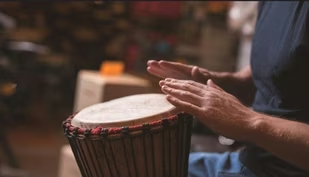
Clip: S5 Ep1 | 5m 53s | Local man follows his passion and makes and restores drums. (5m 53s)
Video has Closed Captions
Clip: S5 Ep1 | 4m 52s | A free program that teaches people to read and they are looking for tutors. (4m 52s)
Providing Support for PBS.org
Learn Moreabout PBS online sponsorship
- News and Public Affairs

Top journalists deliver compelling original analysis of the hour's headlines.

- News and Public Affairs

FRONTLINE is investigative journalism that questions, explains and changes our world.












Support for PBS provided by:
You Gotta See This! is a local public television program presented by WTVP