
Community Cafe, Artist, Art Exhibit
Season 15 Episode 5 | 28m 45sVideo has Closed Captions
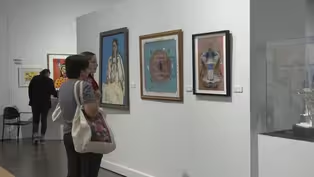
Frieda's Cafe; honoring Oscar Howe w/ artist Wicanhpi Iyotan Win; and a joint art exhibit.
Frieda's Cafe, in Willmar, started with a WWII refugee story and continues on as a community staple. Join us in honoring Oscar Howe, with artist Wicanhpi Iyotan Win (Autumn Cavender). Also, learn about a joint art exhibition between the American Swedish Institute and All My Relations Arts.
Problems playing video? | Closed Captioning Feedback
Problems playing video? | Closed Captioning Feedback
Postcards is a local public television program presented by Pioneer PBS
Production sponsorship is provided by contributions from the voters of Minnesota through a legislative appropriation from the Arts and Cultural Heritage Fund, Explore Alexandria Tourism, Shalom Hill Farm, Margaret A. Cargil Foundation, 96.7kram and viewers like you.
Support provided by:


Community Cafe, Artist, Art Exhibit
Season 15 Episode 5 | 28m 45sVideo has Closed Captions
Frieda's Cafe, in Willmar, started with a WWII refugee story and continues on as a community staple. Join us in honoring Oscar Howe, with artist Wicanhpi Iyotan Win (Autumn Cavender). Also, learn about a joint art exhibition between the American Swedish Institute and All My Relations Arts.
Problems playing video? | Closed Captioning Feedback
How to Watch Postcards
Postcards is available to stream on pbs.org and the free PBS App, available on iPhone, Apple TV, Android TV, Android smartphones, Amazon Fire TV, Amazon Fire Tablet, Roku, Samsung Smart TV, and Vizio.
Providing Support for PBS.org
Learn Moreabout PBS online sponsorship(upbeat music) (uptempo electronic music) - [Announcer] "Postcards" is made possible by the Minnesota Arts and Cultural Heritage Fund and the citizens of Minnesota.
Additional support provided by Margaret A. Cargill Philanthropies, Mark and Margaret Yackel-Juleen on behalf of Shalom Hill Farms, a retreat and conference center in a prairie setting near Windom, Minnesota.
On the web at shalomhillfarm.org.
Alexandria, Minnesota, a year-round destination with hundreds of lakes, trails, and attractions for memorable vacations and events.
More information at explorealex.com, the Lake Region Arts Council's Arts Calendar, an arts and cultural heritage funded digital calendar, showcasing upcoming art events and opportunities for artists in West Central Minnesota.
On the web at lrac4calendar.org.
Playing today's new music plus your favorite hits, 96.7 Kram, online at 96 7kram.com.
(people murmuring) (burgers sizzling) (uptempo cheery music) - Thank you.
- You're welcome.
- Nobody ever wrote down anybody's order.
You just took it, and you gave it to my mom, and she probably had eight, 10 more orders going on, she'd add your order to that.
All of us waitresses once in a while we'd be like, "Okay, where did this go again?"
And my mom would say, "Table four (laughs)."
She had her back to us, and she still knew where it came from.
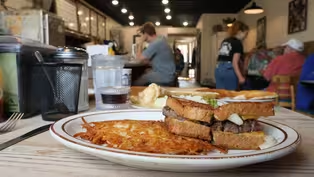
(uptempo cheery music) (car engine roaring) Frieda's is a small cafe in Downtown Willmar, and it's been in existence with the name Frieda's Cafe since the 1970s.
My mom owned it, and it was named after her, but my grandmother worked there.
My dad came in and helped with the till during the really busy times.
My brother helped with that.
And of course, I waitressed.
(slow somber music) My mom was born in Prussia, which is now part of Poland, but it was part of Germany back when she was born and when she was eight years old, World War II started, and my grandfather had no choice.
He got drafted into the army, but he and his troop found themselves surrounded by Russians on one side and Americans on the other, and they just surrendered to the Americans.
That left my mom and my grandma on their own.
(tense dramatic music) As the Russians were advancing.
She and my mom, they were in a whole big line of refugees that were crossing a frozen lake.
Russia came over and started dropping bombs on 'em.
And so my grandma tells me how she just threw herself on top of my mom and hope and prayed that they would make it through this bombing.
After the war was done, it took them three years, and the help of the Red Cross to get in contact again with my grandpa.
My grandma had a brother, Uncle Max, who lived on a farm up by Benson, and he said, "I could use help on the farm.
Why don't you come here?"
My mom didn't speak any English at the time, but she learned English, and then she met my dad maybe about six months or so after, they came here, and they were married in 1955.
(slow somber music) My mom, my grandmother, my grandfather, and the funny thing about this picture is this is my dad's mom and my dad's brother.
They didn't know each other yet.
They were at that "Welcome to America" party that they put on at the church.
(uptempo cheery music) That's my mom, and this is my grandmother doing her dishwasher duty.
(uptempo cheery music) I had to laugh when I was looking through some of the old articles from the newspaper.
They had the old Benson Avenue where the cafe is located, all dug up and mud on the sidewalks, and all that kind of stuff.
Within a day, the city crew came in, and put gravel in there or something.
And I just had to laugh because I am thinking these guys just want their breakfast, they wanna be able to get in there.
If there was a blizzard, my mom couldn't get out of her driveway, and they kind of figured she couldn't.
They'd go get her at three o'clock in the morning and bring her to the cafe.
(uptempo cheery music) - She was one hardworking gal, and good food all the time, just like now, you know, it hasn't changed a bit in years.
(uptempo cheery music) - [Deb] So my mom sold it to my husband's nephew and his wife.
So it's still in the family, it just flopped sides.
- We were a young couple, and we decided we wanted to work for ourselves, be our own boss.
So my husband decided he would come ask Frieda just straight up, come ask her, "can we buy the restaurant from you?"
And Frieda said, "No, absolutely not."
So my husband said, "Okay, if you change your mind, just let us know."
Six months later, she made the phone call.
I think I was 23 and Steve was 24.
(slow relaxing music) Frieda was, you didn't really wanna mess with her, you know, she kind of was very black and white, and she had a job to do, and that's what she wanted to do, but in a very nice, kind way away.
- Her coffee was 10 cents a cup.
She refused to raise that.
She got a phone call from another person that ran a cafe or a restaurant or whatever in town, and he told her that she had to raise her prices.
And so my mom being naive and being from Germany, she comes home and tells us this, and we're all like, "Nope, you can do whatever you want.
They can't tell you what you have to do."
So she never raised the prices.
It was always 10 cents for a cup of coffee.
- Life is hard and I just wanna have a nice place for families to come and not feel stressed about a high bill.
And that's what Frieda always wanted too.
And she said, "We gotta have a niche.
And her niche was dime coffee, get the people through the door for a dime coffee.
And we kept it at a dime for maybe five years, but then we jumped it up to 50 cents, and we've kept it there since.
(people murmuring) (slow relaxing music) You know, it's the Frieda's family, and we're, come on in, you're fine.
Come on in.
- Okay.
- No troubles.
So, you know, I've been known if a customer doesn't show up for one day or two days, I will go to that customer's house.
I'll knock on the door, and make sure that customer is okay.
So it's more than just coming in to eat.
- [Customer 1] My boy has a.
(food sizzling) - Best place in town.
Come here and eat and we shake dice at 2:30 for coffee.
(machine whirring) - [Customer 2] I like the homey atmosphere personally, but the food is great.
Pretty much all of it's homemade.
- I flew in to come visit him, and I heard of the place from him.
Absolutely, probably the best food I've ever tasted.
- I would agree with that, I love it here.
- Well, I've been coming here for, I'll bet you 80 years.
The counter was over here when I first started coming, we used to come early in the morning, and she'd let us in the back door (chuckles).
- It's hard, hard work, but the people are what make it fun.
Coming to work every day, and seeing the people, and seeing how much they love coming to Frieda's is what makes your heart happy, and that's what I have on the back of my shirt, "Your happy place."
(slow poignant music) - There were many older gentlemen, mostly, that would come to the cafe for all their meals, and at Christmas or at Thanksgiving, she would invite them to our home for Christmas dinner meal or Thanksgiving meal, so we shared the table with many of her customers every holiday.
I always thought that was very kind of her to do that.
(slow poignant music) I think my mom would be very happy and very proud of the fact that her name is still on that cafe.
Steve and Amy have done a fabulous job with it.
So I know my mom is looking down and is very happy about that.
(slow poignant music) - Love you, bye.
- Love you, bye, bye.
- Coming from a very Dakota perspective on art, and what art is, if art is not telling a story, then I don't really believe that it's art.
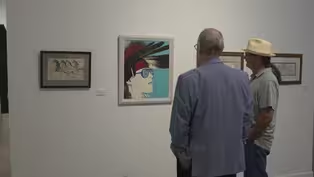
(traditional drum playing) (singers singing in Lakota) Oscar Howe is arguably the most famous contemporary Dakota artist, certainly the most famous Dakota artist of the 20th century.
And on this, this kind of major anniversary of his passing, this exhibit was put together as a satellite exhibit to the Dakota Modern Exhibit that toured in between Portland, the Museum of the American Indian, and then the Museum of South Dakota and Brookings.
And so this satellite exhibit is really about the legacy of Oscar Howe as it relates generationally to Indigenous artists, specifically Dakota artists in our own home territories.
(slow relaxing music) The legacy of Oscar Howe really is unparalleled in Native American art, because he was one of the first people to really, truly articulate, and put to words the contemporary nature of American Indian artwork.
He was one of the first people to draw a very, very firm line academically to say that there is no differentiation between modern art, and ancestral art or traditional Indian art, that they are one in the same, they come from the same tradition, and that our cultures are dynamic, and moving, and constantly integrating new information and new mediums, and so that the art that he produced over the course of his life was no less traditional than something that you would see in a museum about Native American people.
(slow relaxing music) Oscar Howe himself is Dakota, and specifically he was born and is from the Crow Creek Reservation here in South Dakota.
The story of the, the founding of Crow Creek Reservation is actually rooted in the US Dakota War of 1862 because all of the prisoners of war, all of the concentration camp survivors, all of the survivors of the concentration camp in Davenport, Iowa, were all congregated and shipped by rail and by boat out to Crow Creek, South Dakota, to the military fort located there, and really, they were sent there to die.
The descendants of those survivors, those concentration camp survivors who were sent to this place, those are the people from whom Oscar Howe originated.
Those were his grandparents.
Indeed, his grandmother, Shell Face, would tell him stories about the way that she survived battles that took place in Minnesota prior to her exile, and so if we're talking about Oscar Howe's legacy, it begins in Minnesota, because that is how he ended up here.
It begins with the war in 1862, because that's how he ended up here.
And it begins with the survival of his grandmother when her older brother placed her on a white horse and told her to ride and not look back.
When we carry those kinds of historical stories with us, it becomes real, it's tangible, it's something we can hold in our hands.
It's something we can see on wall through these paintings.
But they're no longer dry stories in a history book, right?
This isn't some abstract survivor of some battle that happened 150 years ago.
This is Oscar Howe's grandmother who was shot through the hand when she fled, and the bullet passed through her hand and into the horse.
And after a night of riding, that horse finally died after it got her to safety, (uptempo dramatic music) Oscar Howe was seen as this kind of rags to riches Indian story, a successful assimilationist story.
Here is a native person who became a soldier, who then went through the GI Bill, and became a successful artist and a college professor.
Isn't this such an exceptional Indian story?
And that was often how it was framed over the course of his life, but the actual legacy of who he was as an artist and a person has far transcended that and really pushed the narrative of what success means as a native person within contemporary colonial society.
For me, Oscar Howe is this kind of very subconscious foundation to what I believe good aesthetic art to be?
(uptempo dramatic music) This is actually in some ways two pieces.
You have the first part, which is the main installation.
It's the part we're sitting on, and this part is called the House of the Skin Painters.
The idea of the skin painter is something that came up repeatedly in Howe's work as the people who carried on history, who carried on Dakota aesthetic and design work.
This idea of being here is really about potentiality, right?
What hasn't been made yet, and even the idea of projecting on the hide rather than painting on it, rather than putting something permanent on it, reflects that transience that actually brings us to Iyun Woihanbde or Paint Dreaming, which is the name of the video that's being projected onto the hide.
And so this video is actually utilizing a combination of ancestral intelligence and synthetic intelligence instead of artificial to take work of Oscar Howe and to train these different artificial intelligences, these different synthetic intelligences on these images, and insert in them ancestral knowledge, insert in them historical, and contemporary images of Dakota art and co-create along with this thing that we can now use as a tool to both talk to, you know, talk to ancestors, right?
In an active conversation of the modern and the ancient through this means of synthetic intelligence, through synthetic technology, which for me is super exciting and super cool.
This itself is actually a rendition of Oscar Howe's paintings of skin painters painting.
And so some of the other geometrics that you see on the hide are very similar to that (slow relaxing music) As these images shift and as they burn away, and come back, and shuffle in, and glitch in.
It's this kind of on running idea of these are the dreams that we have prior to putting a brush to paper, prior to putting a brush to skin.
For me it was also a really interesting reflection on Oscar Howe himself, and the legacy of it.
He's now one of our collective ancestors that we draw on for information, we draw on them for inspiration for our work.
You know, he's one of our collective whole of people that we call upon.
The only narrative we ever hear is that Indigenous art is something that exists in the past, is a museum piece, and is consistently relegated to the subsection of history rather than living and moving forward.
It means that we ourselves don't really have a future because we don't have a present.
Imagining ourselves in the present through contemporary art and telling our stories of both our contemporary past and potential future realities through these mediums helps us imagine ourselves moving forward.
It helps us imagine a future in which we continue to exist.
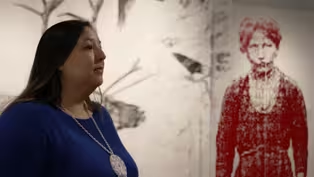
(traditional drum playing) (singers singing in native language) (audience applauding) - All My Relations Gallery has been an operation since 1999, and it was established by a founder who recognized that Native American artists were not receiving the same opportunities as their contemporary colleagues, and so the space was created specifically for American Indian contemporary artists.
(slow dramatic music) This new exhibition is titled Okizi, which is a Dakota word meaning "to heal."
And it's been part of an ongoing relationship that has been established between All My Relations Arts and the American Swedish Institute.
It is in response to the traveling exhibition that is being hosted at the American Swedish Institute called Arctic Highways.
And the more that we were talking about what their exhibition was featuring, there was two artists and their work was titled "Mygration."
And they were sharing how the Sámi people had this relationship with the reindeer.
And it piqued my interest of like, "Oh, Native people have a relationship with the Buffalo, you know, the Plains Indians, Dakota people, you know, we have this relationship with the Buffalo.
Like, so there's this similarity that I can respond to, and then also more and more that we've learned about like the Sámi people.
and the experiences they've gone through in terms of language loss and boarding school experiences, which is so much similar and parallel to what Native people here in this country have experienced with our language loss, and the impacts of Native American boarding schools.
So it was really recognizing how we had a shared similarity in our cultures.
(uptempo dramatic music) I myself, you know, being able to learn more about the Sámi culture and the Sámi people is something I didn't grow up learning about.
So this has provided an opportunity for me to be able to learn more about Sámi people.
(uptempo dramatic music) - Sámi people are the only Indigenous people in Europe, and the definition of Indigenous people is the people that were living and have their own language, and their own livelihood in a specific geographic area before it was nationalized and the border were drawn.
I would say the starting point, I mean I've been working almost 40 years as artist, and it's only the latest 10 years I would say that we started to get recognition from abroad.
I think it's, I believe it's United States and Canada has been kind of started this attention to Indigenous, although USA has a horrible history toward their Indigenous, but that sends a signal to Europe and Scandinavia.
(slow relaxing music) The favorite part is that we could collaborate with other Indigenous artists.
In Arctic Highway, we are nine Sámi artists from Sweden, Norway, and Finland, and there are two from Canada, and one from Alaska.
(slow relaxing music) I can see here in Minnesota, and the Dakota, Lakota tribes that we share that connection to the land.
(slow dramatic music) It was kind of a, with the help of the American Swedish Institute that we managed to exhibit Mygration and Arctic Highway, and All My Relations Gallery at the same time to build bridges and including Indigenous people in America.
We do this exhibition from Indigenous to Indigenous, but of course all the public is welcome.
(slow relaxing music) - So we have the three exhibits.
There's Arctic Highways, there's Mygration, and then there's our family gallery experience in Nature's Story.
All of these exhibits are intertwined in various ways.
Artists that exhibit in some of them and some in others.
This what we're seeing here.
Mygration was in collaboration with All My Relation Arts, a friendship that we've been building with the Indigenous community here in Minnesota.
Part of this exhibit is on display at All My Relations, and part of it is here, and it goes together with Okizi, which is an exhibit that All My Relations has.
Again, half of the art is at their gallery, and the other half is here at the American Swedish Institute.
(people murmuring) (person laughing) - I'm an artist that works with animals and nature, so I paint in black and white and I'm inspired by the Chinese ink painting.
And also I'm a sculpturist, so I'm interested in light and shape.
And then the grayish colors and the black and white suits me very well.
I saw that Tomas Colbengtson was going to do some glass art in the house where I have my studio and I just read that he's coming there and I thought we were just acquaintances.
And then I had this dream during the night that I see my paintings and his art together in a special way.
And I just made a sketch of that, and contacted Tomas, and asked him if he was interested to do a collaboration.
And we started to work with Mygration.
(slow dramatic music) It's important because it's a forgotten history.
In school, we read so little about the Sámi culture.
So I think it's very important to lift, focus on the forgotten history that is around us.
So that was the inspiration of Mygration.
And then we, the name is M-Y-gration, so it's my trip and your trip, and the group's Migration too.
So it's both individual and a group.
So it's also about time, like past, present, and future.
(people murmuring) I always get tears in my eyes when I walked in.
I got so emotional because of seeing the crowd and the people amongst the art.
it's very touching, (slow dramatic music) - ASI very much engages locally and then connects globally.
I think that is one of the big things.
But more importantly, it is a gathering place for people.
The connection that I think is most exciting is because we have the Sámi, who are the Indigenous folk of the Nordic countries.
And they are Indigenous like we are, like I am.
And so to have them here with their culture and be able to do that cultural exchange, because we kind of mirror each other.
An ASI is this wonderful a conduit and host to bring us.
- Well done all of our artists, and all of you gere in this room, I greet you.
- I am a member of the Lower Sioux Indian community, Cansayapi, where they paint the trees red.
We not only remember our ancestors.
and thank them for the choices and decisions they made, so we can be in this moment, but we also think of the generations to come.
And so we do things to hopefully let them know that we cared about them and loved them, and the Sámi have so many things and ideas and life ways and culture that are so, like I said, a mirror image of what our experience here in the United States as Indigenous people are.
(uptempo dramatic music) (uptempo electronic music) - [Announcer] "Postcards" is made possible by the Minnesota Arts and Cultural Heritage Fund and the citizens of Minnesota.
Additional support provided by Margaret A. Cargill Philanthropies, Mark and Margaret Yackel-Juleen on behalf of Shalom Hill Farms, a retreat and conference center in a prairie setting near Windom, Minnesota.
On the web at shalomhillfarm.org.
Alexandria, Minnesota, a year-round destination with hundreds of lakes, trails.
and attractions for memorable vacations and events.
More information at explorealex.com, the Lake Region Arts Councils Arts Calendar, an arts and cultural heritage funded digital calendar, showcasing upcoming art events and opportunities for artists in West Central Minnesota.
On the web at lrac4calendar.org.
Playing today's new music plus your favorite hits, 96 7 CRA.
Online at ninetysixseven.com.
(upbeat music)
Community Cafe, Artist, Art Exhibit
Preview: S15 Ep5 | 40s | Frieda's Cafe; honoring Oscar Howe w/ artist Wicanhpi Iyotan Win; and a joint art exhibit. (40s)
Video has Closed Captions
Clip: S15 Ep5 | 10m 1s | Frieda's Cafe in Willmar began as a WWII refugee story and continues to serve. (10m 1s)
Honoring Howe: Legacy of Stories
Video has Closed Captions
Clip: S15 Ep5 | 9m 32s | Wicanhpi Iyotan Win (Autumn Cavender) talks about the legacy of artist Oscar Howe. (9m 32s)
Video has Closed Captions
Clip: S15 Ep5 | 11m 11s | The American Swedish Institute & All My Relations Arts present an art exhibit. (11m 11s)
Providing Support for PBS.org
Learn Moreabout PBS online sponsorship












Support for PBS provided by:
Postcards is a local public television program presented by Pioneer PBS
Production sponsorship is provided by contributions from the voters of Minnesota through a legislative appropriation from the Arts and Cultural Heritage Fund, Explore Alexandria Tourism, Shalom Hill Farm, Margaret A. Cargil Foundation, 96.7kram and viewers like you.