Inside California Education
Community Colleges – Taking to the Stage
Season 4 Episode 5 | 26m 46sVideo has Closed Captions
Social justice issues take center stage at this South Central LA community college theater
Social justice issues take center stage at this South Central LA community college theater program, where students put on a virtual performance about police relations with the Black community. Discover how formerly incarcerated students are getting a second chance at higher education at Solano Community College. See how MiraCosta College created the first social work program at a community college
Problems playing video? | Closed Captioning Feedback
Problems playing video? | Closed Captioning Feedback
Inside California Education is a local public television program presented by KVIE
Funding for the Inside California Education series is made possible by the California Lottery, SchoolsFirst Federal Credit Union, Stuart Foundation, ScholarShare 529, and Foundation for the Los Angeles Community Colleges.
Inside California Education
Community Colleges – Taking to the Stage
Season 4 Episode 5 | 26m 46sVideo has Closed Captions
Social justice issues take center stage at this South Central LA community college theater program, where students put on a virtual performance about police relations with the Black community. Discover how formerly incarcerated students are getting a second chance at higher education at Solano Community College. See how MiraCosta College created the first social work program at a community college
Problems playing video? | Closed Captioning Feedback
How to Watch Inside California Education
Inside California Education is available to stream on pbs.org and the free PBS App, available on iPhone, Apple TV, Android TV, Android smartphones, Amazon Fire TV, Amazon Fire Tablet, Roku, Samsung Smart TV, and Vizio.
Providing Support for PBS.org
Learn Moreabout PBS online sponsorshipChristina: Coming up on Inside California Education: Community Colleges Actor: Why are you pulling a gun on me?
Why are you pulling a gun on me?
You don'’t know me, even when I'’m standing right in front of you.
You don'’t see me.
You see through me, as if I don'’t exist.
Christina: An experimental theater group from Los Angeles Southwest College creates a powerful, online video performance about police relations with the Black community....written entirely by the students JONATHAN EVANS: And I think that's one reason our experimental theater lab has been so successful.
It's student-driven, it's student-created work.
Darletta Mitchell: We had no choice.
It had to be told it had to be, um, addressed.
Christina: Discover how students who'’ve done time behind bars get a second chance at higher education at Solano Community College in Fairfield...one of dozens of re-entry programs across California offering a path from incarceration to graduation.
Edwin McCaskie: Education is very, very important, um, and it gives us freedom.
Celia Esposito-Noy: The fact is, is that when folks have done their time, they've done their time.
Christina: And discover how MiraCosta College created the first social work degree program that'’s entirely online... opening up new careers paths to students in San Diego County Sean Davis: These are the jobs and the careers and the positions that are really helping our local communities.
Christina: It'’s all next...on Inside California Education: Community Colleges Annc: Inside California Education: Community Colleges is made possible by: College Futures Foundation believes nothing is more transformative for individuals and our society than an educational opportunity.
We partner with organizations and leaders across California to help students earn college degrees regardless of zip code, skin color, or income.
More information at collegefutures.org.
♪♪ ♪♪ JONATHAN EVANS: I thought at the time there was no way for theater to survive.
I thought that we needed to take a break and theatrical work would literally pause.as the streets sort of cleared and things became like a ghost town.
JASON: WHEN COVID-19 HIT IN EARLY 2020... LOS ANGELES SOUTHWEST COMMUNITY COLLEGE SHUT DOWN THE CAMPUS.
LAPTOPS WERE HANDED OUT AND CLASSES WENT ONLINE.
SO HOW DO YOU HAVE A THEATER PROGRAM WITH STUDENTS ALL TAKING CLASSES REMOTELY?
JONATHAN EVANS: ...but then I realized my group, my ensemble here at Los Angeles, Southwest college, they were stronger than that.
And they saw through that difficulty.
JASON: FOR THE STUDENTS HERE, NO STAGE DOES á*NOTá* MEAN NO PERFORMANCE.
IN THE WAKE OF GEORGE FLOYD'’S DEATH, AS THE COUNTRY GRAPPLED WITH RACE RELATIONS, STUDENTS FOUND A WAY TO MAKE THEIR VOICES HEARD.
THEY PRODUCED AN ORIGINAL SHOW CALLED '‘THE THREAT.
'’ IT'’S A POWERFUL, EVOCATIVE ONLINE VIDEO PRODUCTION -— INSPIRED BY CURRENT EVENTS -— TACKLING POLICE RELATIONS WITH THE BLACK COMMUNITY.
Actor: Those 8 minutes and 46 seconds felt like 8 years, as I felt myself going.
DARLETTA MITCHELL SHERMAN: Well, it it's, it's like right in our backyard, front yard, you know, um, up the street on our street.
So we had no choice.
It had to be told it had to be, addressed.
Actor: The cop in front of him slapped the soda out of his hand.
The cop behind him grabs him, slams him face first in the concrete and breaks his nose.
CRAIG MITCHELL SHERMAN: I remember driving on my first day at work, my grandfather's Cadillac six in the morning to go to work.
And I'm pulled over to ask to be asked, is this my car?
And I'm afraid.
I'm very afraid because you don't have to just fear the gangs now.
You fear someone who has a job that was supposed to protect you, and that might not happen.
Actors: Too many black people are dying.
Too many black people are dying.
Too many black people are dying.
DR SEHER AWAN: Our students are from more disadvantaged populations.
We are predominantly serving students of color at Southwest.
Our students are not trained theater students.
They don't come from a background of arts and theater.
They're coming from our community pretty much, uh, learning those skills with Professor Evans through this program and to see them share their pain and their human experiences and their trauma in a way that fuels a beautiful performance because it's so raw and so authentic.
(choking) Actor: You try to kill us.
Jonathan: That'’s what your body wants to do, is let go.
Right?
JONATHAN EVANS: Uh, we have a theme or we have a topic every year we start with, we usually start our projects in July or August and the first month of the year.
Of the work is just really discussing, what are we trying to say this year?
Or what are we trying to say this semester?
What do we, as a group in an ensemble, what do we, as the Los Angeles, Southwest College experimental theater lab, you know, what do we want to say?
CRAIG MITCHELL SHERMAN: It's simple to do something like Othello or Romeo and Juliet, but we're not living in a time at which Romeo and Juliet a play like that can just, we can just put it on and just, and be real with it.
Not when so much has been going on in our world.
Those are great plays, but we wanted to bring reality to the stage.
We want it to be as real as possible, and we didn't want to be, um, just another group of people putting on another play.
JASON: SHOT ON CELL PHONES AT HOMES, SIDEWALKS AND PARKS... PART FICTION, PART HISTORICAL DOCUMENTARY, PART PERSONAL MONOLOGUE...
THE THREAT IS WOVEN TOGETHER WITH A MIX OF DEEPLY PERSONAL PERFORMANCES.
Actor: He got right in my cousin'’s face and asked him again: Say boy, where did you steal that bike from?
My cousins said, man, I told you that'’s my bike.
I didn'’t steal nothing, that'’s my bike.
CRAIG MITCHELL SHERMAN: It is a piece of innovation, but also we were able to make it organic.
I didn't know what other people were shooting.
And we were sending in hope that it will come to get there and it came together and I was blown away.
Actor: Had a good job, a good job with dental benefits, had all my teeth and everything.
JASON: TYANA HAYWOOD PLAYED THE ROLE OF A HOMELESS WOMAN.
Actor: That officer knocked my teeth out and broke my arm, and I couldn'’t work no more.
He took everything from me.
Everything!
TYANA HAYWOOD: Yeah I spent a lot of time with that character.
She um, she's from the streets her name was, Nina Simone.
She has a burden to bear and she like, most women she's been doing what she has to do and sometimes doing things that she doesn't want to do to survive.
THE THREAT PERFORMANCE: "“I want to live in a world where I matter!
I want to live in a world where Kamala Harris is an everyday occurrence, the VP of companies don't make the headlines... JONATHAN EVANS: Many of my students could walk onto a set tomorrow and be professionals.
But they don't necessarily have to have that goal in mind.
We're looking for the person that's ready to say something bold.
We're looking for the person that's saying, I want to be a part of a social justice ensemble.
I've got something to say and I've got something I feel, and I'm not going to hold that back.
DARLETTA MITCHELL SHERMAN: I love the theater.
Um, and if I get the opportunity to do it, to do it professionally, I wouldn't pass that up.
It changed my life.
And I I'm hoping that it will change other people's lives just by the work that I put out there.
Every time my child walks out of the door, I see a target on his back.
DARLETTA MITCHELL SHERMAN: I don't want to just entertain people only.
I want to put a thought in someone's head that will provoke them to action, Actors: As James Baldwin once said, American history is longer, larger, more various, more beautiful and more terrible than anything anyone has ever said about it.
CRAIG MITCHELL SHERMAN: We don't hate the police.
We don't, we actually say that in the piece.
Um, we hate injustice.
We want to be able to, um, cause you to think after you've seen our piece, we want you to think.
We don't want you to go out there and just start rioting, but we want you to think, how can I do better?
Actor: If you find out later that they weren'’t reaching for a weapon, then I'’d rather be judged by 12 than carried by 6.
DR. SEHER AWAN: Like our students and their pain, it's just, it's, it's so real.
And they put, they leave it, they leave it all on the stage.
THE THREAT PERFORMANCE: "“Because today I claim victory over police brutality.
I claim victory over systematic racism.
I claim victory over the mental and physical enslavement of a people.
The mental and physical enslavement of a people of our young black boys and black men.
JONATHAN EVANS: You know, I've worked with so many talented actors in my career, but never a group that will fight to be heard.
And I think that's what really, it really touches me.
I really am.
I'm very, um, I get very emotional because of what I've seen happen here.
When you see a group of people that are willing to fight for their lives, for their voices to be heard, that's very moving to me as an artist.
JASON: THE INNOVATIVE PRODUCTION WAS RECOGNIZED BY THE KENNEDY CENTER AMERICAN COLLEGE REGION 8 THEATER FESTIVAL.
SINCE IT'’S DEBUT, THE TEAM HAS RELEASED ANOTHER VERSION, FOCUSING ON THE STORY OF GEORGE FLOYD -— KILLED BY MINNEAPOLIS POLICE IN 2020.
"“GEORGE FLOYD"” PERFORMANCE: (CHOKING) "“My neck.
They are trying to kill me, man.
Mama.
"” CRAIG MITCHELL SHERMAN: We're all working together.
Every color, every creed, every human being.
Because that's what we want.
We just want unity.
We want equality.
We want justice, but that comes when we all come together and we're all informed.
THE THREAT PERFORMANCE: "“Big Floyd out.
Christina: Mainstream theater in America has long presented plays that have characters acting in stories that have a beginning, middle and end.
Experimental theater groups, like the one at Southwest College, break free from that tradition.
Also called avant-garde theater, this style gained traction in the 1960s as a reaction to the political movements and unrest of the time.
Today'’s experimental theater is likewise inspired by current events, challenging audiences to question their attitudes, beliefs and values.
♪♪ Edwin McCaskie: Redemption is possible for anyone, uh, no matter what you have done, uh, no matter what you've been through in life, um, there's always hope.
Kassy P: Don't give up, like always be in the positive mindset of, I can do this, because if you're determined to do something, you will do it.
Jim: Redemption.
Perseverance.
Hope.
Often hard to find behind bars, or among those who'’ve done their time and returned to society.
But for Edwin McCaskie and Kassy P...students at Solano Community College in Fairfield... redemption, perseverance, and hope are all qualities embraced, practiced, and shared with other formerly incarcerated students.
Edwin: Education is very, very important, um, and it gives us freedom.
It really does.
And, and it equips us and teaches us to be able to live a more fulfilling life.
Jim: McCaskie'’s own story is one of redemption.
As a teenager, he was in and out of juvenile hall.
At age 23, he was shot and lost his left forearm.
He was involved in a murder and spent 22 years in prison.
There, McCaskie became a certified drug and alcohol counselor... and dedicated himself to rehabilitation... and rescuing others.
Edwin: I really want to help those that are going down that dark path, specifically youth that are at risk.
Um, I feel like, uh, I have a story and I have a skillset that I can help people.
Jim: Edwin and Kassy are two of the more than one hundred eighty students who are part of Solano'’s SOAR program: Students Overcoming Adversity and Recidivism.
All were formerly incarcerated.
All receive a wide variety of support services to help them stay on their chosen path towards graduation, college degrees, and good careers.
Shanan: Everybody makes mistakes some worse than others.
I believe in second chances.
Jim: Shanan Danley, Program Coordinator for SOAR, was himself once incarcerated.
He says their services include everything from help with registering for classes, to housing assistance, financial aid, job counseling, career advice, even food supplies like the groceries these students are bagging to share with classmates.
Connection...peer counseling... encouragement... are all part of the package.
Shanan: The people that they interact with on campus.
The new associates and friends that they make.
People, people need something that they can grab, grab a hold to.
When it comes to the re-entry population, they want that sense of belonging.
They want to feel like they're part of something.
Celia: The fact is, is that when folks have done their time, they've done their time and we have to be prepared to support them to be productive in our communities when they are released.
Jim: Solano Community College President Celia Esposito-Noy says their program not only helps formerly incarcerated students on campus... it provides online or correspondence instruction to those still serving time.
Unwise use of our tax dollars?
Just the opposite, she says.
Celia: We know that when folks participate in these programs, they have a very low rate of returning to prison to jails.
We know that this works and that's been proven in a number of programs that are offered, not just in this state, but throughout the country.
Jim: That fact is borne out by the hundreds of re-entry and incarcerated student programs across the U.S.
Some of the most successful were featured in a 2019 PBS documentary, College Behind Bars.
Student: College it helps us become civic beings.
It helps us understand that we have an interest in our community.
That our community is a part of us, and we are a part of it.
Jim: In California, the UC system has the Underground Scholars program.
Cal State universities have Project Rebound.
Many individual California community colleges already had their own re-entry and incarcerated student programs.
But recently, a statewide network called Rising Scholars was established by the Chancellor'’s office, the Foundation for Community Colleges, and other foundations and organizations.
The network now includes 70 colleges across the state.
Eloy: Every prison in California has a partnership with one or more of our colleges.
Ten percent of all the men and women in prison in California are enrolled in a community college.
Great news.
We need to continue to grow that.
Francisco: Because we serve more veteran students, more students with disabilities, more immigrants, more former foster care youth or formerly incarcerated, more first-generation students, and more low-income students than any other segments of higher education in the world and we're very proud of that.
Jim: The pandemic has for now curtailed in-person instruction inside most of California'’s correctional facilities.
But most instructors say they'’re anxious to return... and incarcerated students are still finding ways to work towards their degrees.. like Tabithi Wilson.
He'’s serving time inside Pelican Bay State Prison in Crescent City and taking classes through College of the Redwoods.
His goal: a possible future master'’s or law degree.
Tabithi: I believe education has given us reason to dream, and not just dream, but believe our dreams are now attainable.
Jim: Noehalani Casperson ...also formerly incarcerated ...says the re-entry program at Orange County'’s Cypress College completely transformed her life and her future.
Noehalani: Community college gave me hope.
And if I can spend the rest of my life giving out hope, like that'’s what I want to do.
What it shows up as, where it looks like, I do know one thing: education is a door opener, it'’s a special key for me to get to the places I need to be to help the people that need the help.
Jim: Students like Edwin and Kassy say it'’s about more than just getting their own degrees.
Both have become "“ambassadors.
"” They, along with these interns and others, help formerly incarcerated students maintain the resilience they developed while "“inside"”...encouraging them to keep a firm grasp on their second chance.
Alicia: If they pass the test or if they, you know, get a new job or they, you know, meet one of their goals, they call me or they text me and they're so excited.
So I often get gratitude and a lot of thank you'’s.
Celia: And so my hope is that we become a more compassionate society.
When we think about how to serve those who are incarcerated, and maybe begin to look more broadly about what a true justice system could and should look like in this state.
Edwin: I believe that, yeah, the system, the way that society is starting to see things, people, people are starting to see things differently now.
So to work on ourselves, to get out, um, to have this second opportunity.
We want to make the best of it.
We want to give back to society.
We want to be productive and helping other people.
Kassy P: There is always hope and it doesn't matter how many times you mess up.
You can always restart.
♪♪ Christina: Community college courses are offered to more than 45-hundred men and women in California'’s 35 prisons.
Those students are held to the same standards as if they were on campus.
The courses are transferable, and lead to academic degrees.
A Stanford study found that incarcerated students earn higher grades than students on campus, with 80 percent earning a GPA of 3.0 or higher.
The study notes that earning a higher education degree reduces the chance of re-offending, helps develop critical thinking skills, and opens up career pathways that can transform lives.
♪♪ KRISTEN: BEFORE THE PANDEMIC FORCED CAMPUSES TO MOVE ONLINE, MIRACOSTA COLLEGE IN SAN DIEGO COUNTY WAS ALREADY SETTING UP AN ONLINE PROGRAM OFFERED BY NO OTHER CALIFORNIA COMMUNITY COLLEGE ... AN ASSOCIATE DEGREE PROGRAM IN SOCIAL WORK AND HUMAN SERVICES, PROVIDED ENTIRELY ONLINE.
Taylor: This gives an opportunity to our students, our local community, to start that at least the exploration and start getting into the field and get some experience at the community college level.
KRISTEN: IT'’S A CAREER FIELD THAT'’S EXPECTED TO GROW EXPONENTIALLY IN THE COMING YEARS ... AS THE NEED FOR SUCH SERVICES ALSO INCREASES.
THE CALIFORNIA EMPLOYMENT DEVELOPMENT DEPARTMENT SHOWS JOBS IN THE FIELD OF SOCIAL WORK ARE EXPECTED TO INCREASE 12.9-PERCENT OR ABOUT 4,000 JOBS BY 2026.
Sean: These are the jobs and the careers and the positions that are really helping our local communities.
KRISTEN: SEAN DAVIS IS A FACULTY MEMBER IN THE SOCIOLOGY DEPARTMENT AT MIRACOSTA.
HE SAW A NEED IN THE COMMUNITY, AND AN INTEREST AMONG HIS STUDENTS FOR TRAINING IN THE FIELD OF SOCIAL WORK.
Sean: So I wanted to tell you that this is historic.
North County, and MiraCosta specifically, has never had social work classes.
You are the first students to experience that.
KRISTEN: A GRANT PROVIDED BY THE CALIFORNIA VIRTUAL CAMPUS ONLINE EDUCATION INITIATIVE ALLOWED HIM TO DEVELOP THIS ENTIRELY NEW PROGRAM, ALONG WITH TAYLOR TIRONA A CAMPUS COUNSELOR AND SOCIAL WORKER, WHO IS NOW THE INSTRUCTOR.
Taylor: This class hopefully will introduce you to the field of social work to the extent to where you can make an informed decision.
We were able to get an instructional designer to help us create this like really innovative and engaging course and so I came in with the content piece of it having my background in social work.
♪♪ Carlos: As a police officer you'’re kind of, I'’d say you'’re kind of like a social worker.
Every call that you'’re going to go to is different.
And then working on a college environment we deal with, I'’d say a fair amount of mental crisis calls for service.
KRISTEN: POLICE OFFICER CARLOS CARRIZOSA HAS A BACHELOR'’S DEGREE AND A CAREER IN A FIELD WHERE SOCIAL WORK IS PART OF HIS DAY-TO-DAY JOB.
HE ENROLLED IN THIS NEW PROGRAM THE FIRST SEMESTER IT WAS OFFERED ... FALL OF 2020.
CARRIZOSA FOUND THE ALL-VIRTUAL OFFERING MADE IT EASIER TO ATTEND CLASS DESPITE HIS BUSY SCHEDULE.
IT ALSO MADE IT EASIER TO CONNECT WITH, AND LEARN FROM, HIS CLASSMATES.
Carlos: I think students were able to open up more because they'’re behind a screen.
You'’re not looking at them face to face and you can kind of get more of a discussion and really learn about what'’s happening in other people'’s lives.
♪♪ Alexa: Once I got into the class I understood that there'’s so many avenues I could go with social work and that'’s what excited me about it.
KRISTEN: STUDENT ALEXA LEE WAS PLACED WITH THE MENTAL HEALTH PEER EDUCATOR PROGRAM ON CAMPUS, WHERE SHE VOLUNTEERS AT A FARMERS MARKET, DISTRIBUTING FOOD AND INFORMATION TO STUDENTS.
Alexa: So, basically we are the middle person for students and resources so we try to link both of them together.
KRISTEN: STUDENTS WHO COMPLETE THE PROGRAM EARN AN ASSOCIATES DEGREE FOR TRANSFER, SO THEY CAN CONTINUE THEIR EDUCATION AT A CALIFORNIA STATE UNIVERSITY CAMPUS, OR BE QUALIFIED TO WORK FOR THE COUNTY AS A SOCIAL WORKER.
INSTRUCTORS SAY REGARDLESS OF WHAT THEY DO NEXT, THIS PROGRAM GIVES ALL STUDENTS A TASTE OF THE MANY PATHWAYS AVAILABLE FROM A CAREER IN SOCIAL WORK.
Taylor: That'’s what we'’re hoping to do for students is we'’re at the tip of the iceberg but let'’s see a little bit about what'’s below the surface and what those opportunities are that we as the general public may not have exposure to.
Sean: Social work is involved in a lot of different sectors of our society.
They'’re basically there to help and make sure people have the resources they need and connect them to any kind of services that can better their situation.
KRISTEN: ADMINISTRATORS SAY THE RESPONSE TO THIS NEW ALL-ONLINE PROGRAM HAS BEEN OVERWHELMING.
BOTH SEMESTERS HAVE FILLED UP, WITH A WAIT LIST.
Sean: There'’s a buzz around it and I think that people recognize that this is something that we have needed for a while and maybe we just didn'’t know it.
KRISTEN: STUDENTS WHO HAVE PARTICIPATED SAY IT'’S NOT JUST AN INSIDE PATH TO A GROWING FIELD, BUT A WAY OF CONNECTING WITH THE WORLD AROUND THEM, REGARDLESS OF THE WORK THEY DO.
Alexa: It'’s providing us the tools and the knowledge of how to change what we feel that is wrong and what is unjust.
Carlos: It'’s understanding that everyone'’s an individual and we have to treat them as an individual no matter what kind of problem they'’re going through and see what we can do to guide them in the right direction.
Christina: That'’s it for this edition of Inside California Education: Community Colleges.
If you'’d like more information about the program, log on to our website insidecaled.org.
We have videos from all of our shows, and you can connect with us on social media.
Thanks for joining us.
We'’ll see you next time on Inside California Education ♪♪ Annc : Inside California Education: Community Colleges is made possible by: College Futures Foundation believes nothing is more transformative for individuals and our society than an educational opportunity.
We partner with organizations and leaders across California to help students earn college degrees regardless of zip code, skin color, or income.
More information at collegefutures.org.
♪♪
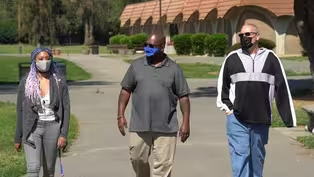
From Incarceration to Graduation
Video has Closed Captions
Clip: S4 Ep5 | 8m 15s | Formerly incarcerated students get a second chance at higher education. (8m 15s)
Training the Next Generation of Social Workers
Video has Closed Captions
Clip: S4 Ep5 | 5m 18s | The first social work program at a community college that's entirely online. (5m 18s)
A Virtual Performance: Social Justice Theater
Video has Closed Captions
Clip: S4 Ep5 | 9m 41s | Social justice issues take center stage at this South Central LA community college theater (9m 41s)
Providing Support for PBS.org
Learn Moreabout PBS online sponsorship
- News and Public Affairs

Top journalists deliver compelling original analysis of the hour's headlines.

- News and Public Affairs

FRONTLINE is investigative journalism that questions, explains and changes our world.












Support for PBS provided by:
Inside California Education is a local public television program presented by KVIE
Funding for the Inside California Education series is made possible by the California Lottery, SchoolsFirst Federal Credit Union, Stuart Foundation, ScholarShare 529, and Foundation for the Los Angeles Community Colleges.