Inside California Education
Community Colleges – Training Students for the Front Lines
Season 4 Episode 8 | 26m 46sVideo has Closed Captions
Community college students learn how to work on the front lines.
Meet graduates of a new program in San Diego that trains community college students how to work on the front lines with the homeless. Discover how Yuba College is making changes to its police academy in the wake of George Floyd’s death, teaching cadets how to de-escalate common situations. Go inside a unique program in Sacramento that trains students how to become licensed morticians.
Problems playing video? | Closed Captioning Feedback
Problems playing video? | Closed Captioning Feedback
Inside California Education is a local public television program presented by KVIE
Funding for the Inside California Education series is made possible by the California Lottery, SchoolsFirst Federal Credit Union, Stuart Foundation, ScholarShare 529, and Foundation for the Los Angeles Community Colleges.
Inside California Education
Community Colleges – Training Students for the Front Lines
Season 4 Episode 8 | 26m 46sVideo has Closed Captions
Meet graduates of a new program in San Diego that trains community college students how to work on the front lines with the homeless. Discover how Yuba College is making changes to its police academy in the wake of George Floyd’s death, teaching cadets how to de-escalate common situations. Go inside a unique program in Sacramento that trains students how to become licensed morticians.
Problems playing video? | Closed Captioning Feedback
How to Watch Inside California Education
Inside California Education is available to stream on pbs.org and the free PBS App, available on iPhone, Apple TV, Android TV, Android smartphones, Amazon Fire TV, Amazon Fire Tablet, Roku, Samsung Smart TV, and Vizio.
Providing Support for PBS.org
Learn Moreabout PBS online sponsorshipComing up on Inside California Education: Community Colleges: Tara Stamos-Buesig: I love coming out here and doing this work and, and getting to meet individuals and find out, find out more about them because we're people.
Meet graduates of a new program in San Diego that trains community college students how to work on the frontlines with the homeless.
Student: I clocked you back there going a little bit over the speed limit.
Student: Always have to pull people over, I don'’t understand.
Couldn'’t have pulled a nice guy over without speeding, because I sure wasn'’t.
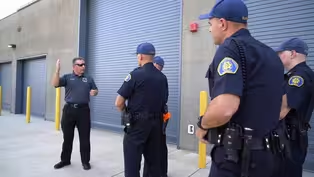
Discover how Yuba College is making changes to its police academy in the wake of George Floyd'’s death...teaching cadets how to deescalate common situations.
And go inside a unique program in Sacramento that trains students to become licensed morticians.
Jessica Cocar: Death is the one single experience that everybody goes through.
Not everybody gets married, not everybody has kids, but everybody experiences death.
It'’s all next, on Inside California Education: Community Colleges.
Annc: Inside California Education: Community Colleges is made possible by: College Futures Foundation believes nothing is more transformative for individuals in our society than an educational opportunity.
We partner with organizations and leaders across California to help students earn college degrees, regardless of zip code, skin color or income.
More information at collegefutures.org.
♪♪ ♪♪ Tara Stamos-Buesig: Shorts.
Four bags.
Shorts and a smoking kit.
And Narcan.
Tara Stamos-Buesig: Life is rough right now, and we are people, many of us, being one paycheck right now being on the streets.
And its really hard to exit homelessness and so it'’s our goal to fight for change, and to do something different.
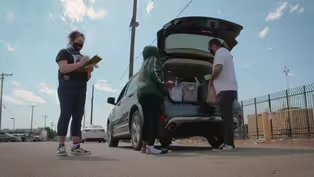
Rob: Tara Stamos-Buesig is at a homeless encampment today in the Point Loma neighborhood of San Diego, handing out safe smoking and injecting supplies.
Tara: You can call that number and someone like myself will stay on the phone with you while you use, and if you do not respond, we call the paramedics.
So you don'’t have to die just because you'’re using substances alone... ♪♪ Craig: Tie-offs, it has cotton and a cooker.
Rob: Tara and her husband Craig have a trunk full of supplies... including the overdose reversal drug Narcan and these Fentanyl test strips.
Craig: So wherever you are at, you can be safe in whatever you are doing with this kit.
Rob: Tara runs a non-profit called Harm Reduction Coalition of San Diego.
She calls it a "“radical act of love.
"” She'’s not just offering supplies to keep people alive - she'’s also offering hope - and even hugs - to those living on the street.
Tara: You matter.
You want a hug?
Rob: Tara created the non -profit after completing a new program at San Diego City College called PEER - or Program for Engaged Educational Resources.
The creators of the PEER program believe it'’s the first of its kind in the nation that trains people how to work on the frontlines with homeless individuals.
Tara: I enrolled as a person with lived experience.
I'm a former person who used to use substances chaotically.
I've struggled with homelessness, myself and I have had to, I supported my drug habit doing a lot of things.
I've been impacted by the criminal justice system.
I've been to prison.
I've been impacted by the child welfare system.
I have, um, a lot of different lived experiences.
And I had made the decision a long time ago to turn all that pain into some sort of purpose.
Man: Hey.
Hey, G. They're, they're the syringe people.
The syringe exchange.
Craig: What you gonna do?
Tara: So, um, yeah.
We're gonna park right up here.
Man: Alright.
We'll meet you guys over there.
Tara: Alright.
Yep.
Man: Thank you for you guys' services.
Craig: You're welcome.
Lisa: Over the past decade, um, San Diego has been somewhere in the top 7 to 4 cities in the country, as far as homeless population is concerned, whether sheltered or unsheltered.
So there's a significant need for resources and a response to that here.
Rob: The San Diego Housing Commission partnered with San Diego City College to create the PEER program.
They saw too many jobs going unfilled at places like homeless shelters and agencies in San Diego, and wanted a qualified pipeline of workers to fill them.
Lisa: So when we reached out to City College, it was for a number of reasons.
City College serves a really diverse population.
And it's also at a community college level, it's very accessible because it's affordable.
So, um, and another thing that I think is really critical is that sometimes folks who have experienced homelessness, or the homelessness system themselves are the best to turn around and work in that field.
Rob: People like Tara - whose non-profit grew quicker than she ever imagined.
It'’s already served 2,500 homeless individuals in less than a year.
Tara: I do this work because I came from that space and I remember what it feels like to be forgotten and looked past and, and, uh, and knowing deep inside that I did matter.
Langston: I personally haven'’t had to use Narcan, however, I've saved more than a couple of lives that they would have passed away had I not been on scene.
Rob: Langston tells us he used to work as an EMT...but ended up homeless after losing his house, his car and his Dad all in a short period of time.
Langston: I think it means a lot in just knowing that there's somebody out there who cares and allowing that to give hope to maybe recovering and getting back to a level of just kind of getting a life together.
Tara: We get pushback from the community.
We get pushback from individuals who don't want to see homeless individuals on the sidewalk.
Um, and that's okay.
Because we are not going to stop what we're doing and we're going to keep going out there and keep providing people a way to, um, to have some humanity and dignity.
Kirin: Our students are thought leaders out in our communities.
They are taking what we've done, what we've always done, and saying: How can we do this better?
How can we challenge ourselves?
Our systems, our organizations, our service providers to think differently?
How are we empowering our community members to really become independent and self-sufficient?
Rob: Professor Kirin Macapugay says she was stunned by the amount of interest in the PEER program - from students and even other cities.
Kirin: They're contacting us saying, Hey, we're seeing this in our city too.
What are you doing to address it?
Rob: Employers, too, are taking notice.
Father Joe'’s Villages is one of the largest shelter providers in San Diego, and offers comprehensive services for the homeless.
Jesse: The work that we do is really hard work.
It's rewarding work, but it's really hard work.
The curriculum being taught through the PEER program helps an agency like Father Joe's Villages because we owe it to our clients to make sure that we have top-notch staff that are prepared and trained and empathetic to the circumstances that a client may be experiencing.
Diane: Well we'’re here to support you as much as we can.
Rob: Diane Ritchie enrolled in the PEER Program while a student at San Diego City College.
She'’s now a case manager at Father Joe'’s Villages, helping clients find housing and income.
Diane: When you see a client come in for the first time and they are broken, just completely broken and you walk with them through that journey of brokenness.
And they start to feel self-sufficient and you can see that through them, obtaining it as simple as obtaining an ID, a social security card, then they go look for work.
Um, they start having a savings.
Um, they start finding this self-confidence.
And so when you see that - from the brokenness and you start to see them heal for me, that'’s rewarding.
Rob: Diane says she approaches every client from a place of understanding... having once walked in their shoes.
Diane: I myself was homeless as a child.
Uh, I grew up in a home where my parents suffered from substance abuse and there was a lot of violence in the home.
So I ended up homeless.
And I just remember thinking, like, why didn't anyone help our family?
And when I became an adult, I said, one day, I want to be able to help people.
Tara: Taking all this experience right and giving it a meaning, you know, that no mud, no lotus.
Like right now if you honor that space of being in the mud, like I'’m in the muck, I'’m learning things to take with me to further my journey to help humanity.
Maybe you had to come out here... Kirin: When I see our students move on, fulfill their goals, fulfill their dreams, but more importantly, see themselves as change agents in our communities.
And when I see them out there doing great work and making an impact on our San Diego region, to me as an instructor, that's a dream come true.
Christina: Still ahead on Inside California Education... meet students who are training how to work in the funeral industry, through a program that'’s offered at only two community colleges in California.
Valarie: Teaching the students to sit and listen to the families, really listened to them.
Uh, let them tell you what they need to tell you about and, you know, be empathetic.
Christina: But first, see what changes are underway at community college police academies across the state, as they place a greater focus on de-escalation techniques.
♪♪ It'’s a scene you'’ve seen played out in cell phone videos countless times.
Student: How'’s it going today sir?
A police officer stops a driver.
A confrontation follows.
Student: I clocked you over there going just a little bit over the speed limit... Student: Always have to pull people over, I don'’t understand.
Couldn'’t have pulled a guy over for speeding, because I sure wasn'’t.
Christina: Things could escalate...but in this scenario, the confrontation ends quickly... and the driver leaves without incident.
Student: So here'’s the deal, you were going about 15 over in a school zone.
I'’m not going to cut you a ticket.
I guess you were having a bad day... Christina: This role-playing exercise is being carried out by students of Yuba College'’s police academy in Marysville.
Ron Johnson: You didn'’t take the bait and say something sarcastic back, or anything like that, you remained professional... Christina: Led by instructor Ron Johnson, these students are learning how to de-escalate a common situation ... a driver who is angry about being pulled over by police officers.
Ron Johnson: We make sure that they understand that when they're making contact with people, uh, it's a stressful situation.
It may be a scary situation for them.
And so they need to do everything they can to keep things calm and, and to remind people that they're there to help them, that they're not the bad guy.
Christina: Community colleges across California, like Yuba College, are putting a greater emphasis on de-escalation techniques.
It'’s a change that administrators say was already underway, but was accelerated by the murder of George Floyd while in police custody in Minneapolis.
Marty Alvarado: With the events of June 2020, the George Floyd murder, um, we really felt that we needed to take bolder action and, uh, go beyond statements.
And so that was really the catalyst for our call to action.
Christina: California community colleges graduate about 25 percent of the state'’s law enforcement workforce.
Nineteen community colleges have police academies... where more than 12,000 people a year earn certificates or degrees in administration of justice.
The curriculum is set by the state Commission on Police Officer Standards and Training, or POST.
But here at Yuba College, cadets get 210 hours of extra training beyond the minimum ... time that can be spent on things like de-escalation, or discussions about what they call "“principled policing.
"” Pete Villarreal: In 2014, when I first came to you to Yuba College.
There was a question referenced to - are police really guardians?
Or are they warriors?
I thought we should be guardians, but always being prepared to react as warriors if in fact it was necessary.
So in 2014, we began to transition from a strictly warrior mentality for the police officers, uh, to a type of guardian.
That was a quite a cultural change for police academies, especially back in 2014, when we first began that transition.
Brian Vizzusi: I think we have a primary responsibility to make sure that our curriculum, what we're teaching, uh, is contemporary and we're teaching them, you know, to the right things and to do the right thing out there.
Brian: And go ahead and draw.
What are your verbal commands going to be?
Students: Get on the ground!
Christina: As part of this bigger shift, Yuba College is one of the few police academies providing taser training to their cadets.
Brian Vizzusi: This is a taser.
So it's made to look exactly like a taser.
This, the cadets were a red gun, so they were plastic guns in our academy.
And, um, we were seeing obviously officers mistakenly grabbing, um, their guns instead of tasters.
But we thought, what could we do as an academy to try to prevent any of our students from having that happen?
Get on the ground, stop resisting, I don'’t want to have to taser you!
Brian Vizzusi: When they first put that belt on, they know where that tool is at and how to grab that tool and what side it's on and what hand to use.
It's going to be an automatic thing and they're not going to have to think about it.
Jacob Robertson: I've definitely learned quite a lot of stuff that you wouldn't normally learn.
The effort and the amount of, uh, class time we have really goes to show that there is a lot to learn, and a lot to build upon if we want to have the opportunity to serve people and go out and be officers.
Johnny Burke: The best stops are the ones where there is no violence, and there is no confrontation.
The ones where people can be talked to as people.
Christina: Johnny Burke is a student cadet attending evening classes at Yuba College.
During the day, he works for a local homeless consortium and is also a church pastor.
Like many, he says he was affected by what happened to George Floyd.
Johnny: Shortly following Mr. Floyd's death, which really could be called the murder, there's no doubt about it.
Um, the there was protests that were organized around here, peaceful protests.
All the, uh, city police departments, both local Sheriff's departments, they got involved and marched side-by-side.
And so there was no us versus them.
And so what that's done for me is to show that it doesn't have to be an us versus them mentality.
It shouldn't be at all.
It should be a community mentality.
There was a lot of bonds that were made in following that during the time.
Brian Vizzusi: It's really interesting to see the change in the mindset of, of, uh, officers, uh, coming on.
10 or 15 years ago, we had a lot of people sitting in those seats that had that warrior mentality, We're seeing a shift in, um, more of the guardian role, where people, people really want to serve and change and they want to be the change.
Christina: Still... police departments are struggling to hire right now.
Academies like this one have half as many recruits as they did a few years ago.
Almost every single cadet will be hired before they even graduate.
Administrators say those who are enrolling ... are certain about their future.
Pete Villarreal: We don't get individuals that are guessing whether it'd be nice to be a police officer.
We get individuals that have already made that commitment.
Johnny: There's a real lack of people jumping into this field at this time.
And it takes a true passion and desire to be out there and be willing to, to put yourself on the line and have people automatically not like you, just because the badge on your chest and be able to affect change and be able to, to change the perception and let people know that you're out there to help them because you're part of the community and it's not just a job and you're not just power hungry, but you legitimately want to help people.
And you care about the community you're involved in.
Jacob: After this academy, I hope to serve my community.
Because I believe that is one of the most critical things as an officer is to be a servant your community.
And that'’s critical of officers is to serve.
♪♪ Christina: California recently adopted several new laws that address policing, including: -Banning the use of chokeholds, or carotid restraints -Requiring police officers to intervene if they see a colleague using excessive force -Raising the ageto become a police officer from 18 to 21 -Setting statewide standards for using of rubber bullets and tear gas in crowds.
♪♪ Tacye: "“We'’re going to laugh.
We'’re going to cry.
We'’re going to laugh some more.
And that'’s how Jack would have wanted it.
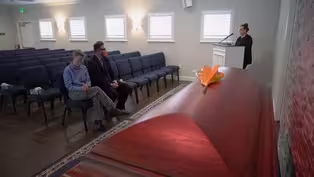
"” Christina: Everything about this funeral looks real.
It'’s being held inside of a funeral home, with a certified celebrant leading the service.
Tacye: Sandy and Jack caught each other'’s eyes at the young tender age of 14 years old.
Christina: But this funeral is just for practice.
It'’s a way for students in the Funeral Service Education program at American River College to prepare for their future careers.
Valarie: What we're doing is just kind of giving them the basics of what the funeral director's role is in a funeral.
Most people have kind of a general idea of a funeral, but they don't know all the little intricate things of it.
It teaches them how to act.
I that's one of the things that I think has come out of this more than anything, is it gets them to understand how to present themselves.
Christina: Valarie Rose is the chair of the program.
She started working in the funeral industry 30 years ago.
Back when female morticians were rare.
Now, many students in her program are women, and the industry is experiencing sky-high demand.
Valarie: It'’s out of this world.
Uh, every day I have mortuaries calling, asking if I have any students or graduates that would like to come to work.
Craig: It really takes a person who can handle a lot of, uh, long hours and a detail -oriented job.
Christina: Craig Strunk owns Affordable Cremation and Funeral Center in Sacramento.
They partner with American River College, giving students access to real funerals, viewings and embalmings.
Craig: They get the real feel of what'’s going to happen.
I mean, this is really what happens, this is real-world, um, they see what goes on in the embalming room.
Participating in the funeral services really gets the students to see what's what it's going to be like in real life.
You know, learning from the book in the classroom is completely different than being hands-on and doing the labs here, uh, at our facility.
So it's a real world on-the- job training, and I think you can't get better than that.
Valarie: We bring students in from the first week they are in the program.
So they may have never seen a dead body, possibly.
And we bring them in, we start teaching them how the process works and having them help with the embalmings.
Once the embalming is completed, then what they might be doing is also doing cosmetics, dressing, casketing, things like that.
Christina: Instruction also takes place at American River College'’s campus, where students earn their Associate of Science degree.
It'’s one of only two community colleges in California offering funeral services education; the other being Cypress College in Southern California.
Students leave the program prepared to be a licensed funeral director or embalmer...taking classes like restorative art.
Valarie: The masks that we use are practice for learning how to do reconstruction on faces, how to apply cosmetics.
Uh, amazingly a lot of them have no idea how to do cosmetics.
And so we practice that over and over so that they get the hang of it.
Jessica: Just being able to take something that, you know, for them, it could be, really painful the last image that they, you know, when they saw them last alive and to be able to fix it and give them back their Grandma or their Grandpa, or their loved one, or their friend, and go here there you go, they're, you know, peaceful, it's a really rewarding.
Molly: I just feel like it's really interesting and very relevant to daily life.
The program is extremely comprehensive with anatomy and physiology, pathology, microbiology, and history about the funeral industry.
And I just find it fascinating.
I'm really drawn to it and I pursued it just for that reason.
Christina: Molly Gleason -Kodama currently works in assisted living and memory care.
She wanted to learn how to do even more to help families.
Molly: People who come to you when you're in the funeral industry are going through one of the worst times of their lives.
And they need support.
They need someone who knows how to help them and to give them some direction and also some, some, uh, consoling.
And so, uh, that's very attractive to me, uh, because I really love helping people who need help.
We're trained in this program to learn how to help people in every way possible.
Valerie: How 'bout you?
I know this is your first one.
Molly: Yes.
I really enjoyed escorting the family.
And being of comfort to them.
Christina: That "“help"” ... even extends to the community.
American River College partners with the Sacramento County Coroner'’s Office to provide free funerals to families who would not be able to afford a service otherwise.
The college has even provided military honors for veterans... including George Tillman, whose story was featured in The Sacramento Bee.
Valarie: The wife had been caring for her husband.
He had been hospitalized for a while.
Actually quite a while.
And their medical bills were just so much that they weren't able to afford a funeral.
And so the coroner's office directed them to us.
And we were able to take care of having a service and a viewing for him and the military honors also, which, which was huge.
Craig: What they're offering is invaluable.
I mean, this family can actually get a service of what they're wanting.
Have closure, come in and have time to say goodbye to their loved one.
Their students will actually do all the arrangements and follow through.
So it's, it's training for them, real world.
And then the family gets to have closure.
Man: ...to celebrate my brother's home-going.
Thank you, Lord God for brother Tillman... Christina: Soon, American River College will be able to offer the funeral services on their own campus.
Plans are in place to build a mortuary, chapel, viewing rooms and labs at the college.
Molly: I think it's really important that a community college is offering this program because it gives everybody an opportunity to explore this.
People don't really do it unless they're passionate about it, because you can certainly make more money doing other things, but if you really want to help people and support them and, um, be there for them at a time when they need a helping hand, it's an excellent way to do that.
Jessica: And I like when people ask me about my career because I like to, I like to talk about it.
I think that as a society, especially in American society, we've kind of sterilized the death process and the grieving process.
And I think it's good to be death positive and talk about it.
That way people are informed.
Valarie: We get a lot of students who this is a second career for them.
A lot.
And then they're able to jump into going back to school and doing something like this, something that they just always wanted to do.
That's what they tell me all the time is just, '‘this is something I've always wanted to do.
And I'm finally doing it.
'’ Christina: According to the National Funeral Directors Association, the funeral industry is seeing these new trends across the United States: -More personalized funeral services that celebrate the individual'’s hobbies or favorite music -Planning and paying for your own funeral in advance, taking some of the burden off of family members -Offering a live video stream of a funeral service, or recording the service and making a recording for the family -Offering "“green"” burials, often with a burial happening in a natural setting with biodegradable materials That'’s it for this edition of Inside California Education: Community Colleges.
If you'’d like more information about the program, log on to our website insidecaled.org.
We have videos from all of our shows, and you can connect with us on social media.
Thanks for joining us.
We'’ll see you next time on Inside California Education.
Tara: And it's really hard out there to exit homelessness and, and so our goal is to continue to fight for that change and to do something different.
Student: Alright, so here's the deal.
You were going about 15 over in a school zone.
I'm not gonna cut you a ticket.
I guess you were having a bad day.
Ron Johnson: You didn'’t take the bait and say something sarcastic back, or anything like that.
Okay?
You were being professional.
Valerie: Every day I have mortuaries calling asking if I have any students or graduates that would like to come to work.
Annc: Inside California Education: Community Colleges is made possible by: College Futures Foundation believes nothing is more transformative for individuals in our society than an educational opportunity.
We partner with organizations and leaders across California to help students earn college degrees, regardless of zip code, skin color or income.
More information at collegefutures.org.
♪♪
Community College Police Academies – A Focus on Reform
Video has Closed Captions
Clip: S4 Ep8 | 7m 22s | Discover how Yuba College is making changes to its police academy. (7m 22s)
Funeral Service Education – Caring and Comforting
Video has Closed Captions
Clip: S4 Ep8 | 7m 36s | A unique program in Sacramento trains students how to become licensed morticians. (7m 36s)
On the Front Lines with the Homeless
Video has Closed Captions
Clip: S4 Ep8 | 8m 16s | Community college students learn how to work on the front lines with the homeless. (8m 16s)
Preview: Training Students for the Front Lines
Preview: S4 Ep8 | 30s | Community college students learn how to work on the front lines with the homeless. (30s)
Providing Support for PBS.org
Learn Moreabout PBS online sponsorship
- News and Public Affairs

Top journalists deliver compelling original analysis of the hour's headlines.

- News and Public Affairs

FRONTLINE is investigative journalism that questions, explains and changes our world.












Support for PBS provided by:
Inside California Education is a local public television program presented by KVIE
Funding for the Inside California Education series is made possible by the California Lottery, SchoolsFirst Federal Credit Union, Stuart Foundation, ScholarShare 529, and Foundation for the Los Angeles Community Colleges.