
Community in mourning after UNLV shooting
Season 6 Episode 22 | 26m 46sVideo has Closed Captions
We explore the impacts the UNLV shooting has on the community and mental health.
Three people were killed in a shooting at UNLV. It’s a tragedy that has shaken the Las Vegas community. We look at what happened from a reporter on the scene, the resources available for anyone affected, and how mental health plays a role in this tragedy.
Problems playing video? | Closed Captioning Feedback
Problems playing video? | Closed Captioning Feedback
Nevada Week is a local public television program presented by Vegas PBS
Community in mourning after UNLV shooting
Season 6 Episode 22 | 26m 46sVideo has Closed Captions
Three people were killed in a shooting at UNLV. It’s a tragedy that has shaken the Las Vegas community. We look at what happened from a reporter on the scene, the resources available for anyone affected, and how mental health plays a role in this tragedy.
Problems playing video? | Closed Captioning Feedback
How to Watch Nevada Week
Nevada Week is available to stream on pbs.org and the free PBS App, available on iPhone, Apple TV, Android TV, Android smartphones, Amazon Fire TV, Amazon Fire Tablet, Roku, Samsung Smart TV, and Vizio.
Providing Support for PBS.org
Learn Moreabout PBS online sponsorship(Georgia Barrett) Surprised that it happened today, but not really surprised that it happened, in general.
-A shooting at UNLV kills three victims and sparks painful memories... How the Las Vegas community is responding, that's this week on Nevada Week.
♪♪♪ Support for Nevada Week is provided by Senator William H. Hernstadt.
-Welcome to Nevada Week.
I'm Amber Renee Dixon.
Six years after 1 October, the deadliest mass shooting in U.S. history, our community is once again grappling with a mass shooting, this time at the University of Nevada, Las Vegas, a place where so many Nevadans have gone to school, held a job, or even cheered on the Rebels.
The shooting happened Wednesday around 11:45 a.m. Police say 67-year-old Anthony Polito entered Beam Hall, home of UNLV's Lee Business School, and shot and killed three UNLV faculty members.
They were 64-year-old Cha Jan "Jerry" Chang, 39-year-old Patricia Navarro-Velez, and 69-year-old Naoko Takemaru.
A fourth person was seriously injured, and the gunman was killed in a shootout with University Police.
At the time, UNLV's campus was packed with students and staff, but instead of preparing for finals next week, they found themselves barricaded inside classrooms.
The students we spoke to, trying to utilize what they've learned from active shooter drills.
(Mary Alice DiRienzo) There was a lot of crying, a lot of panicking.
Everyone was on the phone with their parents, their loved ones, their friends, other people on campus.
It was just-- it was a really upsetting environment to be a part of, because we're all stuck there.
There's nothing you can do.
You have to hope for the best and wait it out.
You have done plenty of drills?
-Oh, yeah.
Nothing can prepare you for that.
-How long have you been doing those drills?
-My entire life, like since elementary school.
So 18 years now?
Yeah.
-And to finally have to implement that, what was that like?
-It felt like everything I had been taught, everything I had known went out the window, because your body is telling you to do something completely different.
Like you go into panic mode, and there's just, like nothing can prepare you for that, that feeling.
-Honestly, I'm kind of surprised it did take this long for me to be on campus between my regular schooling and then graduate or post-high school schooling.
So, yeah, it just-- it feels real, but not real at the same time.
I don't really know how to describe it yet.
-And how prepared did you feel for this?
-Um, unfortunately, I felt pretty prepared.
I've been doing these drills for years and years and years.
The problem is that the people doing the shooting have also been doing these drills for years and years and years.
So as much as I felt like I was prepared, I'm sure that the people, you know, causing the shooting were also prepared.
And so that is a weird feeling, knowing that they know exactly what we're going to do as we're trying to keep ourselves safe.
(Marco Lau) I knew sort of what to do just from high school and everything that they taught back then.
But I didn't, at the same time, because you never think that it's gonna happen.
You just never know.
-What do they teach you?
-Get low.
Be quiet.
Shut the door.
Barricade the door.
Run, hide, fight.
That's it.
(Matthew Hills) I was just hoping to survive my second school shooting, because at my old college, there was one as well.
And similar situation a couple buildings away.
-On the scene of the shooting and following the story ever since have been Dana Gentry, Reporter for Nevada Current, and Brett Forrest, Reporter at News 3.
Thank you both for joining us.
Brett, you were not only on the scene after the shooting, but during the shooting.
Why?
And what was your experience?
(Brett Forrest) I was there on assignment for an entirely different story.
It's kind of a lighthearted story, speaking to seniors graduating in two weeks with the Engineering program, doing their final presentations.
I was speaking to some about an F1 presentation, and it was great to hear all the hard work they put in.
It's a Capstone project.
And then as we wrapped up our interviews, my photographer, Jay Aguilar, and I were trying to leave the building we were in when students began rushing in.
And I said, "What's going on?"
And they started saying, Shooter!
Shooter!
There's an active shooter!
And as a journalist, my first instinct was, We should maybe go check it out.
And they just said, "No.
We have to shelter in place."
And so we immediately-- there were probably two or three dozen students and then several faculty members and then my photographer and myself.
We immediately had to shut and lock the doors.
We were in a wide-open room, plenty of windows.
And these students, as we just heard, a lot of training growing up, unfortunately, of what to do.
So we realized the room we were in was not a good room, and we had to push farther back.
And we actually ended up in the UNLV president's office and library.
And we had to hunker down there.
And we ended up sheltering in place for four hours.
And it was just impressive in a sad way of just how these students immediately went into action, knowing what to do, crouching down, trying to stay away from the windows.
There's a kitchen attached to where we were.
They immediately blocked all the doors with freezers, carts, trash cans, whatever they could find.
-The students did?
-The students did.
And it was frightening, because once I realized it was the real deal, I started shaking a bit, because I'd never been in that situation before.
And I didn't quite know what to do.
I graduated high school in 2007, so mass shootings weren't unknown to me, especially the Columbine.
I'm from Colorado, but I wasn't sure what to do.
So looking back, I'm thankful as with these students who acted so quickly, but also sad that they have to know how to treat a situation like that.
-Dana, you were a UNLV student yourself at one time.
You told me off camera that two of your nieces were on campus at the time of the shooting.
What were their experiences?
(Dana Gentry) Very much like what Brett said.
My niece Riley took command and told everybody to barricade the door and to stand away from the window next to a wall.
And you have to realize these kids have been brought up with these drills.
You pray they will never have to use them in a real situation, but they are prepared in a way that my generation-- I graduated 30 years before Brett, so I-- school shootings were just not something that we ever thought about.
But it was terrifying.
-How are your nieces doing?
-They're fine.
I mean, one is very stoic.
And that's of concern to me.
But you know, I told her it's okay not to be okay in a situation like this.
This is not normal.
This is not something you should ever have to encounter.
-And we're going to be talking more about that ahead.
But three victims in this shooting who have passed away.
We're taping this Friday morning, and we recently learned the name of the third victim, Naoko Takemaru.
Brett, what do we know about these victims?
-They're all faculty members at UNLV.
And they were, I believe, on the 4th floor of Beam Hall.
The investigation is ongoing about how the shooting started, who was targeted.
I don't know if these three were specifically targeted, but it's known that the shooter had a list.
He was disgruntled with UNLV not hiring him.
And it seemed he went to that specific location to target these faculty members.
And the three victims, they're all professors.
One was a mother of four, I believe.
And so it's just tragic that they now don't have their mother.
And the other two victims, you know, you mentioned the name just released, head of their Japanese Studies Department, I believe.
And so, I mean, it's reason to say that possibly her family is in Japan.
That's possibly why it took so long to notify her next of kin.
-Right.
-And I can't imagine what any of them are going through.
And it's just tragic that they were just going to work, doing their job.
-As you mentioned, we don't know whether the shooter was targeting them specifically.
What do we know about him?
-Well, the Sheriff did say that the people who were killed were not on the target list.
I believe he said two were discovered on the 3rd floor, one on the 4th floor, and they believe the victim who did not die but his condition has been downgraded was on the 5th floor.
You know, I think, unfortunately, people in our business and perhaps the general public have become somewhat inured to this.
And my first reaction, and it's a horrible reaction, was thank God it was just three people, just three people; whereas, 20 years ago, a shooting at UNLV that killed three people would have been out of the question, you know, out of the realm of possibility.
So I think we have to remember that to the families of the three people, even though it wasn't a bigger tragedy, it's a humongous tragedy to those people.
-That target list, where was it discovered and-- -On his body, from what I understand.
I was a little confused yesterday.
I thought it was in the apartment, but today I read that it was on his body.
-And how many people on it?
Numerous, correct?
-Numerous.
Both at UNLV and his former university, East Carolina University, which is in North Carolina.
They also discovered a type of last will and testament in his apartment.
I don't believe they've released what's in-- what was detailed in that, as well.
-But not a motive, per se, or are we-- -Well, I don't think-- you know, the Sheriff stopped short of calling it a motive, but he did say that the man had applied to numerous institutions in Nevada, higher education institutions, and had been denied employment.
And the fact that he had a target list of university professionals and had sent 22 letters to higher education professionals here and at his former place of business, I think you can assume that that had something to do with it.
-And that was at his Henderson apartment where that last will and testament was found.
Police also said an eviction notice was on the door, implying he was having some financial struggles.
Those envelopes that you bring up, what happened with those?
-So how the process works, my understanding, they work with the postal inspectors, and they try to capture these envelopes before they get delivered.
There's no return address.
They did at least recover one and tested a white substance that they found inside, which people fear could be fetanyl these days, something to cause a reaction or death of whoever opens it.
And police released a statement that they found it was no harm, no harmful substance.
But they are warning people if they receive an unknown letter with no return address, especially if you're in one of these academic institutions, to be wary of opening them.
-All right.
And in regard to the police response to this shooting, Adam Garcia of UNLV Police spoke about that.
Let's listen to him first, and then I'll have you respond.
(Adam Garcia) The first officer on the scene of the incident was there within 78 seconds.
Additional arriving units from Metro and UPD then entered Beam Hall.
And as you saw in the video, two University Police detectives then confronted the suspect and engaged in a gun battle, which neutralized the threat.
These two detectives are heroes.
They risked their lives in order to save countless others and, as the Sheriff pointed out, what could have been a bloodbath.
-Dana, with the details that police have provided, could this have been a lot worse?
-I think it could, but we still don't know.
You know, the Sheriff was adamant to say that the police entered the building without hesitation because I think there was so much criticism after the 1 October shooting massacre on the Strip about the police hanging out in the hall.
-And Uvalde.
-Exactly.
-Right.
And you know-- but the thing is the, as Adam Garcia said, the police entered.
They responded in 78 seconds.
So we're looking at about 11:45 and seconds.
And then the suspect exited at 11:55.
So in those 10 minutes, I think we need to find out as much as we can about what happened and who was searching and how the suspect evaded those people in those 10 minutes.
But I completely agree; those Campus Police who took down the suspect are heroes.
And the Sheriff suggested that he was headed for the Student Union.
I'm not sure, you know, because he had a target list.
It's hard to say.
-He was carrying several magazines, though.
So that makes me worry about how much worse it could have been.
-So you're looking to find out exactly what happened inside that building and then to the time when he exited, which is when he was shot was outside.
-I don't think they have cameras inside the building is part of the problem.
So they're asking now for anyone who has videos or any information to come forward.
And Brett, what are you still looking to find out?
-I would like to know about this target list, this hit list that police were saying the shooter had, who was on it.
My assumption is more faculty members or specific faculty members, but it would be-- I'm interested to learn what his intentions were walking into that Business School on Wednesday.
Just who was he looking for specifically?
-All right.
Brett Forrest, you will be attending President Joe Biden's press conference later today.
As I said, we're taping this Friday morning.
So watch his coverage on Channel 3 or news3lv.com.
And Dana Gentry, your award winning reporting can be found at nevadacurrent.com.
Thank you both.
-Thanks for having us.
-Thank you.
-We move now to mental health and lessons learned from 1 October that can be applied in the aftermath of the UNLV shooting.
Here to discuss are Tennille Pereira, Director of the Vegas Strong Resiliency Center, and Stephen Benning, Associate Professor of Psychology at UNLV.
Thank you both for joining us.
And first off, Stephen, you were on campus at the time of this shooting.
What was your experience?
(Stephen Benning) So I received word through the UNLV alerts system that there was a shooter.
We got three messages in pretty quick succession, which had never happened before.
Whenever there was a training drill, we knew ahead of time, and there was plenty of warning it.
And it was usually just one message.
And so I dragged a desk in front of my door and got messages after about, oh, 12:30 or so.
I think that the situation had been resolved and that the police were clearing buildings.
So I waited in the office and was contacting all of the students in our Clinical Psychology department to make sure that they were okay or at least had been able to shelter in place.
Got in touch with all of the first-year students.
Our Associate Director of Clinical Training was taking the second- and third-year students.
I had gotten through two of the fourth-year students when the police came to evacuate me to the Thomas & Mack.
And so I went around looking to provide psychological first aid to people who were there and also greeting some of our students who came through additional evacuation waves, tried to see if they could get belongings, figure out where people were going, and then drove home after it was very clear that Las Vegas had established a great crisis response at the Reunification Center.
-Psychological first aid, I've never heard that.
But you were administering that to other students.
How have you administered it to yourself?
How are you doing?
-Well, just before coming in today, my wife was cleaning off the door of our patio, talking about the little paw prints.
And the day that all of this happened, I got an email from his school saying that there was an incident, a fire drill, which made me really start wondering what that incident was.
And it elicited a sort of overwhelming burst of emotion before coming in.
And it's, it's really easy to shame yourself in that moment and feel like, I shouldn't be feeling this way.
My wife was right there.
She came over to my side as I was weeping and comforted me.
And I still felt, even as a psychologist, even as someone who knows that these kinds of reactions are completely normal, having these associations, these triggers come out, totally normal, totally expectable, not disordered in any way, they are simply reactions to these kinds of traumatic events, I still had this sense of guilt for burdening her and felt like I shouldn't do this.
Fortunately, I have the training to be kind to myself in the, in the acute moment at that stage and say, This is a reaction.
This is totally expected.
And when triggers come up in random ways, I will be experiencing these waves of emotion.
Other people who were even closer will probably have more frequent and stronger emotional responses.
Those are okay.
And those are things that are simply normal reactions to this kind of trauma.
-Tennille, I keep seeing you shake your head.
The Vegas Resiliency Center was formed in response to 1 October.
What has that experience-- what impact has it had on how you've been able to respond this time around and hearing stories like that?
(Tennille Pereira) We had over six years to prepare for the reality of the world that we live in.
You know, the community has changed a lot of things in how we respond to these.
You know, we have a lot more knowledge on how trauma impacts someone and how we respond.
We've tried to do a lot of education with just the general community that, you know, these things are normal to respond in this way.
You know, we were ready to go.
Immediately, we were ready to go.
All the relationships that we built of all these community partners were in place.
Things went much smoother, the reunification stage.
And we have programming in place already.
We know who to call.
We know who's properly trained.
So definitely in a much better place.
It was, you know, a bit too familiar, doing these things again.
And we know the long road of healing that many people are going to have now, the community is going to have.
I do find a sense of comfort in our knowledge and our experience, though.
It's sad that we have mass violence experts, but we do.
-You bring up the long road to recovery that's ahead.
You are part of a study.
You've been the chief person behind a study about 1 October, which sort of established a recovery timeframe for people who were at 1 October and members in the community.
Will you better explain it for me?
-Sure.
So we launched a study within a couple of weeks of it happening, asking people to tell their stories, as well as report on symptoms of psychological distress, like post-traumatic stress disorder, depression, as well as psychological well-being, things like meaning in life, gratitude, a general sense of purpose that people might have.
And so what we found is that in the what we call the "acute stress period," that is basically three days to a month after a tragedy or a trauma, the relationships between the symptoms and well-being was jangled.
There was almost no relationship whatsoever.
Once we got into the post-traumatic stress period, well-being was negatively associated with symptoms.
So the more symptoms people felt, the lower their well-being was.
And it turned out that in the initial part of the acute stress period, people in the community had elevated levels of post-traumatic stress.
But about 50% of people who were at the festival would meet probable levels of symptoms that would be consistent with a PTSD diagnosis.
In the community, symptoms seem to recover almost completely on the whole by about three months out.
There were still some people who had elevated symptoms, but the mean levels in the sample, as a whole, were down about where we would have expected.
-So someone in the community, for example, in this situation, who's suffering, who's feeling the hurt, who wasn't actually there at the shooting, but who's, who's hurting, may have about three months of a period of recovery?
-Something like that.
-Okay.
-On the whole.
And there will be some people who are more strongly affected than others.
The people who were at the festival, by the time our year-long followup happened in the final wave of the study, their average levels of post-traumatic stress symptoms were about where the average level of those symptoms were in the community right afterward.
And we also saw a bump of depression happen in the community at that one-year event that didn't seem to happen for people in the festival, largely probably because they were still having relatively elevated levels of symptoms.
But even in the community, an anniversary effect may happen in a year.
-And Tennille, what kind of impact have you seen or do you expect to see as a result of this shooting on victims of 1 October who you've been serving?
-We have seen an impact.
-Already?
-Yes.
It's been very, very hard on them.
And in particular, the ones that are living here in Las Vegas or have connections to Vegas or UNLV.
We are a fairly small community, and almost everyone has some type of connection to UNLV.
So it feels a lot more personalized when you have that connection, and then these individuals have a mass violence connection from Las Vegas as well.
So it has been very emotional for them.
-Who needs to be seeking help, in your opinion?
-Anyone that's struggling.
There is help out there.
They don't have to go through this alone.
And you know, we really want to stress that.
To your point earlier, a lot of people think, I should be fine.
I should be fine.
I don't need help.
Others need help more than I do.
It's that kind of survivor's guilt.
There's others that are struggling more.
That is not the case.
There is plenty of help to go around, and we want people to reach out for resources if they're struggling.
-Also, for people who may not even be aware that they are in need of help, does the onus then fall on their loved ones?
And how do loved ones deliver that message?
-I'm not sure that the onus falls on them, but they may be another source of information for people.
Because when you are in the midst of processing this kind of trauma, sometimes you just don't even recognize what's going on.
You're having a hard time just figuring out what to do from hour to hour sometimes.
And so having that kind of reflection is much more challenging.
The thing that came out of this study that's really important to recognize is that there are going to be levels of suffering that people have that are probably normal and expectable reactions.
But that doesn't mean that they don't need help from other people.
And right now we're moving into a, an era in which we're moving towards skills for psychological recovery, because the acute trauma has passed.
And unlike a natural disaster, people's needs are now still probably met.
They're able to go back to their cars, the classrooms, their classrooms, get the information and the material that was left behind.
And so I think it is important that they exercise these skills to help themselves and make connections with other people.
-We so appreciate both of your time.
Thank you for coming on Nevada Week.
And thank you for watching.
For anyone in need of help right now, we have a link to the Vegas Strong Resiliency Center on our website.
That's vegaspbs.org/nevadaweek.
And that's also where you can find a link for UNLV students to request support and a link for information on the UNLV Emergency Support Fund.
We also want to make sure that we acknowledge the people who have lost their lives in this tragedy and that they are remembered.
They are Cha Jan "Jerry" Chang, Patricia Navarro-Velez, and Naoko Takemaru.
Our hearts go out to their loved ones and everyone impacted by this tragedy.
Mental health awareness following UNLV shooting.
Video has Closed Captions
Clip: S6 Ep22 | 11m 39s | Speak to experts about mental health plays as the community processes the UNLV shooting. (11m 39s)
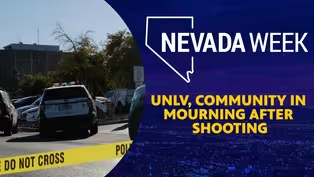
UNLV, community in mourning after shooting
Video has Closed Captions
Clip: S6 Ep22 | 13m 36s | We discuss the shooting at UNLV and the wide range of impacts it has. (13m 36s)
Providing Support for PBS.org
Learn Moreabout PBS online sponsorship
- News and Public Affairs

Top journalists deliver compelling original analysis of the hour's headlines.

- News and Public Affairs

FRONTLINE is investigative journalism that questions, explains and changes our world.












Support for PBS provided by:
Nevada Week is a local public television program presented by Vegas PBS