Traverse Talks with Sueann Ramella
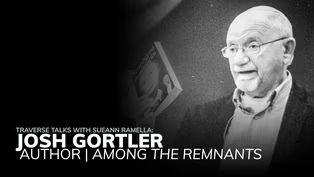
Community Leader Josh Gortler
1/10/2022 | 50m 23sVideo has Closed Captions
Community Leader Josh Gortler And Friend, Gigi Yellen On The Concept Of Tikkun Olam.
Community leader Josh shares his story: his childhood, fleeing with his family from the Nazi Holocaust, his adolescence, in Displaced Person camps, & his adulthood, free to speak as Jew in America. His memoir, Among the Remnants: Josh Gortler’s Journey, is co-written by Gigi Yellen - classical music host for NWPB. Gigi also shares her own experiences with Sueann about growing up a Jew in America.
Problems playing video? | Closed Captioning Feedback
Problems playing video? | Closed Captioning Feedback
Traverse Talks with Sueann Ramella is a local public television program presented by NWPB
Traverse Talks with Sueann Ramella
Community Leader Josh Gortler
1/10/2022 | 50m 23sVideo has Closed Captions
Community leader Josh shares his story: his childhood, fleeing with his family from the Nazi Holocaust, his adolescence, in Displaced Person camps, & his adulthood, free to speak as Jew in America. His memoir, Among the Remnants: Josh Gortler’s Journey, is co-written by Gigi Yellen - classical music host for NWPB. Gigi also shares her own experiences with Sueann about growing up a Jew in America.
Problems playing video? | Closed Captioning Feedback
How to Watch Traverse Talks with Sueann Ramella
Traverse Talks with Sueann Ramella is available to stream on pbs.org and the free PBS App, available on iPhone, Apple TV, Android TV, Android smartphones, Amazon Fire TV, Amazon Fire Tablet, Roku, Samsung Smart TV, and Vizio.
Providing Support for PBS.org
Learn Moreabout PBS online sponsorship(somber music) - Josh Gortler is a Holocaust survivor who, with the help from NWPB's classical music host, Gigi Yellen, wrote a memoir about his family's survival.
(somber upbeat music) His book is "Among the Remnants: Josh Gortler's Journey."
It reads fast and offers good and interesting insight into a child's perspective of displaced persons camp, understanding the bigger picture of what was happening and discovering, you're white.
and also changing your name to fit in.
and why does it feel uncomfortable for some people to say Jew?
I'm one of those people.
You'll hear from Gigi Yellen later about that.
First, Josh Gortler.
(somber upbeat music) So Josh, this podcast, while we talk about your book, I wanna have a conversation with you about things that have been missing from some of your interviews and presentations.
So while the story of your family and your journey, and there's a lot of personal information in here, I'm really curious that when did you get to the point where you could talk about your experience and the death of friends and families?
- Yeah, it's interesting that I did not that share my story during my youth, during my college years, during my employment.
It was really when my grandchildren started to ask questions, which is about 30 years ago.
I started to share with them only with a question they would ask, I would answer.
And it's interesting that my parents never shared anything with me either.
- Right.
- And in fact, they shared with my wife.
So my wife has a more depth from my parent's mouth, what happened, than they shared with me.
- Why do you think that is?
- Well, it's to spare me from reliving those moments.
- Yeah.
- Because when I talked to audiences today, when I get finished, I really feel drained out because the images are coming back and I have very difficult time after talking about it.
So the first time I officially talked about it was since somebody asked me to do a presentation at the Rainier Beach High School.
,And if you know the Seattle area, Rainier Beach High School is not your top high school, academically, it is the bottom of the public school systems in Seattle.
And somehow one of the history teachers wife was working at the Kline Galland, and she heard that I was a survivor, said, "How would you like to share your story at the school?"
And so I put together some old-fashioned slides, photographs and slides.
So I came to the school and I started to speak from a stage, this for about 200 kids.
- Wow.
- And it did go very fast.
I just went off the stage and got into the audience and started to share with them.
And they really got into the discussion.
- And after that day, do you remember how you felt after that presentation?
- I was wiped out.
First of all, the audience at the beginning, they had, I was told a few years ago, someone else, who came to speak to them about the Holocaust, and they basically threw tomatoes at the individual.
It's a tough school.
And that was my introduction to talk in front of an audience... Well, I'm comfortable talking in front of audiences.
That was not an issue.
The issue was the particular audience and the particular topic.
- Both difficult.
(Ramella laughs) - Most difficult, correct.
- And their lives, I'm wondering if their lives and experiences had a lot of similarities going through trauma, difficult times, being told you're something else and other and don't belong.
So you resonated with them?
- Yeah, I did.
- Josh, when you were young, there wasn't a lot of talk about therapy or mental health.
And in your book, you wrote about a time in the displaced person camp, When the celebration of, and I hope I say this right, Tish bav?
- Tisha b'av.
- Tisha b'av.
But really no one really wanted to discuss what just happened.
Things are too fresh.
And how could you celebrate?
Let me see, look in the book here.
Why celebrate something from so long ago when something very tragic just happened?
- Right.
Tisha b'av is a day when the two temples in Jerusalem were destroyed on the same day.
Tisha means nine.
b'av, that's the Hebrew month of av.
The Hebrew calendar is totally different than the calendar we use today.
So Jewish holidays in the DP camps that write about 'em, is that they wanted to talk about nice things, they didn't want to talk about the destruction because of destruction of the 6 million was in front of our eyes.
And there's a number of pictures in my book where the classroom...
There is a handmade menorah and it said, "Six million (speaks Hebrew)."
It means do not forget, remember.
So any place you went, it was in your eyes, the 6 million.
- Yes.
And what I got from your book was that that number was everywhere.
They wanted you to remember this.
- Correct.
- But at the same time, not talk about it, - That's right.
- Right?
No tools.
So how did you...
I know there was a social worker somewhere in there, but I'm so curious how you eventually became a social worker yourself and realized you needed to talk about these things.
- It's a good question.
There were social workers who helped us, not through therapy.
The social workers' role we're more of assisting to get where you have to get and to to do what you have to do.
There was no real therapy or to discuss the feelings; How do you feel about it, the trauma, none of that.
Because we had to get on with our lives, this post-traumatic stress that today, everything is post-traumatic stress, we didn't have that.
The term wasn't even, the terminology was not in our lexicon.
- And now in hindsight, do you feel like you had post-traumatic stress.
- Definitely.
(Ramella laughs) But we were too busy to be concerned about it.
I had to learn how to write and to read.
I had to learn how to write in a new world.
I had to look for a future.
There was no time to think back.
- And in the story, Josh, you were three years old, when your family left your home and you traveled far; Missing the Nazis by sometimes just days.
And you are as far as Siberia, then back down.
And eventually after many years, I think you were 15, you made it to the United States, but it wasn't easy.
There are three camps that you stayed at, refugee camp, displaced person camp, and all through that time, you had no formal schooling.
- Well, but formal schooling started in the DP camps.
- In the DP... That's right.
Where you learned to write your name?
- Right, I learned how, in the DP camp.
Just to give you an idea.
I think the leader of the DP camp looked at the children as the future, the commodity that they have to preserve.
And they immediately started an educational program and there was quite a bit of discussion.
What should the program be like?
And how should the program for the children be taught?
And I remember we were in a DP camp with many, many children from different parts of Europe and each one spoke a different language, a German, Hungarian, Romanian, Russian, Polish, Slovakian, done.
So the leaders decided that the common language is going to be Hebrew.
And they taught us the alphabet and the taught us to write and read.
And all the secular subjects like arithmetic, geography, basic science, literature was all in Hebrew.
That was the common language that they they had to create.
I'm using the term secular studies, which is based on a model that was used in Eastern Europe for the non-religious schools.
They use the Tarbut.
It was called as the secular school, but taught in Hebrew.
And then there was the religious school, which was known as Yeshiva.
And that's where we were taught the religious studies, the Bible, the Talmud everything else that we learned was in Hebrew, but it was in a religious school.
So in the religious school system, they were only created for the boys, not the girls; The secular education was boys and girls.
So it was a mess.
(Ramella laughs) And then in addition to this, I had to learn the A, B, C, D, E, F. Now one goes from the left to right and one from right to left.
Where am I?
It was a... Really brain was going in 20 miles per second.
- Now, looking back on that time, was your brain gathering that information or were you-- - I was like a sponge, soaking up everything.
- And then Josh, when you came to America, the social workers said that your name, Shaya?
- Shia.
- Shia.
- Your name Shia.
Wouldn't make it.
- Yeah, well, it's interesting.
I write in the book because from my immediate family, there are four of us and each one was easy to convert.
My father's name was Yashab, became Joe.
Joseph, very simple.
My mother's name was as Estara, Esther.
My brother's name was Moses, became Morris.
Now Shia presented a problem.
(Ramella laughs) First of all who's gonna pronounce it?
How do you spell it?
So in my document from the DP camp, I have Shia spelt in five different ways.
(Ramella chuckles) - With that advice from your social worker at that time, it was helpful because of integration.
And you mentioned your grandchildren asked questions.
Were you open to their questions at first or hesitant to tell them.
- No.
I was not hesitant at all, because my life was put together.
And also I felt, that call of social work was a perfect match for me.
Because in order...
I went through a not analysis, but when you go through graduate school in social work, you have to learn a couple of concepts, not to be judgmental and not to enter you own feelings.
You have to sort of deal with the feelings of your client and not to project your feelings to them.
And part of my training, it was almost like self analysis.
Why am I doing this?
Why am I saying this to this person at this given time?
And that part of the training, you get when you're a social worker, it's all almost like self analysis.
- Self analysis.
- Yeah and that talks a great deal for me to find my roots.
So to speak.
- I'm wondering if that gave you the tools and skills to do self therapy.
- Yes.
It was in a way self-therapy, yes.
(somber music) - This podcast is brought to you by NWPB donors, a gift of $5 a month supports the production of this program.
And it makes you eligible for NWPB passport.
With the passport you have access to an on-demand library of more than 1500 episodes of PBS favorites.
Come to nwpb.org and click on the donate button at the top.
(gentle inspiring music) - Do you have any dreams of the displaced persons camp now?
- I do, and the displaced persons camp for me, we're really an awakening.
It was wonderful, education, food was provided, we were free to do what we wanted to do; We were basically like the kids in "Oliver Twist."
(Ramella laughs) We'd go out to a farm and climb up a tree, pick apples, chase after a chicken and catch it and bring it home and kill it.
And give it to the guy to have kosher meat.
So, the DP camp for me, even though people write about the horrors of the displaced people camps or refugee camps, it was wonderful for a child of 10-15.
Especially the years before I couldn't raise my voice.
- Right.
You had to be quiet.
- Quiet, right.
If I raised my voice, they had to... My mom or somebody would put a rack in my mouth.
So I wouldn't be making any noise, I had to keep it all in.
- Constantly trying to survive and hide.
- Yes, I can survive.
- Hey Josh, I wanna go back to the question of dreaming.
Do you still have dreams of the camps?
And if you do, what are the dreams typically like?
- The dreams were not unpleasant.
They're not unpleasant dreams.
When I have...
The running before the DP camp are unpleasant, like I run and run and run, in a dream and I don't get anywhere.
And I wake up yelling.
But DP camps are pleasant.
- Yeah.
So it was an awakening for you in the DP camps.
What type of awakenings, if any, did you have when you became an American citizen?
- Well, that was really something else.
I was delighted, when I got that citizen paper and I write about it in the book.
I dressed up for the event and I went down to meet with a judge and the judge asked me some basic questions and he said, well, you know more than many of the Americans.
Here you are, you're an American citizen.
- So true.
- I have to wait for five years and go through a background check-- - My mother immigrated to the United States.
And she told me, (Ramella chuckles) I think I know more about American history than Americans.
(Ramella laughs) - Yes, that's true.
It's interesting.
They happiest day for my mother, especially my mother, was when she became an American citizen.
Now, she couldn't write or read well English, so my brother would read the pamphlet and she would write it out in Yiddish, transliterate it.
Like in America, there is three branches of government.
Then she'd should write it out in Yiddish.
And then she would memorize that.
And then when she took the test, they gave her an oral test.
Thank God they didn't have the computers to give you.
But you meet, and somebody asks you a question and knew the question because she had transliterated the answers and the material from English into Yiddish.
And this' how she memorized it.
When she went to the court, she knew the answers.
- You lived two lives in the book.
you were Jewish in the home, but outside you were passing and blending.
When were you able to be a Jewish man all the time?
- When I went to Yeshiva university.
- College, - High school actually.
- Surrounded by others.
- I was surrounded by others and felt very comfortable.
In Phoenix, many times I tried to pass to the outside, as a non Jew.
It's interesting in the house we spoke Yiddish.
First year when I was in Phoenix, I felt very uncomfortable when... And you're becoming my therapist now, you know that?
(Ramella laughs) I was very uncomfortable.
Like I would walk with my parents and we would speak Yiddish amongst ourselves.
And I didn't wanna do that.
I felt uncomfortable, because in the 50s to be a Jew, it was not very acceptable, especially in a place like Phoenix, which was really not too many Jews at the time, today it's a metropolitan Jewish community.
But those days it was not.
So it actually, even when I first came to high school and I write about it, my journey meeting black people, and I'm a white men and all of the experiences, I began to feel really who I am; As a Jew and as an American and live in both worlds.
- Can we talk about that a little more, because there's a moment in the book you write about getting on the bus to go to school, to New York and you realize for the first time that you're white, can you share that story?
- Sure.
Now I met some people of color, those days they were reported as Negroes in the DP camp.
These were mainly people driving buses or Jeeps in the armed forces.
I saw people of color in Phoenix when I came, but I've never realized that sitting on a bus, a person of color and a person of white, is so segregated, separated.
This is 1951 in my experiences was, wow, this is America.
And that even then I started to feel even more ashamed that I'm Jewish.
Because I was afraid people will know that I'm Jewish and I'll be treated like the black people are treated.
They cannot blend in, but I blended in.
And, I write in the book that I found a magazine called "Jet magazine."
It was very simple for me to read, but part of the white guys saw it and he pulled it out and said, Hey, you're a white guy.
You're not black.
- Yeah, that was an interesting moment in the book.
- It's a powerful moment.
For me it was.
- Yeah.
So switching gears just a little bit, You were so young, when your family left your home and traveled so far.
What advice would you give to children who are migrating alone to the US Southern border?
- My gosh, that's a tough question.
I don't know, I honestly do not know, whether it's somebody who is left behind and I see the image of this young child, that it was in the news, where he was in a group and they leave him alone and now he's all alone.
And I just wonder if whether a child like that would have even under the worst conditions or whatever country the child was from, whether he would have been better off being with a loving family, than to be dropped off near a border or thrown over a fence.
I know people did it during the Holocaust and I don't know what is better.
I don't have the answer.
But I was very lucky.
We survived as a family unit.
But I don't know if people who took from Germany children and put them on the train and send them to England.
They did survive, but what kind of life did they have?
That haunted them?
- Yes, and your mother says that you were going to stay together as a family.
And if you died you die together.
- Right, Because she...
Originally when they went into hiding or departed, they put up with a Gentile family, and but then she said, no, if we die, we'll all die as a unit because I cannot see my children suffer.
- With that said, just thinking about migration and immigration and people being refugees.
It's the complicated reasons, but usually it's because there's violence that people are fleeing.
So do you see any parallels between what is happening in South America with migrants coming to the US and what happened to your family?
- They are definitely, definitely, definitely parallel, two parallel trains.
But it's hard, it's a very, very hard question to answer.
They are definitely parallel; People try to come to the country.
There's no better country in the world than the United State, the opportunities I could have never had.
And that's one of the reasons that even when Israel became a state and people started to immigrate to Israel and my parents' decision was, I and my brother would have more opportunities in the United States.
And we certainly had the opportunities and it's good that can give back to the country; I think every immigrant, whether they came in legally or illegally, are always giving back to the country, they adopt as their own.
So there are parallels, but there are also systems I believe of immigrating.
And I'm reading this fascinating book that came out last summer.
It's called "The Last Million."
It's about the refugees after the second world war, my era, so to speak, and all the politics that was going on on immigration to Palestine and the United States.
It's fascinating reading that everybody didn't want to mend it.
The United States was afraid.
and the people who actually were the most hospitable, were people of the countries in South America: Argentina, Colombia, was much easier to immigrate after the war, than the United States.
- It sounded very difficult.
your family had to wait a long time.
- Long time, a long time.
- And then short notice when train or the ship arrived.
- It arrives, jump on it.
(Ramella laughs) (gentle upbeat music) - You can always have NWPB in your pocket by downloading our free mobile app, just search for NWPB wherever you get your apps, you can listen to us anywhere.
(gentle upbeat music) - You share your story with students and in juvenile detention.
And there was one person named Jordan that you had an impact on.
Do you remember that?
- Of course I remember Jordan, I met Jordan and the kids at a detention center.
- Well, as I was reading up on you and saw some YouTube videos about excerpts and interviews, you've done with various places.
What I was struck with, with this particular story is he was in a juvenile detention you gave a presentation.
- That is Correct, and I talked to Jordan afterwards and he told me his story, that he was abused as a child, he was on many, many foster homes and ended up in jail.
And I always tell the kids after I talk to them, then went the following year and I come back and I say, how many of you have I met here before?
And if a child raises their hand and they said, I met your last year.
I said, well, you have not to learnt the lesson; I asked them to leave the room.
I said, I'll let you stay in the room, on one condition; That if you listen to me, and you never come back again, then I made an impact.
But if you come back again, I don't wanna see you here.
(Ramella sighs) So when I leave the story with each time when I talk to them, I say, I'll come back next year, but I hope none of you are gonna be listening to me here.
If you see an advertisement that I think somewhere else welcomed, introduced to me.
But if I tell you behind bars, I don't wanna see you behind bars.
That's the message I give them.
- And you tell them your story?
- Right.
- And what did Jordan take away from your story.
- That there's hope, that life could turn around.
And Jordan turned around to his life.
And I got Jordan a computer, he learned how to use a computer.
So there are other people that hope that my story makes an impact.
I didn't write this to get glory out of this book.
I wrote it that people could learn from their various, very deep depth.
One person could lift himself up and do something for himself, the family and society.
- Yeah, you know your story touches people, but there is an example of the whole purpose of this, is you educated someone and help them have a better life.
- Yeah, I write in the book, about another story which happened in the prison in Seattle, where by a six year old child was in prison for murder one.
And he asked me, "If you were to meet Hitler today, "would you kill him?
What would you do?"
Something like that, I'm paraphrasing it.
And I said, I am angry at Hitler, there's no question about it.
But by going ahead and killing, what will I solve, I'm gonna end up in jail; If there were any other way of handling that matter.
And he says, you know, I killed a person and that's why I'm here.
And if I would have heard basically your story before maybe this wouldn't have happened to me.
I thought that was such a powerful moment.
- Yeah.
That's why you have to keep telling your story.
And I really appreciated it.
It's a good reminder when we hear other people's stories and what they've been through.
Because then we can reflect on ourselves and know that we have strength within as well.
Yeah.
- Yeah.
- Your advice to young people is to help the individual and not to be silent when they see something wrong.
- That is correct.
So I'm wondering, what are your thoughts then on Black Lives Matter when people are speaking up more about seeing violence against minorities and black folk?
- Well, I feel that, I have to go back to scripture, so to speak, there is a statement and I'm trying to think it, without looking up the exact terminology, "One cannot stand by on the shed blood "of another person."
If you see something, you gotta take a stand You gotta say something.
And if you don't not only are you not helping the individual in trouble, but people see you as a stand by and do nothing.
They'll do nothing.
But if you see something and you say something and you do something, people will use you as their leader And follow your example.
So you can be a leader of helping, or you can be a leader of being quiet.
And if you quiet, the other people are quiet and nothing's happening, no change will happen.
But if you are doing something whether verbal, or physically other people will follow your direction.
- Yeah.
And then you've been asked before, why do you do these talks?
And you often quote Ecclesiastes.
Can you tell us more about that?
- Well, I quote Ecclesiastes, and I quoted it in the book, I think in the last chapter.
where I write (speaks in foreign language), there's a time for everything, a time to be silent and at time to speak.
And I was silent all of those years.
I didn't speak about it.
But now as the generation disappears and the new generation, I'm probably one of the last cohort that is still alive and is able to tell the story.
Before me, I saw other people speaking.
There were people my parents' age, who could go up and speak from their experiences in the death camps and in the concentration camps.
I was silent at the time because other people spoke about it.
But now there are very few left, and every one of us must speak up right now, because soon there will be nobody else to speak.
And I often finish my presentations, especially in this younger people, with all the people, adults either use it, but I often quote (speaks foreign language) he writes in his diary, as he was led into the DASA concentration camp.
And I'm quoting now from the notes.
"First, they came for the mentally ill and I said nothing.
"Then they came for the Jews and I said nothing.
"Then they came for the communists and I said nothing.
"Finally, they came for me "and there was no one left to say anything."
So these are powerful words about social action and doing something if you can.
- Yeah, very powerful words, that's a good quote.
Josh, I'm so glad that we did connect and that I got a chance to read your book.
I learned many things, one of which is just how strong the endurance of the human spirit is.
And I particularly was gravitated toward your parents because they were working so hard to keep you all together.
- Yes.
- And that is incredible.
And putting themselves out there to come to a foreign country and start a new, to give you and your brother a chance.
- Yeah, they sacrificed a lot and my brother sacrificed a lot by letting me go to New York and he missed out on the Jewish education and the Jewish life that I was able to live in New York.
- Cause he stayed in Phoenix?
- He stayed Phoenix because he had to help my parents.
- I see.
- They never drove, he was their eyes and mouth.
- As a lot of first-generation immigrant children do for their parents, they interpret, they sign the paperwork.
- Correct.
- Yeah.
Before we go, Josh, I just have a question about, is it an immigrant thing to really push for education?
- Yes.
- Why do you think that is?
- Well, because through education, the world is open to you and you can enter areas, especially in the Jewish and in the Asian community.
It's engraved in us, the importance of education.
- And also the sacrifice, it sounds like-- - Yeah, yeah.
The Asians are the old Jews of yesteryear.
- I don't think I've ever heard that, in the Korean culture there's a thing called Han, which is like deep ancestral regret.
And there's a lot of oppression because Korea has always been invaded by different people and whatnot, but a lot of that longstanding generational missing people or being moved around or being taken over by somebody.
I always felt I had a relationship with what happens to the Jewish people in ancient history and recent history.
- Yes, I think so.
You know we have this concept, I don't write it in the book at all, (speaks in foreign language) to improve the world.
So when we pass on, if we help one person to live better or to do something good, is that helps the whole world.
And each one of us has to leave a legacy, not in money, but family and values; That's the important thing, the values that you leave, the ethical values that I leave and is able to impart that on other people, In the town, but again, I'm stepping out of my role as a survivor or remanent to a role of a teacher.
In the Talmud it says the following.
And again I'm paraphrasing again.
The whole world is made up in a scale 50:50, there are 50 people that are very producing and there are 50 people who are takers, take away everything that you do.
Look at yourself in a scale.
There are 50:50, if you do one thing right, You go now on the scale, the scale is now 51:49.
You made the whole thing different than before.
If you decide to step on the other side, you are there now 51% of evil and 49% of goodness.
So if each person can take himself and put himself in a position, that say, yes I can make a difference, by me stepping over that scale.
It's now 49 to 51%.
- Yeah.
That's good teaching.
That's a good way to end Josh.
- Hey, great.
- Thank you, Josh, have a great afternoon.
- You too, Bye.
- Bye.
(soft upbeat music) That's Josh.
Gortler living in Seattle.
His book is "Among the remnants, Josh Gotler's journey."
So Josh, how do you know Gigi?
- I've known Gigi for a hundred years.
(Ramella laughs) - I'll tell her that, that's so funny.
I really like Gigi.
- So do I, began to know each other when they moved into the Seward park neighborhood.
- I see.
- And we belong to the same synagogue.
- Good.
I love that sense of humor.
Now earlier I mentioned that Northwest Public Broadcasting's classical music host Gigi Yellen helped with "Among the remnants."
Gigi is Jewish and chatted with me about the book, her own experiences and why some folk feel uncomfortable saying Jew.
(soothing upbeat music) Gigi, I have learned a lot from you about the Jewish culture.
And I was just wondering if you could tell us a little bit about yourself and how you grew up.
- Well, I grew up as a Jew, the daughter of a fellow who went to war in world war II to fight for the United States of America.
He was the son of European Jewish immigrants who came to this country in the 1910s.
And so was my mother.
So I am the granddaughter of European Jewish immigrants.
As a Jew, I've grown up knowing some things and being taught that there's always more to learn.
My education was general.
And in one of the most prominent features, unfortunately for a kid growing up in my generation of American Jewish life, was the never again message.
The Holocaust happened, never again.
And I think that that message goes really deep.
It goes as deep as identifying as a Jew and realizing that the word Jew itself is awkward for a lot of people who didn't grow up identifying as such.
I have actually talked to colleagues who can't even say the word without feeling that they're saying a bad word.
- Yes.
Why do you think that is?
I have to tell myself that it's just a description and there's nothing wrong with me saying, you're a Jew.
- Yes, that's true.
The word is an English version of the name, Judah, who was one of the biblical ancestors of this people.
And it was also the name of a part of the land, which was the land that according to historical documents and so forth was the home of Jews.
And then there were all kinds of historical things that happened involving Romans and exiles and stuff, but the word Jews stuck and that's who we are, we're Yehudim, we're Yidin, we're all those things, that if you identify as a Jew, that's who you are.
So just every time I hear somebody say Jewish people, it sounds like a euphemism to me.
And I'm thinking you don't have to call me a Jewish person.
You can just call me a Jew because I am.
And if that to you is a negative epithet, then it's your problem.
- Gigi as I'm thinking about why is there that hesitancy?
Most of, I would say your co-workers don't have any malice in their heart about you or saying the word Jew it's that maybe our epigenomics or the culture around us and what has happened, made things so scary and frightening that, saying and calling out a person as Jewish is almost uncovering them for the world to see and harass.
- Yes, which makes this actually a little bit of scary coming out for me, talking about this on the radio.
And I think part of what moves me about Josh's story is that Josh doesn't have that issue because he's an immigrant, he's the guy who carries the tradition kind of firsthand.
And his experience of having been displaced during a war is not all that different from so many other different kinds of people around the planet who've been displaced.
Who've been displaced because somebody hated somebody and didn't want them there.
The story in his life about how his parents tried to go back home to their village, their town in Poland and their neighbors didn't want them anymore.
That's not an uncommon story.
- They were angry.
What are you doing.
- Right.
They thought they were gone for good and they didn't care how they were gone.
They didn't care if they were...
If they'd just moved or if they were dead, they just had their stuff, they had their house.
And so Josh's family being very resourceful, figured out how to get out of there alive and make a new life.
But the transition between getting out of there and making a new life involve displaced person camps.
And that was one of the things that he wanted to do in the book, was talk about how he, as a successful adult professional was formed by his experience in the displaced persons camps, where he was as an adolescent.
- So Gigi how did you get involved with writing the forward of the book and how did you meet Josh?
- I wrote the forward of the book because I was actually involved as the person who listened to him.
I recorded his stories and I spent three years, recording, transcribing, and then putting his stories into a readable front to back journey that he wanted.
So I knew Josh by reputation first, and he was connected with everybody in town that I could see.
And then when he retired, he started doing these talks as one of several survivors for the, what was called at the time that Washington state Holocaust education center, it's now called the Holocaust center for humanity based in Seattle.
And as we talked...
So how I got the gig to work with Josh on his memoir was basically we had a mutual friend, who was doing a book talk and we were both at her book talk and Josh's wife knew me as a radio person and suggested to him that if he was gonna do a memoir, maybe he should have me work with him because I was a writer and all kinds of good stuff.
And it was a very inspiring experience to hear.
Every day we would talk and we talked for three years on and off, sometimes like three times a week, we would have these sessions and something would unfold.
And then I would go back and ask details, try to make it a book full of personal color, as much as I could.
And I also wanted to make sure that in his book, the sound of Josh is understandable to somebody who doesn't come from any kind of Jewish background.
I did my best to transliterate words so that the sound of them could come out and then offer not just translations, but also a little cultural context.
- I found that so helpful while reading the book, it really allowed me... Because every time a word would come up, I'd ask, before I even thought, well, how do you say this?
Or what does it mean, at the very bottom, you gave great description.
And it put me more in a sense of place and time and in his culture.
So, which I find as an American, very important, because I feel as if that gets stripped away a lot and to dive into that book about Josh, with those annotations and a little asterix was deeper.
- Well, that was really important to me to do.
And I didn't want a chapter of notes in the back of the book where you would have to flip back and forth, because I knew that a reader like yourself who doesn't have the background would have the question right then, and they would want to know right then, what is that?
what does that mean?
How is it used?
- What was your takeaway as a Jew from Josh's story?
And what do you hope readers take away from it?
- Well, my takeaway was that one long life is many stories and it's helpful as a younger person to look at how one successful older person can take struggles that they went through and turn them into real good for not just themselves, but their community and beyond.
And you had a second?
- What do you hope readers take away from Josh's book?
- Well, first of all, I hope readers will understand that the word diversity includes people like Josh and people like me.
As I say, this is kind of like coming out.
I don't talk about my Jewish heritage much on the air.
In fact I really don't.
And I think the whole American project of learning about and respecting and discovering the newness in the cultures that we bring together.
That's what I hope readers will take away, that there's this too, this culture too exist.
And these are the essential values and these are how they're lived in the best way.
And I think that's what Josh's story shows is the best human supporting values of the tradition that he represents, how those can teach other people and how those can be used to add to the cultural mix of this region.
(somber music) - Thanks for listening to Traverse Talks.
I'm Sue Ann Ramella.
(somber music)
Video has Closed Captions
Clip: 1/10/2022 | 3m 30s | Conversation highlights from retired social worker and community leader Josh Gortler. (3m 30s)
Providing Support for PBS.org
Learn Moreabout PBS online sponsorship












Support for PBS provided by:
Traverse Talks with Sueann Ramella is a local public television program presented by NWPB