
Competing Plans to Reform Renters' Rights Move Through City Council
Clip: 7/21/2026 | 12m 25sVideo has Closed Captions
More than half of Chicago households are renters.
Two amendments to Chicago's 40-year-old ordinance that covers landlord and tenant responsibilities are under consideration. While both propose many of the same changes, a few key differences have emerged as sticking points.
Problems playing video? | Closed Captioning Feedback
Problems playing video? | Closed Captioning Feedback
Chicago Tonight is a local public television program presented by WTTW
WTTW video streaming support provided by members and sponsors.
Competing Plans to Reform Renters' Rights Move Through City Council
Clip: 7/21/2026 | 12m 25sVideo has Closed Captions
Two amendments to Chicago's 40-year-old ordinance that covers landlord and tenant responsibilities are under consideration. While both propose many of the same changes, a few key differences have emerged as sticking points.
Problems playing video? | Closed Captioning Feedback
Where to Watch Chicago Tonight
Chicago Tonight is available to stream on pbs.org and the PBS app.

WTTW News Explains
In this Emmy Award-winning series, WTTW News tackles your questions — big and small — about life in the Chicago area. Our video animations guide you through local government, city history, public utilities and everything in between.Providing Support for PBS.org
Learn Moreabout PBS online sponsorship>> More than half of Chicago households rent and the longstanding debate over how the city should protect those residences in the spotlight.
Once again, 2 amendments to the city's 40 year-old ordinance that covers landlord and tenant responsibilities are under consideration in City Council in June, Mayor Brandon Johnson introduced the protecting renters ordinance or pro.
Then last week, a group of Alderman countered with the Fair and accountable.
Illinois renters ordinance or fair.
Both proposed many of the same changes but a few key differences are emerging as sticking points.
Joining us to talk about the proposals are that said Castaneda commissioner of Chicago's Department of Housing, Jonah Karsh organizer with the Metropolitan Tenants organization.
Michael Glasser, president of the neighborhood Building Owners, Alliance and Gilbert Villegas 36th Ward Alderman and City Council Zoning Committee chair.
He represents parts of the northwest side including Belmont, Craig and Hermosa and Humble Park.
Thank you all for being here.
We appreciate your time to see and hear So there's been a lot of conversation about what went into these ordinances.
Some of the folks backing them.
Commissioner Castaneda, if I can begin with you for the stakeholders that you worked with while drafting pro.
Yeah, absolutely.
For the last couple of years, the Department of Housing has been running the advisory committee on renting right.
And that has allowed us to have an opportunity to talk to.
But Lambert, stakeholders and housing justice advocates.
We've had folks like the Chicago Land Apartment Association.
We've had folks like the metropolitan its organization, and we've got feedback from the Chicago Realtors, much of what was put into the ordinance does actually reflect feedback from both camps.
Alderman biggest, what were the stakeholders you worked with while putting together fair?
Yeah.
So our colleagues as well as on the ground talking to landlords as well as renters to explain to them what pro could potentially do and do some concerns.
And that's why we work collectively.
As as a council members to figure out what we can do to put forward an ordinance that I think forces compromise, as you stated before, there are things that we agree with some things we don't agree with.
The administration has reached out to me and said, hey, we like some of the things that you you have a new ordinance that not in ours.
So the question is, how do we figure out a way to continue dialogue so that potentially could be some type of compromise.
John Dickerson know one of the key pieces of pro is this idea of just cause eviction requirements for folks who aren't familiar.
Can you tell us about what those are and why your organization is advocating for Sure.
So right now in the city of Chicago landlord has the right to not renew a tenant's lease for any reason or no reason at all.
Unfortunately, we see this used to disguise retaliation frequently.
We also see it as a tool of Gentrify ERs who want to come into neighborhoods.
And have worked with buildings that were completely empty.
People were given just 120 days to leave what the just cause requirements do is say that if a tenant is being displaced for a reason that isn't their fault, not for any of the reasons on the screen that they would be entitled to relocation assistance from the landmark.
We think it's a vital measure that's necessary in order to protect tenants.
And to be clear that that relocation assistance, that monetary assistance yet its monetary assistance that is designed to help cover the cost of attendance move in the event that they're being rather terminated their lease for no fault of their One thing I do want to say in regards to what's on the screen, it is not true that if a tenant refuses to sign a lease with a rent increase, that they would be entitled to relocation assistance.
That is only the case.
If the rent increase was offered, quote, with the intention of encouraging the tenant not to renew.
So this is just trying to prevent bad behavior.
It is not the intention of protecting renters coalition to prevent landlords from increasing rent Michael Glasser.
You know, as as a building owner and someone who works with other owners, what's your reaction to these?
proposed requirements around a just cause eviction?
It's terrible.
absolutely.
First of all, it's a lot of talk about affordability.
Adding more burdens and housing providers making it more burdensome for us to run or buildings only increases the cost of housing and it goes the opposite direction of the goal that some of many of us share of making housing more affordable.
This notion of just cause eviction.
It's not a good name.
I prefer to call them endlessly.
Ce.
And the problem with that is housing provider, we call ourselves housing providers that we have words.
We.
very diligent in putting folks in our building that will be good tenants.
And if we know that certain tenant has endlessly synonym title meant to a lot of medically renew their lease, we're going to be so careful and who we put in that building.
That's many, many folks that have blemishes on their credit reports or have a criminal background problem.
Bankruptcy.
We're not going to rent to them out of fear that we're going to be with them for forever.
And so for for many reasons, it really deprives.
The owner of the ability to Preet their building.
And it's also at the service to tenants who might feel that other tenants are harassing them or or noisy.
And the only recourse that a landlord would have or housing preventer would have would be evasion, which only added to the number of evictions out there and make it in evictions permit breach of contract.
A very tough to prove and commissioner cast.
And yet I know pro also contains a tenants Bill of rights.
What does that involve and and what what enforcement look like for those rights?
Yeah.
Ultimately what we would want to be able to do through pro is to build out the Bureau of Rental Housing Services.
This will be a service.
Both for tenants and for landlords.
In fact, that would be one of the biggest expenses of services to landlords and what that will mean for things like the tenant Bill of Rights is that it will be a place where you can come to adjudicate any issues that might occur between a landlord and a tenant when they're trying to have things like peaceful enjoyment of their home.
The other thing that the tenant Bill of Rights will do is that it will codify services and protections for gender based violence survivors to ensure that they have recourse in the instances where they have Feis that violence in their own homes.
Alderman you the fair keeps enforcement with the Department of buildings rather than creating that new entity.
The commissioner just discussed.
What do you think?
That's the right approach.
This and talking about we have a budget deficit here.
Then the budget deficit here to city Chicago.
And so we're trying to figure out how to minimize costs, how to streamline processes.
And so the fact Department of Buildings has staff that's in place in the public housing staff.
There's opportunity there to take a look at using that current staff in order put forth services will ultimately help the people of Chicago.
So we're concerned about adding more additional cost to the budget.
Additional pension liability.
I think there's ways that we can do what our current staff commissioner is there a significant cost here?
So everything from pro would be covered from within the Feast of the rental registry, which art here to ensure that the smallest impact goes to the smallest landlords and the largest impact goes to the biggest landlords.
We have a three-year implementation plan and that ramp up does include existing staff from the Department of Buildings and the Department of Housing.
And then anyone else that would be hired.
This is a revenue neutral ordinance.
So it would be all from within that same pot of money.
And ultimately it would mean that the bureau would be there to serve again, both landlords and tenants services like having things like model leases and other things that landlords have not had access to before.
>> Yeah, the rental registry also comes with the registry fee.
just in terms of of having that registry of available units, you know, John Carse, what would that mean for tenants?
>> Yeah, it's it's a great transparency measures so out.
One of the things that I really appreciate about the protecting renters ordinance is the amount of data that it would allow the city to collect one of the reasons that we struggle to figure out, for example, how many small landlords we have in our city is that we just don't know because we don't keep the data the rental registry that's proposing to protecting renters ordinance would include detailed information landlords would pay a fee to register, but not the smallest Lambert who would be exempt.
Those other landlords would pay no more than $5 a month per unit and that money would go towards both the administration of the registry and the Bureau of Rental Housing Services to a proactive enforcement and education of rights.
One of the biggest gaps that I see in my organization which assist tenants across the city response to thousands of cars a year on a hotline.
Is that the landlord might be breaking the law.
But if your only recourse is to take them to court and sue and the city's not getting involved, it's really hard to have justice for tenants that are being wronged in real time.
I think the bureau solves that.
I'm concerned in the ad says ordinance does not include a funding mechanism for the registry.
So so you have the reason why doesn't include red rental registries because we've we've been in discussions based on the ordinance that we propose that there's technology out there that currently being used in different cities and states that.
The tenants, I'm sorry, owners themselves.
so they have you have registries before closure.
They also do registries for rental and but they do is they work with the banks in order to to put to pay for those costs.
But they also work with the housing providers as well.
It doesn't create whole new bureau.
also allows for the technology to continue to be up up up to speed.
Could we see the proposals put forward by the new bureau is that it includes department of Technology.
Innovation, creating a whole new platform here.
And so there's off the shelf technology didn't exist that we can work with its proven technology that would getting up and running quicker and we don't have to be in charge of So we have a tenant.
We have someone that's actually working with us that would be able to provide this information on a monthly basis real time.
Another issue that I want to get to, you know, both plans put limits on security deposits pro goes further to ban certain, you know, move in fees.
Michael Glasser, what's your reaction to that proposal?
>> You know, we've surveyed.
Tenants and learn that.
It's about even mix between tenants provided an option between a refundable security deposit.
Maybe a month month and a half rent versus moving fee which might be 30 to 50% of a month's rent, which is non-refundable.
Tenants are split on that.
Oftentimes tenants who more challenge to come up with the money to get an apartment prefer pay the move in fee of say 350 or $400 to get the apartment rather than come up with a month and a half rent for security deposit.
So we believe that there should be choices and the folks that are best able to make those choices come through the marketplace, the tenant and the housing provider to make the choice between them and those folks are more than capable and have been more than capable and not be unduly restricted bylaws that really just make life a lot more complicated for everyone before we run out of time.
The other wrote earlier today on Facebook there, some negotiations are already underway.
But you were, you know, calling out the mayor for.
>> You know, attacking supporters of fair rather than coming to the table.
What do you hope to see out of negotiations going forward again when he introduced this fair ordinance?
Within 2 days, we had the administration reach out to us to talk about, there's some things in there that we can support.
We see that there's a lot of similar some of the language how we've worked together.
That's great.
However, when you start going up public and you start criticizing the only for putting forward a proposal that that is very similar, but it's just not 100%.
This just this reminds me budget.
2 point.
Oh, where the mayor was able to get most of what he wanted.
But we have some just we had some disagreements on certain things.
This it the way that program right now we feel that ultimately is going to end.
causing renters.
So we're concerned about that.
We've got about a minute left.
But commissioner casting into what are you looking for in terms of negotiations moving forward?
I think that the ultimate right, that there are some points where we can agree on.
We all want to see that there is more production, that vacant land is brought back into productive use.
A vacant properties are back into productive use.
>> And ultimately we want to meet this moment.
We know that this is the first substantive update to pro to the residential, Mr.
Tan an ordinance in 40 years.
We know that important that we lead the way in ensuring that renters are protected because we cannot have a housing for all vision.
does not include I wanted to add as his own teacher, we're going to build build, build in order to deal with the supply issue, which is actually squeezing renters.
All right.
I'm sure this conversation will continue in the weeks and months ahead.
But that's all the time we
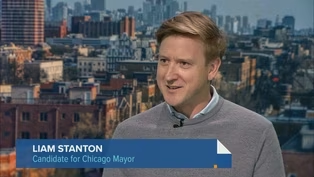
Entrepreneur Liam Stanton on His Campaign for Chicago Mayor
Video has Closed Captions
The Rogers Park native is one of seven candidates in the race so far. (7m 48s)
Providing Support for PBS.org
Learn Moreabout PBS online sponsorship New Episode
- News and Public Affairs

Top journalists deliver compelling original analysis of the hour's headlines.
 New Episode
- News and Public Affairs

Today's top journalists discuss Washington's current political events and public affairs.
 New Episode
 New Episode
 New Episode
 New Episode
 New Episode
 New Episode
 New Episode
 New Episode
 New Episode
Support for PBS provided by:
Chicago Tonight is a local public television program presented by WTTW
WTTW video streaming support provided by members and sponsors.