
Concrete dust concerns, GDYT summer jobs, St. Patrick’s Day
Season 8 Episode 37 | 26m 46sVideo has Closed Captions
Concrete dust concerns, Grow Detroit’s Young Talent and St. Patrick’s Day celebrations.
Detroit residents fight against heavy industry and concrete dust affecting air quality and living conditions in the Schoolcraft neighborhood. Grow Detroit’s Young Talent summer jobs program returns for its 10th year to recruit and employ thousands of Detroit teens and young adults. Plus, find ways to celebrate St. Patrick’s Day and more around Detroit on “One Detroit Weekend.”
Problems playing video? | Closed Captioning Feedback
Problems playing video? | Closed Captioning Feedback
One Detroit is a local public television program presented by Detroit PBS
Concrete dust concerns, GDYT summer jobs, St. Patrick’s Day
Season 8 Episode 37 | 26m 46sVideo has Closed Captions
Detroit residents fight against heavy industry and concrete dust affecting air quality and living conditions in the Schoolcraft neighborhood. Grow Detroit’s Young Talent summer jobs program returns for its 10th year to recruit and employ thousands of Detroit teens and young adults. Plus, find ways to celebrate St. Patrick’s Day and more around Detroit on “One Detroit Weekend.”
Problems playing video? | Closed Captioning Feedback
How to Watch One Detroit
One Detroit is available to stream on pbs.org and the free PBS App, available on iPhone, Apple TV, Android TV, Android smartphones, Amazon Fire TV, Amazon Fire Tablet, Roku, Samsung Smart TV, and Vizio.
Providing Support for PBS.org
Learn Moreabout PBS online sponsorship- [Narrator 1] Coming up on One Detroit, we'll examine the fight against heavy industry by residents in a West Side Detroit neighborhood affected by concrete dust.
Plus, a future of work report on the city of Detroit's efforts to recruit thousands of teens and young adults for its summer jobs program.
And we'll tell you about some of the activities taking place in metro Detroit over the St. Patrick's Day weekend.
It's all coming up next on One Detroit - [Narrator 2] From Delta faucets to Behr paint, Masco Corporation is proud to deliver products that enhance the way consumers all over the world experience and enjoy their living spaces.
Masco: Serving Michigan communities since 1929.
Support for this program is provided by the Cynthia & Edsel Ford Fund for Journalism at Detroit Public TV.
- [Narrator 3] The DTE Foundation is a proud sponsor of Detroit Public TV among the state's largest foundation's committed to Michigan focused giving.
We support organizations that are doing exceptional work in our state.
Visit www.DTEFoundation.com to learn more.
- [Narrator 2] Nissan Foundation, and Viewers Like You.
(soft music) - [Narrator 1] Just ahead on One Detroit, the city of Detroit wants to put thousands of young people to work this summer.
We'll have a future of work report on the Grow Detroit's Young Talent program.
And Dave Wagner and Cecilia Sharp of 90.9 WRCJ share some ideas on how you can spend this St. Patrick's Day weekend and beyond.
But first up, residents in a West Side Detroit neighborhood have raised concerns about the dust in the air that routinely covers a nearby overpass at I-96 in Greenfield Road.
They've also found the residue on their cars.
One Detroit senior producer, Bill Kubota teamed up with filmmaker and One Detroit contributor, Nicole McDonald, to investigate the source of the dust and the hazards of heavy industry operating in city neighborhoods.
(soft music) - [Nicole] This is a common site in a West Side neighborhood of Detroit.
A constant flow of trucks and dust around heavy industry.
A concrete crusher in a residential neighborhood.
I got interested in this more than a year ago when I learned about a proposed concrete crusher in the core city neighborhood of Detroit, not far from downtown.
- I'll say core, you say city.
All right?
Core.
- [Nicole] Here, neighbor's mobilized.
- Core.
- City.
- Core.
- [Nicole] They stopped the construction before it started.
(all clapping) I make films about Detroit and how our city is changing, and how that change affects residents, who is coming and who is leaving the city.
Lately, I found that a lot of Detroiters don't want to continue living next to heavy industry, expanding nearby.
And so, they're taking a stand.
This led me to the Schoolcraft neighborhood.
- So, we're very happy and proud of our community.
And the greatest asset is our residents.
- [Nicole] The Schoolcraft neighborhood is bordered to the North by Schoolcraft Road and Home of Detroit Roller Wheels, a popular spot for skaters.
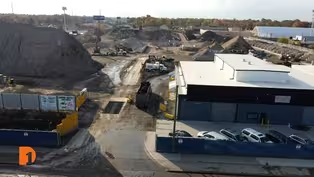
(music plays in background) On the south side is the I-96 freeway, and there's Dino-Mite Crushing and Recycling where mountains of material can be seen even from the other side of the freeway.
- The Schoolcraft neighborhood is 99% black residents, and residents that have been there for decades.
And in 2019, a company Green Valley slash Dino-Mite Concrete Crushing got a permit to crush hundreds of thousands of tons of concrete at this 12 acre site directly across from residents.
- I think our lack of knowledge in what is entailed in a concrete crushing operation is hard for us to say, okay, y'all need to stop this and do that.
We can just only tell 'em the problems we're having.
And hopefully, they can figure out some way to improve that.
- [Nicole] Many problems stem from the dust.
Like, a constant residue on Carol Couch's new car.
- You see all this?
In here?
This is the first time we ever had a problem in 45 years.
Just happened when this company got up there.
- I don't know if you can see that.
- It's in the air.
Can you prove it's coming from them?
But it's more dusk in the air now than it has been.
- That's not good.
- [Nicole] Concrete dust and dirt.
- Oh man- - [Nicole] Collecting on one of the main thoroughfares.
- I think it's the mud and the concrete mix.
And when it gets on there, you can't dry it.
It dries on its own.
And once it dries, you cannot remove it from the car.
- You know, there's a lot of pride in our community.
It doesn't make me feel good to tell somebody take 96 to Greenfield on your way to my house because I know that they're gonna pass this dust laden area.
It's an embarrassment.
- [Nicole] And what would you say is the truck traffic?
- I will say from, maybe, seven in the morning to at least five in the evening.
- Right.
Around seven to five heavy- - [Aaron] Seven and five, heavy.
- [George] It's just very heavy.
- And what happens?
So, trucks come in with materials.
Trucks go out with materials.
- And mud, and they're everywhere.
- It was very clear to me that they were in violation of the Fugitive Dust Ordinance.
- The Schoolcraft neighborhood, it's part of City Council member, James Tate's district.
- And so, we would see some days where there are wind storms that are happening and you would see, you know, it looks like the Wizard of Oz, you know, when Dorothy's house is going up in the air 'cause you see all this dust.
- That area is zoned for manufacturing.
- That one little spot there?
- Right.
The perimeter, the Greenfield Fullerton intersection is zoned for heavy manufacturing.
They're legally there.
- But then you've got people living really close by.
- But then we've got people living two blocks away.
- [Nicole] Residents say that trucks don't always stay on the designated routes.
Curtis Jackson says some come by his house despite the posted signs.
- Blunders about them coming out here, tearing up this pavement, and potholes gonna come.
Yeah, you tear up your vehicle.
And this out of pocket expense.
- [Nicole] Neither Dino-Mite's representative, nor the company's attorney have answered my request to talk about problems in the neighborhood.
- The first thing I noticed about it was where the dusting area.
- [Nicole] For retired police detective, Eugene Owens, Dino-Mite was a mystery that he had to investigate.
- And then I kept looking at the thing and I was wondering, I say, you know, what is it?
'Cause it's got a big mountain of dirt and you got bulldozers.
- [Nicole] So, when did you notice that?
- Oh, that was a couple of years ago.
So, I started looking into it.
We found out that they were actually crushing concrete.
So, I said something don't seem right about that.
So, we started inquiring how did this place get here?
- Did you or the community group receive notice that the Dino-Mite crusher would open here?
- I did not.
- No.
No.
- I did not.
- Originally, they had put in as a garden supply.
- They advertised landscaping supplies, you know, lawnmowers, snowblowers, rakes shovels, wheelbarrows, you know, you name it.
- So, you did get some forewarning about the landscape supply opening.
- I was well informed of that.
Yeah.
- And you did you contest that?
- No.
- No.
No one contested that.
Yeah.
Because I mean, that was a good proposal, you know, because it touted jobs, you know, for the community.
Sounds great.
- [Nicole] The city did grant a permit for both the landscape supply store and the concrete crusher.
But everyone we talked to in the community, they never knew about the crusher until it started operating.
According to a Detroit ordinance, facilities like Dino-Mite, they only need to notify residents within 300 feet of the business.
- Emissions and dust doesn't just stop at 300 feet.
Emissions from asphalt and concrete mixing plants can travel one to two miles.
- The Greenfield supply company, that was a negotiation with the community and that's how it came about.
So, that was secondary.
- But were they notified that there'd be concrete crushing, that there'd be piles of aggregate?
- So, in terms of what they were notified on in terms of what it would look like, I can't say today.
And I say this again, as a resident and as a district council member, what I can say is the notices went out on what the project was.
- Okay.
- But as we always know, looking at it on paper and what it actually turns into, sometimes, doesn't translate the same.
- [Nicole] In general, there are notifications of proposed developments in the neighborhoods.
But how many residents are actually informed?
And do they know how to find out about it?
- Yeah, public notice regarding these things is often scattershot.
People often don't know exactly what's happening.
And by the time they do, either decisions already been made or it's about to be made or it's just more or less too late.
- [Nicole] It's late September, 2023.
- Okay, let's keep it, let's keep it down, please.
- [Nicole] This is the Schoolcraft Improvement Association's monthly meeting.
- All that dust that's going on Greenfield, that has to stop.
- BridgeDetroit has found that this city has cited the company operating Dino-Mite with nearly 300 blight violations over the last few years.
Now, George Perdue has news from BCD, the City Buildings and Safety Department, which is taking the Dino-Mite company to court over some recent violations.
- The city took Dino-Mite to court with seven, seven violations.
Seven.
And guess what?
- [Nicole] The alleged violations include failing to maintain an effective fugitive dust plan, illegally expanding its operations, failing to provide a technical report and to secure the proper permits.
The court said, however, that the crushing operation was in substantial compliance with the conditions of the land use grant.
And so, revoking the land use grant is not reasonable under the circumstances.
- And I brought up the point of silica.
- [Nicole] At the meeting, Eugene Owens explains the hazards of concrete dust.
- And when you do concrete crushing, silica is spread into the air.
One of them, when you read online from the federal government about silica, one of the first things they tell you is that once it's in your lungs, it's there for life.
- The American Lung Association says that microscopic particles will lodge deep in the lungs.
And too much silica can be fatal.
An occupational health expert we spoke to said diseases like lung cancer and silicosis, they're not likely to appear in the short term.
It can take decades of heavy exposure.
The bigger concern is for those living nearby with asthma and emphysema.
They can have serious reactions from far less exposure.
And breathing in any dust is not recommended for anyone.
- Cement, concrete is 20 to 40% silica.
So, when you see a picture of dust in the air, is it silica which is more hazardous, or is it other types of dust?
So, that's the first question you want to ask.
- [Nicole] So, what's really in the dust?
Residents we talk to, don't know.
- There isn't testing that is required of what is in the dust that's coming from this concrete crushing operation.
But their permit does allow them a certain percentage of visible opacity.
So, they are permitted to cloud the air to some degree so we know that there is particulate matter in the air in that neighborhood.
- A lot of people don't know what's going on up there.
- [Nicole] At the meeting this night, is Pam Weinstein from Detroit's Grandmont Rosedale neighborhood.
- She's a fighter.
- [Nicole] Weinstein helps stop a hot mix asphalt plant from locating in Grandmont Rosedale in 2022.
- Now, the difference is the permit hadn't been granted.
Your issue is that the permit was granted, which is very typical.
That's what we found.
The initial presentation that they brought about this asphalt.
Oh, it's just like baking a cake, they said.
Not any cake I'd want to eat.
- [Nicole] Meanwhile, Dino-Mite says that it keeps trying to reduce the dust.
It runs a street cleaner in regular intervals, and it wants to pave the site, which the company says will reduce some of the dust.
- Good morning once again.
This is our 10:00 AM hearing.
- [Nicole] The company asked permission to do this from the city in a hearing last October.
Chris Jackson represents Dino-Mite touting the operation.
- The recycling facility employs over 30 full-time jobs and supports over 20 direct trucking jobs that my client employs.
And of course hundreds of other trucking jobs that are associated with the various companies that used the facility.
This site was previously an abandoned industrial site that Mr. Calo has turned into a very viable business.
- [Nicole] It's Anthony Calo's name that appears in the Dino-Mite business records that are filed with the state.
The Dino-Mite site had been a lumber yard going back to at least the 1930s.
The site was also a coal yard for a while.
- Can you please unmute yourself?
- Hi.
Good morning.
- [Nicole] Resident spoke at the hearing too.
- On the behind the dirt hill.
I didn't even know they were opening up such a place in my neighborhood.
My son, he has asthma.
He's on a breathing machine.
I had no idea that this facility would be open up here.
I would've totally been against that.
- [Nicole] In the Schoolcraft neighborhood, the city's denied the company's request to pave the site.
And the city is appealing the ruling on Dino-Mite's violations, which could possibly shut the crusher down.
The fight against heavy industry continues.
- The more that these cases are brought up and supported by decision makers, then I believe it could set a precedence and it could start a trend in a direction where human health is being considered by decision makers rather than sort of profit.
- What they're doing is great.
You know, they're recycling concrete.
Where would that concrete go if it wasn't being recycled?
So, we agree totally with that operation.
However, the location.
You know, it's always location.
Location, location, location.
This is not the location for a concrete crusher.
This isn't the location.
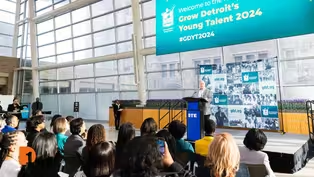
- [Narrator 1] Let's turn now to the annual Grow Detroit's Young Talent program.
Applications are being accepted until May 31st for summer job opportunities.
The employment and training program is open to Detroit residents ages 14 to 24.
Organizers hope to match 8,000 young people with employers in a variety of industries.
As part of our future of work series, American Black Journal host and One Detroit contributors, Steven Henderson, spoke with three people connected to the jobs program.
(soft music) - Dana Williams, I will start with you.
Talk about Grow Detroit's Young Talent.
Remind us what year we're in for this and what we have to look forward to this year.
- Sounds wonderful.
Thanks so much, Steven.
So, it is an honor to say that this is year 10.
- 10?
Oh my goodness.
(Steven laughs) - Incredible.
So, we have actually done quite a bit, of course, in that time.
We've grown from around 5,000 students a summer to now 8,000.
- Oh my goodness.
- And certainly, couldn't do that alone.
The Detroit at work system is so glad to have partners, like Shuna who's here with us, and a host of other nonprofit agencies and workforce development companies that work with us really closely to deliver these experiences to young people.
We're glad that this year, we're gonna be offering a range of experiences as we always do that really correspond to a young person's level of work experience.
Right?
So, someone who's 14 never been to work, certainly may have a different experience than someone who'd be 18, 19, or 20, may be at taking some college courses, and who may be on a real, what we call, a career pathway job.
Those will pay a minimum of $15 an hour.
So, real work, real money, right?
- Yeah.
- Well, this summer.
And they're gonna have a host of other customized experiences to get some professional development as well as they always do.
So, in addition to resume writing and interviewing, some financial coaching.
They'll open a bank account, right?
We gotta make sure young people are ready to receive the funds that we're gonna give them.
All these wonderful things.
So, really excited again about this 10th year.
- Yeah.
- Shuna Hayward, talk about how this fits in the, kind of, broader context of workforce and workforce development.
The kind of things that we are always really worried about here in the city and that we need to be working a lot better.
- Right.
Well, first and foremost, we want our young people to know that there are resources available to them and that there are a host of connections and opportunities in the city of Detroit so that we not only grow our talent but also retain our talent.
So, they need to understand that there are high growth, high demand sectors here that they can connect with.
They can experiment with opportunities that they may be interested in, but you know, don't know too much about.
So, this just gives them a chance to kind of branch out, test out some things, see what they like, see what they may not like.
But also importantly, provide those important connections to caring adults to like-minded peers and begin that task of building their skills and their network.
- Yeah.
Yeah.
So, Naeema Muhammad, I wanna bring you into the conversation here 'cause you're someone who had this experience.
Tell me about what you did, what you learned, and how you think of it today.
- Yes, absolutely.
So, I did the program for three years.
And throughout the different experiences I had, I've learned so much.
I actually am now a unmet aeronautical vehicle pilot, which means I can fly a remote drones, - Oh my goodness.
- for profit, commercially.
I had the experience of working for two summers with a Tuskegee Airmen because of Grow Detroit's Young Talent.
I also had the opportunity to go to the GM plant for the electric vehicles.
And I was honestly really excited about that because I just love EV and technology.
So, being able to see what all goes into building the, the vehicle as well as spoke to some people and they actually said that, well, actually you're not in where they design the vehicles, you're where they build them.
So, just being able to have those opportunities, to have those conversations.
And I also, through that experience, there were some people, because, you know, you get that experience and they're excited to have young people that are interested in technology.
And the vehicle designing and things of that nature.
They actually did mock interviews with me.
They said, okay, if you decided to come here, this is what you need to learn, this is what you need to do and let's actually sit down and ask those questions that you would get if you were in a real interview with us.
- Yeah.
Yeah.
- So, it was really exciting.
- So, let's go back to the first summer you did this.
And maybe that first day at work, did you know then that you would find a pathway to the thing that you're end up doing as an adult?
- Yes and no.
- Yeah.
- I went in as this is a summer job.
My mom told me to come.
So, let's- (Steven laughing) - So, I gotta be here.
Right?
- Yeah.
So, it's a- Let's just see what happens.
- Yeah.
- But actually, going through the summer, meeting different, a very diverse group of young people, even though we were about, you know, about 15 or 16 when I first did it, just hearing some of their backgrounds and what they were actually interested in.
There was another young man, he wanted to be a pilot.
I'm still in contact with him.
He's now in college for it.
So, he's going to pilot school.
And then, there are just, just the different avenues people took and hearing their stories of how they got to that point in their lives was interesting.
- Yeah.
Yeah.
So, Dana, that's gotta just absolutely warm your heart to hear.
What a story, right?
She starts at 15, and now, is doing something that's related to what you guys gave her an opportunity for.
- That's exactly right.
I'm thrilled to hear stories like what I sharing with us here today.
And that's what we wanna do, right?
As Shuna said, we wanna make sure that these young people are connected to the high growth, high demand jobs and the industries that are here, as we know, that are here in Detroit.
- Shuna, I wanna talk a little about the employer side of this as well.
Employers are getting quite the, sort of, lift I think and benefit out of Grow Detroit's Young Talent as well.
And the importance, I think, of having that connection between employers that exist in our city and the young people in our city is, it's immeasurable.
- Yeah.
And it's really critical.
And it is definitely a two-way street.
Even the young people benefit, but the employers benefit just as much from having the young people in those spaces.
They change the energy, they bring new ideas.
And they also help those employers see the potential that's coming down the pipeline in our young people and what they can bring to the table.
So, it's very exciting.
We just have tons of interest and support.
Detroit is such a great city, because especially, when it comes to our youth, people are ready to get on board to support our young people.
- [Narrator 1] And interested young people can apply for the Grow Detroit's Young Talent Program at www.gdyt.org.
It's a big weekend for the Irish and everyone else who celebrates St. Patrick's Day.
Plus, there's a lot of events in the metro area that will put you in the mood for spring.
Cecilia Sharp and Dave Wagner of 90.9 WRCJ have today's One Detroit weekend.
- Hey Cecilia, ready to chat about what's going on in Detroit this weekend?
- You bet I am.
This Sunday is St. Patrick's Day.
And there are many ways for everyone to enjoy the Irish festivities.
Let's start with Trinity Irish Dance.
Coming to the Music Hall Center for the performing arts on Friday.
The audience will be able to enjoy the tradition of Irish dance with some modern twist.
It should be a great time.
- [Dave] You can also head to Milford and enjoy St. Patrick's weekend at River's Edge brewery.
There will be Irish food specials along with live music Saturday and Sunday.
And then on Monday, the brewery is hosting dinner and a movie in partnership with the Milford Independent Cinema.
- [Cecilia] And if you want a little science with your brews, head to the Michigan Science Center on Saturday for a Brewsology Beer Fest.
The event includes many local craft brews and ciders and access to the museum where you can get hands-on with exhibits and witness science demonstrations.
- And next week, Cher is in town.
What Dave?
Cher is coming to Detroit's.
- No.
Not the real Cher, but the Cher Show will be at Fisher Theater, March 19th through the 24th.
The musical takes you through the superstars live from childhood to the present, including 35 of her amazing hit.
- If you are seeking a little springtime wonder, head over to the Meijer Tropical Conservatory in Grand Rapids where Butterflies Are Blooming takes place through April 30th.
- Have a great weekend.
(soft music) - [Narrator 1] That'll do it for this week's One Detroit.
Thanks for watching.
Head to the One Detroit website for all the stories we're working on.
Follow us on social media and sign up for our weekly newsletter.
- [Narrator 2] From Delta faucets to Behr paint, Masco Corporation is proud to deliver products that enhance the way consumers all over the world experience and enjoy their living spaces.
Masco: Serving Michigan communities since 1929.
Support for this program is provided by the Cynthia & Edsel Ford Fund for Journalism at Detroit Public TV.
- [Narrator 3] The DTE Foundation is a proud sponsor of Detroit Public TV among the state's largest foundations committed to Michigan focused giving.
We support organizations that are doing exceptional work in our state.
Visit www.DTEFoundation.com to learn more.
- [Narrator 2] Nissan Foundation, and Viewers Like You.
(soft music)
10th Annual Grow Detroit’s Young Talent summer jobs program
Video has Closed Captions
Clip: S8 Ep37 | 7m 26s | Grow Detroit’s Young Talent jobs program kicks off its 10th year of summer employment. (7m 26s)

One Detroit Weekend: March 15, 2024
Video has Closed Captions
Clip: S8 Ep37 | 1m 53s | St. Patrick’s Day celebrations, “The Cher Show” and more this weekend around Detroit. (1m 53s)
Schoolcraft residents raise concerns over concrete dust
Video has Closed Captions
Clip: S8 Ep37 | 13m 16s | Residents fight against concrete dust and heavy industry in the Schoolcraft neighborhood. (13m 16s)
Providing Support for PBS.org
Learn Moreabout PBS online sponsorship
- News and Public Affairs

Top journalists deliver compelling original analysis of the hour's headlines.

- News and Public Affairs

FRONTLINE is investigative journalism that questions, explains and changes our world.












Support for PBS provided by:
One Detroit is a local public television program presented by Detroit PBS