
Congressional Map Saga, Marie Newman, Abortion Act, and More
10/29/2021 | 26m 46sVideo has Closed Captions
Discussion on Congressional Map Saga, Marie Newman, Abortion Act, and More.
Host Hannah Meisel (NPR Illinois) and guests Kent Redfield (UIS) and John O'Connor (Associated Press) discuss the ongoing Congressional Map saga, how much influence Marie Newman has, repealing the Illinois' Parental Notice of Abortion Act, and the Health Care Right of Conscience Act being used for the right to not follow the mask mandate.
Problems playing video? | Closed Captioning Feedback
Problems playing video? | Closed Captioning Feedback
CapitolView is a local public television program presented by WSIU
CapitolView is a production of WSIU Public Broadcasting.
Congressional Map Saga, Marie Newman, Abortion Act, and More
10/29/2021 | 26m 46sVideo has Closed Captions
Host Hannah Meisel (NPR Illinois) and guests Kent Redfield (UIS) and John O'Connor (Associated Press) discuss the ongoing Congressional Map saga, how much influence Marie Newman has, repealing the Illinois' Parental Notice of Abortion Act, and the Health Care Right of Conscience Act being used for the right to not follow the mask mandate.
Problems playing video? | Closed Captioning Feedback
How to Watch CapitolView
CapitolView is available to stream on pbs.org and the free PBS App, available on iPhone, Apple TV, Android TV, Android smartphones, Amazon Fire TV, Amazon Fire Tablet, Roku, Samsung Smart TV, and Vizio.
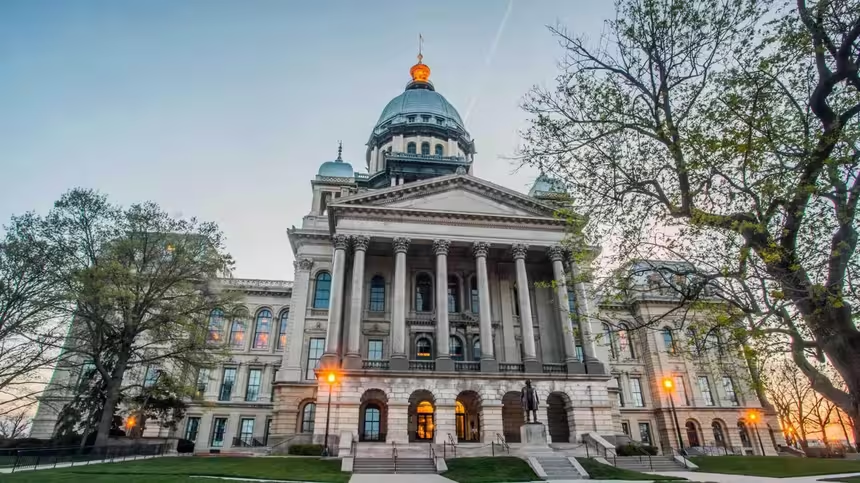
CapitolView
CapitolView is a weekly discussion of politics and government inside the Capitol, and around the state, with the Statehouse press corps. CapitolView is a production of WSIU Public Broadcasting.Providing Support for PBS.org
Learn Moreabout PBS online sponsorship(dramatic music) - Welcome to "Capitol View," where we discuss the latest in Illinois state government and politics.
I'm Hannah Meisel with NPR Illinois.
Joining us this week is Kent Redfield, professor emeritus of political science at the University of Illinois, Springfield.
Thanks for being here, Kent.
- Good to be here.
- And also here is John O'Connor, political writer with the Associated Press.
Glad you're here, John.
- Always a pleasure, Hannah.
- Well, another unpredictable week of veto session in Springfield.
Always interesting to kind of gauge where lawmakers are at, what their priorities, when we are in a kind of fall session.
I mean, especially after the summer that we've had with on and off session and negotiations over energy bill, but lawmakers had a lot on their plate this week, especially after getting almost nothing done in their first week of the veto session.
So, John, ostensibly, lawmaker's first priority was going to be passing a congressional map, but it looks like that effort is stalled.
It looks like inter-party fighting among Democrats has led to this outcome where we might not actually see a congressional map until January, which runs up very close to when would-be candidates are going to start filing petitions on January 13th, I believe it is.
So how did we get here?
- Well, I remember a couple of Januarys ago, at the start of, I believe, the last biennial session when Democrats had won super majorities once again in both the House and Senate and I was speaking to a group of school superintendents and I said, "The good news for Democrats is that they have super majorities in both chambers.
The bad news from Democrats is that they have super majorities in both chambers."
This is just a simple case of so much power consolidated among a political caucus in one state and a state that has such a huge diversity in terms of geography.
We've talked about the Northern part of the state being north of Boston and the Southern part of the state being south of Richmond and the cultural differences that go in with that.
So, you're going to have a lot of bashing of heads, inter-party bashing of heads, if you will.
- Oh, sure, I mean, this is, when you're not really fighting the other party because you have kind of made them a non-entity, there probably gets to be a point where you have made your own caucus so large, this is true in every sort of group.
It's like herding cats, but, it's very interesting to see the dynamic, how it was under former House Speaker, Mike Madigan, that the last group of legislators were elected and Democrats lost one in their super majority last November.
But, it's been really interesting to see the difference in management from former House Speaker Madigan and current House speaker, Chris Welch.
So, Kent, are you at all surprised that after being able to stay relatively together on legislative maps not once, but twice this year, despite a lot of court challenges, are you at all surprised that it was the congressional map that kind of held up the caucus?
- Well, when you're drawing legislative maps for House and Senate districts, you've got 59 Senate districts, 118 House districts.
You've got a lot of room to maneuver.
We're going from 18 congressional districts to 17 congressional districts in a state that's had some pretty dramatic population/demographic changes.
Now, not as great in the last decade as the decade before, but still significant and so this is a fight primarily in Northeastern Illinois.
The downstate portion of map seems to be pretty set.
That's just strict partisan politics in Northeastern, Illinois.
We're wrestling with, we've got 11 Democratic districts up there.
How do we reelect 11 Democrats?
But then we have questions of diversity, particularly Hispanic representation, where not only you have ambitious people, which we have conflicts between the White, Hispanic, and Black legislators and constituents, but you also have the threat of litigation.
One of the things, the few things, you can sue a map over is diminishing voting rights of racial minorities and so everybody's got leverage at this point and we went from one Hispanic district to one Hispanic and one strongly leaning Hispanic district.
Obviously some people want more.
And then this gets tied up in the numbers, right?
The Illinois Constitution, right now you need a three-fifths vote for an immediate effective date or it goes all the way to July, which means that would make the map irrelevant.
But, once we get into that magic window, after the 1st of January, before we get the new General Assembly, you can do things with 60 and 30.
So, the people that are trying to leverage the map have to decide where's my maximum leverage.
Can I get something done now or if I ask too much?
There's certainly 60 votes to pass that map.
So, it's probably going to be a very interesting day or maybe two days to see what's going to happen.
So, somebody's odd man out in this and it's not just in terms of getting rid of a Republican in the redistricting, but it's also, if you've got two Hispanic districts up in Northeastern Illinois, then you've got two incumbents somewhere that are going to have to probably run against each other.
And so, it's an interesting dilemma.
- Right, as you mentioned, yeah, you do have to make some decisions somewhere and it's in the three drafts that Democrats have unveiled in the last couple of weeks.
John, Congresswoman Marie Newman, she's a freshmen who, she ran twice.
She beat Dan Lipinski after losing to him narrowly in 2018.
She and her progressive creds, she has gotten kind of a lot of notoriety already in her not even a year in Washington.
But, under the first map that Democrats unveiled, her district was made a lot more rural and White by extending it all the way west to Starved Rock and, under the subsequent two drafts that the party has unveiled, she and Sean Casten, another fairly new Democrat who kind of beat the map in the 2018 Blue Wave and throwing out long-time Congressman Peter Roskam in that sixth district, those two would have to run against each other under these maps for the sake of adding that second Latino influence voting population district in the city's suburbs.
So, John, do you think that Marie Newman has much influence here?
Or do you think that it's just the luck of the draw and last one in first one out kind of a principle of a lot of workplaces?
- Well, as Kent and I were discussing off-air, yeah, it's kind of a, what's the term?
A wealth, an abundance of wealth among the Democrats.
I'm sure Illinois Democrats wish they could export Sean Casten and Marie Newman to Indiana or Missouri to help the House on Capitol Hill.
But, it comes down to, we were talking about the, we have Sean Casten and Marie Newman, you're our favorites.
It's just that we have four or five favorites ahead of you and I would think that, given her record, she would have some influence within the party, but it is kind of still, there still is a machine aspect to the Democratic Party.
There is still, we don't want nobody nobody sent kind of mentality that loyalty is gonna play a big hand and there may be people in the party who are still upset that Dan Lipinski lost.
He and his father before him were both party regulars.
So, there's a lot of that being figured in.
On the other hand, Marie Newman would not be the first to have a vastly different district than she was first elected in and many people before her have shown their mettle by surviving in a vastly different district than they initially, so it comes down to the rough and tumble of politics.
- And, Kent, before we move on from that, because we do have a lot to talk about aside from that, but creating this second Latino-influenced congressional district, this is something that folks in the mold of Congressman Jesus Chuy Garcia have agitated for for years and they have put in a lot of work ahead of the 2020 Census in getting their communities to answer the census to show, and, it's like we said on the show many times, it's not just the story in Illinois, but it's the story everywhere of growing Latino populations.
And so, if Latinos and progressives too, if you want to highlight that arrangement between the two, if they give up on this, I mean, I guess my question really is, do you see Chuy Garcia giving up on this?
I mean, it also brings to mind that, during the end of Madigan's tenure as House Speaker, he and Chuy Garcia, not that they were natural necessarily allies, but they got together.
They formed some sort of partnership and they got a lot of mutually beneficial things done.
Do you see this ending with that second Latino-age-population district?
- I think there's no question there's going to be that Latino-influenced district.
This is a judgment, long-term, building the party base over time.
The progressives, they can not participate.
They've really got nowhere to go.
Where the Latino/Hispanic broadly defined, where that growing group, and that's a very fast-growing demographic, where that sits within American politics is up for grabs.
And so, this is a judgment, at one level, that for the future of the party, we need to be diversifying.
We need to bring Hispanic voters into the party and if we have to make trade-offs between making some of the more progressive voters or a particular member of Congress unhappy, that's the trade-off we're willing to make.
So, it's about this election, but it's also about what happens over the decade and where that group of very fast growing voters are going in terms of their political identity.
So, but it does, yeah, the Democrats really don't want to make anybody unhappy, but someone's going to be unhappy, short-term and long-term, and so that looks like this is where they're putting their boats.
And so I would be surprised if we didn't have, I mean, the rumbling now is about, we want a full Latino district.
Well, the percentage of voting age population of Garcia's district, the percentage of Hispanics are much higher than the percentage of African-Americans in any of the other three districts that are currently represented or will be represented by African-American Congressman.
So, we'll see how much of this is real and how much of this is just trying to leverage the best deal you can get.
It would be foolish to have this breakdown and have it end up in the federal courts.
So, I think that we'll get something that looks like the current map and we may not get it before January and that's risky.
- Well, we have 10 minutes remaining.
I want to break down a couple of things that Democrats did push through this week.
John, for years, since 1995, at least, but really more than a decade for that, there has been this fight over what's called the Illinois Parental Notice of Abortion Act, which requires that minors or teens, their parents or guardians are notified before they get an abortion.
This has been on Illinois' books.
1983, there was an attempt, never enforced because years of court battles.
1995 law, again, never enforced until 2013.
But, pro-choice activists have been, this has been in their cross hairs ever since and especially in the last five years as progressive seek to kind of make Illinois a safe haven for those who would come to the states or in-state residents who want to terminate their pregnancy.
So, tell me a little bit about the dynamics at play when we're talking about, it's not an issue that falls neatly on where someone might expect the usual dividing line on abortion are.
So, how difficult was this for say a moderate Democrat to either vote no or take a walk on that bill?
- It's interesting when were talking about this a couple of weeks ago.
We wondered what was going to happen in the veto session other than the congressional map and this is an example of maybe too much time on their hands in terms of this wouldn't have come up now because it is so contentious and I was predicting that, no, the veto sessions too short a time to whip the votes to get this done.
But, it is an issue that progressive see as a matter of stopping abortions, keeping abortions, because when the abortion facility has to notify a parent or guardian, progressives say that delays the procedure and it will put another block in the step toward a minor's constitutional right to an abortion.
But, moderates see it as pretty innocuous.
It requires 48 hours notice, not consent, as they want to point out.
Parents don't need to consent, but Republicans say parents have a right to know.
They have to give consent for a school field trip, for a kid to get an aspirin in school.
Why can't they at least know that their minor child is undergoing an abortion?
The other side of that is that many children are in abusive relationships or abusive environments and it would cause them danger or harm to notify the parents that the law includes a judicial bypass.
If I don't feel comfortable having my parents notified, I can go to a judge.
Well, the judge intervention has only happened 500 times and only once has an abortion been denied by a pro-life judge.
So, it seems to be a situation where Democrats know their power in Illinois and they see their role as one of, it's not so much about parental notification.
It's about abortion, period, in America.
We have in Texas, a month ago, a law took effect, the heartbeat law, that virtually bans abortions.
We have a Mississippi law going to the Supreme Court that bans most abortions after 15 weeks.
The Texas law is six weeks.
So, the progresses in Illinois feel threatened.
They feel like this is their opportunity to say, "Illinois is still a safe haven for abortions.
Illinois is still very much in favor of abortion rights and women having the right to choose."
So, I think it's less about the issue itself and more about abortion.
Less about parental notification, more about the bigger issue of abortion in America.
- Sure, I mean, yes, this is a very nuanced law, very nuanced situation, but in the end, it seems as if progressives' political calculation is that eventually this will fit into the entire kind of arc that is about abortion access and not necessarily about the nuances of parental notification, once all the details have blown over.
But, Kent, the other interesting thing that we saw this week was this fight over another decades-old law that also has to do with abortion.
In the wake of Roe V. Wade in the late 1970s, lawmakers adopted things to react to legalizing abortion, including the Healthcare Right of Conscience Act.
All states have some sort of version of this, which shields medical or healthcare professionals who say "I'm a Catholic doctor and I have a religious objection to performing abortions.
I will not be forced in my practice to perform an abortion."
But, in the last couple of months, some creative lawyering has led to a brand new reading of that Healthcare Right of Conscience Act, saying that "I shouldn't, as a teacher or a nurse at a hospital," all kinds of employers, the legal bounds are still being tested, but it's had some success for those who don't want to comply with their employer's vaccine mandate for COVID and there's been some success and, definitely, the governor, J.
B. Pritzker's office and Attorney General Kwame Raoul are nervous about this.
And so, an amendment to that decades-old law has been in the works this week.
But, it's been really interesting to see the breakdown of, people are just not willing to go for this at this time, especially moderate Democrats, again.
- Yeah, and we put more than 60 votes on repealing parental notification.
In that case, it was all that was left.
I mean, the right to consciousness passed in '78, the parental notification in 1995 and, at that point, you had a whole laundry list of things that the reproductive rights groups wanted, the pro-choice groups wanted.
Well, now we're reacting to Texas.
"Oh, well, how can we signal we're even stronger in Illinois?"
There's nothing left to do except repeal parental notification.
In this case, with the right to conscience, you've got something that was designed narrowly for medical professionals, nurses, doctors, anesthesiologists, not to participate in things that they felt violated their religious conscience.
That now bleeds over into pandemic politics and we still get a 60 vote majority with a lot of regionalism in it that has to do with moderate Democrats.
But, it really reflects the cultural changes and the political changes in Illinois that the state in 1978 easily passed the religious freedom conscious.
In '95, we got parental notification under a Republican governor, a Republican legislature.
Now, under a Republican governor, Bruce Rauner, he signed a whole bunch of changes and now we come to today or last night and we've got a solid majority to assert that we are a very progressive, pro-choice state.
It's stunning in terms of the change that's taken place in Illinois politically and culturally over the last 40 years.
- Sure, and, as we sit here filming this Thursday morning, the House has passed that.
But, it's kind of a watered down version and Democrats seem that they want to come back and take another bite at the apple in January when it would have a more immediate, effective date.
But, we're going to have to leave it there.
I want to thank our guests Kent Redfield, John O'Connor.
I'm Hannah Meisel.
Thanks for joining us on "Capitol View" and we'll see you again next time.
(dramatic music)

- News and Public Affairs

Top journalists deliver compelling original analysis of the hour's headlines.

- News and Public Affairs

FRONTLINE is investigative journalism that questions, explains and changes our world.












Support for PBS provided by:
CapitolView is a local public television program presented by WSIU
CapitolView is a production of WSIU Public Broadcasting.