
Contempt citations, Gun Control, Primary Election
5/20/2022 | 26m 46sVideo has Closed Captions
Contempt citations, Gun Control, Primary Election
In this episode of CapitolView, guests Amanda Vinicky of WTTW/Chicago Tonight and Jeremy Gorner of The Chicago Tribune join Host Jennifer Fuller to talk about the week’s news. Contempt citations for the DCFS Director, a new law banning some guns in Illinois, and a look at how the upcoming primaries are shaping… all in this week’s CapitolView from WSIU.
Problems playing video? | Closed Captioning Feedback
Problems playing video? | Closed Captioning Feedback
CapitolView is a local public television program presented by WSIU
CapitolView is a production of WSIU Public Broadcasting.
Contempt citations, Gun Control, Primary Election
5/20/2022 | 26m 46sVideo has Closed Captions
In this episode of CapitolView, guests Amanda Vinicky of WTTW/Chicago Tonight and Jeremy Gorner of The Chicago Tribune join Host Jennifer Fuller to talk about the week’s news. Contempt citations for the DCFS Director, a new law banning some guns in Illinois, and a look at how the upcoming primaries are shaping… all in this week’s CapitolView from WSIU.
Problems playing video? | Closed Captioning Feedback
How to Watch CapitolView
CapitolView is available to stream on pbs.org and the free PBS App, available on iPhone, Apple TV, Android TV, Android smartphones, Amazon Fire TV, Amazon Fire Tablet, Roku, Samsung Smart TV, and Vizio.
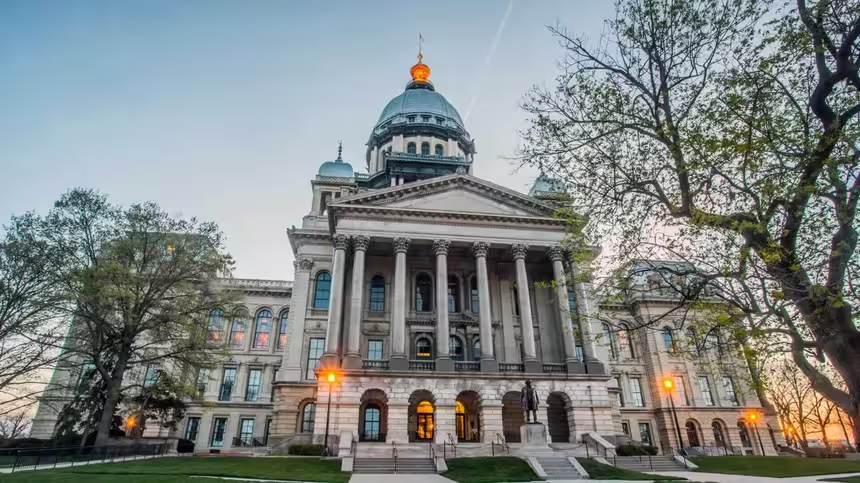
CapitolView
CapitolView is a weekly discussion of politics and government inside the Capitol, and around the state, with the Statehouse press corps. CapitolView is a production of WSIU Public Broadcasting.Providing Support for PBS.org
Learn Moreabout PBS online sponsorship(bright music) (camera lens beeping) (dramatic music) - Welcome to "Capitol View," a weekly look at the happenings inside and outside the Illinois State Capitol.
I'm Jennifer Fuller.
Our guests this week are Amanda Vinicky of WTTW and "Chicago Tonight" and Jeremy Gorner of the "Chicago Tribune."
Thanks to both of you for joining us this week.
- Happy to be here.
- Glad to be here.
- Let's start with what's arguably grabbing most of the headlines right now and that comes to DCFS.
Just how long are the headlines going to read, "Another Citation for Contempt," another child that's been left in unsustainable care.
Amanda, we're not hearing a lot from Governor Pritzker in terms of change at the top at DCFS.
What do you think should happen here?
What do you expect in the next several weeks?
- So, Jen, I don't know when those stories are going to stop and frankly, we haven't gotten a good answer out of the Department of Children and Family Services to that end, beyond we know money has been funneled to the agency, but to what end?
As you noted, the governor has been asked about this, because there are a lot of calls, granted, mostly from Republicans, but not exclusively so, for the director of the agency, Mark Smith, to be forced out, to be fired.
He has, thus far, the governor has thus far stuck by him and when asked about it most recently said, "There has been so much turnover at the agency "that really what DCFS needs is stability, and that is why he is sticking with Smith.
And frankly, we hear pretty often from Pritzker, and he's pointing, and most people I think would say, fairly at least some of the way or even most, but not wholly, he points the finger at his predecessor, Bruce Rauner.
But when you talk to people in the foster care space, that watch DCFS closely, they say, "Hey, wait a second.
"We agree that there has been too much instability "at the agency and what it could really need "is somebody who knows it inside and out."
Mark Smith, they say is not that guy, that he does not have a plan, and that is evidenced by the fact that you have these horrific stories, where you have these individuals, you have youth, who are in the state's care, and they are in psych hospitals past the point when doctors say they should be released, and instead, for months on end, they are staying there, and that is what is leading to these charges against Smith.
And that there is no real solid plan to come up with a way to prevent this, to handle those cases, to when a doctor signs off on release, make sure and shift that very clearly vulnerable youth into somewhere where they get the time, attention and care that they'll need going forward, particularly as they become an adult.
So it really is a continued mess, and I don't think, I can't answer when this is going to stop, because again, it does not seem that the DCFS has those answers.
- Jeremy, at what point does this become an issue that perhaps the Legislature gets in charge of?
Where's the accountability here?
- Well, the thing about it is that this has been an issue for the Legislature.
This has been an issue for governors going back to the Blagojevich era from, I think it was 2003 to the time that Pritzker was elected, DCFS went through 14 heads of the agency, so these are old problems, and there's also a lot of, if you look historically, it's taken years for an agency as big as DCFS to catch up and do what it's supposed to do according to audits and inspector generals and so on and so forth.
Like for example, during the Quinn years, he was focusing on unfunded liabilities and pensions from Blagojevich era.
He had to focus on that, and DCFS kind of took a backseat.
And then a couple years later you had the budget impasse, which they're still kind of under the Rauner years, which has also had a ripple effect through agencies throughout state government, including a big agency like DCFS.
Now, Pritzker has obviously stood behind Mark Smith.
I think it's amplified now, especially in an election year where any chance the Republicans get, they're gonna hammer Pritzker for keeping Mark Smith in.
And we're also hearing it a lot from the Cook County Public Guardian too.
I know that Charles Goldberg has said, "10 times being held in contempt is pretty unprecedented "for any head of DCFS," but it just seems that the problems with this agency have been years in the making.
but obviously, it's still on the governor.
It's still on the Legislature to do something about it, and there's just been very few answers.
The problems are the same.
They're just been exacerbated because like I said, this has been close to 20 years, this has been a problem.
I mean, they're still under a consent decree from the late 80s from the ACLU, and yeah, so as far as what can the legislature do?
What can the governor do?
I mean, it doesn't look like there's gonna be any end in sight with this, especially in an election year.
People are gonna use this to their advantage.
- Sure, you mention it being an election year.
Is this yet another albatross around the neck of J.B. Pritzker?
He's got this.
He has the LaSalle Veterans Home, COVID issues.
There are issues with the budget, no matter who the governor is, each time he or she would run for reelection.
Is this the thing that's going to potentially drag him down do you think?
- Probably, I mean, probably not.
I think it's really gonna, if you look at what voters are really interested in, I mean not to trivialize this, they are interested in this, especially those who've been caught up in the system, but you look at issues like the economy, you look at issues like crime, which polling numbers have shown that economy has kind of taken precedent over that.
Those are the, and inflation, those are the issues that voters tend to care about more.
The child welfare system in Illinois, I mean, you really haven't seen a lot.
I haven't seen polling data on that.
I don't know if Amanda has, but that's not exactly something, basically what the Republicans are trying to do, they're trying to use this DCFS issue in conglomeration with other issues they can go after Pritzker for.
Like you were saying, Jennifer, like with the LaSalle Veteran's Home and anything else that they can use.
Like this recent audit that came out, I think that anyone who's really studied the agency for a long time, from the auditor general last week said that the governor failed to ensure adequate care for children.
And also, the DCFS that is, and that DCFS didn't properly track cases for mandatory reporters, including teachers for children who are in the system.
I mean, these are old problems, but obviously, like I said, in terms of is this something that voters are really gonna, is it gonna resonate with voters?
I think that remains to be seen.
- Amanda, any thoughts there?
- I think Jeremy's right, in terms of just polling and the issues that people vote on.
They care about their pocket books, being able to raise their family, fill up their car with gas, get to their job, those sort of things.
That said, could this certainly be perhaps more general when there's more of a focus on Pritzker and whoever the GOP nominee is?
Could this be very ripe for a heartbreaking campaign commercial that targets people?
And is that fair?
Yeah.
This is the same sort of thing that Pritzker used against his predecessor.
He slammed Rauner for not solving problems at DCFS.
There you go, same with the LaSalle Veterans Home, so certainly, I think these are going to be issues.
They just aren't really that much so right now, because Pritzker doesn't have primary competition.
The actions on the GOP side, and as Jeremy noted, a lot of this is long continued.
This is a tough agency.
There are always, I think, very unfortunately, going to be some stories that come from individuals who are in care that are very difficult, very troubling, and it will not matter who the administration is.
That said, these issues of that they've been brought to the fore, when there is an acknowledgement that this continues to happen, when the courts are there, when there's many consent decree, when Illinois has had record numbers of record dollars to spend and is putting it all over the place in the budget, there is, I think, certainly questions that are fair to ask of the Pritzker Administration.
What are you doing to solve this mess?
I would say if it hasn't happened this year, when Illinois had money in the budget to really sort of play around with, what is going to happen in future years to the agency, when you don't have that sort of cushion in the state's piggy bank?
- Another question that Governor Pritzker has been getting a lot, and it comes particularly from the Republican side of the political aisle, is what are you going to do about crime?
And we saw this week that Governor Pritzker signed into law, a bill that bans so-called ghost guns, those guns that have no serial number.
They're very difficult to track in any way, shape or form.
You're talking about guns that can be built from kits, guns that can be printed with a 3D printer.
How in your mind does this change the game in any way, Amanda?
- Hopefully that it will help in some way shape or form, because the crime situation is of course, one that is frightening for people.
I mean, it is literally lives that are at stake.
Republicans, not solely Republicans, but many push back on this saying that where the Illinois law differs from actions taken at the federal level is that also individuals who already own these guns need to register them.
And so you have many of the gun rights advocates, and in fact, thinking back, there were legislators who say, "I build guns as a hobby.
I collect older guns."
They have to now be registered with the state, and that is something that they say is going to be costly, intensive, kind of a pain and not particularly helpful, punishing legal gun owners and not getting to the root of crimes.
The thought behind, however, would be those who have really been pushing for a while for this legislation is that it is going to help law enforcement to better be able to track guns or at least hold accountable people who use these ghost guns who scratch off serial numbers.
That's, by the way, another problem.
It's not just the ghost guns, the kits that you can buy and assemble that come without a serial number.
It's folks scratching out the serial numbers so that they can't be traced.
Hopefully, it will make a difference.
Is this going to be the end all solution to crime, particularly where I'm at in the city of Chicago?
I don't think you have anybody saying that that is the case, unfortunately.
- I know that one of the stories that I read said that there was an incident over the weekend where a ghost gun was found in relation to a case, a gun shot in Millennium Park.
Jeremy, do you see a lot of people saying, "Oh, well, at least they're trying to do something."
Does this move the needle in any way?
- Well, like Amanda was saying, there is a state statute against defacing serial numbers on firearms.
It's a very serious offense.
And what law enforcement tries to do is, there's gotta be some sort of tracking mechanism on these firearms if they are recovered at crime scenes, because who knows, they could be linked to other shootings, especially in a city like Chicago.
Now in terms of, let's look at the city of Chicago, for example, because obviously Chicago has the biggest problem in the state of Illinois with violence.
If you look at the number of guns that are recovered by Chicago police officers each year, they recover thousands of guns, probably around 10,000 off the city streets.
But if you look at how many ghost guns or non serialized weapons that are recovered by Chicago police, very minuscule.
For example, I had some data last year during probably the first five and a half months of 2021, Chicago police had recovered 5,300 firearms off the streets of Chicago, 245 of those guns were guns that did not have serial numbers, which will include ghost guns.
That's really not a lot.
However, that 245 tally was the highest in five years, so there is something to that from our leaders saying that this has become a problem.
We are seeing more and more of it, and I think in terms of the grand scheme of things, in terms of another tool for police in the community to tackle violence, this probably helps a little bit.
I'm sure that especially in neighborhoods beset by violence, any little bit helps.
I mean, I asked, (audio breaks) sponsor on this, and a few weeks ago I asked him, I said, you know, I brought up generally, (audio breaks) I didn't bring it up exact, but I said, "You know, ghost guns comprise very small percentage "of guns that are actually found by police.
"so what's the necessity for this?"
And basically what he says is, "It's not the ultimate piece of the puzzle, "but it's a piece of the puzzle."
He said, "There's people who might think "that this is low hanging fruit, "but basically we're just trying to do something "to affect," like in so many words, he said, "We're trying to do something to," quote, "effectuate some change."
So this really goes to legislators are trying to look for any loophole they can.
I mean, this is a national problem, not just a Chicago problem, Even if it's something that goes after something as ghost guns, even though, in the grand scheme of things, some people might say, "Well, why not real guns?"
Right?
I mean, I think that when you're trying to fight gun violence in a city like Chicago, every little bit helps, but in the grand scheme of things, like I said, ghost guns are only a small piece of the pie when it comes to what guns are responsible for the violence.
- DCFS, violence, guns, those are all campaign issues, and we've seen, at least in this part of the state, quite an increase in political advertising.
It all comes from so much more money pouring into these campaigns, but how much is too much?
Is there a point when everything is saturated and people no longer pay close attention to this?
We saw money come into Republican, Darren Bailey's campaign in the last week or so.
Is that going to be enough for him to be able to eclipse Richard Irvin, Aurora's mayor?
Jeremy, what do you think?
How are things looking?
- Well, I think, it seems to be that if Irvin, so the Republicans have been really hammering Democrats on crime, that's really all they've been doing, but as we were talking earlier, and I know Amanda mentioned it, if you look at polling numbers and polling, there's obviously debate on the reliability of that in the grand scheme of things.
The polling numbers showed that voters care more about the economy.
They care about inflation.
They care about their pocketbooks.
Crime isn't really an issue that is resonating, it appears, early on with voters as Republicans would like.
But if you look at Republicans from the Chicago area, it's resonating with them more than it is from Republicans down state.
So it really depends on the grand, but Ken Griffin is putting a lot of stock in Richard Irvin, $45 million, and he really hasn't spoken a lot about the economy.
He's really been kind of hammering away at crime.
I mean, that's his past life as a defense attorney and a prosecutor many years ago.
He hasn't really talked about, he's talked about it, but he hasn't really gone out there repeatedly with the issues that it seems are resonating more with voters in Illinois.
And plus, you gotta also look at what's voter turn out gonna be like in the primary?
Are voters paying attention to all the candidates as much as the candidates would like, or are they just reserving that for the general election?
- Amanda, what about your thoughts?
- So again, we've had very little polling.
The polling that we do have does show that it appears to be a two person race between Richard Irvin, Mayor of Aurora and Senator Darren Bailey.
Although it appears as if there must be more attention going toward Jesse Sullivan, who's this cryptocurrency guy from right outside of Springfield, because you're seeing attention, money spent on ads from the urban campaign on him.
Jen, you and me both, whenever I'm not watching, of course my dear old WTTW and public media that doesn't air any of these political ads, when I tune into another station, yes, that is all that I see, every once in a while, maybe a pitch for Tide in a car, but other than that, it is all campaign ads for governor, for secretary of state, where you have to the big competitive races right now in the primary and the GOP and the SOS on the Democratic side is really where the action is.
I have to say that, as a journalist, I, of course, don't take any sort of advocacy viewpoint, but I think that there are some very sincere questions to ask, there have been questions to ask when you had last term, two multimillionaire, slash billionaire candidates going head to head.
This time, yes, we talk a lot about Ken Griffin's money.
Of course, Pritzker is in his own right a billionaire who has spent money from his own pocket, both for his own campaign and, by the way, a lot of ads that are seeking to boost Bailey.
The clear implication is that the Pritzker camp, the Democratic Governor Association, which he gives money to, wants him in a general to face somebody like Bailey, a more conservative that moderates wouldn't have any chance going forward versus somebody like Irvin, who has, to the frustration of many reporters as Jeremy noted, not held a lot of public availabilities and is fairly tight lipped, a clear strategy by his campaign to tow the line, appeal as best as possible to Republican primary voters, and then be able to still have appeal to moderates that are dissatisfied with Pritzker come the general election.
That is clearly the playbook, but while most of those ads are pure mud slinging at this point in time, it is pretty brutal.
Another interesting note is that again, not a ton of attention right now, focused on Pritzker.
He's the incumbent governor.
He doesn't have to do as much earned media, but he is up with some pro ads of his own.
So we don't know what his campaign is polling at at this point that makes them want to go up this early, but it is clear that the Pritzker Campaign is looking to not just go that route of boosting Bailey, but also saying "Hi, remember me?"
"I'm J.B. Pritzker, I'm the sympathetic guy."
- What concerns should there be among Republican candidates and perhaps the Pritzker Campaign that in some of the recent polling, while you do see Richard Irvin polling higher than Senator Bailey and the others being, and also ran a number according to polling, 39% of people still saying, "I'm undecided," in the Republican Primary.
Is that something that any of the candidates are looking at and saying, "We need to change gears," or "We need to re-strategize?"
- If I were a candidate, I'd be looking at that and saying, "Eek, yikes, it's a whole lot of unknowns!"
And it shows, I think, in part, perhaps that you're not going to get an immense turnout or does it just show that people aren't really thrilled with any of their choices, all those negative ads, I think take a toll, not just on the current campaign, but you look at belief in government, state of democracies.
There's a lot that goes into it.
I mean, Illinois's track record of corruption, there's a lot that goes into that, but yes, that should certainly be a concern.
Do I think that any of these campaigns are going to change paths right now?
No, they clearly are dug in to their respective strategies.
And again, for the Irvin Campaign, that's by going heavy on air with ads promoting and introducing himself, and then really going against the other two.
Bailey, we're going to, I think, with that new infusion of money, we already have a new ad where he's got a flame torch that he's trying to really make a statement (laughs) with.
So you're going to see just more of these ads.
But I think, like I said, the candidates are really pretty sure in the strategies that they at least are going to hope win over voters.
- If I can take a more global view of a poll that just came out this week from NPR, "The PBS NewsHour" and Marist did, showed a pretty significant shift in what voters are paying attention to, particularly when it comes to the potential to overturn Roe versus Wade.
And the biggest takeaway I see from the election perspective is that a larger percentage of people are now saying that they'd be willing to pull a Democratic ballot or vote for a Democratic in November in order to keep Democratic control in the US House, in an attempt to circumvent whatever may come from the US Supreme court this summer.
Illinois is a blue state as a whole already, but Jeremy, is this telling in your mind that people are looking at Roe and saying, "We need to take action."
- It's definitely given Democrats a boost, I mean, just on the state level.
I spoke with one legislator last week who says the Democrats, at least on the state level, especially if they're from the Chicago area, are very worried about crime, with crime issues hurting them in the election, in primaries and the generals, but with with Roe and the draft opinion, that's really given Democrats a boost.
Now, like you said, Illinois's a blue state.
It obviously could have more implications in swing states.
I mean, look at Pennsylvania with the Senate race with Dr. Oz, et cetera.
It's really gonna be a true test to see how much of former President Trump's influence has had on some of these national elections, whether they're for Congress, whether they're for US Senate, to see how this plays in swing states.
It probably could really help the Democrats in some of these swing states.
Although we are still seeing that even in spite of that, Trump obviously has been out of office for more than a year.
I mean, there's still vestiges of his influence in some of these states, which, Republicans, depending on voter turnout, of course, that's still, it's really kind of half and half (laughs) to see that really is gonna be, have a lot of influence in the upcoming election.
But I mean, polling right, I think it's probably a little too early to determine how much this could help the Democrats with Roe, but it definitely is something that we'll have to see at the end of June if they actually make a decision, the Supreme Court that is, and if the draft opinion sticks, then that's when I think it's probably better to have this discussion again.
- Complicated issues and a lot going on for sure.
I want to thank both of our guests this week, Amanda Vinicky of "Chicago Tonight" and WTTW and Jeremy Gorner of the "Chicago Tribune."
We'll of course, keep track as we head closer and closer to the Illinois Primary on June 28th, and of course the general election in November and all of the issues affecting the state in between.
For now, I'm Jennifer Fuller.
Thanks for joining us on "Capitol View."
We'll see you next week.
(dramatic music)

- News and Public Affairs

Top journalists deliver compelling original analysis of the hour's headlines.

- News and Public Affairs

FRONTLINE is investigative journalism that questions, explains and changes our world.












Support for PBS provided by:
CapitolView is a local public television program presented by WSIU
CapitolView is a production of WSIU Public Broadcasting.