
Cook County Health Anticipates Rise in Uninsured Patients Due to Medicaid Cuts
Clip: 8/10/2026 | 9m 20sVideo has Closed Captions
In 2027, Cook County Health expects a $138 million drop in patient revenue.
In 2027, Cook County Health expects a $138 million drop in patient revenue. At the same time, charity care costs are expected to rise by $100 million.
Problems playing video? | Closed Captioning Feedback
Problems playing video? | Closed Captioning Feedback
Chicago Tonight is a local public television program presented by WTTW
WTTW video streaming support provided by members and sponsors.
Cook County Health Anticipates Rise in Uninsured Patients Due to Medicaid Cuts
Clip: 8/10/2026 | 9m 20sVideo has Closed Captions
In 2027, Cook County Health expects a $138 million drop in patient revenue. At the same time, charity care costs are expected to rise by $100 million.
Problems playing video? | Closed Captioning Feedback
Where to Watch Chicago Tonight
Chicago Tonight is available to stream on pbs.org and the PBS app.

WTTW News Explains
In this Emmy Award-winning series, WTTW News tackles your questions — big and small — about life in the Chicago area. Our video animations guide you through local government, city history, public utilities and everything in between.Providing Support for PBS.org
Learn Moreabout PBS online sponsorshipcommunity health centers and inside Cook County Jail.
Cook County Health aims to provide health care to patients regardless of their ability to pay.
But with Medicaid work requirements looming, the health system's budget is facing new challenges in 2027 Cook County Health is anticipating a 138 million dollar drop in patient revenue.
At the same time, charity care costs are expected to rise by 100 million dollars.
Joining us now is Dr.
Erik McKnight CEO of Cook County Health.
Welcome back.
Doctor, thanks for joining us.
Thank you for having me.
So what are some of the federal policy changes that are expected to impacts Cook County health?
So there's a few and there are some that already gone into play at the beginning of 2026, there was an enhanced enhanced tax subsidy.
>> For our Affordable Care Act, adults that was taken away.
So people saw anywhere from 25 to 30% increased out-of-pocket expenses and Illinois.
We've already seen over 90,000 people forego their coverage.
>> Because of that increase cost.
Now looking forward on October first, there's going to be a redefinition of who qualifies for Medicaid in the immigrant population, essentially victims of human trafficking domestic violence qualified asylum seekers will no longer be eligible.
In fact, they won't even be in trouble.
And then in January, as you mentioned, work requirements are going to go into effect on.
That's going to require the ACA will prove up that they are working, volunteering or in school 80 hours a month.
But there's also one more piece that's in a policy change.
And that is for that same population.
They're going to double the cadence of re determination.
That's the that's the process whereby people prove up that they're still eligible right now.
It's once a year that group is going start doing that twice a Boy, OK, so how many residents are we expect are expected to lose health care.
Illinois were anticipating 400,000 people will lose their coverage and that's outside of the 92.
That's already.
That's that's the upcoming changes in policy.
About 400,000 and half of them live right here in Cook County, the crime.
how is how is county care keeping patients up to date on these changes?
Because it sounds like with all of these rules.
>> It's a lot of people work for you to make sure that, you know, your patients in compliance or not.
It is yeah, on so county, her specifically our team does a lot of work to make sure that we have very frequently determination events.
So we offer one-on-one support for people to stay and that's open to all covered peoples are not just county care.
Everybody is welcome to come continue getting re enrolled.
So and so they do a lot of work there.
However, we did implement a broader effort called the Medicaid Impact Workgroup and that's across all the whole health system.
And from that group, we actually invited people inside and outside of healthcare.
So we've had business leaders, academic leaders, philanthropic and community organizations.
We have technology leadership all come together to have a more meaningful conversation about how we mitigate these impacts.
And one of the big outputs from that is a communication effort.
We've launched the website, get Medicaid facts dot com to really try to help people understand what all these changes are going to be.
So there's actually 2 areas of focus, one for the patients who might be impacted.
And there's an FAQ on the website.
There's a link out fest which is the state's Medicaid administrator where people can validate their insurance and make sure that it's up to date.
And then there's the schedule of our re determination events.
The other focus is for our community partners.
There is a free to download tool kit that helps with standardized messaging and we intentionally didn't brand it to any organization.
We're encouraging the organizations that use to use it to brand it to their organization.
We think that's going to add an extra layer of trust for the community members that receive it from the organization that's using the tool.
It's available in 14 languages.
And again, it's free to download.
Yeah.
All that said, right?
Like you can do as much work as you can to make sure that folks know about the re determination and all that.
But some folks are still going to lose their coverage.
>> The 2027 budget anticipates providing 485 million dollars in charity care.
How does that compare to current or previous budget?
Yeah.
So we it's 100 million dollar increase from this year and over the last few years, just for perspective at the height of the pandemic, when determination was paused, we were in the low 100 Million.
So we've gone from about 125 million out of close to 500 million in the last 5 or so years.
Okay.
A significant Take it.
That is that is a reflection of that need.
it >> Where's the health system looking to save money?
So we've actually been doing a lot of work after the election in 2024, we knew we probably have to prepare for some leaner times and we started work to reduce expenses to really improve our operations.
And I'm really proud of the team.
They've actually been able to remove 315 million dollars out of expenses during that time frame while at the same time improving our revenue cycle operations.
So that would for the cases where we can get paid, that making sure we're not leaving any revenue on the table and then improving operations.
So we make sure that we're maximizing access for patients.
Have you already started to notice an increase in in the the charity care that that you're giving and to the care that people need.
Absolutely not necessarily the care that people need yet.
But we have seen at the beginning of the year when the tax subsidies away, we went from 21% uninsured to almost 25% uninsured within a month.
So anticipating now with the future changes, the cuts that are coming that will probably grow next year to 30%.
And then we'll have to see after that.
It will probably continue to increase into 28.
What does it mean for patients were kind of choices?
Are they making before they end up in in your office is hear E D. That's exactly why I said we haven't seen the problems Unfortunately, we know when people don't have health insurance, they avoid preventative care on, you know, the ration medications not see their doctor.
So I kind of use the simple analogy of instead of managing high blood pressure and diabetes in a clinic will see them down the road in the emergency room with strokes and heart attacks, which is obviously much more burdensome to the patients.
It's much more costly to provide that care.
Not to mention the impact on families and the communities that they come from.
Right and the outcomes that can happen.
Winds when it gets that serious so Cook County Health operates Stroger and prominent hospitals.
How next year's budget affect those services.
>> So again, proud to say we have not had to do any service reductions or layoffs.
We've done a lot of the belt tightening.
And as you know, that fiscal discipline.
>> We do have right now 40 million dollars additional that we are asking the county to supplement so that we don't have to consider reductions in the coming year.
Okay.
And is that enough to feel like that 40 million dollars meet your needs unless there's a surprise?
I think it'll get us through 2027.
The question will be what happens in the out years.
Okay.
Okay.
What happens if it doesn't come through?
it what were toy says you have to make?
Well, we'll have to start making some difficult decisions around what services we want to reduce potential positions that we eliminate.
Other hospitals in the area.
They have shut their doors this year because of financial struggles.
How do you expect, though, those closures to the change in demand a county health?
I think that's the big unknown.
We've already seen 2 hospitals close in the last year or so.
And we know that several are struggling right now.
So the question then becomes what happens to the broader safety net?
As as you know, all of these federal cuts come come into play.
I anticipate we'll probably see more closures and in the coming years.
So what that means, I think for the broader community is.
People still need care, right?
So they're still going to have to go find your hospitals to receive that care.
So potentially has access images.
It's going to be longer waits for everybody.
>> Have rising costs of drugs, materials, you know, has that impacted your or your your bottom line, right?
And what you can provide?
>> Yeah, in terms of supplies and pharmacy, we've done a lot.
That's that's part of the reductions that we're working through as being, you know, better better stewards of those resources, no cost to continue to increase across the board.
What about hiring?
Will that be affected by the budget?
So we've what we did have to freeze some vacant positions.
But again, we didn't or lost their job with but we have done a lot of work in that regard as well in reducing our reliance on agency staffing, which comes at a premium costs more to do that.
So we've actually reduce those costs by about 50% over the last year and a half before any, you know, planned capital investments you know, equipment, that kind of stuff that you would like to do at hospitals that might have to be put on pause that we're kind of.
Are you making this decision we had?
We have had to pause a few things, kind of delay it out to see just how deep these cuts are going are going to you know, machines, those types of things, right, its correctional facilities.
How how will that be impacted?
As you know, the Cook County Jail in Cermak?
>> Yeah.
So it's so that's a piece that I think maybe is worth delving into a little bit We before the ACA, the health system got about 50% of its budget from the county.
It was a tax allocation.
>> After the ACA, we open county care and that allocation drop to 30.
And we've landed now to kind of 8 to 12% of our budget being supplemented by the county and that is essentially our unfunded mandate that the work that we do that doesn't generate revenue.
So the care at the jail is an example of that.
Similarly, we are responsible for operating the County Department of Public Health which sees the public health needs of the roughly 2.5 million suburban residents in Cook County, OK?
So.
>> That means got you still going hear for those patients right like definitely not
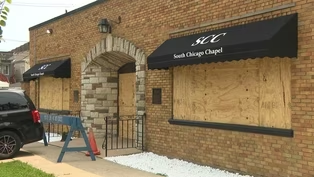
Dozens of Decomposing Bodies Found in Chicago Funeral Home
Video has Closed Captions
The Cook County Medical Examiner’s Office and Chicago Police Department are investigating. (2m 37s)

FDA Approves mRNA-Based Flu Vaccine for Older Adults
Video has Closed Captions
Flu vaccines must be updated annually to best match circulating strains of the virus. (6m 57s)
Providing Support for PBS.org
Learn Moreabout PBS online sponsorship New Episode
- News and Public Affairs

Top journalists deliver compelling original analysis of the hour's headlines.

- News and Public Affairs

FRONTLINE is investigative journalism that questions, explains and changes our world.
 New Episode
 New Episode
 New Episode
 New Episode
 New Episode
 New Episode
 New Episode
 New Episode

 New Episode
 New Episode
Support for PBS provided by:
Chicago Tonight is a local public television program presented by WTTW
WTTW video streaming support provided by members and sponsors.