
Cooking with Que, Wareologie, Deviate, Weekend events
Season 8 Episode 1 | 26m 46sVideo has Closed Captions
Detroit restaurant Cooking with Que, medical company Wareologie, and Deviate Fashion.
We’re sharing future of work stories about innovative entrepreneurs from across the culinary, healthcare and fashion industries and the progress they’re making in Michigan’s economic landscape. This episode features interviews with The Kitchen by Cooking with Que Founder Quiana Broden, Wareologie Founder Gina Adams and Deviate Fashion Co-Founders Cassidy and Kelsey Tucker.
Problems playing video? | Closed Captioning Feedback
Problems playing video? | Closed Captioning Feedback
One Detroit is a local public television program presented by Detroit PBS
Cooking with Que, Wareologie, Deviate, Weekend events
Season 8 Episode 1 | 26m 46sVideo has Closed Captions
We’re sharing future of work stories about innovative entrepreneurs from across the culinary, healthcare and fashion industries and the progress they’re making in Michigan’s economic landscape. This episode features interviews with The Kitchen by Cooking with Que Founder Quiana Broden, Wareologie Founder Gina Adams and Deviate Fashion Co-Founders Cassidy and Kelsey Tucker.
Problems playing video? | Closed Captioning Feedback
How to Watch One Detroit
One Detroit is available to stream on pbs.org and the free PBS App, available on iPhone, Apple TV, Android TV, Android smartphones, Amazon Fire TV, Amazon Fire Tablet, Roku, Samsung Smart TV, and Vizio.
Providing Support for PBS.org
Learn Moreabout PBS online sponsorship- [Will] Just ahead on One Detroit, we're bringing you some of our favorite Future of Work stories.
Coming up, a Detroit restaurant owner shares the secrets to her success.
Plus, a Michigan company makes major advances in the medical device field.
Also ahead, a Detroit-based fashion brand showcases its unique sustainable styles.
Plus, we'll look at some of the events coming up this weekend and beyond, and a performance by Detroit Band Dakho.
It's all coming up next on One Detroit.
- [Announcer 1] From Delta faucets to Behr paint, Masco Corporation is proud to deliver products that enhance the way consumers all over the world experience and enjoy their living spaces.
Masco, serving Michigan communities since 1929.
Support for this program is provided by the Cynthia & Edsel Ford Fund for Journalism at Detroit Public TV.
- [Announcer 2] The DTE Foundation is a proud sponsor of Detroit Public TV.
Among the state's largest foundations committed to Michigan-focused giving.
We support organizations that are doing exceptional work in our state.
Visit dtefoundation.com to learn more.
- [Announcer 3] Nissan Foundation and viewers like you.
(pensive music) - Just ahead on this special episode of One Detroit, we're focusing on innovative entrepreneurs from our Future of Work reports.
We'll meet the founder of a medical equipment company that's empowering people living with physical limitations.
Plus, the creatives behind a Detroit clothing brand talk about making the city a hub for fashion design.
Also ahead, Peter Whorf and Dave Wagner of 90.9 WRCJ fill us in on upcoming events in the Detroit area.
And we'll close with a rock and roll band, Dakho.
But first up, the owner of a Detroit restaurant talks about how she keeps her business alive and thriving.
I sat down with Quiana Broden, better known as Que at her restaurant, The Kitchen.
We talked about working through the COVID pandemic, how Detroit businesses support each other, and her passion for providing healthy food to neighborhoods across the country.
(bright music) One of the things that I hear a lot about working as a small business owner in Southeast Michigan in Detroit is that there is a community of partnership, and essentially an ability and a want for people in this business environment to help each other out.
Is that something that you've experienced when running your business, when getting started, when you come up against a obstacle that you need a solution for?
How has the business community in Southeast Michigan, in Detroit, been there?
- I will say that everybody I've come in contact with, like I don't know if I'm just blessed to meet the nicest people.
Like, people are very caring, they're very warm-welcoming, and they give you information.
So if I know I'm trying to do something different that I wouldn't normally do, I'm not good at, "No," either.
So when people say "No," to me, that just means I'm talking to the wrong person.
So I will go to people who will help me get the information that I need because I don't know everything.
But I also think vice versa.
The things that are working for me, I share it with the people that were in my circle.
And honestly, the people in Detroit, we're like open books to each other, because the thing about it is: What is the purpose of me having this information?
I die with the information.
It's just gonna die with me.
Why would I not wanna share that?
And so I'm very big on that, and I'm also very big on keeping the circle of people around me that we're sharing because we should all win.
There's enough for all of us to win.
In my mind, I don't look at other restaurateurs as competition.
I don't have competition.
I'm my own competition, not everybody else.
We should all be able to win.
And if I'm doing something that's working for me and it makes me successful, why would I not wanna tell you so you can be successful too?
- How has the development that's happening down here, how do you feel about it?
When it comes to the development, are you excited about it?
Are there concerns?
Is there any trepidation?
Where do you feel like you fit in?
- I'm always looking at the positive.
When I say I always look at the positive, there is no negative for me, because the negative is a waste of energy.
So for my brain, I'm always looking at my mission, my purpose.
If I know who my clients are, how do I market to those customers?
When I opened right here on Woodward, there was nobody else.
There was like a clothing store.
It was nothing.
This was a block that was not...
There was no gentrification, okay?
It was like, "Que, why would you wanna put this right here?"
Girl, 'cause my brain said, "Healthy food in every hood."
People should not get food based off of their ZIP code.
They should get food because it should be their human right.
So my focus is always: How do I make this food more available?
So in my mind, just as fast as you see, every time you see a McDonald's in my head, in the future, you're gonna see The Kitchen, because the goal is to put healthy food everywhere, because we have to be the people to change the perception of what it is.
So I'm very glad that they're bringing things back to the city.
I'm glad that they're allowing the people that are from the city to actually get these locations as well.
There are different associations that are always...
They're always pushing for you to support the people who are local, allow them to get into some of the places as far as like... You got the Metro-Detroit Black Business Association.
Like, they're always for the small business owner, and that's a cool backing to have.
But again, you make these allies with the people that are gonna help you keep growing and you keep building.
So for me, I like the community and the way it is now, but I also like that we are getting to see more.
But you can't make your whole business focused on if everybody else is on the block, it's, "How am I gonna bring clients to my location?"
- The biggest challenge that Southeast Michigan is facing, a big challenge that Detroit is facing, all metropolitan areas are facing, is: How do we get millennials and anyone who wants to start a business or anyone who wants to be a part of the workforce to come to Southeast Michigan, to come do it in places like Detroit?
- So my focus, again, it's always gonna be my mission and my purpose, but it's also like families.
What do people do as a family?
What do people do to get back to the table?
So my brain wants to do things to bring people here.
So for us, we do cooking classes that you can bring all age.
We have to get people out of their houses and we also have to stop pushing fear on people.
You gotta think about what people that are home looking at when they're on the news.
You can't come to Detroit 'cause of this.
Yes, we're changing the perspective of it, but it needs to...
I think people just need to see, like, it's a really family-oriented place.
There's things for you to do.
You can come out and eat at all the restaurants.
Or if you're a person that has that business idea, don't sit on it, but create programs that have them where they can come and sit with people who are business owners like me.
Like, "Hey, you got a business idea?
Let's sit and work with you on a business plan.
Let's get you from plan A to B to C." Like, what does that look like?
And it's not to say that there are not programs like that out there, but I think we need to talk about it more.
As much as we can talk about negative things, if we talked about those type of things, I think it would pique the interest of people that are not here, not here in Detroit.
Because you get people that from out...
I have people that would say, "I'm leaving New York to move to Detroit."
But what about the people that are here?
I'm always saying, "Look in your own backyard.
Look around the city of Detroit, all the places that people are...
When people were in the city and they moved to the suburbs, and now why do we want them to come back?"
Put the same thing, the same amenities that are in the suburbs in the city of Detroit.
I shouldn't have to go to the suburbs to find a healthy grocery store.
I'm super excited that they brought more... they're bringing more grocery stores to Detroit.
But Detroit is large.
We should all have the same accessibility to healthy food.
How do I make that, how do I make that become like...
The squeaky wheel gets the oil, like I tell people that come to my classes, like, "Close mouths don't get fed."
If you don't open your mouth and tell your neighborhood, "Hey, at every gas station in the corner, I want you to stop just giving us chips and cookies.
Give us healthy food."
Until we make the noise, it's not going to change.
- [Will] The next Future of Work report is about a Michigan company making waves in the healthcare and medical device industries.
Wareologie manufactures products that help people with physical disabilities recover their independence.
I spoke with the founder Gina Adams about the inspiration behind her products.
- Service the hospital.
(uplifting music) - After my Future of Work conversation with Dan Radomski, the founder of Michigan's only manufactured product incubator, Centrepolis Accelerator, I wanted to talk to a company they had worked with in healthcare because this is a sector that will need to grow its workforce and innovate to meet the needs of a large and aging Michigan population.
So Dan suggested I talk to Gina Adams, CEO of Wareologie, who's an innovator in the healthcare space who first found success with Buttons 2 Button Magnetic Adaptor Set, a NOSO solution for converting shirt buttons into magnetic closures.
- What was the initial inspiration behind Buttons 2 Button?
Where did this idea come from?
- Thank you for asking.
Yeah, my stepfather was struggling with Parkinson's and there's a ripple effect on caregivers such as my mom.
And so it's not only that physical impact, but the emotional toll it takes when you have somebody as... My stepfather was a PhD engineer, and so to lose any sense of independence, he was the rock of the family.
And so to take one activity that he could regain and do independently, that really impacts in a person's emotional wellbeing.
And so that's really the impetus behind it.
- With the successive Buttons 2 Button, Gina has introduced another product, portable parallel bars for physical therapy, a mobile therapy solution on wheels that delivers physical therapy treatment safely.
But getting it into the hands of the people who need it the most poses challenges that, if addressed, could give other Michigan healthcare product companies an edge in the global healthcare market.
Do you think that there's something that could be done there to make the on-ramp to getting a product manufactured for a small company easier?
- We're in what they call The Valley, right?
You have the idea, you have to put a lot of money into that to get it through the development phase, the prototype phase.
And then when you move into commercialization, everything takes on a whole new, I would say cost.
- [Will] Right, yep.
- So what the state could provide for us, I believe, is a little more access to that runway of: How do you get your product commercialized and into the market?
You can't do it alone.
The windows are pretty tight because of the networks.
I've been to the doctor over eight times, getting all of my vaccines like hepatitis, and typhoid, and all of these things so that I could actually walk into a hospital and service the hospital as a vendor.
So there's a lot of these hoops that I feel while they are there and the protocols are important because you need safety in place.
But for medical devices, we're really trying to revolutionize people's health.
It would be great if there was an incubator that kind of supported that space.
- Something to help navigate the process overall.
- Yeah, yeah.
I mean, I was at a conference, and we're there with large global medical wholesale suppliers.
And getting a foot in the door is not always easy.
- As you're going through this journey, as you're developing these products, as you're building this company, you've stayed here in Michigan?
- Well, we're based here in Southeast Michigan and have incredible access to world-class manufacturing, and there's no better place to develop a product, in my opinion.
The opportunity to create jobs here in our home state is really important to us.
And because we are committed to helping people with disabilities, we were excited to also partner with not only our manufacturers, but down to the people that kit our products.
So the first product Buttons 2 Button actually kitted by people with disabilities as a form of job creation.
It's great to have the opportunity to collaborate directly with your manufacturers so that we are building together.
There's a lot of lessons learned along the way, and to take a product from a prototype that's 3D-printed into a commercialized product is a huge leap.
And so working here with incredible manufacturers has really helped expedite the process versus, "I can't imagine the cost of going overseas."
Whether they're in a bed or they're in a wheelchair and standing up, now you have something that is structurally- - In the next five years, what do you hope for the future of work at your company?
- The next five years are going to be so exciting because we know that we have sales verticals within the VA, we have hospitals that have given us the thumbs up, they have use for it.
It's a matter of going through those protocols.
So if we can help people get standing sooner and safer, we're gonna be in a great spot.
- When most people think about things made in Detroit, the automobile industry and Motown records come to mind.
But what about fashion?
Can the city become an international hub for fashion design?
I spoke with the co-founders of the clothing brand Deviate about their decision to base their successful high-end fashion business in the city.
(uplifting music) (upbeat music) The word was fashion.
You said it has a bad connotation.
Why is that, what frustrates you about it, and what is being missed when people have that perspective on it?
- Yeah, I think in some settings, it has a negative connotation where there isn't a level of seriousness that comes with industry.
It's a giant industry.
And design, there's so many different avenues.
There's manufacturing, product design, retail, there's the creative direction that goes into it.
I mean, there's just so many opportunities.
It's a giant industry.
And I think when people think of fashion, they think of the sensationalized portions that maybe don't necessarily screen business.
But fashion is a giant business, and I think it would really benefit the city to take it seriously in terms of being the future of it, of the city, where an industry can really develop and flourish, and where we can push boundaries in the national, global industry.
Detroit can be a major player.
It should be a major player.
We have the infrastructure here for manufacturing, we have a skilled workforce, we have super creative talent.
We need to bring it all together and really take it seriously as a fashion industry hub.
- How is business going?
Are you doing well?
Is there anything that you guys currently need that could help you expand?
Is it a tough environment because you're here in Michigan?
What is this outlook?
What kind of things are you navigating?
- The fashion industry specifically is an antiquated industry.
There's a lot of notorious characteristics in terms of exclusivity and not really being an industry that the majority of the population can participate in.
Whether it's unaffordable prices, or gatekeepers, or whatever it may be, it's an industry that is not easy to participate in.
And so I think being based in Detroit, Michigan is our greatest strength and our greatest weakness at the same time.
So I think it's interesting that we're able to participate in it from a city that a lot of people don't, in the external industry, don't necessarily see Detroit as a fashion city.
Even though we know it here, it's been here, we're a creative community, we're a hyper-creative city, but that perspective isn't necessarily shared outside of Michigan.
And so when we're able to say we're a Detroit-based brand, that gets people's attention and they wonder, "How are you operating there?
How is it different than the rest of the industry?
And that helps us a lot, I think, because it's an immediate icebreaker.
It actually gets us a lot of conversations with cold DM people on Instagram, and they're interested because we're different in that way, 'cause we deviate in that way.
But I think it's also really difficult, too.
It, for sure comes with these challenges.
We're obviously removed from a lot of the larger industry hub like New York or LA.
(gentle upbeat music) - What about New York, Los Angeles, makes these places able to be a fashion hub that we don't have here?
- I think that just the way that the mindset is of like, You leave Detroit and you go to New York to build your business.
Like, that's kind of what people think already is like, "Oh, I can get educated here," or, "I'll go to school in New York, but I'm gonna stay there after and build my network there, and then one day come back and have a family here.
But if we had the resources and all these things that we've been talking about in this conversation, and there are so many people, creatives who are entrepreneurs, like, they're grinding and living off of not enough money to live their dream.
But it's, like, without those resources and stuff here, like we can all keep working towards these things but it's like without the glue to like connect everyone, the resources, the pipeline, then it's like people are gonna leave, and they're gonna go think that they need to do that in New York and then come back here eventually.
Whereas if we had that infrastructure, they could do it here and stay here.
- Do you see your cohort coming here?
What would get them on board?
- Yeah, we actually say this to everyone we meet in New York, we're always like, "You gotta come visit us!
Come to Detroit, come to Michigan."
And actually, a lot of people are interested by it or they'll say, "Oh, I've been there.
I haven't been there in a while.
I heard that there's a lot going on."
And that's kind of...
But we actually are bringing people here and showing them around,, and I think that's another big thing that we should probably invest more time and effort in.
Really, if the fashion industry is something we wanna take seriously, I think we should.
But if that is decided, I think we seriously need to think about the gatekeepers or those in the larger industry that can help the city get to the next level, and plug in, and bring them here, and show them all these things that are going on.
Show them the industry club, fashion design industry club working with youth helping them get internships at Carhartt and product design collaborations with Fortune 500 brands.
And let's show them the brands that are here making it and showcasing their work in New York Fashion Week.
Let's show them the schools that are here, the workforce that's here, all the infrastructure that's here, and just ultimately the opportunity.
Fashion's looking to be more inclusive, fashion's looking to grow and be pushed in new boundaries just given the climate and everything that's happened over the last couple years.
So let's be that solution, let's do it.
But we need to take us seriously, make a deliberate decision to do so and then bring those people here, show off what we're doing in a really meaningful way.
- [Will] Summer is in full swing, and the list of things to do in metro Detroit is growing.
Dave Wagner and Peter Whorf of 90.9 WRCJ offer some options in today's One Detroit Weekend.
- Hey Peter, great to be with you tonight to talk about all of the great things that are going on this weekend here in the Metro Detroit area.
- Yeah, Dave, there's so many options to check out.
Let's start with the Uncle Sam Jam in Woodhaven Civic Center Park through the 9th.
There's a ton of activities for the whole family, including free live music each night and Fireworks Friday.
- Can't get much better than festivals in Michigan in the summer, and something else happening multiple times this season is Opera in the Parks.
On July 7th, you can head to Gordon Park where you can participate in a yoga class at 5:00 PM followed by art and a meditation session.
Then, the Detroit Opera will perform at 7:00 PM, and this is really cool.
Massages will be offered all throughout the evening.
- [Peter] That sounds like a wonderful night of wellness.
On July 7th and 8th, Baker's Keyboard Lounge has the Ralphe Armstrong Trio performing.
Baker's is a place every Detroiter needs to take in at least once.
- [Dave] Absolutely.
Baker's really is a magical place.
I love going there for some food and, of course, always great music.
Now, something a little different for the family are the Historic Baseball games.
They take place in Walnut Grove at Greenfield Village.
You can see games most Saturdays this summer.
So go head out there and see the game as it was played in the 19th century.
- [Peter] Dave, that sounds like a lot of fun.
Just as you mentioned earlier about more festivals happening in the summer, the Oakland County Fair takes place July 7th through the 16th in Davisburg.
It's one of the oldest fairs in the nation.
People can check out the Big Rock Carnival Canines in Flight and there's various competitions for kids and their pets.
- There you have it.
It's another great weekend in Michigan.
So we hope all of you get out there and enjoy what our state has to offer.
- And here are some more things happening this weekend.
(gentle upbeat music) - [Will] That will do it for this week's One Detroit.
Thanks for watching.
We'll leave you now with the band known as Dakho, performing right here on Detroit Performs live from Marygrove.
("Right Here") ♪ I wanna get away from he who pulls the strings ♪ ♪ In almost every way ♪ ♪ Well, I just want to sing ♪ ♪ Maybe I don't know which streets to walk around ♪ ♪ 'Cause maybe we have been searching for the ground ♪ ♪ In my pain ♪ ♪ In my pain ♪ ♪ Starting and stopping ♪ ♪ The world keeps on walking the light ♪ ♪ Don't you lay down inside ♪ ♪ Ooh ♪ ♪ Don't you ever say goodbye ♪ ♪ You're the sunshine ♪ ♪ Right here, right now ♪ ♪ Break free from all your chains ♪ ♪ Right here, right now ♪ - [Announcer 1] From Delta faucets to Behr paint, Masco Corporation is proud to deliver products that enhance the way consumers all over the world experience and enjoy their living spaces.
Masco, serving Michigan communities since 1929.
Support for this program is provided by the Cynthia & Edsel Ford Fund for Journalism at Detroit Public TV.
- [Announcer 2] The DTE Foundation is a proud sponsor of Detroit Public TV.
Among the state's largest foundations committed to Michigan-focused giving.
We support organizations that are doing exceptional work in our state.
Visit dtefoundation.com to learn more.
- [Announcer 3] Nissan Foundation and viewers like you.
(pensive music) (gentle music)
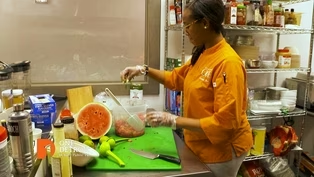
Cooking with Que brings plant-based dining to Detroit
Video has Closed Captions
Clip: S8 Ep1 | 6m 16s | Cooking with Que founder Quiana Broden revolutionizes plant-based dining in Detroit. (6m 16s)
One Detroit Weekend: July 7, 2023
Video has Closed Captions
Clip: S8 Ep1 | 5m 19s | Check out what you can do around Detroit this weekend on “One Detroit Weekend.” (5m 19s)
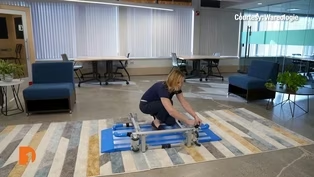
Wareologie makes major waves in mobile, at-home caregiving
Video has Closed Captions
Clip: S8 Ep1 | 5m 30s | Medical device company Wareologie makes major advancements in mobile, at-home caregiving. (5m 30s)
Providing Support for PBS.org
Learn Moreabout PBS online sponsorship
- News and Public Affairs

Top journalists deliver compelling original analysis of the hour's headlines.

- News and Public Affairs

FRONTLINE is investigative journalism that questions, explains and changes our world.












Support for PBS provided by:
One Detroit is a local public television program presented by Detroit PBS