
Many Americans making tradeoffs to afford health care
Clip: 4/17/2026 | 9m 57sVideo has Closed Captions
One in three Americans forced to make financial sacrifices for health coverage
At a moment when there's a lot of political attention around questions of affordability, rising health care costs are a growing concern for many Americans. That's especially true for those who are worried about being able to afford insurance premiums after an expansion of subsidies for the Affordable Care Act expired. But they're not the only ones struggling with this. Stephanie Sy reports.
Problems playing video? | Closed Captioning Feedback
Problems playing video? | Closed Captioning Feedback
Major corporate funding for the PBS News Hour is provided by BDO, BNSF, Consumer Cellular, American Cruise Lines, and Raymond James. Funding for the PBS NewsHour Weekend is provided by...
Many Americans making tradeoffs to afford health care
Clip: 4/17/2026 | 9m 57sVideo has Closed Captions
At a moment when there's a lot of political attention around questions of affordability, rising health care costs are a growing concern for many Americans. That's especially true for those who are worried about being able to afford insurance premiums after an expansion of subsidies for the Affordable Care Act expired. But they're not the only ones struggling with this. Stephanie Sy reports.
Problems playing video? | Closed Captioning Feedback
Where to Watch PBS News Hour
PBS News Hour is available to stream on pbs.org and the PBS app.
Providing Support for PBS.org
Learn Moreabout PBS online sponsorshipAMNA NAWAZ: At a moment when there's a lot of political attention around affordability, rising health care costs are a growing concern for many Americans.
That's especially true for anyone worried about affording insurance premiums after an expansion of subsidies for the Affordable Care Act expired.
But they're not the only ones struggling with this.
Stephanie Sy tells us more.
STEPHANIE SY: A recent report from the West Health-Gallup Center revealed that one-third of Americans are making tough trade-offs to afford health care, skipping meals, driving less, and borrowing more.
The survey involved 20,000 adults.
Many of those facing financial burdens don't have insurance, and with the end of expanded subsidies for the Affordable Care Act for a lot of people last year, that number is growing.
We spoke to some Americans who have had Obamacare about what they're dealing with now as they face higher premiums and less assistance.
BRIAN LANTIER, New York Resident: I'm Brian Lantier, and I live in New York City.
MICHELINE PIERRETTE BERRY, California Resident: My name is Micheline Pierrette Berry.
I live in Santa Monica, California.
BRIAN LANTIER: I believe my premium expired or my plan expired in December, December 15 or something like that.
But that was the date by which I had to renew, and I didn't renew for 2026.
MICHELINE PIERRETTE BERRY: My previous plan was a Silver.
And we're talking $236 a month.
And the same plan this year is $360 for one person.
BRIAN LANTIER: It went from $390, which is what I was saying after the tax credit per month to I think it was $770 was the number a month I was quoted.
So, obviously, I'd sleep better at night if I had insurance.
But I understand that I'm lucky too.
I'm a 54-year-old man.
I don't smoke.
I have a normal BMI.
I have no existing chronic health issues.
So I can make this decision, and I recognize that most people are not in that position.
MICHELINE PIERRETTE BERRY: I'm a cancer survivor.
So the ACA allowed me to have the best care when I was diagnosed and the best follow up-care.
BRIAN LANTIER: I don't really have to participate in it because I'm relatively healthy and I don't have any chronic health issues.
I take no prescriptions.
But I also watched my mother go through the end of her life and have five hospital visits that were over three months of the end of her life in an incredibly expensive health care system.
MICHELINE PIERRETTE BERRY: The health care unfortunately that is available for people if they do not have insurance is not -- it is substandard.
So, yes, whether I had to borrow the money, I would remain on my plan, because my life depends on it.
BRIAN LANTIER: If something were to happen, that would be my plan is to go out and pay out a pocket.
I'm basically self-insuring right now, is the plan.
MICHELINE PIERRETTE BERRY: It is my hope that, with enough pressure and legislation, the subsidizing of health care can be something less of a political issue and more of just a basic human care that is tended to by our administration current and subsequent administrations.
STEPHANIE SY: A number of polls show it's not just people who use publicly subsidized health care who are struggling with rising health care costs, but also people on employer-subsidized health plans.
And this all comes at a moment when the president and a Republican-led Congress have implemented a number of cuts to programs.
The president has had some success with trying to reduce the cost of prescription drugs, but it's far more limited than advertised.
To help us understand what all this means, I'm joined by Larry Levitt, executive vice president for health policy at KFF.
Larry, thank you for being with us.
It's now been several months since it was projected that at least two million Americans would lose those expanded ACA subsidies.
And the Wall Street Journal reported that, in January, 14 percent of ACA enrollees did not make their payment.
What do we know about those people and how this is actually impacting patient health?
LARRY LEVITT, Executive Vice President For Health Policy, KFF: Yes, I mean, we're forcing people into very tough choices, as those two folks you interviewed made clear.
Once these expanded premium subsidies expired at the end of the year, about a million fewer people signed up for coverage.
But then, as you said, The Wall Street Journal is reporting this new study that shows that, even the people who signed up, once they got those bills in the mail and had to pay their premiums in January, many of them didn't.
And we found similar things in our own polls, where people say their costs have gone way up.
These are these ACA, or Obamacare, enrollees, and they are being forced to cut back on other household spending, or in many cases go without insurance entirely.
STEPHANIE SY: Right now, the Republican-controlled Congress isn't doing anything to restore those subsidies.
What does that mean going forward for those people?
LARRY LEVITT: Yes, I mean, I think we're looking at certainly a year of people continuing to face these very, very high out-of-pocket premiums with the subsidies expired.
I mean, in theory, Congress could come back and extend them and make the expanded subsidies retroactive to the beginning of the year.
But, yes, as we're seeing, Congress is having trouble doing much of anything, and there are still big disagreements between Democrats and Republicans over whether to extend these subsidies.
STEPHANIE SY: How does that intersect with the ACA extended subsidies -- or expanded subsidies ending?
LARRY LEVITT: Yes, I mean, these are all kind of mostly low- and middle-income people who are getting these ACA subsidies or relying on Medicaid for their health coverage.
And in the so-called One Big Beautiful Bill that Republicans passed last year, they cut Medicaid by almost a trillion dollars over a decade.
And that's the biggest rollback in federal support for health care ever.
These cuts are mostly back-loaded.
Many of them won't take effect for years.
But, starting January 1, new work requirements for Medicaid enrollees will take effect.
And the expectation is millions of people will end up without insurance as a result of that.
They're either going to have their Medicaid dropped because they're not working or don't qualify for an exemption, or in many cases just fall through the cracks, not being able to navigate the bureaucratic red tape to prove that they are working.
STEPHANIE SY: You have rising costs across the insurance coverage ladder, whether you're on Medicaid, whether you have an ACA plan, or whether you get it through your employer.
I know you mentioned that you all at KFF have done some research on that.
Is this a critical tipping point in which we're going to see millions of Americans become uninsured and just not have access?
LARRY LEVITT: You know, it's hard to say when we're at a tipping point.
I mean, you could go back to President Obama talking about health care costs being unsustainable, President Clinton saying the same thing, even going back to President Nixon in the 1970s saying health care was unsustainable.
And, at that point, it was half the share of the economy that it is now.
But it does feel like these health care affordability concerns and affordability concerns generally really are troubling people.
I mean, we ask people, of your economic worries, what are you most worried about, and health care was at the top of the list.
As you said, while the political debate is focused on Medicaid and Obamacare, there are 160 million people who get insurance through their employer.
And their costs are going up too.
I mean, they're having more money taken out of their paycheck every month for their health insurance premiums.
Deductibles now are almost $1,900 per person on average for people with employer-based insurance.
STEPHANIE SY: And it's not just drug prices, Larry.
It's the cost of hospital care.
And you have people and politicians blaming insurers, but also drug companies and hospital systems blaming each other.
How do we even begin to start to get to a solution here?
LARRY LEVITT: Yes, I mean, there is plenty of blame to go around.
Drug prices are high.
The drug prices in the U.S.
are much higher than in other countries.
But drugs are a pretty small share of health spending.
If you look at what's driving the increase in health spending recently, it's mainly hospital care and, in particular, hospital prices; 40 percent of the increase in health care costs in recent years has been due to hospital spending.
But insurers are not immune from blame either.
Insurers take 15 to 20 cents out of every premium dollar for overhead and profits.
And I think there's going to be greater scrutiny of that.
I mean, what we do know is, we spend much more on health care than the rest of the world.
We spend almost double what other high-income countries spend on health care.
And we get less for it.
We have lower life expectancies, poorer health outcomes.
And we don't even cover everyone, unlike those other countries.
So we are a bit of an island when it comes to health care affordability when you look at the rest of the world.
One thing that does separate those other countries is, they rely much less on for-profit insurance and they regulate much more strictly prices of drugs and hospital care.
STEPHANIE SY: That is Larry Levitt with KFF.
Thank you so much for joining us with your insights, Larry.
LARRY LEVITT: No, thanks for having me.
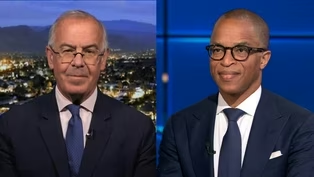
Brooks and Capehart on Trump, Vance clashing with Pope Leo
Video has Closed Captions
Brooks and Capehart on Trump and Vance clashing with Pope Leo (11m 28s)

Ceasefire sparks cautious celebration in Lebanon
Video has Closed Captions
After weeks of fighting, ceasefire sparks cautious celebration in Lebanon (7m 22s)

Ex-Kennedy Center staffer alleges cronyism under Trump
Video has Closed Captions
Ex-Kennedy Center staffer alleges chaos and cronyism under Trump leadership (8m 17s)
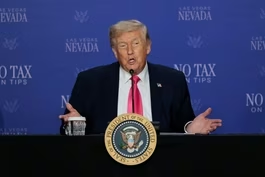
How Trump's actions are affecting support among young voters
Video has Closed Captions
How Trump's recent actions are affecting his support among young voters (4m 30s)

Timeline for Strait of Hormuz shipping recovery uncertain
Video has Closed Captions
Timeline for Strait of Hormuz shipping recovery remains uncertain (5m 26s)
Providing Support for PBS.org
Learn Moreabout PBS online sponsorship New Episode
- News and Public Affairs

Today's top journalists discuss Washington's current political events and public affairs.
 New Episode
- News and Public Affairs

FRONTLINE is investigative journalism that questions, explains and changes our world.

 New Episode
 New Episode
 New Episode


 New Episode
 New Episode

 New Episode
Support for PBS provided by:
Major corporate funding for the PBS News Hour is provided by BDO, BNSF, Consumer Cellular, American Cruise Lines, and Raymond James. Funding for the PBS NewsHour Weekend is provided by...