At Issue with Mark Welp
Could Data Centers Help Illinois Build More Clean Energy?
Clip: Season 3 Episode 33 | 1m 52sVideo has Closed Captions
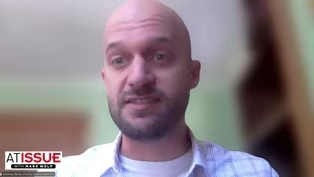
Andrew Raine explains how data centers could support clean energy without raising rates.
Andrew Raine explains why the cost of serving enormous data centers can affect other electricity customers. He also describes a potential upside: requiring data centers to bring enough new renewable energy to meet their demand could protect ratepayers while helping Illinois expand its clean-energy infrastructure.
Problems playing video? | Closed Captioning Feedback
Problems playing video? | Closed Captioning Feedback
At Issue with Mark Welp is a local public television program presented by WTVP
At Issue with Mark Welp
Could Data Centers Help Illinois Build More Clean Energy?
Clip: Season 3 Episode 33 | 1m 52sVideo has Closed Captions
Andrew Raine explains why the cost of serving enormous data centers can affect other electricity customers. He also describes a potential upside: requiring data centers to bring enough new renewable energy to meet their demand could protect ratepayers while helping Illinois expand its clean-energy infrastructure.
Problems playing video? | Closed Captioning Feedback
Where to Watch At Issue with Mark Welp
At Issue with Mark Welp is available to stream on pbs.org and the PBS app.
Providing Support for PBS.org
Learn Moreabout PBS online sponsorshipThe costs of meeting new energy demand is actually socialized among all of the rate payers on that grid.
And that theory worked fine when individual additions to the grid were small.
And even a large factory can be small compared to one of these big data centers.
Now that we have a single customer class coming in with such immense demands, it's not fair for us to pay the cost of those data centers coming in and raising all of our rates.
So we don't literally pay for the energy that a data center uses.
What we pay for is the impacts to our shared resource that the data center is uniquely causing.
So that's a big challenge.
And then the other side of the energy problem is our climate.
Illinois has set climate targets to attempt to decarbonize our electric sector.
And data centers pose a real challenge to that, but they can also be an opportunity.
If data centers are bringing renewable energy with them, if they build enough renewable energy to meet their demand, not only do they not increase our electricity costs, because they're meeting their own demand, they also build out renewables on our grid.
And that has economic impacts, that builds up a sector, that means we can have more trained workers, more trained companies able to build, that reduces the cost of build for everyone.
So we have a path here where data centers can help us meet climate targets if we have them bring their own new clean energy, which is the key policy in the Power Act, acronym is Bring Your Own Clean Energy, is BYOCE.
And it really, if we get that, we can really reshape our energy in Illinois.
What Communities Can Learn From Aurora's Data Center Rules
Video has Closed Captions
Clip: S3 Ep33 | 2m 16s | Andrew Raine says communities know enough to set protections before data centers arrive. (2m 16s)
Why AI Data Centers Raise New Energy and Water Concerns
Video has Closed Captions
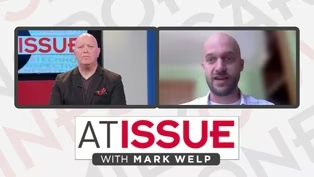
Clip: S3 Ep33 | 1m 53s | Andrew Raine explains why massive AI data centers raise new energy and water concerns. (1m 53s)
Providing Support for PBS.org
Learn Moreabout PBS online sponsorship New Episode
- News and Public Affairs

Top journalists deliver compelling original analysis of the hour's headlines.

- News and Public Affairs

FRONTLINE is investigative journalism that questions, explains and changes our world.
 New Episode
 New Episode
 New Episode
 New Episode
 New Episode
 New Episode
 New Episode
 New Episode
 New Episode
Support for PBS provided by:
At Issue with Mark Welp is a local public television program presented by WTVP