
Countdown to the 2025 Legislative Session
Season 9 Episode 20 | 26m 44sVideo has Closed Captions
Which hot button issues will headline the 2025 Utah Legislative Session?
With less than a week until the Utah Legislature begins its 2025 General Session, our panel discusses the top priorities of legislative leaders. Which hot button issues will be discussed? Will we see another round of tax cuts? And will Gov. Spencer Cox see his biggest goals passed into law? Political insider Marty Carpenter joins journalists Lindsay Aerts and Jay Evensen on The Hinckley Report.
Problems playing video? | Closed Captioning Feedback
Problems playing video? | Closed Captioning Feedback
The Hinckley Report is a local public television program presented by PBS Utah
Funding for The Hinckley Report is made possible in part by Cleone Peterson Eccles Endowment Fund, AARP Utah, and Merit Medical.
Countdown to the 2025 Legislative Session
Season 9 Episode 20 | 26m 44sVideo has Closed Captions
With less than a week until the Utah Legislature begins its 2025 General Session, our panel discusses the top priorities of legislative leaders. Which hot button issues will be discussed? Will we see another round of tax cuts? And will Gov. Spencer Cox see his biggest goals passed into law? Political insider Marty Carpenter joins journalists Lindsay Aerts and Jay Evensen on The Hinckley Report.
Problems playing video? | Closed Captioning Feedback
How to Watch The Hinckley Report
The Hinckley Report is available to stream on pbs.org and the free PBS App, available on iPhone, Apple TV, Android TV, Android smartphones, Amazon Fire TV, Amazon Fire Tablet, Roku, Samsung Smart TV, and Vizio.
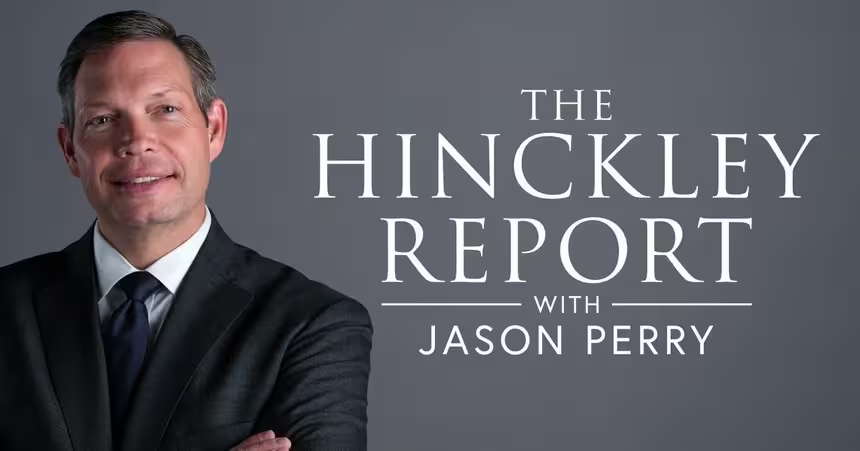
The Hinckley Report
Hosted by Jason Perry, each week’s guests feature Utah’s top journalists, lawmakers and policy experts.Providing Support for PBS.org
Learn Moreabout PBS online sponsorship♪♪♪ male announcer: Funding for "The Hinckley Report" is made possible in part by Merit Medical and by contributions to PBS Utah from viewers like you, thank you.
Jason Perry: On this episode of "The Hinckley Report," lawmakers announced legislative priorities that could have a big impact on Utah, state leaders react to major court rulings, and our panel dives into the stories ahead of the 2025 session.
♪♪♪ ♪♪♪ Jason: Good evening and welcome to "The Hinckley Report."
I'm Jason Perry, director of the Hinckley Institute of Politics.
Covering the week we have Jay Evensen, opinion editor with Deseret News; Lindsay Aerts, anchor with ABC4 and host of "Inside Utah Politics;" and Marty Carpenter, partner with Northbound Strategy.
Thank you for being with us on the program today.
A lot happening as the legislative session gets ready to start, but also as we have an inauguration of the new president of the United States.
Jay, I want to start with you for just a moment because this is going to happen on Monday, the inauguration, and the part that I think is interesting is sort of what's being forecast to come and that is President Trump saying he'll take the oath of office, march to the Capitol, and sign 100 or so executive orders.
Talk about that because it will flavor the rest of our conversation today.
Jay Evensen: Well, I'm glad you're not going to make me recite all those 100, but you know he's made several promises about things that he wants to do on day one.
And I think we're all going to be hovering around the TV to see what he actually does.
It'll be interesting to see the tone of his speech.
David Eisenhower, the grandson of the late president, has talked about inaugurals.
Says, "You can either be a uniter or a leader in the tone of your talk."
Now, this talk also coincides with Martin Luther King Day, who was definitely a uniter.
What type of tone is the president going to take and how will that lead into what happens the rest of the day?
Lindsay Aerts: And I guess I have a question of whether Utah is part of this discussion at all.
We know we have public lands issues here and we've seen this kind of ping pong back and forth between presidents, between growing and shrinking, monuments and our national parks as well.
So, does that play into any of these executive orders?
Jason: Yeah, I'm so curious about it--Marty, go ahead.
Marty Carpenter: I was just going to say a lot of the doing initially is probably a lot of undoing.
So, it's a lot of let's get rid of what was done over the last four years to the extent we can.
Let's start to move things in a different direction.
One thing I've seen though from the administration to be in transition is that they are trying to strike this tone of uniting the country.
And so, I think we'll see a little bit more of that than we saw back when he gave his first inaugural address, at least that's what I would hope to see this time around.
Jason: I want to get to some legislative priorities, but to your point, Lindsay, it's interesting that what our lawmakers in Utah have been quite concerned about is sort of the regulations, and that seems to be what will be targeted in a lot of these executive orders.
Whether it's on energy or immigration, border security, a lot of it is going to get to those regulations themselves, which seems to be something our elected officials have been talking about.
Lindsay: Yes, and it's been interesting when we have a Democrat administration, our, you know, Republican federal delegation doesn't like the president's executive order.
So, I'll be interested to watch whether that also applies when there's a Republican administration, because in theory, the president and our federal delegations are aligned on most of those things, right?
And so, do the executive orders from the president come in and, like Marty was saying, undo things?
Does the federal delegation support the president taking action even though they didn't love it when a democrat did it, right?
Jason: Let's see how this plays into some of the top priorities of our legislature.
Can we start with you, Jay, because one of them, one of the stated top priorities of our House, our Senate, and our governor has been energy.
I know you spent some time with the Speaker of the House this week.
Talk about some of the broad plans on energy development and transmission in the state.
Jay: Well, they talk about all of the type of approach, so more coal, but also nuclear is part of that.
And when I talked to the speaker, it's very clear that permitting often gets in the way.
Well, it always gets in the way.
So, when it comes to a nuclear reactor and we have these new small modular reactors in theory anyway that you could use in Utah.
It now takes decades to get a nuclear reactor permitted and so it'll be interesting to see.
They're hoping the Trump administration can undo some of that permitting red tape, but it might not be so easy to undo that.
Some of those things you might need for safety's sake, for example, and how quickly can that be done?
And how do you get people to invest in this type of technology when four years from now we can have a different president that adds more regulations?
Lindsay: And just this morning we've also seen some legislation, some proposed legislation, about what Utah plans to do with nuclear energy and that was always my question is, okay, you say you want to do nuclear, what is the legislation we need around it, what is the policy?
And so, just reading over this bill briefly this morning and it's early so things could change, but the bill as it states right now talks about creating an energy council and this council would oversee new electrical energy development.
Basically plots of land, areas of land where we're developing energy, and then they're gonna take some of the property taxes from that county and reinvest it into energy infrastructure.
And so, that's how they're working to sort of fund this nuclear stuff that Jay talks about.
Again, very early, who knows what changes, who knows how counties feel about that, but just looking over the bill this morning, that's sort of the plans from the state.
Marty: Going back over 10 years now when I was working for Governor Herbert, we used to talk about an all of the above energy approach.
It always felt like it was all of the above except for nuclear and now it really is sort of an all of the above approach.
And we're going to need it because more people are coming to the state.
That's higher demand for power just to power homes and businesses, but it's also a matter of everyone in their pocket has a phone they had to turn off before we started here that has AI in it.
AI takes up a lot of energy.
And in order to power our AI future and stay ahead in things even in a military application for artificial intelligence to stay ahead of China and other adversaries, we're going to need more power than we currently have.
We don't have what we need now and we're going to have to address it by making nuclear part of the mix.
Jay: And that's an interesting point.
It is a national security issue and it really needs to be tackled on the federal level.
This needs to be a nationwide effort, not just a Utah effort.
And so, it'd be interesting to see, you have to integrate those two, but Washington should really take the lead on this.
Lindsay: And to Marty's point, AI data centers are coming to Utah, it seems, right?
Sort of what lawmakers are signaling, and those suck a lot of our energy and a lot of our power.
So, we need more of it in order to produce energy for those things.
Marty: If there's one lesson I would take away from the fires we saw in LA, it's that when government doesn't take care of the fundamentals and that does get exposed, people have a real big problem with it.
So, you can do a lot of things in public policy, but you've got to keep the lights on.
And as soon as that goes away, you have big problems politically as well.
Jason: Marty, take a second on this point that Jay just raised because you start talking about the federal implications and we have a lot of agency regulations that are creating the delay in permitting, but the state itself has decided to take on a lawsuit against the Nuclear Regulatory Commission committee on this particular issue, saying that you are, and they are actually calling them out, restricting our ability to even do research in the area of small modular reactors.
Marty: You know, I would jump to the messaging on this in the sense that right now it feels like there's big momentum for let's get out of our own way, right?
Federally, I think that that's a big push that's sort of the underlying ethos of the Trump campaign was let's get back to doing things, let's make ourselves great again, let's build things.
That's what I think the state is pushing for is saying can we get out of our own way?
Let's not cut corners on safety, but can we stop with the red tape that keeps us from getting the things done we need to get done.
Jason: Before we leave energy, Jay, this all the above approach means our legislature is still very much talking about coal because we have coal burning plants.
The IPP that we've talked about on this program in the past was slated to convert, close and convert, and there's still talk about the state still relying on some coal for a period of time.
Jay: There's still a lot of coal in Utah and underground, and it's supposed to be some of the best coal in the country, at least that's what they tell me, and I suppose that they would have an interest in telling me that.
But--and there are a lot of jobs connected to coal and so it's a strong lobby at the Utah legislature.
And you are, yes, you are going to see an emphasis on coal, but IPP most of its energy goes to California and California says we don't want any energy that's using coal or any of those other types of fossil fuels.
Jason: Let's transition to another big ticket item for our legislature and that is tax cuts.
Lindsay, I know you talked to many of those legislators and the governor is looking at this too.
There's the tax on Social Security.
They want to reduce.
Maybe give a minute on that and then that's not--might not be where they're done.
Lindsay: Right, so, $165 million is what lawmakers are signaling they're setting aside for some income tax cuts, and the governor wants that to go to the income tax on those older citizens in Utah, 65 and older, or those who take Social Security.
Often times it's kind of the running trope with the legislature where here's the governor's budget and the legislature rips it up and they say we're gonna do whatever we want, but they are signaling a little bit that they don't hate the idea, right?
So, the question will be not only are we going to--or whether we cut the tax on Social Security, the income tax on Social Security, but also whether we cut our general income tax and corporate income tax further.
And over the last few years we've done that several times.
So, my question is how do you make up that income tax?
There's only three-ish pots that come into the state legislature, and income tax is a major one of those.
It also is earmarked to fund education.
So, as you continue to have that income tax come down, how do you replace that income?
That's sort of the big picture I'm looking for some answers on.
Jason: We're still looking for that answer.
Marty, if you'll follow up on that too, with our legislatures saying that in the last four years they've cut $1.2 billion already and that's the question right there too.
We have sort of flat revenues but potential tax cut coming.
Marty: In the old adage is there are two things that are certain death and taxes, but in Utah I would say those are death and tax cuts because the legislature does this pretty much every year where it's almost become difficult to track like what did we cut last year and what did we cut the year before?
And that number 1.2 billion, that's a sizable number.
This is a body that cares about running an efficient and effective government and cutting taxes whenever they can, and the reason you know that they like to do that is this is not an election year for any of them, and they're going to cut taxes, which means they're probably going to find a way to do it again next year when the whole House is running for election and a good chunk of the Senate as well.
Jay: And they particularly want to cut income taxes, which is a tax on productivity, but it's going to be interesting because when you talk about cutting taxes on Social Security benefits.
That's one of Trump's goals as well.
There are two of those taxes.
There's a federal tax and there's a state tax, and some people argue that's double taxation.
I think that they make a good point.
But if Trump cuts the federal tax on Social Security benefits, puts pressure on Utah to cut it as well.
I'm not sure Utah could continue that tax if Washington cuts it.
Lindsay: And I think everyone loves tax cuts.
Who doesn't love to save some money every month, right?
It's very popular.
It's very popular with voters.
It makes sense, but I want to see like getting to some of the numbers, like what is the point of another income tax cut if it's a 0.5% cut that saves you $20 a year.
Does that really help Utahns or does it message more than it helps?
Marty: Well, I think you have to look at the ripple effect of it too--you tax me less on my income.
That's more money I have to go spend.
I go spend it and it gets taxed somewhere else on the sales tax side.
So, it's not a matter of, well, the money is just gone, but it gets used somewhere else in a way that's more productive for the economy and not just in the treasury.
Lindsay: But at some point those pots are going to be mismatched and sales tax may have to go up.
Marty: Absolutely, they've got to tune those dials in, but right now they're saying, hey, we're in a position where we can go cut here and let's see what it does.
Jay: In February we're going to get the new revenue numbers and we'll see because they have been soft and and down actually from what was projected.
And so, that will have a lot to do with how we cut taxes going forward.
Marty: You think tax cuts are a constant, so are the numbers coming out in February, coming up higher than what they said it was going to be before the session.
So, that's also quite a certainty in the state.
Jason: Let me get to another priority, the legislature, which is interesting when it comes to public lands.
The state has sued to try to claim some public lands and as we know here, about 35 million acres of the state of Utah are owned by the federal government, and Marty, I know you've been following this over the years.
I want to get to where the state is on this.
It's that irritant of sorts.
So much of the land, nearly 70% of the state of Utah, is locked up, but the lawsuit was dismissed by the United States Supreme Court this week.
Marty: I think the state should start using a map that shows just the land that actually is Utah and take out the federal land, and you'd be surprised because people back east say, "Well, we have federal land as well," and it's this park or it's this little bit here.
And if you show them a map of just how much of Utah is tied up for the federal government, it's astonishing to people.
But I would also point out that when that happens, it's also that there's, I think, growing support for the idea that's been very popular in Utah for a long time that it's not just that they have it, it's that they don't manage it well.
And when they don't manage it well, it's generally because someone's in charge of that on the other side of the country instead of here where it's in our backyard.
It's not like we want to put up an amusement park right by Delicate Arch.
We just want to use the land to its highest and best purpose, and of course we want to preserve and protect the parts that are most important.
Lindsay: The big question will be now where does the attorney general's office go with this lawsuit, right, because the Supreme Court declined to hear it.
So, the question is they haven't closed the door on bringing it to a lower court where they actually argue the merits of whether Utah should be able to get this land from the federal government.
But inevitably that goes to the 10th Circuit and inevitably it ends up back at the Supreme Court.
Do we fight that battle?
Do we spend the money on that battle?
Is it worth it?
Something we're still waiting for Utah's new Attorney General Derek Brown to tell us.
Jason: Jay, give us a little bit of the historical context of this because in this lawsuit our legislature was talking about this is for energy and grazing and some mining.
The lawsuit didn't include any of those national parks in there, but it's one of those things we're trying to parse that there which is still pretty sizable amount of property.
Jay: Yeah, this has been going on for decades.
You remember about 20 or so years ago environmentalist groups were trying to have millions of acres designated as protected wilderness.
And there are--there's a whole question in there of national monuments as well.
And so, is Trump going to come in and and re-shrink Bears Ears and the Grand Staircase Escalante.
And if that's true, do we keep going in this kind of yo-yo situation where--because presidents under the Antiquities Act of 1906 can designate monuments and we haven't really tested this in the court, but as far as we know now can change the size of monuments from--that were designated by previous presidents.
So, that's gonna be interesting to watch as well.
Representative Malloy is co-sponsoring a bill that would remove the president's ability to just unilaterally declare monuments.
It would be interesting to see in a Republican Congress whether that has any legs this year or not.
Jason: Yeah, Lindsay, talk about that for just a moment because that is sort of the question right there.
You got this ping pong that goes back and forth under the Antiquities Act, not not really challenged as Jay said.
Lindsay: Yeah, and it kind of goes to my point earlier is now that we have a Republican administration and President Trump, does the federal delegation still want that to be the case where the president can't come in and shrink or grow the size of these national monuments?
And so, I think that's something that still remains to be seen.
Marty: A very popular thing for the president to sign a bill taking away that power from him, at least in Utah.
Jason: A couple other interesting things going on in the state of Utah.
We have some hockey fans here, don't we, at this table?
And it turns out to be an increasing number of them.
I saw my own hockey, first hockey game here with the Utah Hockey Club.
Jay, I know you follow this really closely as well.
Some polling that we did with you and the Deseret News, the Hinckley Institute and Deseret News found that 30% of Utahns are following the team closely or somewhat closely, 30% not too closely, 46% not at all.
Give us some of the optimism of these numbers.
Because you follow this so closely.
Jay: I mean, at first blush, if the average person looks at that, they think, well, that's not very good, but let's think about that for a minute.
This is a poll of registered voters in Utah, and there's what, about 2 million or so of those.
If you take 25% to 30% of that, we're talking about somewhere in the range of 400,000 people who are following the team closely.
That's pretty good in the first season for a hockey team.
This typically hasn't been considered hockey country.
We had a minor league team for many years, but if I owned the team, I'd be pretty excited about that.
Lindsay: I'm glad you're pointing that out to me, Jay, because I was one of those naysayers that saw the 30% and I was like, "Oh, wah-wah, that's kind of a bummer."
But because when you go to these games they're fun and they're energetic, and people are so excited, and as we in the media, local media rolled out the team coming in, right?
There was so much excitement, and so much buzz, and so much hype, and so you felt that and then to see the 30% like I'm glad you're saying it's a positive thing because I was kind of like, "Oh well, maybe it's not as big a deal as we thought it is," but I guess those are good numbers.
Marty: The NHL has had success in markets where teams have come into a market and had success on the ice.
They've won a Stanley Cup in Colorado their first year.
Vegas got to the Stanley Cup final their first year.
This team's not probably right there, but I can tell you they have the building blocks that a few years from now, two, three years from now with the right moves, they could be really good, the arena is going to get better.
People are going to get more and more accustomed to it, give them a name, we'll figure all of that stuff out.
I have been convinced for 30 years that Utah is going to be a really strong hockey market because we're a good winter sports market.
We had one of the greatest hockey games in the history of the sport here in 2002 during the Winter Olympics.
It's going to be really popular.
It's going to succeed, and I would say this, I hear more people talking about the hockey club than I do talking about the Jazz right now.
Lindsay: And don't let this guy fool you.
He's a Colorado Avalanche fan, so don't let him--so, don't let him fool you.
Jason: Shows the sincerity right there.
Go ahead, Jay.
Jay: But that same poll questioned people about the Jazz, and it was only about 40% of people who follow the Jazz closely, which again is a very good number.
But hockey is not that far behind, which I think is impressive for the first year.
Jason: Well, this hockey team is part of this bigger conversation that I want to get to about the downtown entertainment zone.
So, the tax that was, you know, that was put into place in Salt Lake went into effect on January 1st.
And Jay, if you're gonna give us a start on this because this are polling as well, this is about 2/3 of Utahns favor creating a sports and entertainment district in downtown Salt Lake City.
This is a big vision for what might happen downtown.
Jay: Yes, they favor it, but I think the same poll found that most people did not favor the tax hike, the sales tax hike to fund that area, which I guess is typical of the way people react to taxes, but I think there is a feeling in the community that this will be an asset to the community, and an asset to the Delta Center, and will help these teams to thrive.
So, people seem to want it.
Lindsay: Yeah, and I think you saw that in the messaging coming out from Smith Entertainment Group as this tax increase was being discussed at the time it was passing with the Salt Lake City Council because to the numbers point, right, not super excited about having public money help fund the renovation of a stadium.
And then you saw Smith Entertainment Group and city and county leaders really come out and say no this is not just about the Delta Center.
This is not just about this arena.
This is about this entire two blocks east of the Delta Center and the revitalization of culture, and sports, and entertainment, and convention, right?
Because you have the Salt Palace down there which is a huge economic driver for the state.
So, you saw the messaging really try to expand out of just hockey and out of sports probably to those numbers point to speak to.
We're going to use this money to invest not just in a new arena but in an entire entertainment district which could be used for the Olympics coming forward and future needs for the downtown area.
Marty: If you're going to get the economic impact of having professional sports in town you've got to expand it beyond just the arena and getting people not only to come down and go to the game but also get out, go to a restaurant, things like that.
That's a little bit tougher to do with basketball and hockey because it happens during the winter and people don't like to walk around downtown as much, but ever since I was back at the Salt Lake Chamber and we worked closely with the Downtown Alliance, there's always been a drive to get more and more nightlife into Salt Lake City building that around sports, I think uniquely aligns with our community in a way that downtown can become a really vibrant space again.
Jay: Going to what Lindsay was saying for the Olympics, you could have a built in medal ceremony spot because there's going to be outdoor places for viewing sports.
And so, if you have an overflow crowd at the Delta Center, you could have people assembling outside, and giant screens watching what's happening.
It's becomes a community type event.
But in the last Olympics here I think they just had to use a parking lot they converted into a spot for medals and this would be something a little bit better.
Lindsay: To the community asset part, Salt Lake City also worked really hard with Smith Entertainment Group to set up more public benefits that the public would get things like festivals, right?
And the Japanese American community using that space down there, and even arts, there's a fund, right, where some of the money can go back in and help with public art and stuff like that.
So, Salt Lake City did, from my view, as I did a lot of reporting on this, work really hard to get some of those public benefits again to the point that this is not just about an arena.
Jason: Before we leave it, Marty, this is your point as well.
Natalie Gardner, who runs the Gardner Policy Institute, estimates that 75% to 80% of the sales tax paid, will be paid by businesses and non-residents of Salt Lake City.
So, largely not the citizens themselves.
Marty: The best way to do it is to tax people who are here from out of town because they leave their money and they go home.
We don't have to educate their kids or take care of them in any other way.
So, that's the best kind of tax revenue you can get.
Jason: Okay, I want to talk for just a minute about this the start of the legislative session because there will be a unique percentage here.
Jay, talk about this for just a moment.
A record number of women in the legislature for this coming legislative session.
It's the most diverse legislative session legislation that we have had, 29% of women, was 31, and we have many new incoming members of our legislature.
Jay: And that's good news and it--we were kind of on an upswing, I think, earlier at the beginning of this century and then we we leveled off and went back down.
It's been a constant criticism of Utah.
Look, we just put a statue of Martha Hughes Cannon at Statuary Hall in Washington D.C. She was the first woman elected as a state senator anywhere in the country.
And we really haven't lived up to the tone that she set.
And it's been a criticism for many years that we don't have enough women in politics, in Utah, in elected office.
It'll be interesting to see how they affect things, how they affect the the tone of the discussions, and legislation that is proposed and passed at the legislature.
It'll be interesting to see too if we continue this trend.
Jason: Talk about that trend, Lindsay.
Lindsay: Yeah, it is, it is important that we have diversity in our state legislature that we have not just diversity in race but in gender as well.
Women make up 50% of our population.
Does it make sense that we have more representation in Utah's legislature?
You know, maybe I'll just say, maybe when it gets to a point when it stops becoming unique that we have women in the legislature, that'll be a good day, but we're still not there yet and we're still working on that.
We have great organizations in the state like Utah Women Run, right?
Who are trying to recruit more women into office.
So, it can only help with our diversity and diversity of thought.
Marty: Yeah, and I think the merit is the point there that the women who are in our state legislature aren't just there and it's, "Oh good we have some women here."
They're actually powerhouses on the hill and they're the go tos on some really important issues.
You know I think of like Karen Peterson and Anne Milner on public education, higher education.
Representative Berkland, who just resigned was, you know, the one who led the charge on a lot of quite controversial issues.
She was not afraid to take on some big things related to gender and athletics and such.
Lindsay: And we have women doctors in the legislatures.
Marty: Yeah, yeah, I mean, Rosemary Lester was in there for a couple of years on the Democratic side.
Lindsay: And Kwan and Senator--well, my names are escaping me, but you know what I mean.
Marty: Senators.
Lindsay: Senators.
Jason: Before our last couple of seconds, Jay, too, this is also the days as we talk about this when we remember the 10 year anniversary of the passing of our first female Speaker of the House, Becky Lockhart.
Jay: Yes, she actually passed away today as we as we tape this show.
And she was a very--10 years ago, very dynamic leader.
She remains the only female speaker of the house that we've had in Utah.
Jason: Thank you so much for your comments, and we can't wait to see what happens this next week in politics.
Thank you and thank you for watching "The Hinckley Report."
The show is also available as a podcast on PBSUtah.org, YouTube, or wherever you get your podcasts.
Thank you for being with us.
We'll see you next week.
announcer: Funding for "The Hinckley Report" is made possible in part by Merit Medical and by contributions to PBS Utah from viewers like you.
Thank you.
♪♪♪ ♪♪♪ ♪♪♪

- News and Public Affairs

Top journalists deliver compelling original analysis of the hour's headlines.

- News and Public Affairs

FRONTLINE is investigative journalism that questions, explains and changes our world.












Support for PBS provided by:
The Hinckley Report is a local public television program presented by PBS Utah
Funding for The Hinckley Report is made possible in part by Cleone Peterson Eccles Endowment Fund, AARP Utah, and Merit Medical.