Unspun
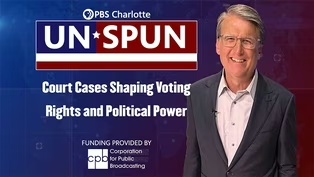
Court Cases Shaping Voting Rights and Political Power | Unspun
Season 2 Episode 220 | 27m 4sVideo has Closed Captions
Key court rulings on voting, abortion, and education are reshaping political power.
Major court cases are reshaping policy and political power from Washington to North Carolina. Recent rulings on voting rights, redistricting, education, and abortion access are influencing elections, lawmakers, and the balance of power nationwide. This discussion explores what these legal decisions mean for voters, public policy, and the future of government at both the state and federal levels.
Problems playing video? | Closed Captioning Feedback
Problems playing video? | Closed Captioning Feedback
Unspun is a local public television program presented by PBS Charlotte
Unspun
Court Cases Shaping Voting Rights and Political Power | Unspun
Season 2 Episode 220 | 27m 4sVideo has Closed Captions
Major court cases are reshaping policy and political power from Washington to North Carolina. Recent rulings on voting rights, redistricting, education, and abortion access are influencing elections, lawmakers, and the balance of power nationwide. This discussion explores what these legal decisions mean for voters, public policy, and the future of government at both the state and federal levels.
Problems playing video? | Closed Captioning Feedback
How to Watch Unspun
Unspun is available to stream on pbs.org and the free PBS App, available on iPhone, Apple TV, Android TV, Android smartphones, Amazon Fire TV, Amazon Fire Tablet, Roku, Samsung Smart TV, LG TV, and Vizio.
Providing Support for PBS.org
Learn Moreabout PBS online sponsorship(upbeat string music) - [Narrator] This is a production of PBS Charlotte.
(upbeat string music) - Tonight on "Unspun," the court cases shaping policy from Washington to North Carolina.
Recent rulings on voting rights, gerrymandering, education and abortion access aren't just legal decisions, they're determining who holds power.
We'll talk about what these decisions mean for voters and for lawmakers, and we'll highlight the biggest issues facing North Carolina courts right now.
(upbeat orchestral music) In today's America, welcome to the spin game.
Believe me, I know, I'm Pat McCrory.
When I was governor and mayor, I played the spin game, I was played by the spin game, but aren't we all done being spun?
Let's take the spin out of the world we're in here on "Unspun."
(upbeat orchestral music) Good evening, I'm Pat McCrory.
Court rulings can quickly become political flashpoints.
In just the past few weeks, the U.S.
Supreme Court has handed down or revisited decisions that could have real consequences, not just legally, but politically as well.
Our guest has decades of experience working at the intersection of law, public policy and government, welcome Bill Graham, a longtime attorney based in Salisbury who understands how legal decisions translate into the real world.
Bill, great to have you back on "Unspun," thank you so much... - Good morning.
Good morning.
- And to drive up from my favorite town, Salisbury, Catawba College, what a great school.
- Yeah, Catawba College, Salisbury, yep, Cheerwine Festival's coming up, so everybody coming up to Salisbury.
- [Pat] The Cheerwine Festival?
- Yeah, yeah.
- You have to pronounce that right.
- Cheerwine, yeah.
- Cheerwine, the home of... In Salisbury.
- That's right.
- Founded in Salisbury.
- Founded out in Salisbury, over 100 years old.
- Let's first talk about the federal courts, incredible how many decisions are coming out of the federal court, very quick decisions, it looks like the war may be going to the Supreme Court on how we define what a war is according to the War Powers Act, do you see this as a potential thing going?
- Yeah, I mean... - Because of the Iran War.
- Yeah, if folks listening to the program will remember the Pentagon Papers, some of your viewers may be too young to remember that, but back in the Watergate era, it was a flashpoint, Daniel Ellsberg and the Pentagon Papers, and the cross-section between... The fight between what the public has a right to know about how their money is being spent in defense, or in this case, war, and what is going on in the Pentagon versus the First Amendment right of the public to know, and then, you juxtapose that with what's the secret?
Can the public know about, you know, the inner workings of the Pentagon and the decisions that are being made about how to prosecute a war?
So here, we have a blockade of the Strait of Hormuz, and we're gonna have the fight between the administrations wanting to keep their narrative their narrative and the press's desire to let the public know what's really going on behind the curtain.
- Well, so you've brought up an issue I wasn't even planning to bring up, which is very important, and that is the media is being investigated on some leaks, and in fact, there was a... We had U.S.
Senator Kelly recently say, "We're running out of missiles," and the Secretary of Defense, or War, or whatever we call it today is saying, "You just let out confidential information, you ought to be possibly prosecuted for that," and this is a tough issue because how much information do we keep from the public versus keeping from Iran because of policies in negotiations and fighting a war?
- Right, but remember, we've got oversight between the Senate Armed Services Committee and the Pentagon, and so, when the Secretary of War or Secretary of Defense, whatever you wanna call him, goes before Congress and the Senate Armed Services Committee and says, you know, "Tell me about how things are going," and he says in an open forum that we're running short on whatever, and then, somebody else says the same thing, they get prosecuted, he gets a pass, well, if it's already in the public domain, that's not a prosecutable offense, it's already out there, he already said it, so there's gamesmanship being played on both sides.
- You know what's interesting?
A lot has changed in news communication since World War II, in World War II, which my dad was a Navy pilot and my father-in-law was a Air Army pilot, you know, the news was across the seas and you had your U.S.
news, you had your European news, you had your German news, Allied versus Axis news, now, with CNN, just lost Ted Turner, he made it worldwide, so does the news have a responsibility coming out of the United States to protect information that's on the battlefield or do they have responsibility to let everyone know what that news is?
- Well, you have webcams everywhere, you have people with phones everywhere, everywhere on the planet, there's someone with a camera, someone with a photograph, a video of something that's going on in downtown Beirut, downtown Tehran, downtown Washington, downtown Charlotte, so what's protected?
Is it the viewer?
Should the viewer be protected from seeing what they're seeing with their own eyes?
And with those images, what information goes with that?
Look, we're in a completely different age than World War II, I think everyone would agree with that, but the courts are always gonna have to balance the public's right to know a thing versus the public's interest to be protected and secure with the information that our armed forces have and have at the ready to protect all of us here on the homeland.
- All right, one other issue, which I brought up at the beginning regarding there's a War Powers Act which was initiated long ago going, "Okay, Congress has to prove after..." "Approve a war or further progress after a certain number of days..." - [Bill] I think 60 days.
- 60 or 90 days.
- Something like that.
- And now, all of a sudden, President Trump is saying, "Well, wait a minute, we've got a pause in the war, so that time clock ends," do you think that's gonna end up being taken to the Supreme Court?
- I hope not, but if it is, the fact that Trump blockaded the Strait of Hormuz, I believe by definition, fits the definition of act of war, so anytime you blockade a country, that's generally assumed and considered... - [Pat] An act of war.
- An act of war.
Now, Congress hasn't weighed in here and they're a little bit behind the curve, but I hope that the two branches can get it resolved so the third branch does not have to weigh in, it would be a very uncomfortable thing for the Supreme Court to have to do.
- This would be setting precedent... - It would.
- And we had this situation with Obama bombing... Doing bombings in the Middle East, with Clinton doing bombings in Eastern Europe and those areas, but this would be more defining legislation, which probably wasn't well-defined when it was passed.
- There were gaps in it, I think it was during Vietnam and maybe some subsequent amendments thereafter, but this is a situation where clearly, we're in a state of war with the country of Iran and I don't think we've been faced with a situation where the administration makes the allegation, "Well, we've called time-out and it's a two-minute warning or whatever, and we're gonna go both to our benches, and then, we're gonna come out and play again," I don't think the court should weigh in on that at this stage of the game.
- All right, the biggest other issue before we get to some state stuff is civil rights, gerrymandering, election law, we're coming up with primaries in most of the state right now, some voting actually had started, we kinda knew the civil rights law of '65 and other laws were gonna be changed, the Supreme Court's already given that, but what do you think about the Supreme Court now saying you can't do racial gerrymandering?
Yes, you can do political gerrymandering, but not racial.
- This is where the cross-section between what folks' tendencies to vote one political party or the other, with the African-American community, they tend to vote with the Democratic Party, I don't think that's a secret, and then, I think the justices have been itching for a case like this out of Louisiana to say, "Ah, you know, now we've got a case and we can make a ruling on the Voting Rights Act," so they say, "Look, if you wanna gerrymander for political purposes, go right ahead..." - [Pat] "Anything you want."
- "Go do that, but if you wanna gerrymander for racial purposes, uh-uh, can't do that," but here, they said political purposes, fine, go ahead, interestingly, a month before I walked in the studio, this morning, South Carolina, one of the legislators stood up and said, "Have y'all seen this crazy district that somebody drew that puts downtown Charleston in with Columbia?
They're not gonna have any of that," so there are gonna be states that are gonna go that way and they're gonna redraw, and it's gonna be for political purposes as we're sitting here, but then... And then, other states are gonna say, "I don't want anything out of that, we like it just the way it is," and that's the way South Carolina's probably gonna go.
- And the national Supreme Court doesn't care... - Doesn't care.
- Well, they go, "That's a state issue, not a federal issue," but if you do racial gerrymandering, I think the South Carolina decision has a lot to do with Representative Claiborne.
- No!
(laughs) - Yeah, I do.
I think even the Republicans don't wanna upset him, and he's one of the most powerful Democrats.
- He has indeed been a institution in the House for decades.
- And he's well-respected across the aisle, regardless if you agree with his politics or not, I think the South Carolina Republicans probably made a smart move, "Let's don't mess with Claiborne," and it might've been... You know, one thing about the gerrymandering decisions, I hate it, I hate all of it, but in the long-term, it actually might make a lot of districts more competitive now.
- Depending on the margins of where you have independent voters and you have a large independent turnout, you could have some districts going either way, if in the situation where Texas was redrawn, they've drawn some of those lines so close to urban areas that they... That may backfire on... - Some Republicans might lose races... - That's exactly right.
- Including right here in North Carolina too, with District 1 with Davis.
- Yeah, I mean, so where you've drawn these lines in particularly urban areas where there tends to be a greater independent and Democratic vote, these Republicans could be at risk.
- All right, we got, like, two minutes for state, but let's talk about state politics, the power struggle between the governor and the legislature.
The legislature did some pretty tricky little things that are legal.
They didn't do this with me, they did some bad things with me, but they... For example, the elections board, all right, they didn't take it from the executive branch, they just gave it to the state auditor.
Smooth move.
- Smooth move, I mean, this... It's a little cute.
(laughs) I don't really think it needs to be over in the auditor's bucket, but that's where it is right now.
- He's a good man.
He's an ethical man, but does anyone know that they're voting for the state auditor?
That the state auditor has...?
- No, absolutely not, absolutely... Maybe a couple of people here in the studio and you and I.
- And we ran into the situation, the state auditor got involved in the Berger primary, and yet... Of course, then again, governors have been involved in primaries too in the past when they were over the elections board, so politics is politics, isn't it?
- Exception in your case.
- I did not do it in my case.
- You did not do it.
- Thank you for making that clarification.
Any issues in the future, the remaining 60 seconds, that we ought to be...?
That might be going to state Supreme Court that you see happen?
- Well, the Leandro decision was just... Came down and it basically has to do with school funding, I know one of our good friends, mutual friends, Bob Water was big time into that, Justice Orr, I don't think is gonna go away with this, they're gonna find a way to retool and bring that case back, so see in the future Leandro two, but that case will come back and it may have a different outcome depending on how the election turns out with the Supreme Court.
- That had to be... The previous state Supreme Court said you had to have a certain amount of funding for public schools, and the legislature's going, "You don't have the right to do that."
- That's right, see charter schools, see other private schools, but public school funding, ironically, just this morning, a budget was approved giving teachers a large pay increase and a bonus, also for police officers and other law enforcement folks, but Leandro two is coming.
- Bill, appreciate it, by the way, congratulations on helping get Elizabeth Dole... Senator Elizabeth Dole Road going right through Salisbury, well-deserved honor, and me and Jim Martin were honored to be there for the... - A wonderful Salisbury if there ever was one.
- [Pat] Bill Graham, thank you very much for being on "Unspun."
- Great to be here.
(upbeat orchestral music) - All right, now for the "Unspun" top five countdown, you know, most people only hear about the Supreme Court in Washington dealing with these massive cases that are impacting our personal lives, but the fact of the matter is, the state Supreme Court right here in North Carolina is making some major decisions, both now and I anticipate in the future that are gonna impact our lives, both in Charlotte and throughout the region and throughout the state, so let's talk about the top five things that the North Carolina Supreme Court is acting upon both now and possibly in the future, we'll start out with number five, number five, ah, a big one, control the election board.
We used to have the governor of North Carolina control the election board, but the Republicans didn't like the new Democratic governor controlling the election board, so what'd they do?
They handed it over to the state auditor is now in charge of the election board, sooner or later, that will be challenged again.
Number four, number four, crypto investments in the pension program, one of the best-kept secrets in North Carolina, the North Carolina legislature, under Republican control, and then, signed by a governor that's a Democrat, signed that you have to put 5% investments of the pension program in crypto, sooner or later, someone might challenge that, that could be a future case.
Number three, control of K-12 education, this is a huge fight in North Carolina, the fact of the matter is almost no one controls K-12 education, you have the local superintendent, you have the state superintendent, you have a Board of Education in the state of North Carolina, everyone controls the state Board of Education, but sooner or later, the courts are gonna give more power to one person, I prefer the governor have that power.
Number two, gerrymandering for state and local districts, boy, you see this issue at the federal level and in many states, and right here in North Carolina, but we only talk about the congressional elections and state elections, the next big fight is gonna be city, county and school board gerrymandering, which happens right here in Charlotte, and Durham, and Raleigh, and other major cities.
Sooner or later, someone's gonna challenge the political gerrymandering of those districts and possibly the racial gerrymandering of those districts, and the number-one thing that North Carolina courts are gonna look at in the future is the power of cities to make their own laws.
Ah, do you remember HB2, where Charlotte said, "We're gonna have transgender laws regarding bathrooms, and locker rooms, and women's sports, and things of this nature?"
We fought that battle, major battle, there are more battles to come and the next big battle's gonna be can cities make their own minimum wage?
That'll be a huge battle regarding state control or city control of minimum wage laws throughout the state of North Carolina.
(upbeat orchestral music) All right, it's time again for what we call "One on One," where I'll go head to head with a member of our local media, and today, our political writer, Andrew Dunn, joins me again, Andrew, it's great to have you back on "Unspun."
- It's good to be back, you know, and super important topic today, and I'm glad I'm here today, let me tell you what I'm most worried about when it comes to all this stuff.
Yeah, I'm concerned that we might get to a point, you know, in Washington and in North Carolina where judicial decisions just become purely partisan, where the decisions that come out are based on a preferred political outcome rather than the facts of the case, you know, here in North Carolina, I feel like this really started when you were governor, when there was the whole "sue until North Carolina is blue" effort, and now, I think maybe the risk is the pendulum swinging back too far the other way, I don't see it yet, but people are starting to talk like that, you know, is there an off-ramp to this or is this inevitable that the political pressures will just get too much and the judiciary becomes essentially a political arm?
- That is a great question, we do have to put this in perspective, 90% of the cases that both the state Supreme Court and the Federal Supreme Court see... Review are not partisan.
They're decided almost unanimously or with very low minority vote, so we have to put that in perspective, it's the high-profile cases that tend to feel like they're more Democrat, Republican, conservative, liberal, supporting President Trump or President Biden or not, or Governor Cooper or Governor McCrory or not, that's where the politics comes in is the high-profile cases, especially on social cases and also on separation of powers cases, and that's where there's a concern right now, "Well, if you go against the president that appointed me," but that's why they're lifelong appointments, why would they feel pressure that way?
I don't get it.
Sometimes, the media also emphasizes this, they go, "The conservative court," or, "The liberal court," without really identifying who are the conservatives and who are the liberals, because sometimes, both the liberals and the conservatives are in disagreement themselves, and we've seen that between the Chief Justice and other justices on the Supreme Court, so the big question is how personal is it getting among Supreme Court members where they try to keep the personalities in it, the dissenting opinions now seem to be getting very personal, and the other concern are protests that are occurring as though there are retail politicians at their houses, protests are occurring at the houses, that never happened 20, 30 years ago and that's a big issue about the safety of the Supreme Court, these... You know, if all of a sudden, someone attempted to assassinate or harm a Supreme Court member, you can upend the whole political justice system right now.
- Yeah, that would be extremely bad for... - There's a movie about that with Denzel Washington, I remember, "The Pelican Brief," about the assassination of a Supreme Court justice... - Oh, geez.
- And it was all arranged and coordinated, so sometimes, movies are ahead of the real thing, I hope that's not the case.
- I hope not too, I'll have to go back and watch that, you know, here in North Carolina, you know, we elect our our justices and our judges, and I think probably a part of the answer just comes down to electing good solid justices, you know, but do people pay enough attention to judicial races in North Carolina?
- No, they have no idea who they are, they have no name ID, I used to campaign when I'd go to political events and the justices would come to the rallies, no one knew who they were.
Everyone knew who the gubernatorial candidate was, no one knew who the Supreme Court justices are, but there's... One big change that's happening the last five years, Super PAC money is now impacting, by the way, the Supreme Court too, even though they're not individually run, you're starting to see a lot of the Super PAC money impacting or trying to advertise a case, and at the state level, you're seeing multimillion-dollar Supreme Court races in the state of North Carolina, the Democrats are usually supported by the trial lawyers, the Republicans are usually trialed by... Supported by corporate lawyer money, there's an agenda here, class action suits are trial lawyers, tend to be more liberal, go after big, multi, hundred-million-dollar cases like tobacco funds from years ago and the corporations are trying to defend their rights, so money is driving a lot of the Supreme Court cases, which does scare the heck out of me in all politics.
- Yeah, so what's the solution?
I mean, do you think North Carolina should consider having governors appoint justices or does that just open up another thing?
- I think they should consider it, but it won't happen, but then again, who influences the governor?
And right now, you can tell who influences who by the big money, who gets the big money, believe me, I know, I used to... I played the game, I've been played by the game, I know the game, and the game is the big money is trying to influence people, and that includes judges at this point in time, and most judges are elected in North Carolina, a few are appointed by the governor when there's lower-level governors and lower-level justices, but that's about it.
- Yeah.
Well, speaking of big money, the big news recently is the State House and the Senate finally at long last reached a budget deal.
- [Pat] We'll see.
- Well, they called it a budget deal, but there's actually nothing on paper, it's kind of a framework for a deal, but what I'm most interested in is a couple things, you know, one is the tax rate's continuing to go down, but also, teacher pay going up, it's... You know, what I'm hearing is a proposed 8% across our average teacher pay increase, you know, you've studied to be a teacher, why is teacher pay such an important topic in North Carolina?
- Well, it's an important topic for two reasons, one is we're having a tough time recruiting great teachers, the second reason is the teacher's lobby is very powerful getting votes, especially for the Democratic Party, the teachers' union, as you saw by the march several weeks ago in Raleigh, can draw a lot of voters, and they run a lot of commercials worth millions upon millions of dollars, so everyone knows the power of the teachers' union and they have more power than, say, prison guards, who to me, have the toughest job in North Carolina, their pay is much less than teachers, and so, you have a little battle between teachers now and all the other state employees, state employees are being offered maybe a 3% raise, teachers are being offered an 8% raise, the state employers are going, "Well, why are teachers getting more?"
Well, two reasons, tough to recruit and the second is they're more powerful politically, no doubt about it.
- Yeah, for sure.
You know, you've been involved in budget negotiations, is it...?
You know, does it really look like a backroom...?
Smoke-filled room, or how do these budget negotiations tend to play out?
- It's usually between five or six people.
It's not a room of a lot of people, it's five or six people, the leaders of the House and Senate, the big question will be how involved were the...?
Was the Governor Stein administration involved in these negotiations?
And will the governor...?
He's been quiet on this so far, will he veto it?
That will be very interesting, I predict maybe him not signing it to show, "Well, we need a budget, I don't like it, but I'll go ahead and let it become law in several weeks by not signing it."
Hey, thanks for having us... Being, again, on "Unspun," we really appreciate it.
- Yeah, thank you.
- Take care.
(upbeat orchestral music) A unique part of North Carolina politics has always been the power struggle between the governor and the general assembly.
In Washington, the debate often centers on whether presidents have too much power, in Raleigh, the question is often the opposite, does the legislature have too much control?
During my time as governor, I took my own party's legislative leaders to court after they attempted to remove powers from the governor's office.
I won that case, but the struggle didn't end there.
Today, under Governor Josh Stein, the same tug-of-war continues.
This time, the strategy is more creative.
Rather than transferring authority directly to the legislature, lawmakers have moved some of the powers from the governor to other statewide elected officials, offices that just happen to be held by Republicans.
From a legal standpoint, it's a clever approach.
From a political standpoint, it can be misleading to voters.
Take the State Board of Elections.
Responsibility for overseeing elections has shifted from the governor to the state auditor.
Now, when voters cast a ballot for state auditor, are they really thinking about who should help control election administration?
Are you kidding?
Probably not.
Most people are thinking about audits, accountability and how tax dollars are spent.
Well, that's what makes this so troubling.
The title on the ballot says one thing, the real power attached to the office may say something very different.
To be fair, both political parties have played these games over the years, the difference today is that the tactics have become much more sophisticated, more creative, and frankly, harder for the public to see.
It's just shameful, whatever political party is in charge, voters deserve to know who actually holds the power and why.
When political chess moves become more important than clear and honest government, the public loses, and that should concern all of us.
Well, that's the truth as I see it.
I'll see you next week on "Unspun."
(upbeat electronic music) (upbeat electronic music continues) (upbeat string music) - [Narrator] A production of PBS Charlotte.
(upbeat string music)
Court Cases Shaping Voting Rights and Political Power Preview | Unspun
Preview: S2 Ep220 | 30s | Key court rulings on voting, abortion, and education are reshaping political power. (30s)
Providing Support for PBS.org
Learn Moreabout PBS online sponsorship
- News and Public Affairs

Top journalists deliver compelling original analysis of the hour's headlines.

- News and Public Affairs

Today's top journalists discuss Washington's current political events and public affairs.











Support for PBS provided by:
Unspun is a local public television program presented by PBS Charlotte