
Covid-19 & Primaries, Democratic Party, and More
8/19/2021 | 26m 46sVideo has Closed Captions
Covid-19 & Primaries, Democratic Party, Schools' Mask Mandate, and Energy
Host Jennifer Fuller (WSIU) and guests Charlie Wheeler (UIS) and Kent Redfield (UIS) take a look at how COVID has affected the primaries, a potential rift in the Democratic Party now that Michael Madigan has left, lawmakers coming to Springfield to talk about legislative and congressional maps, the schools' mask mandate, and energy legislation.
Problems playing video? | Closed Captioning Feedback
Problems playing video? | Closed Captioning Feedback
CapitolView is a local public television program presented by WSIU
CapitolView is a production of WSIU Public Broadcasting.
Covid-19 & Primaries, Democratic Party, and More
8/19/2021 | 26m 46sVideo has Closed Captions
Host Jennifer Fuller (WSIU) and guests Charlie Wheeler (UIS) and Kent Redfield (UIS) take a look at how COVID has affected the primaries, a potential rift in the Democratic Party now that Michael Madigan has left, lawmakers coming to Springfield to talk about legislative and congressional maps, the schools' mask mandate, and energy legislation.
Problems playing video? | Closed Captioning Feedback
How to Watch CapitolView
CapitolView is available to stream on pbs.org and the free PBS App, available on iPhone, Apple TV, Android TV, Android smartphones, Amazon Fire TV, Amazon Fire Tablet, Roku, Samsung Smart TV, and Vizio.
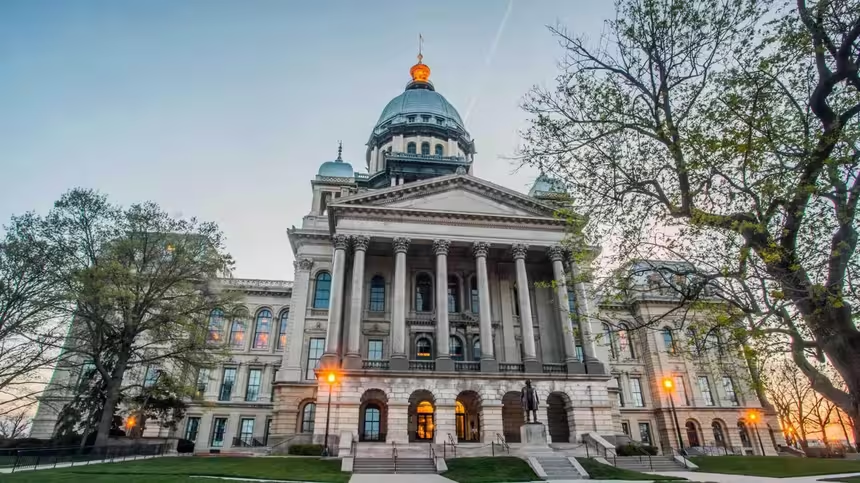
CapitolView
CapitolView is a weekly discussion of politics and government inside the Capitol, and around the state, with the Statehouse press corps. CapitolView is a production of WSIU Public Broadcasting.Providing Support for PBS.org
Learn Moreabout PBS online sponsorship(dramatic music) - Welcome to "Capitol View," a look at politics inside and outside the State Capitol in Illinois.
I'm your host, Jennifer Fuller.
Joining us, this week's guests are professors emeritus Charlie Wheeler of the University of Illinois Springfield public affairs reporting program, and Kent Redfield of the political science department, also at the University of Illinois Springfield.
Gentlemen, thanks for joining us.
- My pleasure.
- Good to be here.
- It's the time of year that ordinarily we'd be saying, "Let's start talking about primaries "and who's filing for statewide offices "and things like that."
It's the week of the Illinois State Fair in Springfield.
So you have Democrat Day, you have Republican Day, you have stump speeches, all of those things, but this year feels a little bit different, and I think part of that probably has to do with the fact that the primary is still nearly a year away, being pushed back to June of 2022.
How do things feel as far as what you're watching?
Kent, I'll start with you.
Does this feel like a typical political week at the state fair?
- Nothing feels normal mid-pandemic, wherever we happen to be, and so it's strange to be out there.
I haven't been out, but I've talked to people that have been out there.
The activities, the Republicans are really down in terms of they hold no statewide offices.
They're definitely going to get battered by the redistricting process.
The Democrats, having all the offices and all the money, have decided to pick a fight over controlling the state Democratic Party, which really doesn't seem like...
It's pretty much inside baseball.
I'm not sure it makes a lot of difference.
And then nobody knows what the congressional districts look like, so they're having a hard time figuring out how to position themselves.
Same with people who are thinking about running for governor on the Republican side, their at least one candidate, Rodney Davis from Central Illinois here, who seems to be kind of waiting to see what his district looks like in terms of whether he'll run in for Congress again or statewide.
It's not nearly as organized and focused, and just within with the backdrop of everything revolving around pandemic COVID precautions and stuff, it's a strange fair, but it's part of a strange year.
- The imagery is certainly quite a bit different than what we'd ordinarily be seeing, and Charlie, I can't mention that there's this growing, I don't know if you wanna call it a rift or what's going on within the Illinois Democratic Party.
Now that we're six or seven months since former House speaker Mike Madigan stepped down both as House speaker and as the chair of the party, it really appears like the Democrats are trying to figure out who they want to lead them and how they want to do that.
- Yeah, I think that it's something that is probably important to those of us who, as Kent said, are into inside baseball.
I think for the average Illinois voter, that individual could care less about this kind of internecine fight among the Democrats, and I think when all is said and done, it's gonna prove to be much ado about nothing because the Democrats will be united.
They'll be behind Governor Pritzker for another term.
They'll be behind electing Democrats to the House and the Congress, because when push comes to shove, there's a lot more that unifies the Democrats, despite their apparent differences now, than there is that would lead them to not support to take it or back a Republican.
And as Kent said, there's still a lot of time before we have to actually make any decisions.
So matter of fact, the primary's on the 28th of June next year.
So that's 10 months away.
The filing doesn't begin until the 7th of March, and people can't start circulating petitions until the 13th of January.
So we're really a long way away.
We're not even sure who all the candidates are gonna be.
As Kent said, there's a lot of speculation, particularly among the Republicans, about who may run for what.
They're waiting to see what the final shape of the maps is.
And the Democratic side, there's not, with one exception, there's really no uncertainty about who's gonna be running for statewide offices, the difference being, of course, who's gonna be the Democratic nominee for Secretary of State since Jesse White is retiring, and there is several candidates who, as a matter of fact, they appeared here in Springfield for Democrat Day to make their pitch to a pretty scattered crowd of the faithful.
So we're still a long way away, and we'll have lots of time to talk about it in the future.
- Charlie, how does that affect messaging, particularly on the Republican side of the ticket?
You've got three people who have announced their candidacy for governor in Gary Rabine, former state senator Paul Schimpf and current state senator Darren Bailey, and they're continuing to be out, putting out their messages, getting signs out, things like that.
Is the hall now too long?
Are they gonna get lost in the mix, do you think?
- In terms of the messaging at this point, you have to focus on a primary.
For the Republicans, that's going to be centered in...
The primary electorate is in the suburbs for the Republican, but then it, and downstate.
Downstate, with the loss of population and the extreme shift to the right, you're gonna end up with a pretty conservative candidates coming out of whatever primaries there are, and from what we saw from the latest census data, that's really bad news for the Republicans, because Chicago apparently is stable.
The collar counties and the extended collars at least have some growth.
Downstate has lost a ton of people, and so if you get a candidate that runs really well in central and southern Illinois, it's very hard to put together a winning coalition because those issues are not gonna resonate in northeastern Illinois, so Republicans really have a dilemma in terms of the primaries pull them to the right, and that makes it harder for them to get back into the center, where it's very hard to see, absent somebody really screwing up and becoming unelectable on the Democratic side, how the Republicans could win the statewide.
So it's not a pretty picture in terms of the prospects going into this next election, even though we don't know what the legislative and congressional maps look like.
- I would concur with Kent on that.
The difficulty is that folks who have announced their candidacy for governor on the Republican side all tend to be very conservative.
Darren Bailey, for example, has made a name for himself as being an anti-masker, anti-vaccine guy, and that plays well maybe in Southern Illinois, but in the Chicago suburbs and in the city, that's a recipe for disaster.
So I think the Republicans, and Kent, you would know this better than I, they're probably gonna be starved for money whoever their gubernatorial candidate is.
I think the big money people are gonna step aside, knowing that they, no matter how rich they are, they can't match J.B. Pritzker, and this is kinda gonna, I would say this is gonna be a by year for the Republicans, if you will, by in the sense of they really don't have anything going.
- Still you see that there are lawsuits being filed over the maps, particularly now that these new census numbers are out, and the Republicans are using words like gerrymander.
They're saying that the Democratic map is not going to be legal, that they expect a court to overturn it, and we're even hearing rumblings that Democrats may have to come back to Springfield this summer, Democrats and Republicans, I should say, the entire legislature, to perhaps take a closer look and maybe make some changes to the map that they've already approved.
Do you think that that's possible?
- Oh, sure.
I think it's not only possible, I think it's absolutely going to happen.
For one thing, the legislature still hasn't drawn lines for Congress, so they've got to do a map for congressional candidates, and they'll also tweak the map that they drew based on survey data rather than the actual census numbers for the legislature.
Now, the Republicans argument is that, "Well, because you used the wrong data, "we should throw the whole thing out "and go to a commission."
But I think, and obviously I'm no lawyer, but my sense is the statute or the constitution says that you go to a commission if there is no legislative remap enacted by June 30th, and enacted in my mind means passed both chambers of the general assembly and signed by the Governor, which in fact occurred.
So I think the Republican argument really doesn't hold water, and what will happen in my judgment is the Democrats will come back, they'll draw up a congressional map, eliminating one of the downstate Republicans, maybe two if they get greedy, and they'll tweak the lines for the legislative map to make the populations conform more closely one to another.
You may recall that the map that was enacted in 2011, the population variance between the largest district and the smallest district was exactly one person.
- Yeah, and the Republicans and the people suing the map are in federal court, and if they thought they had a case in terms of getting to the redistricting commission because somehow the Democrats had not complied with the process and the timeline requirements of the state constitution, then they would be in state court, but they're suing on the basis of essentially one man, one vote, and the Voting Rights Act, federal kinds of constitutional issues, which they could claim, but they could not present data until they got the census data, which happened last week.
So the map that exists for the legislature is a bill, I mean, it's a law.
It's a 10-year law, and the legislature could go in and amend existing statutes.
So they will have to go in and fix the differentials between districts in terms of population to get within the requirements of one man, one vote.
When that is done, then it'll be a grossly partisan gerrymander favoring the Democrats on the congressional map and on the state map.
You can decry that as being unrepresentative, unethical, but according to the US Supreme Court, it's not illegal.
And so there really isn't any grounds for saying the map is politically unfair, and I suspect it will be politically unfair, but until the court gives you some leeway on gerrymanders, or we actually pass a revision to the redistricting that would stand up to the state requirements, to the state constitution, we're stuck with the process.
So there'll be a lot of noise, but I suspect the Democrats will get a map that people will have, everybody will have to run on, because it will meet, it'll pass muster in terms of the state and federal constitution.
Charlie's right.
They definitely will be back in town to get a new congressional map and to fix the map that they passed.
- Charlie, you mentioned that the Democrats may even try to draw two Republicans out of their districts if possible.
Is there any more data that you've seen in the census numbers that could indicate who might be targeted?
We've talked a lot about Rodney Davis perhaps being in danger, perhaps Mike Bost, Mary Miller, others.
Does the map change in your mind based on what we saw last week in those numbers?
- I think there's been some sentiment all along to try and figure out a way to gerrymander the congressional maps to guarantee that the seat that Illinois is gonna lose will be held by a Republican, and there are some people who are saying, "Well, there's even a way that we could maybe craft it "so we have a chance to keep all our incumbents "and eliminate another Republican," and I have no inside information.
I don't know if they'll do that.
I assume it's possible because when basically you have a free hand in drawing the maps, you can draw them any way you want.
Years and years ago, Jerry Shay, who was then a Democratic leader, this is almost 50 years ago, talking about redistricting, told me, "You tell me what outcome you want, "you let me draw the maps, "and I will guarantee that you will get that outcome."
- Yeah, and just quickly, because there are more bodies in the suburbs, and actually more bodies in Chicago, that means that some of those voters can then be pushed downstate more, pushed south.
That will allow some of that to perhaps take Kinzinger's district and make it more a suburban district that leans Democratic.
In the fantasy, the best-case scenario, you take Bustos' old district, Quad City to Rockford, you run that into the suburbs a little bit more, then you take Davis' district all the way up to Bloomington, all the way down to the Metro East so Bost and Mary Miller run together, and that district suddenly becomes a Democratic district.
Now, it's a hundred mile...
I mean, it's very long.
It goes a neck over to Champaign, up to Bloomington, all the way down to St. Louis, but it's certainly possible.
They can take a shot at actually...
It would then be Kinzinger.
One of the downstate Democrats would be gone, but Kinzinger might be gone because of his district being less rural and more urban and shifting more to the northeast.
The numbers were not good for the Republicans 'cause you've got more people in the suburbs, a stable Chicago and a depopulating downstate, and that just allows for all kinds of mischief on the part of the Democrats.
- Certainly something we're gonna continue to keep an eye on.
I wanted to change gears a little bit into COVID, which has really cast its shadow over everything that we talk about these days, but specifically when it comes to the state board of education and a number of school districts across the state that have decided that they will oppose the mask mandate and go mask-optional in class.
We're seeing there was a list that came out this week that included districts all over the state that were in danger of being either not recognized, if they were private schools, or on probation, if they were public schools, which could lead to things like a lack of state funding, the inability for students to participate in sports and other extracurricular activities.
You could even be endangering some diplomas of seniors who would be graduating if schools continue in this line.
How serious is this when you talk about the state issuing a mandate and local schools arguing their own local control?
Charlie, have you seen anything like this in the past?
- I personally can't recall anything quite as, what would you say, all-encompassing as this, but then on the other hand, we've not had a pandemic like this for, what, a hundred years?
And despite my beard, I wasn't around for that one.
But yeah, you said school districts all over the state, but it's interesting, if you actually look where the school districts are located, there was a story that appeared, oh, a day or so ago, and it listed something like 32 districts that had been put on probation for not complying with the mask mandate.
Half of them were in Southern Illinois.
There was only one in the northern part of the state, in Winnebago County, where Rockford is.
There were none in the Chicago area.
So this is very much a cultural thing in keeping with the, kinda the whole Southern Illinois, Central Illinois attitude that we don't want people telling us what to do.
We know what's best for our kids.
We're not gonna get vaccinated because that's Bill Gates wanting to put a chip in our arm, all of this stuff that is absolute garbage that people pick up from bad actors on social media, in my judgment, people who know better but cynically spread this misinformation, for whatever reason, I don't know.
Maybe they're trying to cull the herd, if you will, and put some social Darwinism in effect.
- Because you have the state, you've got public health combined with the state board of education, which has the authority to discipline and to bring sanctions, and so it's clear that the Governor wants to play hardball with this, and the initial shot across the bow was essentially withdrawing the recognition from a private school in Northern Illinois who, apparently the Speaker of the House's children attend that district, and they quickly reversed course, and what school boards are gonna hear from their lawyers is that you've got a liability issue.
You've got a process, but ultimately, the state board of education and the Governor hold all the cards.
So the Governor and the state board are gonna take the heat, and people can't yell.
They can yell at the local school board, but they really are not gonna have any choice in terms of this.
So I suspect that once we get into this, plus there's likely to be a lot of quarantining and a lot of disruption with the amount of infections that are starting to show up in school-age children, that you're gonna get pretty wide compliance, begrudgingly in lots of places, but you're really, they're not gonna have any choice other than to comply if they wanna participate in sports, if they wanna keep their insurance liability coverage, and ultimately in terms of their funding.
So again, the Governor is willing to play hardball.
He's betting that this plays well in terms of his reelection constituency, as well as I think a sincere judgment on his part this is the best thing to do in terms of public health, given what's happening with the new variant and the increase in cases, but he also, I'm sure, thinks this also plays well in terms of his political fortunes as well as doing the right thing.
Charlie will remember that Richard Daley famously said that good politics and good policy are not necessarily opposed to each other.
He said it a little more eloquently than that in terms of typical Daley speak, but yeah, this is good politics and good policy from the Governor's standpoint.
- You mentioned though that the Governor is playing hardball on something like this, but he's been very non-committal about returning to a mask mandate statewide, as well as perhaps moving some regions of the state back into mitigation because of their high positivity rates and high hospitalization rates.
Do you think that the two things go hand in hand?
Do you see the Governor being forced to make a decision like that in the future?
- I think it all depends on what the numbers show.
The numbers have been trending in the wrong direction for the last, what, several months, and part of it is because people aren't getting vaccinated, and in my mind, it's, what would you say, it's socially irresponsible not to get vaccinated unless you have a medical reason that you can't get vaccinated.
You can talk about your freedom in schools.
"My kid shouldn't have to wear a mask."
Well, guess what?
If your kid decides to come to school without a shirt, do you think that'll pass muster?
Or if your kid decides to come in a swimming suit, is that gonna pass muster?
No.
School districts can do this.
As a matter of fact, in several states, school districts where the administration, Republican governors say, "No, there can't be any mask mandates," school districts are embodying masks as part of their dress code, just as you have to wear pants and a shirt and shoes.
And in my mind, it's the same kind of thing, and you do it for public health reasons.
- The governor can't paint himself into a corner.
If we get to a situation where the whole state is out of intensive care units, beds, and we've got all kinds of death, and businesses can't stay open even if they wanted to, they have to send everybody home 'cause everybody's sick, then, so that could happen, and so he's careful about what he says.
So he doesn't wanna paint himself into a corner, but given what's happened culturally, it would be very, very difficult unless the worst, worst-case scenario, to go back to a lockdown situation where you're forcing non-essential businesses to close and all of that.
Culturally, I mean, the public is just, we're past that, and Charlie is right.
There's a way to get back out of this if we vaccinate.
So I think the Governor's being prudent by hedging his bets.
I think he'd be crazy not to, given how the virus keeps changing and changing.
- Sure.
Just a minute or so remaining, but I wanted to get to the energy legislation that has so far been stalled in the legislature, but there's been more conversation about it this week.
Charlie, what are we hearing on that, and do you think that anything will kind of break the log jam when it comes to clean energy legislation at the State Capitol?
- From what I hear and what I read, there's some movement in the sense that people are starting to talk, but there's no, what would you say, no clear solution, and part of the difficulties, at Princeton, everybody thought the problem was gonna be, how do we fund these two nuclear plants that ComEd wants, or Exxon wants to shut down?
Well, that got worked out, and then the question became, well, what do we do about the green motion to go to coal-free electric generation by, what, 2045, and that's where the hangup is between the environmentalists and the unions, both of whom are very strong Democratic constituencies, who, on the one hand, environmentalists want to get us away from coal and fossil fuels, but on the other hand, the unions say, "There are a lot of jobs at these plants, "and we don't want to lose those."
- And with that, we're out of time, always out of time before we have a chance to talk about all the things that we'd like to talk about.
Charlie Wheeler and Kent Redfield, thanks so much for being our guests this week on "Capitol View."
(dramatic music) (bright music)

- News and Public Affairs

Top journalists deliver compelling original analysis of the hour's headlines.

- News and Public Affairs

FRONTLINE is investigative journalism that questions, explains and changes our world.












Support for PBS provided by:
CapitolView is a local public television program presented by WSIU
CapitolView is a production of WSIU Public Broadcasting.