
COVID-19 Resurgence, Afghanistan Withdrawal
Season 6 Episode 1 | 27m 23sVideo has Closed Captions
Debates over COVID-19 mandates reignite and Utah welcomes refugees from Afghanistan.
A resurgence of COVID-19 cases in Utah and across the country reignites the debate over mask and vaccine mandates. Utah welcomes its first refugees from Afghanistan following the U.S. military withdrawal. Plus, state leaders seek to mitigate the impact of the ongoing drought and wildfires.
Problems playing video? | Closed Captioning Feedback
Problems playing video? | Closed Captioning Feedback
The Hinckley Report is a local public television program presented by PBS Utah
Funding for The Hinckley Report is made possible in part by Cleone Peterson Eccles Endowment Fund, AARP Utah, and Merit Medical.
COVID-19 Resurgence, Afghanistan Withdrawal
Season 6 Episode 1 | 27m 23sVideo has Closed Captions
A resurgence of COVID-19 cases in Utah and across the country reignites the debate over mask and vaccine mandates. Utah welcomes its first refugees from Afghanistan following the U.S. military withdrawal. Plus, state leaders seek to mitigate the impact of the ongoing drought and wildfires.
Problems playing video? | Closed Captioning Feedback
How to Watch The Hinckley Report
The Hinckley Report is available to stream on pbs.org and the free PBS App, available on iPhone, Apple TV, Android TV, Android smartphones, Amazon Fire TV, Amazon Fire Tablet, Roku, Samsung Smart TV, and Vizio.
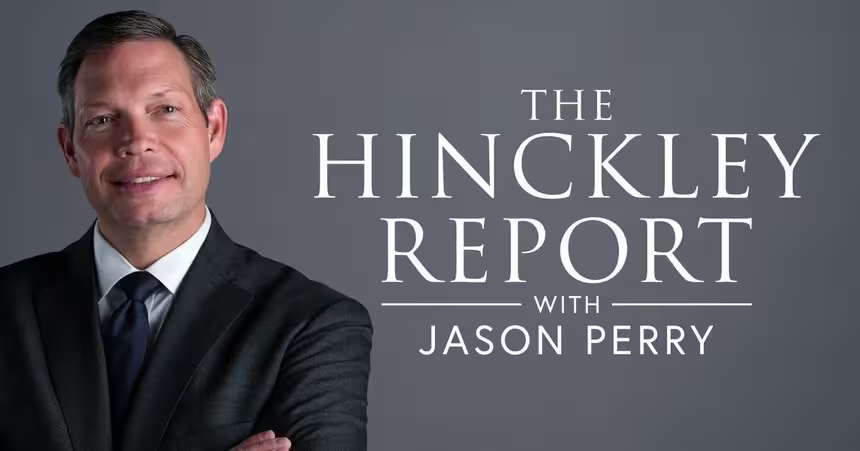
The Hinckley Report
Hosted by Jason Perry, each week’s guests feature Utah’s top journalists, lawmakers and policy experts.Providing Support for PBS.org
Learn Moreabout PBS online sponsorship♪♪♪ male announcer: Funding for "The Hinckley Report" is made possible in part by the Cleone Peterson Eccles Endowment Fund.
Jason Perry: Tonight on "The Hinckley Report."
Our panel discusses the major events of a tumultuous summer.
A resurgence of COVID cases reignites the debate over mask and vaccine mandates.
Utah welcomes its first refugees from Afghanistan, and citizens weigh in on the military withdrawal.
And officials seek to mitigate the impact of the historic drought and wildfires.
♪♪♪ CC BY ABERDEEN CAPTIONING 1-800-688-6621 WWW.ABERCAP.COM Jason Perry: Good evening, and welcome to season six of "The Hinckley Report."
We're glad to have you with us.
I'm Jason Perry, director of the Hinckley Institute of Politics.
Covering the week, we have Max Roth, inker with Fox 13 News.
Michelle Quist, columnist with the Salt Lake Tribune, and Glen Mills anchor and senior political correspondent with ABC4 News.
Thank you for being with us.
Wow, this--a lot of stuff this summer has been happening, and what's so-- Glen Mills: I have no idea what you're talking about.
Jason Perry: Can you believe it?
When the show goes off the air, we're talking about some things, and we're back to some of those, but wow.
Glen Mills: Right back where we left off.
Jason Perry: It's true, and to that point, Glen, why don't we just start right there with where we left off?
At the end of last season, Michelle, schools were shutting down, Salt Lake City school district in particular was, we're talkin' about masks, talking about vaccines, turns out what all you talked about did happen, and that controversy continues.
Talk about what's happened in our schools over the summer and most recently.
Michelle Quist: Right, we're still talking about masking, and we're still talking about vaccines, but thankfully we're in school, so you know, at least we can count those blessings.
But you know, there have been some, you know, mask--the legislature passed a law that said if there's gonna be a mask mandate from--the County Health has to pass it first, and then the County Council has to approve it.
Salt Lake County tried to do that, county health passed mandate, Salt Lake County counsel voted against that, and Salt Lake City, Erin Mendenhall, Mayor, came in and said Salt Lake City schools will be wearing masks.
Grand County also--they're also wearing masks in their schools, but you know, they did it the the council approved the county health mandate.
Jason Perry: So then essentially, how the two tracks went, because there was an effort in Salt Lake and Salt Lake school district, and the mayor ended up needing to do it, as opposed to what just happened in Grand County, which there was a legislatively authorized process to get to a masked mandate, which Grand County did, but talk about the political dynamics of that, because that is kind of where the real interesting political theater is.
Glen Mills: Oh boy, this turned into a fight and quick.
The mayor felt like she needed to do what she needed to do to protect the kids within her city limits.
So through executive order, she made that order.
She surprised some people when she made at K through 12.
A lot of us thought it would probably be K through 6 as was recommended by the County Health Department, but she went K through 12.
It immediately drew fire from state legislators.
Representative Mike Schulz coming out not long after it was implemented saying, look, she does not have the authority to do this.
It cannot be enforced.
And other people have weighed in on that as well.
Most attorneys I talk to agree with that, even those who back the mayor and what she's doing, they say this doesn't have authority, and it doesn't have the teeth.
However, as you look at the way it's been implemented, from what I'm hearing people are abiding by it in Salt Lake City schools.
And if we're really honest, and I had this conversation with with my panel a couple weeks ago, if we're really honest about it, you cannot look at the situation and say Salt Lake City Mayor Erin Mendenhall is not representing the majority of her constituents, she is.
She's doing what the majority of them want her to do.
Michelle Quist: And last year, we were begging them to let us go to school, the kids will wear masks.
It wasn't a problem, and now all of a sudden it's a problem to, no, no, you know, we can't wear masks.
The numbers aren't lower, there's still a pandemic going on.
People are still getting sick, especially those who aren't vaccinated, and you know, I think she did what her constituents wanted, like Glen said.
Max Roth: Along those lines, Michelle, you know, the numbers are higher, they are significantly higher, and especially among children nationally, it was 12% of kids before this this last month, it's 20-- I mean not 12% of kids, but 12% of cases were in children.
Now it's 25% nationally.
You look at the CDC's numbers for Utah, children's cases are going way up.
Its precipitous how fast they're going up.
Primary Children's Medical Center, I was just on a call with them yesterday, with an ICU nurse and their epidemiological doctor, and they say that their ICU is overflowing, and it's not just because of COVID.
They have a lot of RSV cases that they didn't see last year when masks were in place.
And so the evidence for the efficacy of masks is there.
That's not really a question in terms of the facts and the science.
The question is just whether it is an infringement on on freedom or so much of one that you can't require them.
Jason Perry: So Max, what are you hearing in that regard, because these two examples are giving with Grand County but also with Salt Lake City with regarding their school district, it's something that may be replicated across the state.
What are you hearing from legislators, other elected officials that may give us a signal about what might be coming?
Jason Perry: Well, you know, like you mentioned, Grand County is really the only place that put this law into effect.
I mean, it went in--Salt Lake County used the law as it's--as the process as designed by the law, and so they don't have a mandate.
Grand County does, but when we say Grand County does, the entire county has 10,000 people, they have one elementary school.
So really, under the auspices of that law, there's one elementary school in the state that has a mandate.
It's hard to imagine any other county not overturning it because--unless it's say Summit County.
I think its Salt Lake, Summit, and Grand are the three counties where there's probably the political leaning to do that, but elsewhere I don't see any movement in that direction.
Glen Mills: Yeah, I haven't heard any appetite from the legislature to make changes to that other than to potentially close these loopholes that the mayor, Salt Lake City mayor, found to implement her mandate.
I think that will be coming.
Whether it's in a special session this year during interim, I'm not quite sure.
It may hold off until the upcoming general session next year.
But I'm pretty sure that we're going to see that addressed.
Michelle Quist: Somehow the conversation around masking is about mandates and you know about liberty concerns, and you're forcing people to wear masks.
You know, every single one of these schools have had dress codes for decades.
And most of these dress codes affect primarily the young women and what they're allowed to wear and what they're not allowed to wear.
And it's mandated, and they can't go to school if they're, you know, wearing spaghetti straps, or if they're wearing a crop top or you're showing a shoulder, whatever it is.
A mask is a piece of clothing, it's a piece of cloth.
You know, these--clothing has been mandated.
The conversation is off of public health and onto liberty, and I don't think it's applicable.
Glen Mills: It's totally political, this conversation has become political.
You take a look at the votes, as Max alluded to.
The areas that do have the political leanings to issue these mandates, and Salt Lake County, it went along party lines.
It has become so political and so controversial that when the governor brings up the idea of an executive order of his own to local district leaders they say thanks, but no thanks.
I don't want to touch this thing because I don't want to be the one facing the public, the angry public if we make that decision.
Jason Perry: Yeah, let's talk about that for a moment, because they had a chance.
Max Roth: The difficulty--I'm sorry to interrupt there, Jason, but the difficulty is that what's become political also are the facts, the science, and that is what is so hard to communicate across that divide, because we do have these public officials who are making statements in--like in the Salt Lake County Council about what's happening in schools and the impact of masks that simply are not true.
They just are not backed up by the data and the facts.
And then I--you listen to talk shows locally and nationally and you have media figures who also encourage people to believe things that are just provably false, and so we can't have the conversation based on those on facts.
And then there's a legitimate conversation to have.
Public health does infringe on liberty, it does, and it's a question of how much you can do that.
And but that's not the conversation that we're having.
We're having this--people believe that there's malice going on in the science, and that's hard to talk through.
Jason Perry: Well, we better carry this forward to when we start talking about public health and an agency of sorts.
A big move yesterday by President Joe Biden, Michelle.
A vaccine requirement across the country.
This is 100 million workers now inside this order from the president.
Michelle Quist: Right, mandating vaccines for companies with over 100 employees, for medical, you know, facilities that accept federal funds.
I heard somebody was surprised it didn't apply to universities that, you know, accept federal funds.
I don't think that, you know, might be far off.
It was a surprise President Biden has been saying that he doesn't--don't want to go that way, but honestly if people had been vaccinated, then he wouldn't have needed to, you know?
It's--so now the conversation is he, you know, is he trying to save lives, is he trying to force, you know, people into the anti-vaccines and try to, you know, pick up the suburbs, perhaps, you know, force people to be black and white on this issue, or is it just, you know, tyrannical anti-liberty?
Jason Perry: Well, let's get this, Glen, because this is actually--people who heard some something maybe coming from the president thought, well, this may be sort of a requirement on federal workers or someone directly under his purview, but this was much bigger.
People were a little bit surprised this wasn't just government workers.
This is if you've got 100-plus employees, you're gonna be caught up in this.
Glen Mills: I think people were surprised that he put that into the private sector as well.
I think most people were expecting that it would be mostly centered around the federal government, and so that did catch people off guard.
And the reaction we've seen here in Utah from our governor, from our attorney general and others is, look, we strongly recommend you get the vaccine.
We want you to get the vaccine, but we're not going to force you to get the vaccine.
And they have called into question the constitutionality of what the president announced in this plan.
Jason Perry: Want to make sure as we're talking about these two separate groups.
We have the government employees under the executive branch.
Those particular employees have no option to test out.
These employers do as long as they do testing inside their organization, which is the interesting distinction between those two particular groups.
But I'm kinda curious what you're all seeing about this reaction from the business community itself, but also we think we just have to hear it from Max, our own elected officials had a response very quickly.
Oh, yeah, yeah.
The quickest was from Senator Mike Lee, who is very tuned into issues of civil liberties, and he came right out, and has called it autocratic and said that--and then went through a whole host of things that he thinks that President Biden has done to infringe on liberties.
And gosh, this is a tough question.
I mean, it's that's--of course that is really heavy handed what the president's doing.
There's no question about it, but it goes back to this situation that we're in.
You know, we've got this virus.
Some people don't believe it's real or it's that serious.
I looked at a poll from the census bureau just released yesterday talking about Utahns who are unvaccinated, why are they not vaccinated?
More than 40% say they don't trust the vaccines.
More than 30% say they don't trust the government.
A lot of people think that the vaccines are harmful.
And so that--but that doesn't speak to the constitutionality of a president just going in and telling every business owner that they have to do this.
That's a tough one.
Jason Perry: So it is, and I want to get to this quote.
Michelle, maybe I can show a quote from Mike Lee as we were just talking about, 'cause it does get that heart of what Max was just saying, what people across the country are talking about.
Senator Mike Lee, this is a very quick response from him.
He said, "From ignoring property rights, to shirking his duty at the border, and now, coercing private citizens to undergo a medical procedure, Joe Biden has shown a wanton disregard for the U.S.
Constitution."
Michelle Quist: You know, I'm not falling all over myself over that quote, because this is from the same party that tried to legislate intravaginal ultrasounds for women last year or the year before.
They didn't have the same concern there when women were at issue.
I think the angst over this is not that it's unconstitutional.
I think the angst is that it might be legal.
You know, under the regulatory scheme that the United States has broadened at this point and nobody has, you know, tried to-- I mean, they tried to tamp down and they talk about it a lot, but both parties use it constantly, this you know, regulatory control over people.
And it might be legal, and I think that's the angst here.
Jason Perry: Mm-hmm, so Glen, this order--this is--and for a Utah perspective, this is 64% of our employment, of our workforce in the state.
This is over 2,000 companies in the state of Utah.
They're having this very same conversation.
Glen Mills: Yeah, and they're wondering how is this really going to apply to them, because we've already heard threats of lawsuits coming in.
When will it be implemented?
How will it be implemented?
Will it be implemented ultimately?
So a lot of questions up in the air for them.
And one point I want to bring up that we haven't hit on yet is that the president's plan also includes a $14,000 fine for businesses through OSHA that fail to comply with that.
That's hefty.
Jason Perry: Mm-hmm, one more-- Max Roth: I think a part of the tough thing on this, part of the substance is what it does to the conversation too.
Because it's--we're already so, so--there's such a big chasm between the two sides.
This doesn't help that, and that's just this difficult place that we're in, but where the president puts this mandate down, and and I worry about the response, especially on the more extreme end of things.
The people talked pretty tough about about how they respond to personal freedom, imposition on their personal freedom, and it's--the conversation can be scary.
Michelle Quist: You know, our Utah legislators have been, you know, very outspoken about not having to force these masking mandates or vaccine mandates.
We haven't heard much from them about actually doing good, wearing masks when it's, you, know, helpful to your neighbor.
Getting vaccinated because it helps you, your family, and your community.
You know, Utah is famously known for not supporting social programs because we want charitable, you know--we want us to do it without being forced.
If we believe in doing things without being forced, why aren't we doing the things that they're now forcing.
If the country, if people had been vaccinated, the mandate wouldn't have been necessary, and that's just a fact.
Jason Perry: Glen, before we leave, this is just an interesting observation to bring together what you're all talking about, the legality of some of these moves, maybe yes as you indicated, maybe no, but it's just so interesting as you see local elected officials, Glen, and also on the national level is saying, well, the law may not be perfectly clear, but I'm taking this action, because by the time we get through the court process, before--by the time we get through the political process may have had the desired impact.
Glen Mills: Yeah, I think we've certainly seen that play out during this pandemic, there's no doubt about that.
A lot of, you know, we've already brought up the Salt Lake City School mask mandate, a lot of people with legal background--more than me, understand it more than I do-- most that I talk to have said she doesn't have the authority to do that, but she did it, and people are abiding by it, and there is this back and forth, well, you know, I'm going to do it, and you make your move to stop me.
And we've seen that play out a lot in this pandemic.
Michelle Quist: Vaccinations are gonna go up.
Jason Perry: We'll watch them closely, won't we?
Well, let's add another thing to the difficult decisions our local elected officials have to make, because there are some other she's impacting the state of Utah quite directly.
Max, give us an understanding of what's happening.
I was gonna give two big broad categories, the drought and fires, two things we've been talkin' about in the state of Utah.
Max Roth: Categories that are entirely connected, and first of all the drought, it's historic, it's been 20 years.
The term exceptional drought, that's the highest risk category that they have or the highest category of drought you can get into.
Exceptional is supposed to be something that it happens in a tiny place, you know, once every 100 years is what when I talk to the federal meteorologist who put together one of those forecasts said.
And we're just--we have more than half the state in it for most of the summer.
It's getting better right now, because it's getting colder, and we've had some good rains.
But those wildfires, you realize that climate change has-- is here, it's come to bite us.
Those fires in California, Oregon, Idaho, we haven't had big fires here in Utah, but it's still been a bad fire season for Utah, because the wind blows our way, and August was by far the worst month for particulate pollution in Utah.
This year far worse than we had in our winter and version months of January and February.
July was the third worst month this year, and July and August are not supposed to be bad particulate months.
We have ozone problems in the summer, they haven't gone away, but now we're dealing with wildfires, and it's a serious serious issue.
Jason Perry: Wow, Michelle, it's totally true, and what's been interesting to watch over the past couple of weeks, too, is what Max alluded to is we have our own issues here in the state of Utah compounded by the fact that a lot of the smoke is coming from fires in California.
Michelle Quist: We can't even do anything about that.
I mean, we can't put up a wall, we can't blow it out, you know, our our geography is such that it gets stuck in the valley.
I do think it's been good to see that, you know, the government's education campaign for individuals not--you know, for manmade fires in Utah, those numbers have been down.
And you know, that's helpful, but what do you do about, you know, the fire's elsewhere that blow here?
I mean, I think we were worst in the world or top five in the world.
Jason Perry: We had one day where we were the worst in the world.
Michelle Quist: I thought there was a fire next door.
It was--I mean, you couldn't go outside, and it was states away.
Glen Mills: So, if--I was at the state fair last night with the Governor, and we were talking about this very issue.
If we do not have a good winner this year, we're in big trouble.
And we're in a state now where I believe it's acting as a wake up call to state leaders.
The governor is very serious about taking action this next legislative session to really impact the effect of the drought here in the state of Utah, sweeping issues and action that he believes is necessary.
And he tells me that his talks with the state legislature and legislative leadership are coming along well.
They recognize the problem.
It's an issue.
We had at least two towns that I can think of this year that's water supply totally dried up.
That is a dire situation.
We all drive by our reservoirs, and we can take a look.
We can see the impact of what's going on and see that it's not good, so I do expect in the next session to see some pretty significant action when it comes to the drought.
Jason Perry: Well, it's so interesting, Max, I know you follow this issue well, and you talk to so many elected officials, but we've talked about a lot of controversial issues on the program tonight, but water is definitely appropriately on that list, because this is the limiting factor for the state of Utah in terms of growth, but also what we're seeing terms the climate.
Jason Perry: Yes, and it is-- Glen is absolutely right that we're facing a potentially dire situation next summer, because those reservoirs are perilously low, and they need to be filled.
Snow fills the reservoirs, rain does not.
And the other thing that I mean, all of us have to think--I'm lucky I already have the ugliest yard on my block, and so it's not that much of a sacrifice to water a whole lot less, because hey, you know, it's a--polish whatever analogy you want, but that is--but really I mean, we should pray face the fact that yards in Salt Lake City should look like yards in Phoenix or, you know, Palm Springs in California or something.
We are much worse at conserving water than other states thus far.
We need to get a lot better.
Glen Mills: And you take a look at the monsoon season we had this year.
It's one of the better ones I can remember.
We saw all this rain coming down, areas flooded, cities flooded, but yet that does very little if nothing at all to get into the reservoirs, so that's a scary thought when you think of all the rain we had and the little impact it had on our water levels.
Absolutely right, well at least Max has an excuse for his yard.
Michelle Quist: Flex.
Jason Perry: True, I wanna talk just for a moment about a worldwide issue with--that is-- it has impacted by decisions United States and a little bit in Utah as well.
Let's talk about a recent poll that the Deseret News and the Hinckley Institute of Politics did, talking about the withdrawal from Afghanistan.
And I just want to get your your understanding what you're talking to elect officials about, what people think about this.
And our poll asked whether or not Utahns approve of how the withdrawal was handled.
Which is the question, which is interesting.
Twenty six percent of Utah's approved, but this is the important part, 62% of Utans disapproved with how that happened, and once you break that down into the categories, it's not completely a partisan issue necessarily as well, particularly when you look at the Democrats, which is about 44% of them approved, 40% disapprove.
Michelle, what are you hearing about this issue?
Because we are impacted, and there are Utahns that are interested in this issue.
Michelle Quist: Yeah, I don't think anybody thinks that the withdrawal was done correctly.
Obviously, a lot of people, you know, have sensitive feelings about our being in Afghanistan, how long we've been there, you know, whether it was time to withdraw, and even if it was time to withdraw, how we went about doing that.
I think this is really a mark against President Biden that I think perhaps even, you know, he's trying to change the subject with the the vaccine mandate, get the focus off of Afghanistan, because it really is a blender, and people have lost lives, and we've lost Utahns.
Jason Perry: So interesting, our own center Mitt Romney, Glen, talked about this withdrawal and said it was the biggest mess-up in his lifetime.
Glen Mills: And we've heard that echoed from other leaders as well, being compared in a lot of ways to the exit of Saigon.
And I agree, this is going to be a point that people are going to certainly look back at it, and it probably will have that implication of Saigon many years and decades down the road.
And it's--the personal stories are heartbreaking.
Senators' and representatives' phones are ringing off the hook with casework.
Like, I've heard from workers, from staff, that they're literally in tears after taking these calls, and so it's just-- it's been a bad situation all around.
We lost a Marine from Utah.
His family has been vocal in speaking out about the president.
And they're not happy with how it was handled either.
Jason Perry: Uh-huh.
Max Roth: And it's hard to defend how that went.
I mean, it was just tragic.
I guess it's like if you're going to ask people how do you think that, you know, they did driving the car away from that crash?
You know, there was a-- Afghanistan's been a problem.
You know, the Taliban approaching those sorts of things.
I'm not sure--I'm sure it could have been done better, but I'm not sure that anything was going to look really good from that situation.
But the other thing, you know, and comparing it across--I mean, Senator Romney was alive when Saigon fell, and that was, you know, in the end-- You know, there have been comparable things, but it's a mark against him.
Jason Perry: We've got about 20 seconds.
Michelle, why don't you give a small preview of what's going to happen as we have the 20th anniversary on Saturday, when this is a national day of service.
I know you were there at ground zero on this day.
Your quick thoughts there, but this day of service too.
Max Roth: You know, it's really important to remember the change that was supposed to come from it.
You know, tribulation brings, trials bring growth and understanding.
And I'll never forget the feeling in New York City after those--after that day and how we all came together.
And I think that's what the day of service really tries to to bring together.
Jason Perry: Thank you for that, and thank you all for your insights this evening.
And thank you for watching "The Hinckley Report."
The show is also available as a podcast on PBSUtah.org/HinckleyReport or wherever you get your podcasts.
Thank you for being with us.
We'll see you next week.
♪♪♪

- News and Public Affairs

Top journalists deliver compelling original analysis of the hour's headlines.

- News and Public Affairs

FRONTLINE is investigative journalism that questions, explains and changes our world.












Support for PBS provided by:
The Hinckley Report is a local public television program presented by PBS Utah
Funding for The Hinckley Report is made possible in part by Cleone Peterson Eccles Endowment Fund, AARP Utah, and Merit Medical.