
COVID-19 Surge and New Political Boundaries
Season 6 Episode 2 | 26m 56sVideo has Closed Captions
Surging case counts fuel more COVID debate as Utah preps to draw new political boundaries.
With COVID-19 case counts surging and ICUs at capacity, debate over health policy continues. Legislative leaders are laying the groundwork to tackle controversial issues in the next legislative session. Plus Utah prepares to draw new political boundaries as campaigns gear up for a tough midterm election.
Problems playing video? | Closed Captioning Feedback
Problems playing video? | Closed Captioning Feedback
The Hinckley Report is a local public television program presented by PBS Utah
Funding for The Hinckley Report is made possible in part by Cleone Peterson Eccles Endowment Fund, AARP Utah, and Merit Medical.
COVID-19 Surge and New Political Boundaries
Season 6 Episode 2 | 26m 56sVideo has Closed Captions
With COVID-19 case counts surging and ICUs at capacity, debate over health policy continues. Legislative leaders are laying the groundwork to tackle controversial issues in the next legislative session. Plus Utah prepares to draw new political boundaries as campaigns gear up for a tough midterm election.
Problems playing video? | Closed Captioning Feedback
How to Watch The Hinckley Report
The Hinckley Report is available to stream on pbs.org and the free PBS App, available on iPhone, Apple TV, Android TV, Android smartphones, Amazon Fire TV, Amazon Fire Tablet, Roku, Samsung Smart TV, and Vizio.
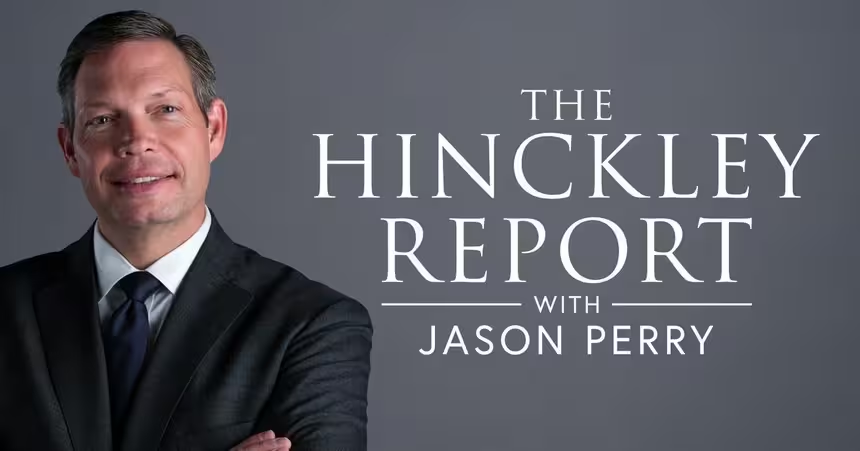
The Hinckley Report
Hosted by Jason Perry, each week’s guests feature Utah’s top journalists, lawmakers and policy experts.Providing Support for PBS.org
Learn Moreabout PBS online sponsorship♪♪♪ male announcer: Funding for "The Hinckley Report" is made possible in part by the Cleone Petersen Eccles Endowment fund.
Jason Perry: Tonight on "The Hinckley Report," state lawmakers meet to lay the groundwork for the next legislative session as they prepare to tackle controversial issues.
Leaders and citizens engage in a fierce debate over COVID policies in response to surging case numbers and rapidly filling ICUs.
And Utah prepares to draw new political boundaries as campaigns are already gearing up for a tough midterm election.
♪♪♪ CC BY ABERDEEN CAPTIONING 1-800-688-6621 WWW.ABERCAP.COM Jason Perry: Good evening and welcome to "The Hinckley Report," we're glad to have you with us.
I'm Jason Perry, director of the Hinckley Institute of Politics.
Covering the week, we have Jay Evensen, columnist with the Deseret News; Kate Bradshaw, Bountiful City Councilwoman; and Ben Winslow, reporter with Fox 13 News.
Thank you for being with us this evening, a lot of things happened in the state of Utah legislature--with the legislature, health departments.
We've got a lot to get to today.
I want to start with our legislature, Kate.
Revenue numbers, we're starting to get to take a look at.
Do we really have $3 billion extra?
Kate Bradshaw: Apparently we do, it's a lot of money.
You know, how the legislature is going to deal with this is gonna be so interesting, because we're not sure if this is sustainable or if this is all about people spending those stimulus checks, people that are getting the money for the child tax credits, how long will that last, how long will we keep spending so should we treat this is kind of like a one-time bonus to the state, or should we count on it, but there's a lot of money and a lot of discussions about what we should do with it.
Jason Perry: Ben, put this in perspective, it's interesting, a 60% rise in personal income tax, 94% increase in corporate tax.
So legislators are looking at this the way Kate's talking about, how do we look at the state of Utah going forward?
Is this ongoing money, is this one-time money, how do they spend it?
Ben Winslow: They're going to be getting a lot of requests to spend money, so many requests, but a lot of it already we are seeing signs that the legislature is looking at infrastructure improvements, looking at even tax cuts, giving an income tax cut, the Senate majority leader has proposed, and so they're saying things are looking so good maybe it's time we give some money back.
There's all these asks.
We're going to see probably so many requests for money, everybody's wish list, and I think some people are still going to come into the legislature thinking it's Christmas and everybody's getting what they want, and they may still leave sorely disappointed because there are still a segment of lawmakers who want to hold onto this money, who want to exercise some fiscal prudence with this, so stay tuned.
This laundry list is gonna get longer for what people want and what they're actually gonna get.
Jason Perry: That's absolutely right.
Jay, the point that Ben just brought up is interesting.
For a couple of sessions now our legislature's talked about potentially doing some kind of tax cut, we see these big revenues.
It's not the first year we've had it, last year we did as well.
What are you hearing about that possibility and the likelihood of success.
Jay Evensen: Well, you know, this is kinda like waking up in the morning and opening your bank app and seeing that you've suddenly got $2 million in there that you didn't know about, or in this case $3 million, and your first thought is that there must be a mistake, right?
And that there's something unusual that's causing this, and so I guess they're going to be reluctant, but there's a lot of pressure going to be put on them to return money to the people of the state of Utah, and you're hearing that from a lot of advocacy groups right now on the right.
And so I think there's gonna be a lot of pressure that way.
The other factor in this is inflation, and we've seen inflation now about a 5.4% annual, and I think there's--as Ben said, there's gonna be some reluctance to go too far and maybe a desire to treat this more like one-time money and wait another year and see if we still have the same revenues.
Jason Perry: Yeah, it does seem like that is the strategy right now as I look at the next legislative session.
I want to talk about some bill files that are open, some things that we might see coming, Ben, because you've covered this a lot.
We are seeing a death penalty bill, eliminating capital punishment in the state of Utah.
It's not a new thing for us to see, but give us some perspective on what's might be different this time.
Ben Winslow: Well, this bill is different because its repeal and replace.
These bills have been run in the past, and they've never really gotten anywhere.
There's been a lot of pushback to capital punishment repeal bills, even though you know there's arguments for why you should, about how long the length of appeals are, the costs associated with all of that, the fact that victims families wait decades to finally see a sentence carried out, but this year this idea of repealing and replacing it not with you know, we're getting rid of capital punishment, but the idea is that you add instead, an option of 45 years to life in prison.
Now, that's in addition to the potential of life without parole and what is already in statute, which is 25 years to life in prison, and this is getting some momentum on Capitol Hill.
We've seen family members of victims.
I interviewed Sharon Wright Weeks, the sister of Brenda Lafferty in one of Utah's most heinous murder cases, who is also speaking out in support of this bill because she said that she waited 37 years.
Ron Lafferty died of natural causes on death row waiting to be executed.
She supports this bill, this idea of a 45 to life.
That could be a good carrot for some lawmakers who are still in favor of capital punishment.
But we've also seen some lawmakers just simply changed their minds and say given what we've seen, how long it takes, maybe we go down this path.
And the other thing that this bill does, I should point out, for the seven men who are still on death row right now, it does not commute their sentence.
They still face the firing squad, so that's--they're not exempted, or they're not included in this repeal.
They're just--they stay there under statute, but this thing-- this is getting some interesting momentum.
Jason Perry: You know, Kate, you had a chance to talk to Lowry Snow, Representative Lowry Snow who's the one, kind of the face of this right now.
You've been on the hill for many years.
We've seen these bills come and go time and time again, what did he say about this to you?
Kate Bradshaw: You know, what's interesting about having Representative Snow take on this issue is that early in his career, he was a prosecutor, now he's in private practice.
He's one of the most respected legislators on the hill on legal issues.
He's known for being thoughtful, rational, he has a very calm demeanor, and he just-- tremendous respect, both chambers, both sides of the aisle, and because he's kind of gone through this process and has come to the conclusion that, you know, this justice delayed is justice denied, that the whip song of these families is so hard.
He has moved and evolved his position and the combination of Lowry Snow as the primary sponsor and Dan McKay as the floor sponsor in the Senate, who has, you know, a very different kind of personality in the house, is known for being kind of a very passionate sponsor of bills, gets very excited about the bills he sponsors, and so the combination of those two is a different kind of recipe than we've seen to try it on this bill in the past, and it may just get us over that hurdle, and you're also seeing, you know, that the district attorneys, the counties are coming on board, and so there's a different kind of momentum this year that just might put it put it over, and it's because I think of the evidence, the costs, the families, all of those things where people might say, look, I'm morally okay with this, but we're not seeing what we ought to see in terms of closure to these cases, and so let's move in this different direction, and you're doing it with these really key thoughtful leaders that put this package together.
Jason Perry: Jay, go ahead.
Jay Evensen: Yeah, I think you can't overestimate the county attorneys and particularly David Leavitt in Utah County.
Currently you've got Jared Baum on trial for a heinous murder down there, and he's basically taken the death penalty off the table there, and Conservatives who support this are using kind of a different argument.
They're saying look, as Conservatives, we have a healthy distrust of government, so why should we trust government with the power to take people's lives?
If we believe governments are fallible, and we've seen I think it's something like 185 death sentences overturned because of DNA evidence in this country, and so it's a little bit different argument.
And if it holds, you know, Utah could end up being a trendsetter among Conservative states on this issue.
Jason Perry: Very interesting, we'll watch this one closely.
This might be it, our panel kinda thinks maybe so.
Ben Winslow: It certainly has the chance.
Kate Bradshaw: I think it's got the best chance it's had in a long time with this package of sponsors and this coalition behind it.
Jason Perry: Let's get to another committee hearing that happened this week.
Ben, I think that you were there as our legislature was talking about a Supreme Court ruling that just came down to Utah Supreme Court ruling about gender identity being listed on official public documents, on records, the requirement, you know, birth certificates for example, start talking about driver's license, whether or not you need to put a sex or gender designation on these documents.
Talk about that, because this is going to have some implications for this next session.
Ben Winslow: Yeah, this is in response to a Utah Supreme Court ruling dealing with transgender people and gender markers on birth certificates.
Right now--or the way it was prior to the court ruling is Utah law allowed for people to do this.
People who wanted to change their gender marker to match their identity had a process they could go through.
You could petition the court to have it done and have your birth certificate amended and changed and all of that.
The problem was one or two judges wouldn't do it, and it depended on if you rolled the dice and you got this particular judge who wouldn't do it.
So the case went all the way to the Supreme Court because two people were denied, and they sued to challenge this, and the court said no, we have the authority to do this, and there should be a uniform policy.
So the court ruled in favor of allowing for this process.
Now, there's some exemptions, you can't have it for fraud, you have to have proof that you've been going through some of these therapies to transition, but the legislature in light of this ruling held a hearing to decide do we need to mess with this?
And that gave some members of the committee a lot of heartburn.
Some are saying, look, the court ruled, they set a policy, it's a uniform policy, why do we need to touch this?
Others are questioning if they need to weigh in.
Then there was also just kind of this philosophical discussion of do birth certificates need to even have a gender marker or a sex marker on them?
And that was its own debate, driver license division says, well, we do need them for our purposes of federal--some federal requirements that we have.
We don't even know if there's really gonna be a bill on this.
There seems to be an appetite among some lawmakers to maybe look at whether they need to create some kind of a policy or set some kind of a statute; however, there was a lot of lawmakers that said, look, the court ruled, it took a number of years, leave it alone.
Jason Perry: Yeah, so but Kate, but Merill Nelson had some comments about it, has not left off the table some kind of legislation to get to this thing, and what many were talking about was what Ben just said, the Utah Supreme Court decision did lay out pretty clear infrastructure.
Kate Bradshaw: You know, it's it's a fraught issue at the at the state capitol, and it'll likely bring in some of the other issues last year that were also difficult in this same area, for instance, transgender athletes.
Sometimes you have to wonder whether that forum helps us have a thoughtful discussion about these issues, or whether they're harmful or helpful to people that are transgender and transgender youth, versus allowing that court decision to stand.
I think it is likely given the diversity of opinions in the 104 Utah legislators that there will be some type of a bill filed, and hopefully that if they choose to engage in that discussion, they can do it in this thoughtful, respectful way that will still make sure that those people that are transgender feel understood, heard, respected, loved, and part of our, you know, valued part of our community.
Jason Perry: I think we're going to keep hearing this discussion for a little while, through legislation or otherwise.
Jay, I want to talk about some things, they're kinda still brewing in the state of Utah.
In our program last week, we talked about this vaccine mandate from the president of the United States, reactions from the state of Utah we talked a little bit, but we're seeing even more over this past week from our governor to our legislature to our attorney general.
Explain a couple of things are happening right now in some those moving parts.
Jay Evensen: Well, I think the attorney general's getting you ready to join with 23 other states in a lawsuit to try to overturn or to challenge the president's mandate.
And yesterday we published an op ed by the Senate president and the speaker of the house saying that they're urging Governor Cox to stand firm and not to give in to this.
It's interesting, though, because I mean this is a rule that's coming through OSHA, that's going direct to businesses, so it makes it kinda hard for the state to stand in the way of that.
The lawsuit is the best chance, and now you got almost half the states that are opposing this, are going in on a lawsuit.
It's going to be interesting to watch.
The courts have rule pretty consistently over the last century that states do have the power to issue vaccine mandates, but they'd never ruled on whether the federal government does, and that's the issue here, and I would look for a fairly quick decision from the Supreme Court hopefully on this.
Jason Perry: So interesting, so Kate, our legislature is looking at this, and they have signed this letter.
It's interesting, you're an elected official, you represent people and businesses, also is interesting in the letter that was sent to the president from these attorneys general, and it was something one of the big arguments was part from it's illegal, which was their key point.
The other one was it actually hurts the workforce and makes us less likely to open up our businesses than it does to close them.
Kate Bradshaw: You know, I think elected officials at every level, whether you serve in local government or in the state legislature, you're hearing a lot from residents about vaccines and about masks.
I certainly do, even though authorities are fairly limited at the at the city council level.
It's interesting because, you know, we've--you've kind of reached I think a point where the people that have wanted to get a vaccine and that are trusting in that science have done that and those that don't are--we're kind of locked in.
Only when we lower the age limit might we see a big uptick of new individuals that want to get a vaccine.
The hard part is is while we're caught between what the Biden administration may do via this OSHA path is the businesses who want to comply.
I was with some clients in the construction trades where OSHA inspections are common who were saying should we move and make all of our plans to be prepared because we'll have inspectors on our sites for other types of OSHA requirements, or should we let this core process play out and, you know, one of the things businesses like and crave is that certainty, tell us the rules we need to play by, we'll play by them, and right now they're feeling caught in between, and anything that makes commerce feel uncertain sometimes pushes down those those effects of the ability for people to feel comfortable doing business, you know, working in spending capital, and we want people to feel comfortable.
Jason Perry: And, Ben, some of these businesses are even saying I'm having a hard enough time finding workers, we're like 2.7% unemployment in the state of Utah.
Ben Winslow: Two point six today.
Jason Perry: Wow and it keeps getting lower.
Ben Winslow: Yeah, it's a tricky situation here, because there-- if people leave, you know, who do you find to fill them?
And that was one thing a group that really opposes the mandates kind of packed a legislative committee room this week to say is that we don't think--we think that you should run a bill.
They asked the legislature to actually run a bill to block businesses from mandating vaccines because they worried about the impact on the economy, even though they said it wouldn't impact small businesses more in this rule it should be point out doesn't apply to businesses with less than 100 employees.
But this is something that even I think lawmakers are gonna have a lot of heartburn about, because on the one hand, they support the idea of businesses being able to make these decisions for themselves, but where it gets complicated is when the federal government says, well, we're going to impose this on businesses to have them enforce this or make this decision, and so it's kind of caught some lawmakers in a bit of a quandary here, because the Cox administration, for example, has been supportive of the idea of businesses mandating this, making this decision to have their employees vaccinated.
But do you need the federal government to make the business mandate it, you know?
It's a weird situation.
So I want to pick up on this idea, for you, Jay, on this quandary for these elected officials, because you were right, and that's what some-- many of them are in.
The Deseret News and the Hinckley Institute did a poll recently to try to get to issues surrounding these masks requirements, and this is a question that you wrote, Jay, so I want to ask you about this, because the question we asked Utahns was do they support the law that was passed restricting local government's power to enact mask mandates?
And it gets to this quandary idea, what are elected officials to do?
'Cause Jay, it's so interesting, 44% of Utahns approved of that order restricting that law, restricting governments, but 43% of them said that they were-- they disapproved of it.
I think we lost Jay for just a moment, but Kate, you've seen this poll as well.
What is an elected official supposed to do when 43% and 44% of what you got--and this is such a major decision.
Kate Bradshaw: It shows exactly what elected officials have been dealing with at all levels for the last, you know, over a year and a half where you've got kind of a highly polarized electorate and very different positions and deeply and viscerally held positions, and so it has made for some, you know, tension in tryin' to chart that best path forward.
You know, elected officials, I'm a part time elected official, and I don't have a healthcare background, so having to make weighty decisions on some of those issues are really tough given that my background is in a whole different area due to my day job and life experiences.
And you're being bombarded with information, and so it's definitely made elected officials have to dig deep into their networks to try and get good information.
Jason Perry: Well, the policy decision to be made when you don't even have a 50% on either side is something else.
But Jay, went to another question that we were looking at here, too, which is, Ben, who should be making these decisions?
And so that's what's interesting.
So you got 43% disapprove, 44% approve of these restrictions, but we ask them who do we think should be making these decisions, and it's interesting, people did not think it should be elected officials.
In fact, 26% of Utahns said it should be a state health department 27% said it should be a local health department.
Ben Winslow: And this is the situation if you--well, this is the situation is the fact is the legislature has created a path and this is how it's going to be.
This is you get your approval or the health department can make a recommendation, but then you have a check and a balance.
The argument that the legislature made was that we should not have unelected officials making these decisions, that it should have a check and balance, and that's the system they've created, and we've seen it play out to some people's satisfaction and to others' dissatisfaction.
And this is the quandary sort of if you are also an elected official, you are damned if you do, and you're damned if you don't.
When the community--as Kate said--is this divided on this.
Jason Perry: Jay, put these two questions into context for us about the approval for the mask requirement and also who Utahns feel should be making these decisions.
Jay Evensen: I heard part of your question, Jason.
I think you're talking about who should be making the decision.
The interesting thing to me is that only 8% thought the state legislature and 8% thought the governor should make that decision, and when you break that out by politics, Republicans and Democrats, it's almost virtually the same.
So I think and I'm sorry-- Jason Perry: I think we're having some technical difficulties with Jay, but he's explaining that difficulty for these elected officials for sure.
Can't wait to see what they decide to do, because it's no clear marker for them.
I know these legislators are looking as results saying, well, I think I made the right decision, and there certainly isn't a majority saying that I didn't, which is an interesting position, particularly when you're an elected official.
I'll tell ya what else is coming over the next couple of weeks, redistricting, alright?
So I'm just gonna get your flavor, all right?
As I always ask the question are you wearing a donut scarf or a pizza tie, you know, guess what the legislatures keeps sayin' about this, is how are we going to carve up the state of Utah?
Kate, what are we looking at?
The redistricting commission is starting to put some maps together.
Are we going to see a change, a change of approach where we're gonna say we're not just going to split the whole state up like a pizza, we're gonna create a donut around Salt Lake City's, Salt Lake County maybe, and go from there.
Kate Bradshaw: I think we're early in the process.
You know, we got the data really late, and so the legislature is on a very fast path to have these maps ready by November for a vote.
You have the independent process playing out, you've got the legislative process playing out, you know, our growth patterns are interesting.
You still have our, you know, our blue dot kind of around Salt Lake City.
You've got tremendous growth in Utah County.
It's hard to draw, it's very easy to play with the computer modeling and draw one or two or three perfect-- Jason Perry: Did you do one?
Kate Bradshaw: I have started on one, in part because I live in Davis County, and I found it frustrating that my county's divided between two congressional districts, but it's--it is actually harder to to play with all the numbers.
You know, I think given the population of Salt Lake, you will see it fall within a couple districts.
I don't know that they will be able to resist at least applying some type of a division that may look a little pizza-ish.
Ben Winslow: I don't think you'll ever see Salt Lake County be a stronghold for Democrats or for anybody else really.
The population, the way that it is it's probably going to be split up no matter what because of a balance.
You have to have that balance of rural and urban interests, but you also have to have these thresholds that the legislature, the committee that makes the decision has to consider.
The independent redistricting commission can make recommendations, but at the end of the day it's the legislature that's going to have the final say, which is why all of this is incredibly important and why drawing maps is incredibly important, why people need to get involved in this.
But there are some--there are still some rules that they want in place of this population threshold, and rural Utah can't have its own district because they don't have the population so you've got to get it from somewhere, and that's Utah County, Davis County, Salt Lake County.
Jason Perry: The three counties that seem to be growing the quickest in the state of Utah.
Are you hearing any push from the legislature, anything kind of behind the scenes about just suggesting some of these boundaries, particularly when it comes to a couple of our congressional districts like the fourth?
What are you hearing about that?
Ben Winslow: It's going to be-- the boundaries will shift just as in nature of the population.
How competitive it ultimately becomes is a different question, really, than just the pure numbers, but this is gonna be interesting, and I'm hearing that a lot of frustration is going to be with the House and Senate boundaries for state House and state Senate, too, 'cause those are gonna be shifting, and it's gonna be interesting to see if everybody keeps their seats or if you consider incumbency, if you don't consider incumbency, and who represents what at the end of the day.
Jason Perry: And I'm curious what--oh, go ahead, Kate.
Kate Bradshaw: Obviously, that's an interesting layer on the maps, which the public can play with.
They can play with the same mapping software to build congressional or school board or legislative districts that the legislators and the independent commission are using.
There are some filters you can apply, and one of those filters is whether you turn on, whether you see where the incumbents are or aren't in, you know, the different flavors of filters you can apply to your maps and the tools the software gives you to help build.
And that is an interesting thing to think about, how should incumbency matter, should it not?
Jason Perry: It does play into it, and I just want to add one more factor and see what you say as an elected official, too, some of us watch the political reports, shows kind of how far a district leans to the right or to the left, in Utah all four of those congressional districts lean to the right, but what's interesting is the political report said they give no congressional district in Utah a chance of of changing, no or minimal risk in changing, in spite of the fact we're going through redistricting.
Kate Bradshaw: You know, we have the four seats, we didn't grow enough to get another another seat because of the way our population is concentrated and the way you have to include those rural areas.
It is--you have to draw some lines somewhere, and so it is more likely they will draw them I think in favor of of solidly Republican seats than in a standalone Democratic seat in part because there's just more people that would fall and more geographic territory that would fall on that conservative end of the spectrum.
So if you were looking at the different ways you can roll that dice, it comes up more Republican more times.
Jason Perry: Okay, we'll watch this one closely, can't wait to see these lines, submit your maps.
Can't wait to see them.
Well, thank you for watching "The Hinckley Report" this evening.
This show is also available as a podcast on PBSUtah.org/HinckleyReport or wherever you get your podcasts.
Thank you for being with us, we'll see you next week.
♪♪♪

- News and Public Affairs

Top journalists deliver compelling original analysis of the hour's headlines.

- News and Public Affairs

FRONTLINE is investigative journalism that questions, explains and changes our world.












Support for PBS provided by:
The Hinckley Report is a local public television program presented by PBS Utah
Funding for The Hinckley Report is made possible in part by Cleone Peterson Eccles Endowment Fund, AARP Utah, and Merit Medical.