
COVID-19 & The Autism Community; U.S. Rep. Donald Payne, Jr.
6/5/2021 | 26m 55sVideo has Closed Captions
COVID-19 & The Autism Community; U.S. Rep. Donald Payne, Jr.
A panel of leaders discuss the unique challenges children and adults with autism have faced during the pandemic and the reasons why remote learning is challenging for children with autism; Rep. Donald M. Payne Jr., 10th Congressional District, talks about the life and legacy of his father, the late Congressman Donald Payne, Sr., and his impact on New Jersey and the nation.
Problems playing video? | Closed Captioning Feedback
Problems playing video? | Closed Captioning Feedback
Think Tank with Steve Adubato is a local public television program presented by NJ PBS
COVID-19 & The Autism Community; U.S. Rep. Donald Payne, Jr.
6/5/2021 | 26m 55sVideo has Closed Captions
A panel of leaders discuss the unique challenges children and adults with autism have faced during the pandemic and the reasons why remote learning is challenging for children with autism; Rep. Donald M. Payne Jr., 10th Congressional District, talks about the life and legacy of his father, the late Congressman Donald Payne, Sr., and his impact on New Jersey and the nation.
Problems playing video? | Closed Captioning Feedback
How to Watch Think Tank with Steve Adubato
Think Tank with Steve Adubato is available to stream on pbs.org and the free PBS App, available on iPhone, Apple TV, Android TV, Android smartphones, Amazon Fire TV, Amazon Fire Tablet, Roku, Samsung Smart TV, and Vizio.
Providing Support for PBS.org
Learn Moreabout PBS online sponsorship- [Narrator] Funding for this edition of Think Tank with Steve Adubato has been provided by PSE&G, committed to providing safe, reliable energy now and in the future.
The Healthcare Foundation of New Jersey.
University Hospital.
One goal, one passion, every patient, every time.
Prudential Financial.
Summit Health a provider of primary, specialty, and urgent care.
Horizon Blue Cross Blue Shield of New Jersey.
Here when you need us most, now and always.
New Jersey Sharing Network.
The Robert Wood Johnson Foundation.
And by Rutgers University Newark.
Promotional support provided by NJBIZ, providing business news for New Jersey for more than 30 years, online, in print, and in person.
And by CIANJ, and Commerce Magazine.
[MOTIVATIONAL MUSIC] - Hi, I'm Steve Adubato.
We're gonna have a compelling, important and very relevant conversation about autism, the autism community and the impact of COVID.
We are honored to be joined by Michele Adubato is the CEO of The North Ward Center and the founder of The Center for Autism.
And yes, my sister Michele Adubato.
Dr. Suzanne Buchanan, not my sister.
She's Executive Director of Autism New Jersey.
And finally Nadine Wright-Arbubakarr who is the Founder and President of Nassan's Place.
I wanna thank you all for joining us.
Michele, let's jump right into this.
You have been dealing with the autism community for over two decades, correct?
- Yeah, close to three.
- Put this in perspective, the greatest challenge or challenges facing the autism community since March of 2020 are?
- First of all, let's just go back for just a second.
And then we'll talk about the challenge because the number one thing that happened to our autism community is that we were shut down.
And in an instant people's whose lives were based in routine and structure just went away.
The mental health impact of that and the physical impact of that and just moving around was extraordinary for our community of people with autism.
So one of the challenges, I think the greatest challenges how have we navigated that in our community because many of our community programs have been shut down rightly so by the state of New Jersey because it's just too dangerous to open.
We're changing that now.
So I think that the major challenge has been how do we reopen and how do we bring back that daily routine that is so important for our community of people with autism.
- Nadine, let me ask you this.
Nassan's Place you've been with us before make it clear, put in context, Nassan.
- Nassan's life as Michele, hello Michele.
- Nassan's your son - He's my son, his life as Michele said was turned upside down children were taken out of their routine regression started to happen.
It was very challenging to get him back into some type of routine being home and not being able to get up in the morning, go to the bus or his transportation go to school and come home.
It was very challenging and it continues to be even more challenging for a lot of our families as we continue to cope and deal with the COVID-19 pandemic.
- Suzanne, you know what's interesting to me, I mean we're taping this on the 22nd of April.
It will be seen after.
I mean 14 months plus into this pandemic.
I don't remember one compelling, detailed, substantive, long form news report on the impact of COVID on the autism community.
We in the media have fallen woefully short, have we not?
- I think there's been some coverage and it's been very- - Not enough.
- No, not enough, not enough but there have been some reports.
And I think it's also a symptom of the pandemic itself where we all kind of mentally and physically went into a lockdown survival mode.
And unfortunately people with disabilities especially those with intellectual disabilities sometimes go into the shadows in those times.
And that's what's happened here.
I think the number one concern, obviously for everyone but particularly for people with autism has been health and safety because many individuals with autism and intellectual disability don't understand what a virus is.
They don't understand the risks.
They still might not wear masks.
They still may touch their face and touch other people and stand too close.
And so the things that we all picked up pretty quickly have taken months, if not...
Some individuals still haven't learned these things.
So there're obviously greater risk for COVID infection because of the kind of the educational and day program type structures that they need where they need individuals close to them.
Sometimes for physical prompting to get through activities they're just at much greater risk overall.
- So Michele help us on this because those of us who have children who are not on the autism spectrum listen to our kids talk about how challenging it is to "learn remotely."
Teachers teaching remotely.
What are the challenges facing those on the autism spectrum of a certain age who are in school, "learning remotely?"
- Well, I don't think that it goes into just one category because I've heard varying stories.
Yes.
I'll give you an example.
My grandson, who's four years old, was diagnosed at two, mild autism.
Forget it with virtual.
We tried virtual preschool and he's like, "I'm not having it."
So we were able to do some other things for him.
I think the younger and the more advanced autism is I think it's more of a struggle.
I have heard from other parents from people falling on the Asperger's end of autism that said, "This has been their greatest year.
How about that?"
- Really, - Yeah, - Because?
- Because it was one on one attention and there was no socialization.
Like they didn't have to be looking at who's looking at me, I'm not being played with in the recess time and all those other things went out the window.
Now I'm not saying that that's the overriding story but I don't think it can be really put just into one category.
- They're are different experiences.
- But overall, I would say it's been very difficult for everyone.
But I don't think it was a complete number one like it didn't work certainly it's not the solution we need (indistinct) - Nadine, let me ask you for Nassan be more specific, What has it been like?
- He wasn't having it just like Michele's grandson wasn't having it.
- How old is Nassan?
- Nassan is 16 years old.
He's non-verbal, Nassan is on the lower end of the autism spectrum.
So he's not that kid that understands ABC one, two, three.
So it was a huge challenge and it did not work for us.
And it's not a one size fit all with some families it works (indistinct) in some cases it don't I mean, I got calls from some of our families that the kids were throwing the Chromebooks because they felt like they were being forced to sit in front of something that they're not accustomed to doing.
But for Nassan it definitely was not workable for us at all.
I gotta tell you though, a big thank you and shout out to New Jersey Regional Day which Michele was at the helm for many years.
- She was the principle there.
- Right, they did a phenomenal job in reaching out and working with me as a parent to make sure that Nassan continued to get his needs met from speech to OT to actually doing some of the daily living skills that he needed and some of the educational needs.
But I was very fortunate in this instance because Nassan's also gets outside ABA.
And we did not miss a beat through COVID.
He's continued to get his 20 hours of service.
Thank God my ABA therapist lived around the corner.
So we had a lot of support for him but the remote learning was definitely not gonna work for him.
- By the way, if you've just joined us we're talking about the impact of COVID-19 on the autism community, Michele Adubato, Dr. Suzanne Buchanan and Nadine Wright-Arbubakar joining us.
By the way to disclose the North Ward Center is a supporter of what we do.
Particularly in the area of autism awareness.
Suzanne, let me come back to you.
Is it true that the people who are dealing with COVID excuse me, people dealing with autism are more likely to get COVID or is that a misnomer?
- Well I think the research is still emerging on all of that but there do seem to be a lot of higher risk behaviors like I described before, like standing closer to other people not wearing masks, all that.
So yes the findings are certainly trending in that direction.
It's been difficult from a research perspective to separate out individuals with autism like with and without intellectual disability.
Sometimes people with all developmental disabilities are put into one kind of research category but common sense would say that there's more risk.
- Michele, go back to the whole question Nadine mentioned the Chromebooks.
Put the Chromebooks in perspective.
First of all what are we talking about?
Why is it relevant to this discussion?
And they're not cheap.
- No they're not.
And I would agree with Nadine that the overall feeling that its been very very difficult for people with disabilities to do virtual learning.
I just did wanna point out that there has been some instances that it hasn't been as bad.
Now that being said, Chromebooks were the number one thing from a technology standpoint that was the easiest thing to use but it's not so easy to get.
And especially when the pandemic hit we were waiting for months and months.
We had to beg companies to give us and we were able to get donations and all of our Center for Autism clients, a Chromebook.
And we have still been virtual Center for Autism, which is to me an extended learning situation.
I was the principal of Regional Day School And I'm so proud of Regional Day School that they've (indistinct) - Tell everyone what Regional Day School not everyone watching in New Jersey and surrounding States know exactly what it is.
- So Regional Day School is a special needs school.
One of the few that are still around and we do need them that are just geared towards people with autism ages five to 21.
And I was very proud to run that school for over 20 years with our leadership team.
And the bottom line is they're right in the heart of it but what happens after 21?
And that's the same type of situation that we were in at Center for Autism.
So Center for Autism really is an extension.
for lack of a better word sometimes they call it the Regional Day college like often because number one - But age-wise Michele help people understand the government has certain regulations aging out as a funny term.
What does aging out in the context of this conversation actually mean?
- So aging out of the educational system means 21 and over - So what's supposed to happen at 21?
- It depends on where you are and where you live, unfortunately because some people could call it falling off the cliff.
And in many places that happens, that's why the Center for Autism was founded because there really wasn't any place for students and people with autism in our Newark area, Greater Newark area to go after 21.
But we're having the same type of issues in terms of COVID we're now having the discussion like we've got everyone a Chromebook thank you, that's wonderful.
By the way, 100% of our staff have been vaccinated.
This pandemic has shown this in our community.
We are so interdependent upon each other that you can't solely make a decision.
And I think people need to understand this when we make a decision whether to vaccinate or not, okay.
We're not just making a decision for ourselves we're making it...
I can give an example.
We cannot open and we wanna open we cannot open - The Center for Autism.
- The Center for Autism right now.
- As we tape, you can't.
- We cannot.
- Michele, just... - There's a time issue.
Pick it up Suzanne.
- Just today State (indistinct) Mental Disabilities issued updated re-opening guidelines that allows programs to open but uses the COVID index to determine the capacity.
- Okay.
- Here's the deal, here's the deal, ready?
If you're in an urban area, it's not good.
Because we're on that higher end color.
- And you are there, you are an urban area - We're orange-red.
- And let me ask you Nadine, what happens?
This is so interesting.
For you, what is the message you would want to send to those watching right now on public television, other platforms but primarily public broadcasting who are not dealing directly with having a family member on the autism spectrum but are empathetic and wanna care.
What could they do?
How could they be helpful?
- Just to piggyback off of Michele again, Chromebooks was a hot commodity for a lot of our families.
We were not ready for the pandemic.
I think that it gave us a wake up call for our school districts and our communities because my thought process is that first of all we were behind the technology, hard ball so to speak.
Because when this pandemic happened there should have been a Chromebook in each of those schools.
They should've come home with those children when the pandemic hit.
- And who should have provided them, I'm sorry.
- I think the school districts have an obligation and they should have provided one because each and every student should have had one.
And unfortunately in some urban inner cities they fell short and children with special needs were kinda left out of the loop.
Nassan's Place was in the midst of ensuring that we got as many Chromebooks out as we possibly could.
And we're a small nonprofit grassroots I'm so thankful for the donations that came in because not only did we have to get Chromebooks you now had to realize these children were taken out of their day to day school settings.
Parents didn't have the same items that the school districts had for their children.
So we had to buy sensory items to get into some of those homes so that those children had some type of normalcy.
Those who could do the remote learning.
We had to provide, we provided trampolines, we provided sensory items.
We provided balls, we provided chairs.
We provided desks that made it comfortable.
We did whatever we could.
- But non-profits led that, I'm so sorry we've got about a minute and a half left so nonprofits provided that.
Michele was there corporate and philanthropic support for the Chromebooks?
- Yes, there was.
We were able to work with The Healthcare Foundation of New Jersey They have been very generous with us and up and like very quick, very quick response.
- So, the foundation community supporting not-for-profits directly who are providing direct services to those on the autism spectrum.
That's a key to this.
So government real quick, I got a minute left.
What's the role of state and or federal government in this?
Michele go, got 20 seconds, go.
- To support the nonprofits.
- What does that mean, direct dollars?
- Absolutely because it gets truly...
When we talk about the funnel down approach it is the non-profit, it's non-profit that can help grassroots programs like Nadine's, which we have.
And so if you wanna funnel the money correctly and directly, you wanna go through nonprofits that are at the core of every community.
- Did the stimulus package have money going directly to the autism community.
The Biden stimulus package.
Is there direct money going to the causes that you just to the needs of the service you just laid out?
- I don't know if Suzanne wants to answer that.
- Suzanne, real quick is there money directly there?
- There are some stimulus payments going to individuals 16 and over and there are billions of dollars being poured into home and community-based services.
How that actually funnels down to the local level and to the individual family remains to be seen.
- Who's in control of the money?
Federal and State government.
- So the governments, the federal and state government ultimately decide what gets to certain nonprofits or not correct, Suzanne?
- Correct.
- I think what Suzanne is saying is there hasn't been a direct fund.
There hasn't been a direct connection yet.
- Right, right and I just want to pick up what Michele said about getting vaccinations.
- Few seconds go ahead.
- We have a special needs clinic with The Visiting Nurse Association of Central Jersey that has not only special accommodations but what I would call intensive special accommodations.
And we encourage anyone to go to our website at AutismNJ.org, to learn more about getting vaccinated.
- We'll put your website up.
Yes Michele, I said four times, this is what happened in our family dinner table.
I'd say we got to go and she says something else.
You got, go Michele.
- Real quick, it's not what you do, it's not what I do.
It's what we do together.
And that's what we've learned.
- By the way, everyone's website's been out throughout this entire program go to find out more information.
This will not I promise, be the last conversation about the impact of COVID on the autism community.
So complex, Michele, Suzanne and Nadine.
I wanna thank you so much for joining us we appreciate it.
- Thank you.
- Thank you - Stay with us, we'll be right back.
To watch more Think Tank with Steve Adubato, find us online and follow us on social media.
- We're honored to be joined by United States congressmen, Donald Payne Jr.
The 10th congressional district, Congressman, good to see you.
- Good to see you.
- This is part of a special series we're doing that honors African-American leaders not only in the state of New Jersey, but across the nation, some of whom are still with us.
Some are gone, but not forgotten if you will.
And one of them, and I said this to the congressmen in a previous interview, at the top of that list is his dad, his late father, United States, congressmen, Donald Payne.
I'm gonna get this right Donald Payne, senior.
The first African-American to represent the state of New Jersey in the United States Congress, correct congressmen?
- Yes, that's correct.
- Chairman of the congressional black caucus from 1995 to 97.
He expanded educational opportunities making college more affordable through the College Opportunity Act in 1991, Urban Schools America Act in 1993.
Let me ask you this as we show some pictures of you and your dad, why, first of all, he replaced an icon in the United States, Congressman Peter W. Rodino who chaired the Watergate impeachment proceedings against disgraced president Richard Nixon, your dad becoming a member of Congress in New Jersey, so important for so many reasons, what did it mean to you congressman?
- Well, Steve, it was quite an accomplishment for a man that had worked so hard for people all of his life.
You mentioned that he's the first African-American Congressman from the state New Jersey.
He was also the first African-American to preside over the presidency of the YMCAs of the Americas.
And he was the youngest at 33, I believe he was.
And so, I mean, you know, he just had a natural care about people and making their lives better.
So I was able to watch this process that he originally thought about running in 1972.
He finally decided to run in 1980.
- That's right.
- And he was unsuccessful.
And he then ran again in '86, once again was unsuccessful.
But in 1988, he was able to win.
Steve, it was a real lesson in my life about watching someone that had a goal, do what they could do to attain it, not be successful, pull back, look at what they did and move forward again.
So it was really my first true example of watching someone have a goal and doing everything to attain it.
And it was such a life lesson that was really amazing for me.
And I'll never forget that process.
- And you know congressmen, you and I grew up in similar homes in certain ways and very different homes and in other ways but our dads were not only friends, but interacted with each other in the political arena.
They were classmates at Barringer high school back in the day, really back in the day.
And I used to hear about your dad in our home all the time and the kind of campaign he ran again and again, to win that congressional seat, the kind of Congressman he was.
But I'm curious about from your perspective is, his commitment to public service to making a difference, particularly at that time when it was so incredibly difficult for African-American people who chose to be in politics in a white, older male dominated world, beyond persistence and perseverance, what did he teach you about the importance of service?
- That there was nothing greater than the serve your fellow man, and that if you're in the position to make the quality of someone's life better, then it's your obligation to do it.
And that's the model that I followed in following him into public service.
He was such a great role model, Steve, that why wouldn't I want to try to be like him and do the things that I saw him do because I saw the outcomes, I saw the difference that it made in people's lives.
And so I just wanted to try to continue to do those things that I saw him do, because I know what it has meant to different people.
And the people that, you know, on his passing came up to me.
And the stories that they shared with me were just, you know so rewarding and, you know, just really gave me a consoling feeling at a time where I was very devastated.
During that time Steve, when he passed, you know, you naturally receive condolence letters from, you know, dignitaries and people all over the world for him because of his work.
I got a letter from the president of South Sudan.
- He was very involved in Africa, very involved in that region, very.
- Very much so.
And it really epitomized for me in a nutshell, the work that he had done and what he meant to people, you know, you got the normal, you know my apologies, sorry to say.
And then his PS was, if it was not for your father, my country would not exist.
And that was, that really kind of wrapped it up in a nutshell for me.
- Congressman Donald Payne Senior, a giant in Congress in New Jersey and the nation.
I wanna thank you so much, Congressman not just for your service, but also sharing your perspective on your father and the great impact he's had on so many.
Thank you, Congressman.
- Thank you.
I'm Steve Adubato, stay with us.
We thank you so much for watching, we'’ll see you next time.
- [Narrator] Think Tank with Steve Adubato has been a production of the Caucus Educational Corporation.
Funding has been provided by PSE&G.
The Healthcare Foundation of New Jersey.
University Hospital.
Prudential Financial.
Summit Health Horizon Blue Cross Blue Shield of New Jersey.
New Jersey Sharing Network.
The Robert Wood Johnson Foundation.
And by Rutgers University Newark.
Promotional support provided by NJ BIZ, And by CIANJ, and Commerce Magazine.
- Hi, I'’m Joe Roth.
In New Jersey there are nearly 4,000 residents in need of a life saving organ transplant, and one person dies every three days waiting for this gift of life.
One organ and tissue donor can save eight lives and enhance the lives of over seventy-five people.
You have the power to make a difference and give hope.
For information or to become an organ and tissue donor visit www.njsharingnetwork.org, and be sure to talk with your family and friends about this life saving decision.

How COVID-19 Impacted the Autism Community in NJ
Video has Closed Captions
Clip: 6/5/2021 | 18m 44s | How COVID-19 Impacted the Autism Community in NJ (18m 44s)
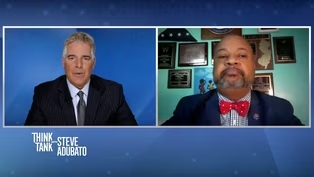
The Life & Legacy of the Late Congressman Donald Payne, Sr.
Video has Closed Captions
Clip: 6/5/2021 | 7m 49s | The Life & Legacy of the Late Congressman Donald Payne, Sr. (7m 49s)
Providing Support for PBS.org
Learn Moreabout PBS online sponsorship
- News and Public Affairs

Top journalists deliver compelling original analysis of the hour's headlines.

- News and Public Affairs

FRONTLINE is investigative journalism that questions, explains and changes our world.












Support for PBS provided by:
Think Tank with Steve Adubato is a local public television program presented by NJ PBS