
COVID Uncovered - 2/3/21
Episode 3 | 26m 46sVideo has Closed Captions
COVID cases are decreasing as the governor urges schools to return to in-person learning.
Governor Roy Cooper urges schools to offer in-person learning. A young, healthy Holly Springs man makes a miraculous recovery after suffering complications from COVID-19. How nurses are handling the stress and pressure of being on the frontline of the coronavirus fight. A Triad couple battles COVID-19 after the birth of their daughter. David Hurst hosts.
Problems playing video? | Closed Captioning Feedback
Problems playing video? | Closed Captioning Feedback
COVID Uncovered is a local public television program presented by PBS NC
COVID Uncovered - 2/3/21
Episode 3 | 26m 46sVideo has Closed Captions
Governor Roy Cooper urges schools to offer in-person learning. A young, healthy Holly Springs man makes a miraculous recovery after suffering complications from COVID-19. How nurses are handling the stress and pressure of being on the frontline of the coronavirus fight. A Triad couple battles COVID-19 after the birth of their daughter. David Hurst hosts.
Problems playing video? | Closed Captioning Feedback
How to Watch COVID Uncovered
COVID Uncovered is available to stream on pbs.org and the free PBS App, available on iPhone, Apple TV, Android TV, Android smartphones, Amazon Fire TV, Amazon Fire Tablet, Roku, Samsung Smart TV, and Vizio.
Providing Support for PBS.org
Learn Moreabout PBS online sponsorship>> Coming up on Covid Uncovered: >> Even the doctors were telling me all the time you're 29 you're healthy, exercise regularly.
We haven't seen many patients like you here.
>> a young healthy holly springs man makes a miraculous recovery after suffering complications from COVID-19 >> we thought it was hard in the beginning, we're at the hardest it's ever been right now.
>> and how nurses are handling the stress and pressure of being on the frontline of the coronavirus fight.
♪ WELCOME TO COVID: UNCOVERED.
I'M DAVID HURST.
COVID-19 NUMBERS ARE ON THEIR WAY DOWN, BUT STATE LEADERS SAY WE CAN'T LET OUR GUARD DOWN WITH NEW VARIANTS EMERGING.
HERE'S A LOOK AT THE COVID-19 DASHBOARD.
THESE ARE THE LATEST NUMBERS AS OF WEDNESDAY.
KELLY MCCULLEN HAS MORE ON HOW THE CORONAVIRUS IS AFFECTING YOU AND YOUR COMMUNITY.
>> North Carolina health leaders report favorable trends in hospitalizations and COVID-19 infection rates as we enter February with attention now turning towards vaccinations.
North Carolina health officials expect nearly 145,000 vaccine doses to arrive weekly in February.
>> And we efficiently and effectively get people vaccinated to the tune of maybe 70 to 85% of the population by the end of the SUMMER beginning of the fall, Then we will have gotten herd immunity, I believe, namely getting that blanket of protection oVER the community.
>> Turning towards politics is a national debate arising over remote learning in public education.
Senate Republicans in North Carolina, wANT all public schools to offer some in person learning options for every grade.
in Chicago, the mayor is questioning whether remote learning is equitable, AND HAS ORDERED Chicago classrooms to reopen.
>> Remote learning, it's just not working for too many of our kids particularly or black and brown students.
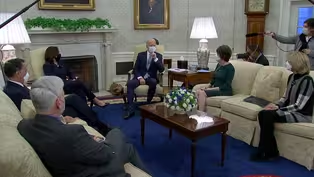
>> tEN us Senate Republicans met president Joe Biden to discuss additional COVID-19 relief.
>> It was a very good exchange of views.
I wouldN'T say that we came together on a package tonight, no one expected that in A 2 hour meeting.
>> Democratic congressional leaders are preparing to pass the 1.9 trillion dollar package with no Republican support.
Kelly mccullen reporting for covid uncovered.
THERE IS A PUSH FOR SCHOOLS TO RE-OPEN AND OFFER IN-PERSON LEARNING.
NEW THIS WEEK, GOVERNOR COOPER AND STATE EDUCATION LEADERS ARE JOINING THAT CALL.
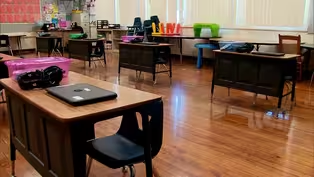
JOSHUA SENEGAL HAS MORE ON WHY THEY SAY NOW IS THE TIME TO ALLOW IN-PERSON LEARNING.
>> This week governor Roy Cooper is strongly urging public schools to allow students back in the classroom.
>> Educators parents and students have persevered.
We've learned much more about this virus.
And now it's time to get our children back into the classroom.
>> Some school districts have already returned to in person classes but many still rely on remote learning, and state leaders say those children have a higher risk of suffering from learning loss, mental health challenges, and food insecurity.
>> We also know that remote learning in this pandemic have taken a tremendous toll on thousands and thousands of families, disrupting jobs, childcare Healthcare, social networks and even food security.
In short, this crisis has negatively impacted students mental health And overall well-being as well as their academic preparation.
>> North Carolina secretary of Health and Human Services doctor Mandy Cohen says the data shows schools have a low rate of COVID-19 transmission as long as there are prevention measures in place.
she also points to research showing that kids infected with COVID-19 generally have mild symptoms or none at all and they're less likely to spread the disease.
>> A study by North Carolina's ABC collaborative found that if someone is attending school had COVID-19 it was very unlikely that they got COVID-19 at school or that they gave it to anyone else at the school.
>> Doctor Cohen notes that teachers are considered essential workers, and are up next to receive the COVID-19 vaccine.
Joshua Senegal reporting for covid uncovered.
>> I'm joined now by doctor Danny Benjamin, a distinguished professor at the Duke University School of Medicine.
I'm told everyone calls you Danny, Danny thanks for joining us today.
>> Right, yeah all the seven-year olds in clinic do that, so David you should do the same.
Thank you for having me.
>> Sounds good.
Danny, you were involved in that study that doctor Cohen just mentioned.
what were some of the main takeaways?
>> So fundamentally what schools need to do is to prevent transmission of COVID-19 at school.
We know that children will come in infected with COVID-19, we know adults will be infected with COVID-19 and they'll come to school with it.
but what schools really need to do is to prevent them from infecting each other Once they step onto school property.
If we can do that, then we provide a safe work environment.
if we have a safe work environment will have a safe learning environment, and it's clear from our study and others its schools are a safer work Environment than the general community.
>> So why do you suspect that there were so few COVID-19 transmissions within the schools that you studied?
>> Fundamentally what you have is a group of adults who committed their lives and their professional goals to provide a safe working and learning environment.
Principals, teachers, school bus drivers, cafeteria workers.
when was the last time you had to say to yourself, gee I wish that school bus driver would not text and drive?
you don't ever see that.
right?
you don't ever see school bus drivers get liquored up and driving down the road.
These are people who are dedicated to safety.
and they took simple instructions and they applied it to COVID-19, they applied it to the work environment, and they provided a safe environment for children and for adults as they always do.
>> So how confident are you that the school districts follow these safety protocols that you mentioned, that they'll be able to limit cases within the schools?
>> I'm confident of 3 things: number one, if schools are closed and only do remote learning we will have cases of COVID-19, and we'll have tragedy.
If schools are open we'll have cases of COVID-19, and we'll have tragedy.
but what I'm very confident of is that schools will have limited within school transmission If they do the mitigation strategies and that data is backed up by not only our study, but also Wisconsin and Mississippi and 10 other studies in the peer review literature.
You've got to have the mitigation strategies and if you do, you can provide a safe environment.
>> Now some are arguing with this debate of reopening or not that we should stay with online classes until teachers and school staff can be vaccinated.
what you think is the value of providing of vaccination to the school staff and to the teachers?
>> Well, fundamentally whenever you vaccinate one group of the population, You deprioritize another.
so if I prioritized school staff, then some other essential workers get deprioritized.
when I vaccinate somebody who say, works at a grocery store I've done a great thing for that person.
I've helped them and their family.
When I vaccinate a school bus driver or teacher, I've helped them and their family, but the value proposition of prioritizing school staff is, I help not only that bus driver, But I help the 30 people who ride the bus with that bus driver, and the families of those 30 children.
And when I prioritize school staff I not only those school staff, but I touch all of those children and all of those families.
and so while only 20% of the population is children, 50% of the population is directly impacted by the school system whether it's a child, a sibling, a family member, a caregiver or an employee.
So the value proposition of public health is to vaccinate school staff now.
>> And hopefully it will be soon.
Danny, thanks for taking the time and thanks for lending your insight on this topic.
Great thank you.
>> While data shows that children are less likely to spread the virus, that does not seem to be the case for young adults.
those aged 18 to 29 make up the highest case count for COVID-19.
most young people who test positive end up having mild or no symptoms, but some have experienced life threatening complications.
I spoke with a young healthy North Carolina man who experienced almost deadly side effects from the virus.
>> In the middle of their second year of marriage Ashley and Chavez Adams both tested positive for COVID-19.
>> It really feel like a mild cold for me.
I had some fatigue and cough.
>> Ashley got over the virus pretty quickly but Chavez battled complications for several weeks after, experiencing extreme fatigue, breathing difficulties, and fevers up to 105 degrees.
>> It was also very frustrating about the whole process going to doctor after doctor and not getting any answers.
>> They got so bad one night that the newlyweds ended up at the emergency room at wake med in Apex.
>> Turned out his blood pressure had bottomed out, his cardiac output was almost nonexistent and he was in a life or death Situation.
A Nurse checked his heart, and they discovered Chavez was suffering from myocarditis, an inflammation of the heart, and a life threatening complication of COVID-19.
>> Even the doctors were telling me all the time you're 29 you're healthy, excise regularly.
We haven't seen many patients like you here.
>> Doctors quickly put in a heart pump and Chavez was taken to the ICU after just a few days, the 29 year-old made what's being called a miraculous recovery, as doctors were able to take out the heart pump and send Chavez home.
>> The virus is real and the virus does not end within those 14 days that we experience something very life threatening A month after, you know, we've contracted the virus and so you know take it seriously, I take it more seriously now than ever before and is trying to ensure that my safety is at the top of my mind.
>> Outside of routine heart checkups, Chavez is now back to his normal self and the couple says they'll forever be grateful to The medical team that kept him alive.
>> I can't thank them enough for stepping in and saving his life.
it sounds so cliche when you hear it from other people sometimes, but having walked through that experience, I know what other people are really meaning now when they say they're so grateful that their husband's life was spared, their wife's life was spared, or something like that.
It's just a phenomenal feeling of thankfulness and gratefulness.
>> Joining me now is doctor blase Carabello chief of cardiology at Vidant Medical Center in Greenville.
doctor thanks for joining us today.
>> Happy to be here.
>> So doctor what exactly myocarditis and how common is it for those who test positive for COVID-19?
>> So whenever you hear the medical suffix, "itis", it means inflammation.
I'd wager, a 100% of your audience has had rhinitis, the inflammation in the nose when you get the common cold.
Obviously that goes away without any problem.
Myocarditis is an inflammation in the heart muscle which is obviously responsible for keeping you alive.
Sometimes that "itis" is very mild and sometimes in the case of a patient that you present it's very serious and disables the heart of being able to do its its function of pumping blood.
>> What are some of the other cardiovascular residual effects that you see in patients recovering from COVID-19?
>> That's the primary one.
most most patients or many patients, feel fatigued or out of breath after covid, but lots of times that's due to the virus itself into lung disease that heart disease.
the major heart problem is the myocarditis although any infection can trigger a heart attack.
Heart attacks occur when blood vessels get blocked, and it does appear that this virus has the ability to cause blood clots to form, and that that can cause a heart attack.
>> And do we know why some people who test positive for COVID-19 develop these symptoms and others don't?
>> we don't exactly though it does seem that the patients who have the most severe symptoms of the disease.
high fever, the kind of person that would likely come to the hospital because they're so ill. those are the same patients that likely get myocarditis.
It would be very unlikely that somebody who has No symptoms just happens to test positive is unlikely that that patients would end up with myocarditis.
the more severe the illness, the more likely it is it will affect the heart.
>> And when we think about the heart we think about exercising you know if I test positive for COVID-19 am I still good to exercise or should I wait?
>> I would wait.
this isn't like the 23 year-old athlete that tears a hamstring and part of rehab is getting that muscle going again some times very painfully and the athlete works through that.
This is an inflammation of the heart muscle.
It's much better to wait till you feel normal again.
start your exercise program and then do it gradually and cautiously because no hurry to get back on your feet after you've had covid.
>> And what are some other recommendations for keeping your heart healthy during this pandemic?
>> So first of all remember the hospitals are a safe place to be.
we see people avoiding coming to the hospital for a routine heart problem because they are afraid of catching the virus.
Every one in the hospital is tested.
the patients that have it are isolated.
You're much more likely to catch the virus in the grocery store than you are in the hospital.
So if you experience chest pain or trouble breathing, The kinds of things that a year and a half ago, would have causes you to seek medical care in the emergency department, go.
We find that people with heart attacks or -- This is nationwide -- are tending to have their heart attacks at home.
this is not a good place to have a heart attack.
theYou think you have a heart problem, come to the hospital.
>> And final question for you doctor, with the vaccine rolling out are we out of the woods yet or is this something people should still take seriously?
>> Well as a couple of days ago, only 2% of Americans in received their second shot.
So sure once we're immune, it does appear that the vaccines are incredibly effective.
So once you know people -- I think they still should be cautious, but once you are you're vacciinated, once everybody's vaccinated, we can get back to normal.
that's going to be a while.
it's taking a long time to roll this out.
>> Doctor Carabello, thank you for your time and for your insight on this topic.
>> My pleasure.
Thanks for having me.
IN THAT LAST STORY, WE HEARD CHAVEZ ADAMS CREDIT A NURSE WITH FIGURING OUT WHAT WAS WRONG WITH HIM.
IT'S NO DOUBT THAT NURSES ARE PLAYING A PIVOTAL ROLE IN THE FIGHT AGAINST COVID-19.
EVAN HOWELL GETS A FIRST-HAND LOOK AT WHAT IT'S LIKE TO BE A NURSE WORKING ON THE FRONT LINES OF THIS PANDEMIC.
>> Hello Haley.
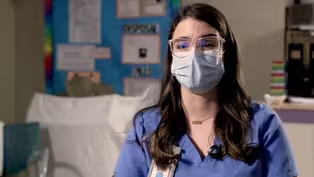
>> Emma worsley has only 2 years out of nursing school, and the pandemic is changing how she treats her patients.
>> They're by themselves.
you have to be there for them in a whole different way to just talk to them.
>> Both worsley's parents were nurses and she watched as they developed relationships with their patients.
It's something that's now difficult with strict hospital safety rules.
>> You have to make an effort to be there not just physically and passing their meds and doing their assessments you have to be there, you know emotionally to be able to Ask them you know "how are you doing, how's your family doing," because a lot of these people they have family that's sick at home or sick in the ICU and they're worried about them too.
>> The emotional toll is making an impact on nurses as well.
Before the pandemic an average of 18% of nurses showed signs of depression and anxiety.
since the pandemic began that number shot up to 50%.
>> Everything changed in March.
>> Suzanne Hartmeier just retired after working as a nurse for 33 years.
she worked through the HIV pandemic in the 80's, And later the Ebola virus.
But she says the last 10 months of her career were a nightmare.
>> I've seen a lot of death over the years.
But with covid, there was literally nothing that was working for these people, and they were just dying and dying and dying.
>> Hartmeier says hospital safety protocols would change weekly as staff tried to juggle treatment with little to no information about the virus.
>> People really didn't know fully at the time how a: deadly it was and B: how transmissible it was.
>> For Emma worsley, she's hopeful that as more Americans are vaccinated, the strain on hospitals and her fellow nurses will decrease, but when that will happen is still up in the air.
>> Just the uncertainty that you can't give these patients the answers that they're looking for because nobody really has a definite answer nobody can say when this will end, you know, We just don't know.
>> I'm joined now by doctor Dennis Taylor president of the North Carolina nurses Association.
doctor Taylor, thanks for joining us today.
>> Thank you appreciate you having me.
so you're on the front lines every day what's it been like fighting this virus The past 10, 11 months?
>> Well, I think it's been very difficult, especially in terms of personal communications and you know we just have not been able to do the things that we normally have done and obviously it has led to increase in that amount to work.
It's an increased amount of stress just being afraid that you're going to take this virus home to your family.
>> And you just alluded to this but what kind of impact is this pandemic having on the mental health nurses?
>> It's obviously having a lot and it's not only the stress at work.
But initially it was day care issues and school issues that the nurses were feeling In many of us that or into our careers may also be taking care of Parents and grandparents and folks like that we know that we're being exposed to the virus In the work environment, especially those of us who are working in hospital settings.
So it it has become very stressful mostly us not wanting to spread it to someone else.
>> And there was already a statewide nursing shortage prior to this pandemic.
how much has this virus made that problem worse?
>> Well, it's obviously impacted significantly.
Prior to the pandemic our educational institutions were still coming up short about 2000 nurses a year in terms of what we need we're seeing about somewhere between a 5 to 7% growth in the need for nurses, a lot of that has to do with those that are in that baby boomer age group that are retiring.
So we know already we're coming up about 2000 nurses a year short.
And what's happening is now with the pandemic and the increased numbers, When you look at hospitalizations and the number of available beds, it isn't so much that we don't have bed availability, We just don't have the staffing to staff those beds.
So we're having to rely on travel nurses on nurses that we are having to pay really extremely high salaries to that unfortunately leads to dissatisfaction for those people who have been working and working through this so we're seeing a significant amount of turnover in those areas and just as you saw in your prior segment of their lot of people who it is expedited their decision to retire.
>> And you wrote a letter to the governor earlier this month, saying nurses need help.
what can the state do to help support these frontline workers?
>> Well, the 3 big things that we really want to emphasize is first of all address and improve the salaries of nurse educators in the educational institutions that are teaching nursing.
One of the things we know right now is that a bedside nurse may take anywhere from 25 to 33% cut in pay just to go teach at an educational institution at a public educational institution.
So we would hope that the Legislature would look at what those salary scales are and significantly improve those.
The second big thing is passing the save act.
the save act is the safe affordable value directed excellent health care throughout North Carolina by modernizing the nurse regulations.
and to say that basically provides for full practice authority for all advanced practice Nurses.
Nurse practitioners, CRNAs certified nurse midwives and clinical nurse specialists.
There was a study that came out at Duke that said that the approval of this one piece of legislation could save the state anywhere from 400 million to 4 billion dollars a year.
And that is through job expansion and health care savings.
And then the 3rd big thing we would like the Legislature to do is to increase funding for school nurses.
One of the things that we would love to see is a school nurse in every elementary middle and high school Across North Carolina, and that's something we really hope that they will look at and address.
>> Doctor Taylor, thank you for taking the time and thank you for the work that you do in fighting this virus.
>> Thank you we appreciate you covering the story and thinking of us.
>> A POSITIVE PREGNANCY TEST CAN BE EXCITING NEWS FOR A TRYING COUPLE.
BUT A POSITIVE COVID-19 TEST, CAN BE TERRIFYING NEWS, ESPECIALLY WHEN THAT COUPLE IS ABOUT TO HAVE THEIR BABY.
THAT'S EXACTLY WHAT HAPPENED TO A WINSTON-SALEM COUPLE AND JEFF SMITH HAS THEIR STORY.
>> For most first time parents, getting the news that you're expecting is exciting.
>> I'll be honest, I was slightly terrified at first.
As the countdown to delivery day drew near the couple had planned for a dinner date to celebrate their expected arrival.
>> the day before when he got sick, I still really wasn't even thinking about it.
I was just like oh, you know, he thinks he has bronchitis.
he probably has bronchitis.
>> Jon Eric quickly went to get tested to make sure that he didn't have covid so he could attend the birth the next day.
>> 7 minutes later, he said I'm sorry but you tested positive for COVID-19.
Now, Jordan needed to be tested to be sure she didn't have the virus as well.
>> I got tested the day before I went in on that Tuesday and I was still negative.
they treated me as like a person under investigation since he was positive.
And then Wednesday evening I developed like a sore throat and was kind of stopped up and ended up testing positive Friday the day we left.
>> Jordan and Olivia went to her parents house to quarantine in the basement with her mom Amy.
Jon Eric remained quarantined separately.
>> They have a glass door in their basement and that's how he met Libya's through the glass door, and he would come pretty much every day.
>> every day.
>> and we'd Sit and talk through the glass door.
>> that was one of the hardest thing was being able to see her but not being able to hold her or be close to her, so one day, they came in the House and i was like, you do what you need to do and then I'm laying on the couch with her the rest of the night.
>> Yeah, >> Just get settled and give her to me.
>> Thank you for joining us this week.
Here's what's coming up next week on Covid uncovered.
>> thank you david.
This coronavirus situation changes almost daily.
we need to know exactly what's going on.
So next week, we're going to once again talk with doctor mandy cohen of dhhs and find out the latest on the coronavirus.
♪
Video has Closed Captions
Clip: Ep3 | 1m 43s | State leaders urge school district to return to in-person learning. (1m 43s)

Video has Closed Captions
Clip: Ep3 | 1m 39s | Winston-Salem couple deals with positive COVID-19 tests during birth of their firstborn. (1m 39s)

Video has Closed Captions
Clip: Ep3 | 2m 9s | The story of a young, healthy North Carolina man who had COVID-19 complications. (2m 9s)
Video has Closed Captions
Clip: Ep3 | 1m 36s | North Carolina vaccinations now top 1-million doses with more on the way. (1m 36s)
Video has Closed Captions
Clip: Ep3 | 2m 10s | Some nurses suffer mental health challenges as they fight COVID-19. (2m 10s)
Providing Support for PBS.org
Learn Moreabout PBS online sponsorship
- News and Public Affairs

Top journalists deliver compelling original analysis of the hour's headlines.

- News and Public Affairs

FRONTLINE is investigative journalism that questions, explains and changes our world.












Support for PBS provided by:
COVID Uncovered is a local public television program presented by PBS NC