
COVID-19’s Impact on Detroit One Year Later/Motown, Po-Town
Season 4 Episode 22 | 26m 29sVideo has Closed Captions
COVID’s Impact on Detroit One Year Later/Motown, Po-Town | Episode 422
How COVID has impacted where the city is headed when it comes to the tax base, housing, office space, restaurants, and mass transit. A look at what some call Detroit’s oldest monuments to racism, the I-75 and I-375 highways. There could be some changes when it comes to funding projects around the Great Lakes. Episode 422
Problems playing video? | Closed Captioning Feedback
Problems playing video? | Closed Captioning Feedback
One Detroit is a local public television program presented by Detroit PBS
COVID-19’s Impact on Detroit One Year Later/Motown, Po-Town
Season 4 Episode 22 | 26m 29sVideo has Closed Captions
How COVID has impacted where the city is headed when it comes to the tax base, housing, office space, restaurants, and mass transit. A look at what some call Detroit’s oldest monuments to racism, the I-75 and I-375 highways. There could be some changes when it comes to funding projects around the Great Lakes. Episode 422
Problems playing video? | Closed Captioning Feedback
How to Watch One Detroit
One Detroit is available to stream on pbs.org and the free PBS App, available on iPhone, Apple TV, Android TV, Android smartphones, Amazon Fire TV, Amazon Fire Tablet, Roku, Samsung Smart TV, and Vizio.
Providing Support for PBS.org
Learn Moreabout PBS online sponsorship- Hi, I'm Christy McDonald and here's what's coming up this week on One Detroit.
Taking a closer look at Detroit a year since COVID.
Mayor Duggan stated the city and Nolan and Steven weigh-in.
Plus, with the policies toward the Great Lakes change, now that there is a new President a Great Lakes Now report.
Then the creation of freeways in Detroit and around the country as Relics of Structural Racism.
And the history of Detroit potato chips.
It's as delicious as it sounds.
It's all coming up on One Detroit.
- [Announcer] From Delta faucets to Behr paint, Masco Corporation is proud to deliver products that enhance the way consumers all over the world experience and enjoy their living spaces.
Masco serving Michigan Communities since 1929.
- [Announcer] Support for this program provided by the Cynthia and Edsel Ford Fund for Journalism at Detroit Public TV, The Kresge Foundation Community Foundation for Southeast Michigan.
- [Announcer] The DTE Foundation is a proud sponsor of Detroit public TV among the State's largest Foundations committed to Michigan-focused giving.
We support organizations that are doing exceptional work in our state.
Visit DTEfoundation.com to learn more.
- Business leaders for Michigan dedicated to making Michigan a top 10 state for jobs, personal income, and a healthy economy also brought to you by and Viewers Like You.
(upbeat music) - Hi there and welcome to One Detroit I'm Christy McDonald.
Thanks so much for joining me.
I hope you're having a great week.
We have a lot ahead on the show for you.
Including a closer look at the city of Detroit one year since COVID.
Mayor Mike Duggan gave his state of the city address this month.
And coming up One Detroit contributors, Nolan Finley and Stephen Henderson talk about the biggest concerns.
Plus as The Country grapples with racism and monuments to the past, we wanted to take a look at the history of freeway building.
Not only here in Detroit, but around the Country.
Then the Biden administration hasn't wasted time making policy changes.
And Great Lakes Activists are now wondering if support for restoration projects and more to protect the lakes will be there.
It's a Great Lakes Now, special report.
And then we'll end with a little Detroit history.
We love our cars and music and pizza but don't forget about Detroit potato chips.
It's a good one.
And it's all ahead.
And we're starting off with the city of Detroit Tax base, housing, office space, restaurants... How has COVID impacted where the city is headed?
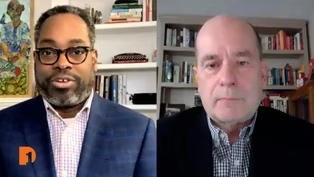
One Detroit contributors Nolan Finley the editorial page editor of the Detroit News and Stephen Henderson host of American Black journal have more.
- So Nolan, it was about a year ago that the world came a part, and here in Detroit, the thing that I remember is all of the apprehension and uncertainty of what we should do and shouldn't do.
I remember that there was a wedding that I was scheduled to attend on March 13th and all of the back and forth about whether that wedding could take place whether people could be there together.
And of course, just a few days later the governor shut the state down and we started really feeling the effects of the pandemic.
A year later, I don't think any of us could have imagined how dramatic the effects and the consequences would be for Detroit and Detroiter.
And we, you know, we really still don't know for as with any kind of certainty, what we can do and what we can't do and be safe.
I think fortunately the vaccines are moving through and, you know, we're on pace to get pretty widespread vaccination by summertime.
If you think about the way Detroit was impacted early on the extraordinarily high infection and death rates in Detroit.
And you know, the state made a pretty good response to that because that's sort of equaled out, as the year went on, but it should be some sort of a clarion call going to forward to improving access to healthcare in the city.
I think the other thing, Steve, and I'd like to hear your thoughts on it is what happens to the, you know sort of that robust comeback Detroit was in, undergoing to at the start of the pandemic.
What will happen with all of this office space?
What happens to transit?
What happens to the once vibrant or getting to be vibrant entertainment scene?
- Yeah, I was downtown last week just to be down there and I was stunned at how different it is still.
It feels like Detroit 2007/8 not Detroit 2020 or 2021.
You know, the... We were just on the edge I feel like of really having that critical density that we were trying to build downtown in terms of both working and entertainment.
And this just sucks the wind out of that.
I don't know how much of that comes back.
I think that has implications for all kinds of other areas of the city as well.
You know, if you don't have the money coming in downtown you know, do you have any chance of helping neighborhoods that weren't benefiting as much?
Anyway, I think that if you're the Mayor or the council is one of your primary concerns going to forward is how do you rebuild that-that momentum?
I also feel like we're not quite there as Detroiters because you know, the personal toll of this in Detroit, it's just different than it was other places as you point out.
And we continue to lose people.
You know, I'm up to 13 now, people that I knew who died from COVID including just a few weeks ago.
Karen Hudson Samuels, who was instrumental in the WGPR museum.
It's just unfathomable, how many people won't be around?
- Oh, I was just gathering up my dry cleaning when it hit me, oh, my dry cleaner died a few weeks ago.
I don't have a dry cleaner more.
But if you look in Detroit it's all this commercial space that went online over the last couple of three years.
We don't know that people are going to be returning to workspaces in the manner they, they worked before the pandemic.
I think work has changed.
The nature of work has changed.
We've learned a lot about what's, what... How people need to be deployed and what's possible through, we can do through a remote workforce.
I think that very expensive downtown office space is now vulnerable, because again, a lot of money was spent developing it and it hasn't been paid for yet.
And you can say what will convert that into residential space, but that's a big expense.
- Yeah, well, it's a big expense.
And if you look at vacancies in downtown mills, you know, a year ago, you had to get on a wait-list.
An apartment in downtown Detroit, right now you can get an apartment tomorrow and they'll cut the rental, by, you know, 25-30% to... - Yeah!
- You know, The entire premise for density, which is what we were trying to build down there looks different now.
I mean the entire infrastructure of the idea of a city that dense, I think is being rethought.
And, you know, for us it means more because we were just getting to the point.
- We were just there, and I would just say that you don't hear anybody talking about mass transit now and there's no certainty about where that's going to go.
Because if the commuter workforce has gone the case for a very expensive comprehensive mass transit plan is harder to make.
I think there's a lot of things we're going to find here over the next few months, that just will never be normal again.
- Plans to remove I-375 and create a Boulevard in Detroit are slowly moving forward.
And what's happening here is sparking conversations about freeways around the country as Relics of Structural Racism; when you look at why and where they were constructed.
Well, Detroit Will Glover has the story.
- You could look at any other part of the country, and you would say you can't have a strong region without a strong city?
I would say racism here was so deep that they were willing to kill the city in spite of themselves.
- [Voice over] Detroit, the crossroads of half the population of the United States is but minutes away... - [Narrator] Starting in the late 1950s construction of the I-75 and I-375 highways cut through some of Detroit's most prosperous Black neighborhoods of Black Bottom and Paradise Valley, which rivaled New York Harlem and Tulsa, Oklahoma is Black wall street.
Thousands were displaced, erasing generations of wealth.
Some call these highways Detroit's largest monument to racism.
This is Detroit historian, Jamon Jordan.
- Historically the building of these freeways affected the whole country.
It didn't just affect Detroit.
But largely, one of the major areas that they affected almost everywhere they went was African-American communities.
- [Narrator] But could there be a way to rebuild the wealth and opportunity for the next generation of Black Detroiters?
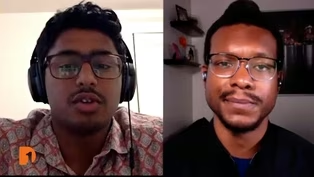
I spoke with freelance writer, Nithin Vajendla whose recent article on Detroit highways being racist appeared in the Detroit Free Press.
- Start with how a freeway, could possibly be a symbol of racism.
- So you look at a construction, the freeways, and they were rather primarily through Black neighborhoods, because at that time and still, even now Black Communities had less power had less political power to be able to resist these kinds of really disruptive changes.
And because of racist redlining policies, land and houses and homes and black neighborhoods were worth far less than homes in white neighborhoods.
- [Narrator] Detroit, wasn't the only city being dissected by highways.
In fact, the man who set the national trend for city planning started in New York city.
His name was Robert Moses.
- [Announcer] Robert Moses, New York city construction coordinator, is world-famous highway planner.
A man who knows his business.
- [Narrator] In a 1974 biography, It was said, Moses suggested suburbs make the water in their community pools colder, to keep Black people from swimming with Whites.
Closer to home, It was Detroit Mayor, Albert Cobo, who put together the plans to build the freeways that in 1956 would decimate Black Bottom and Paradise Valley.
- There are arguments that he'd do it because he's a racist.
and the shortest black the world was left of a black community or did he do it because it was the most feasible place to put a freeway.
And so arguments go both ways.
But looking at the history of Cobo, his acts, his policies and his ideas about the African-American community.
It's pretty clear that this was not a coincidence.
- [Narrator] This is Wing State University law professor and director of the Damon J.Keith Center for Civil Rights, Peter hammer.
- Think about structural racism and think about how structural racism is defined at the key center.
We're looking at the Interinstitutional Dynamics that produce and reproduce racially disparate outcomes over time.
When the freeways were started everyone thought these White people particularly thought this is development.
And it was also thought of necessary for part of a national plan of, of interstate networks, and also for the creation and cohesion of the suburbs.
Now you sort of imagine that that's the city of underwriting its own demise, right?
So the expressways were thought, well, these are easy ways for Detroiters to go out to the suburbs and come back.
They were also easy ways for Detroiters in the suburbs and never come back.
- [Announcer] Sleeves rolled up, you try to levels and shifts and carves the contours of a new city.
And a new spirit of progress matches the vision of its people.
- What was I-75 before it was I-75, right?
And it was Hasting street.
And Hasting street ran up and down Paradise Valley, which was the most important and most concentrated African-American business district and living district anywhere in the city.
So Tulsa has got a lot of, attention lately for very legitimate reasons.
And they told that the Black wall street and that was destroyed by a race riot.
Detroit's black wall street was destroyed by quote-unquote development and the construction of the expressways and the destruction of Paradise Valley.
And people who run up and down I-75 today have no clue.
- [Announcer] Detroit is borrowing funds to build more miles of expressway and build them today instead of years from now.
- [Narrator] The question now can Detroit reverse the process?
That is removed freeways.
Cities like Milwaukee and San Francisco, already have.
- You look at San Francisco, San Francisco's and park at the freeway was heavily damaged in an earthquake in 1970.
Instead of repairing it and simply just remove it.
And when they did that, you know, traffic didn't insignificantly increase, it didn't cause massive, traffic jams, and it significantly improved quality of life for a lot of people.
- [Narrator] I spoke with civic engagement expert and Dean of the school of architecture, at the University of Detroit Mercy, Dan Pitera.
- What, what is the economic impact, you know, to the extent that you can speak on it of undertaking such a project?
- Think about what a scale of a project like this would do, and think about the...
The numbers of thousands of jobs that could truly be generated across the decade of time from planning, engineering, surfing.
It really is we're talking, we're talking thousands upon thousands of jobs that are possible.
Which then means, that we have to then not just plan for the jobs but plan for the preparing and working with people to be ready for those jobs.
- [Narrator] The Michigan department of transportation was to soon start the removal of I-375 in downtown Detroit.
But the project was delayed because of the pandemic.
- Do you think that removing the highway is an opportunity to address some of these, you know historically, you know, systemically racist issues?
- No, I don't think you could make any credible connection to removing highways and, today in undoing the harm that was done.
- The fielding in the I-375, is not harming the African-American community but it won't bring Black Bottom back.
- [Narrator] Many believe that undoing the damage to Black American Communities in cities like Detroit means investing in Black neighborhoods at the same scale and with the same resolve White suburbs received during urban renewal.
- It's a matter of who has the power which means that at the end of the day, if you're not changing the belief system, right?
The sort of highly racialized belief system that have created this history.
Then you have no chance of digging yourself out of the hole.
So a lot of effort has to be of really intentionally reshaping the white mind, right?
In a way that can transcend the sort of a white supremacist heritage that we have received.
- [Narrator] Regarding that stretch of freeway connecting the Chrysler freeway to the downtown riverfront I-375.
With some can't help, but see, as a major symbol of racism will remain for a few more years.
Maybe then the many millions of dollars needed will return to state coffers, allowing for it to be filled in and receive a proper burial.
- President Biden's administration is bringing policy changes from immigration, to the minimum wage, to stimulus checks and more.
And in our Great Lakes Now report, there could be some changes when it comes to funding projects around the Great Lakes.
The Great Lakes Restoration Initiative or GLRI was created to protect and restore the largest system of fresh surface water in the world.
- Really over about 5 to 6 years, there was a great deal of effort to convince Washington that the Great Lakes are a National Treasure.
President Obama came into office.
He had made it a priority in his campaign and a bipartisan Congress signed off on the bill to create the Great Lakes Restoration Initiative which went through in 2009.
- [Narrator] Cameron Davis coordinated a Great Lakes Interagency task force of 11 federal departments under the GLRI, to address five focus areas: Toxic substances and areas of concern, Invasive species, Nonpoint source pollution impact on nearshore health, Habitats and species, and Foundations for future restoration actions.
- So there are things like trying to block invasive species.
Keep invasive species out of the Great Lakes like Asian car.
Trying to clean up toxic hotspots.
These are working harbors and rivers around the Great Lakes that have seen what we call legacy pollutants.
Be discharged over time into those waterways trying to reduce polluted runoff that creates harmful or toxic algae.
Like the kind we've seen around like areas of real priority rebuilding habitat as a priority and also working to help educate the public and make sure that climate change does not undo the important work that's being done right now to restore the Great Lakes.
- [Narrator] Since 2010 GLRI federal agencies have invested over $2.7 billion in more than 5,400 projects across all eight Great Lakes States.
According to the EPA of the 31 US sites that were originally listed as areas of concern, 15 have been de-listed or have achieved an all management actions complete status.
- Actually, I think we're going to wind up finishing the job of these cleanups really in the next, in the next 10-20 years.
There are many of us who thought that may or may never see that.
- [Narrator] Funds to support the GLRI, are appropriated to the environmental protection agency, which provides funding for restoration projects.
The GLRI was originally funded under President Obama at $475 million.
The budget was reduced to $300 million for 2011.
And it stayed at about that level ever since.
In 2019 President Trump proposed a budget that would have reduced funding for the program by 90% from $300 million to $30 million.
Congress rejected that proposal, so the cuts never went into effect.
And in March of that year, Trump reversed direction during a speech at a rally in Grand Rapids, Michigan - I support the Great Lakes, Always have.
They're beautiful.
They're big, very deep record deepness, right?
And I'm going to get in honor of my friends full funding of $300 million for the Great Lakes Restoration Initiative.
(crowd applauding) - [Narrator] Dr. Alan Steinman is a member of the Great Lakes advisory board that provides advice and recommendations to the EPA on GLRI projects.
- With the latest appropriations, it's going to up to $475 million a year.
So at $25 million chunks is going to be increased with each year, assuming that Congress actually appropriates that money each year.
So that's a really significant increase.
- [Narrator] Aside from the environmental impacts the GLRI effect on the region's economy is significant.
- It's been shown through a number of economic studies.
For every dollar, you invest in restoration large-scale ecosystem restoration, there's a return on that investment of somewhere between 3:1 to 6:1.
And so it makes good economic sense to restore these systems beyond just the spiritual and recreational and human health aspects associated with this.
- Restoring the Great Lakes is not just the work of a lifetime.
It's the work of a hundred generations.
Nobody else in the world has Great Lakes like these, nobody.
We have them, they're ours.
We like to share them, but with that privilege comes the responsibility keep them healthy, so that we in return can keep ourselves healthy.
- And for more of our reports on the Great Lakes just head to GreatLakesNow.org - And finally, how about a little bit of Detroit history when it comes to potato chips.
Here's a little chip 101 from our Detroit public television documentary, Detroit Remember When: Made in the Motor City.
(cheerful music) - [Announcer] You know, maybe we should call our beloved Motown, Potown.
Because we eat so many potato chips here more per capita really than anywhere else.
How come, well our emotional attachment runs all the way back to the 1920s.
With that iconic brand in the yellow package.
- Better Made Potato Chips, one of my favorites to this day.
Can't get it any better.
- Better Made had to be Better Made.
- I must skip two letters a week of people wanting to buy us.
I just disregard them because I wanted to keep it as a family business, you know.
My dad and his cousin decided to start a potato chip company since it was all the rage at the time.
- [Narrator] Peter Cipriano came over from Italy at the age of 17.
Cross Moceri worked for Best Made potato chips when Best Made closed.
The two got together and Cipriano got it cooking.
- So you use the best oil, the best potatoes, good salt and he named it Better Made that's M-A-D-E. - [Narrator] They sold chips a nickle bag on Belle isle.
Cause back then more than 20 other companies were making chips town.
- They were all competing for that new snack food business, you know.
- [Narrator] So, chippers open storefront, selling nothing but potato chips.
Better Made even had shops next door to movie theaters.
(bouncy piano music) - [Narrator] In postwar Detroit, New Era potato chips grew into a regional brand.
With factories in Detroit, Chicago and Wooster, Ohio.
- New Era was probably our stiffest competition.
- [Narrator] Frito actually bought New Era back in the 1950s.
And then after Frito merged with Lay New Era, well, it sort of just faded away.
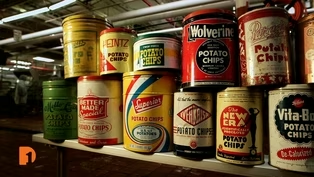
Sal Cipriano's collection of chip canisters are a daily reminder of all the fallen brands.
- Vita-Boy was here and there was Krun-Chee and Wolverine and even Twin Pines.
The dairy company made potato chips for a while.
- [Narrator] Superior stuck around until the 1980s.
Better Made still making chips on Gratiot right across the street from where many of Detroit's first Italian families lived.
- Nice.
I never met a chip I didn't like.
For more stories from Detroit Remember When: Made in the Motor City and everything that we're working on.
Just head to our website at OneDetriotPBS.org and find us on social media.
That's going to do it for me.
Have a great weekend.
I will see you next week on One Detroit, take care.
- [Announcer] You can find more at OneDetroitPBS.org or subscribe to our social media channels and sign up for our One Detroit Newsletter.
COVID-19’s Impact on Detroit One Year Later
Video has Closed Captions
Clip: S4 Ep22 | 5m 28s | Nolan and Stephen take a closer look at Detroit a year since COVID | Episode 422/Segment 1 (5m 28s)

GLN: A New Administration and Investing in the Great Lakes
Video has Closed Captions
Clip: S4 Ep22 | 4m 49s | How will the new administration affect funding for the Great Lakes? GLN has more. (4m 49s)
Video has Closed Captions
Clip: S4 Ep22 | 7m 33s | Will Glover looks at what some call Detroit’s oldest monuments to racism: its highways. (7m 33s)
Video has Closed Captions
Clip: S4 Ep22 | 2m 24s | The history of Detroit potato chips. And, yes, it's as delicious as it sounds. (2m 24s)
Providing Support for PBS.org
Learn Moreabout PBS online sponsorship
- News and Public Affairs

Top journalists deliver compelling original analysis of the hour's headlines.

- News and Public Affairs

FRONTLINE is investigative journalism that questions, explains and changes our world.












Support for PBS provided by:
One Detroit is a local public television program presented by Detroit PBS