
Creative Fire
Season 9 Episode 7 | 26m 45sVideo has Closed Captions
Meet the creators of a popular podcast and a muralist exploring culture and belonging.
Phoebe Judge and Lauren Spohrer, cocreators of the award-winning podcast Criminal, share how they spark intrigue with their true-crime storytelling. Plus, muralist Gabriel Eng-Goetz discusses what drives him to create art that represents culture, understanding and hope.
Problems playing video? | Closed Captioning Feedback
Problems playing video? | Closed Captioning Feedback
My Home, NC is a local public television program presented by PBS NC
Creative Fire
Season 9 Episode 7 | 26m 45sVideo has Closed Captions
Phoebe Judge and Lauren Spohrer, cocreators of the award-winning podcast Criminal, share how they spark intrigue with their true-crime storytelling. Plus, muralist Gabriel Eng-Goetz discusses what drives him to create art that represents culture, understanding and hope.
Problems playing video? | Closed Captioning Feedback
How to Watch My Home, NC
My Home, NC is available to stream on pbs.org and the free PBS App, available on iPhone, Apple TV, Android TV, Android smartphones, Amazon Fire TV, Amazon Fire Tablet, Roku, Samsung Smart TV, and Vizio.
Watch My Home, NC on YouTube
Enjoy a unique look at the food, music, people and culture that make North Carolina our home on the My Home, NC YouTube channel.Providing Support for PBS.org
Learn Moreabout PBS online sponsorship[piano intro] - [Narrator] We are building a creative fire with stories of belonging, exploration, and even crime.
Learn how a story or visual can change perspectives.
Whether an award-winning podcast or art for everyone, it's all on "My Home".
Coming up, next.
[upbeat music] All across the state, we are uncovering the unique stories that make North Carolina my home.
♪ Come home ♪ ♪ Come home ♪ [suspenseful music] [suspenseful music continues] - We're coming on working together for more than a decade now.
And I think when we started "Criminal", Lauren and I were both working in public radio at WUNC and we were sitting on my back porch one night in Chapel Hill and Lauren said, "Well, what if we make our own show and we don't have to ask anyone what to do or what stories we should cover?
We'll just do whatever we're curious about."
And I said, "Well, that's a good idea.
What should we do it about?"
And Lauren said, "How about crime?"
And I thought, "Well, that's the smartest thing I've ever heard.
We're never gonna run out of stories."
I'm Phoebe Judge, this is "Criminal".
[suspenseful music] - I remember one of the early episodes we interviewed this man about getting the phone call that his family members had been killed in a mass shooting.
- [Speaker] And the phone rang and I looked down and it was mom's cell.
And so, I walked out to where I could hear and she told me, she said, you know, "Your father's dead."
- And I remember being really nervous about this and saying to Phoebe like, "I don't think we should bother them.
I don't think we should talk to them.
We have to leave them alone in some way."
But we like crafted this sort of request to see like, would they be interested in talking about this experience?
And they said, "Yes."
And then, I had never had that experience of someone getting to talk as long as they wanted.
- Family members of murder victims are often captured on television, were shown their grief and we watched them try to respond when they're asked impossible questions.
Lauren and I thought, well, wait a second.
Someone might see this who actually was impacted by this crime?
What will they think?
And we have to be aware of who the audience could be.
And we weren't seeing enough of that compassion or empathy or respect for the people impacted by these stories.
It was just ratings a lot of the time.
And we thought, well, I think maybe we could do it a little bit better.
[somber music] - [Speaker] I feel like that we did my father, Henry, proud.
And I think we continue to, and maybe helping people figure out how to get through it, you know, that it is okay to release the names and release some pictures.
It's okay.
Tell your story.
Tell your loved one's story the way you want it to be told.
It's gonna get told one way or the other.
You may as well be the ones, you know, trying to do the telling.
- What we wanted was to talk for an hour and have a conversation and sort of think about this experience that we don't know anything about, but this person has.
And so, I think a sort of very patient sort of slow conversational approach that was something that we didn't see anyone else doing.
And you know, like people are very curious about Phoebe's voice and she does speak slowly and she listens.
And I think that, that sort of, we were able to sort of build something out of our natural curiosities and her natural skills.
In my experience working in public radio, no one pitched anything about crime stories, but there was a sort of sense that, that was lowbrow and that, that was for local news.
and that sort of like, if it bleeds it leads sensational crime storytelling was somehow like beneath public radio.
And we had all these skills.
As you know, Phoebe was guest hosting and I had been producing forever.
I was directing, you know, we had these skills and then I thought like, no one is taking this sort of lens or this sort of like humane sensibility and just interviewing people who've been impacted by crime.
So, it felt to us like we were gonna try to bring our skills to something that nobody else was doing.
Go back, like read ahead from Harris.
- They arrested Robert Harris.
There was never any contest.
None of it had been real.
There wasn't a flat tire, there wasn't a television station and there wasn't a breakfast with Boy George.
The whole thing had been a sting.
I'm Phoebe Judge, this is "Criminal".
- [Lauren] Pretty good.
Pretty good.
- I think we could start it.
I think we need to start it after there, 'cause I'm rushing.
Let's just try it with there.
Okay, ready?
- No.
- We just sort of offered people a different way to think about crime stories on the radio.
We still say radio.
We don't say podcasts.
- We also were I think responding to the types of crime reporting that we were seeing out there.
Be that print or television or radio.
I mean, it dramatized the worst moments of someone's life.
It focused on the violence, it's sensationalized.
It focused on fear, you know, there was a thrill that someone was supposed to get by reading these stories.
[somber music] Had chosen to pick up the gun or the knife.
This is Gordon Parks.
My new suggestion is this.
[pensive music] - What else do you have?
- When he was 25 years old, Gordon Parks bought a camera in a pawn shop.
- It feels like French cooking show.
- Because I think Lauren and I have been successful at this for so long, because we have rather a common worldview, which is that I don't think either one of us believe that people are evil.
I think we believe people do bad things and they get themselves into horrible circumstances.
But if you don't believe at a base level that you can call someone good or bad, it opens up the way that you tell a story.
You have more curiosity about how people get themselves in the positions that they do.
[somber music] The judge who presided over Trevell's trial also sent Steve a letter to include.
It began, "In more than 34 years on the bench, I never previously submitted a letter in support of a clemency application.
I enthusiastically do so now on behalf of Trevell Coleman."
He wrote about Trevell turning himself in.
In my experience, such an act of conscience is vanishingly rare.
Well, the fact that Trevell Coleman shot a gun is not that interesting.
What's interesting in that story is that he decided that he couldn't live with himself and that he would turn himself in that many years later.
That's the interesting part of it.
People are shot every day.
Usually, it's a terrible mistake.
Usually, it's not that premeditated.
Something happens.
That story, we could tell that story 1,000 times a day, But the difference between Trevell's story is that this is a guy who did something.
He wasn't actually, I think meaning to shoot this man.
It happened, it was a robbery gone bad, but he couldn't live with himself.
And so, he took himself to a police station twice, because he showed up the first time and the cop said, "Get outta here.
What are you talking about?"
And it wasn't good enough.
And so, he came back and he said, "No, I have to know.
I shot a man many years ago and I don't know if he survived."
That to us is why we told Trevell Coleman's story.
It was not that an act happened when he was a teenager.
It was that this man could not live with himself.
And so for us, that's why we tell the story.
It's not enough that a crime was committed.
It's how complex the things get after the crime is committed.
And you know, a lot of people have said, "Well, you're a true crime show."
And I said, "Yes, we're a true crime show, I guess, but we're really kind of just a show about the human experience.
[somber music] [Phoebe speaking indistinctly] [somber music continues] - There's nothing Phoebe likes more than a live show.
[Phoebe chuckling] Really, which is, I mean, I get it because we are alone in working at our computers in sort of dark rooms, dark studios.
- [MC] Phoebe, we told lies.
[audience cheering] [audience applauding] - Telling stories and telling jokes and saying phrases all the time.
I have no idea how the audience is reacting.
They're hearing me in their ears, but I can't see their faces.
And so, it's thrilling and terrifying at the same time to be there in front of 1,000 people saying those words and being able to look in their face and see if they're smiling, or nodding, or if they're asleep.
But it's such a nice thing to meet people, you know, to meet people who've been with us on this journey for today.
Would you like it to say anything?
- I mean, "To Megen from Phoebe," is great.
- Megan with an H?
- An E-G, again?
Yes.
- No H?
- No H no.
- You have been to the show before?
- No, this is my first time.
I lived in Greensboro for a long time.
- We know that at any moment someone can turn us off.
And so, it's our job to gain their time and attention and this 10th anniversary tour is an opportunity.
Yes, it's fun to go around the country and to do this in front of an audience, but it's also a chance for us to say thank you for sticking with us for all of these years and we hope to keep bringing you the show for a long time.
- Thank you again for just having, making the podcasts and continuing to doing it.
- We're gonna try to keep making it.
- My favorite hands down.
[suspenseful music] [gentle music] - Can you imagine living in a city or a world where there wasn't any public artwork?
Like you had to go to a gallery or someone's house to see a piece of art?
That sounds like a terrible world to me.
[upbeat music] You need color in the world, and public art tells a story, but also just makes a place less drab.
Public art is not about me, it's about a town, it's about a city, it's about a place, it's about people.
Community engagement is just as or more important than the artwork itself.
That's really where it starts and what it's all about.
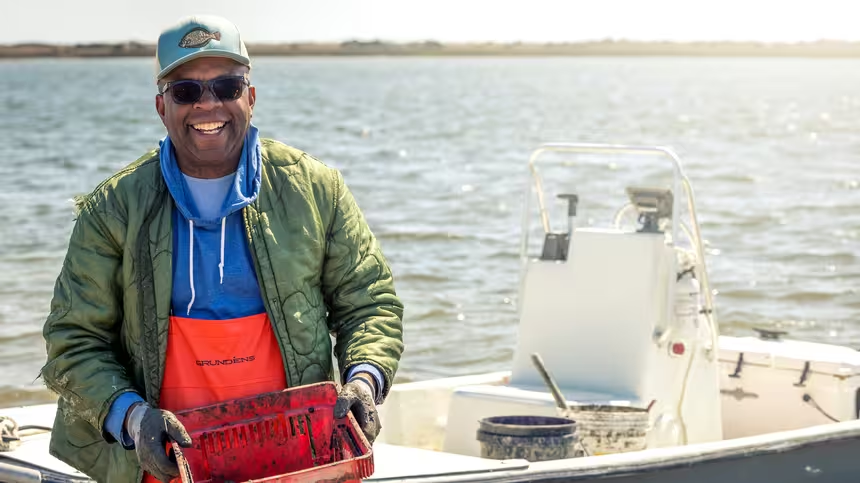
My name is Gabriel Eng-Goetz and I'm from Durham, North Carolina.
[upbeat music] [birds chirping] Public art is something I always knew I wanted to do.
It was just a matter of when.
[birds chirping] After art school I really wanted to figure out how I could create a link between fashion and music and just push both cultures.
So, I created a brand called Runaway.
[upbeat music] I had opened a store on Main Street in downtown Durham and we were hosting, you know, listening parties for local musicians, art shows.
More so than just a clothing company it became a creative platform.
Instead of me just trying to be this solo artist who was just pushing my work, it was like, why don't we come together and really become like this almost collective?
That's really where I kind of realized, okay, like my journey as an artist, whether it's illustration or music art or clothing or now murals and public art, the muse of community has always tied it all together.
That's the one cohesive factor.
[birds chirping] Being a muralist is like being in a long distance relationship.
[person chuckling] You're on the road a lot.
It's really hard work.
Sometimes you'll be tempted by that stable career gazing at you from across the room, but you think back to it though and like continue to do it just 'cause I love it and it's like, you know, always there for me.
So much of my work is about cultural identity outside of just nature and our connection to it, which is a big theme as well.
Cultural identity is huger than my work, especially with public art.
For myself personally, you know, I'm still trying to find my own cultural identity and I think most of us are.
Like, life is really about experiences, relationships, and where do you kind of fit in, and what is your identity.
For me, being a Chinese American person of mixed race, living in the South, just as a kid, like just confused, right?
Kids used to think I was Hispanic until like I got to a certain age and they kind of figure out, oh, his eyes are a little bit.
So like for me, I love to go in and really find other stories here of people who haven't necessarily been listened to.
Where voices for more marginalized communities don't necessarily have a platform or heard, public art goes so much deeper than just enhancing a place.
There is representation there, there's acknowledgement.
You know, it's easy to go into a town and be like, oh hey, like I'm just gonna hang out in downtown, talk to a few people, and we're gonna represent them.
I'm trying to go out in the cut and find these people.
Figure out how I can talk to them and then figure out ways that I can tell their story.
Here in Durham, I decided, you know, I don't see any public artwork really acknowledging this land as indigenous.
I then contacted the Occaneechi tribe and I worked with the tribal council to like gimme their blessing, but also their guidance on imagery for a mural on the Willard Street affordable housing complex right in downtown Durham.
Everything down from the colors, the plant species, the patterns that are within the piece were all from conversations with the tribe.
Public art, it should always be about the people and the place.
Any way you can tie in actual community members working on the project, that's just even better.
[gentle music] [paint guggling] - [Speaker] We didn't know you got to work with the paint.
- [Speaker] Yeah.
[paint guggling] - Yes.
Junior, you're learning.
- My experience working on these public art sites where I'm, you know, painting a piece for two, three weeks at a time, the amount of kids and young adults that come up to me and say, "Hey, how are you doing this?
How can I get into this?"
Like this is crazy to me.
What attracts me so much about public art is it's not about me and it's not necessarily shining myself as someone special.
[lift whirring] It's always be about the people and the place.
- Yeah, but this is extraordinary.
This is one of the best ones I've ever seen.
- [Gabriel] Wow.
Well, that's high praise.
I appreciate it.
- In fact, I'd say it is the best one I've ever seen.
- Okay, here we go.
For me, it's really just about connection.
If I'm going to a new city or town, it's gotta be about them.
[birds chirping] [lift whirring] [gentle music] You know, I'll be, you know, so focused on this wall, you know, staring at it for hours and I'll look up and you know, you just see this beautiful sunset.
Those moments are really where I feel like super grateful, 'cause I'm like literally working outside doing what I love the most and as a career.
[birds chirping] Fishing for me and art, there's a lot of parallels there.
For me personally.
You know, it's definitely meditative, it's challenging.
I'm learning something all the time.
And again, it's just kind of this like wonder of what else is out there, like what's beneath the surface or what is in that town or that city that I haven't uncovered yet.
You never quite know where that's gonna lead you and that's really what it's all about for me, and keeps me coming back for more.
[gentle music] [skateboard rambling] [suspenseful music] - Growing up as a skateboarder, as you're, you know, doing this thing that you love, but somehow a good bit of society's not seeing that as a positive thing and it kind of fuels your drive to make your own things.
Like that's the do-it-yourself ethic that I think skateboarding kind of puts out there is that there'd be nowhere to skate.
It's illegal.
It's illegal to ride anywhere else.
So, unless we go build something for ourselves, then where are we gonna do this thing that we love?
[somber music] [somber music continues] [upbeat music] As far as the art goes, that's always been a part of it.
And being that a lot of us that skateboard are also artists.
A lot of us consider skateboarding an art as well.
And so, it all kind of gets put together in that kinda way.
[upbeat music] [upbeat music continues] [skateboard rambling] Free space to come explore and be creative and you know, with the art that surrounds there and the skateboarding and we consider the skate park sculpture in itself, like a skateable sculpture garden.
So, it's all about the art and freedom of skateboarding.
[upbeat music continues] [gentle music] - I grew up in the early nineties and it was really big graffiti scene at the time.
Kind of as long as I can remember, I saw graffiti.
And growing up around hip hop kids and skateboard kids, just kind of naturally fell into it.
People were drawn to this area, I think because no one cared about it.
A bunch of abandoned warehouses you can go back and spend time doing graffiti on it.
You know, do some big production pieces that took more time.
Nobody would actually pay attention to it at all except for other graffiti artists.
And then for the skaters there was basically just driving around looking for something to skate.
There was a big foundation of a building that got ripped down.
That's why it's called The Foundation.
[skateboards rambling] - In the beginning, it was kind of like our secret spot that we just started putting things.
The former owner of the whole area down there he was sympathetic to us.
He had a son that was also into graffiti and skateboarding, and so, he basically told us that if we kept the place clean, that it was okay to be there, and we could kind of do what we wanted.
So now, we actually leased the property and we insure it for the year, and we work with a local nonprofit Arts to People.
So, that's where a lot of the growth has come from is that once we became legitimate, it was like, well, let's see how far we can take it.
And that's how it started.
[suspenseful music] From that point, we started building more out of wood.
Some of the local skate parks in the town had closed down, so we'd gotten materials from them.
And people like Alex Irvine been a big spearheader of these projects.
[suspenseful music continues] - My involvement building stuff at The Foundation Skate Park has definitely been kind of symbiotic with Push Skateshop & Gallery.
I had an art show at Push, I had like T-shirts for sale, ceramic sculptures, raised like about 1,500 bucks.
1,000 of that went toward renting a dumpster to clean up the place.
It was all sorts of like just trash laying around.
And then there was just enough money to buy the concrete and then like other skaters in the community got really excited and it was definitely like a community effort.
My friends and I will come up with an idea of something to to build.
For instance, for that wave in the middle of the skate park that was in an art gallery and then it was at the skate park.
[suspenseful music continues] I think The Foundation and the graffiti around it, they're important, because people crave authenticity.
Everybody's trying to sell you something.
Every corner you walk around.
Down there, we're not trying to sell you anything.
We're just trying to, you know, celebrate, you know, time we have here.
Bask in the joy of our own creativity.
[dramatic music] [dramatic music continues] - People are drawn to this area because of the art and because of the skateboard culture and because it's a different kind of alternative to what's provided in Asheville as far as breweries and the tourism industry.
Now, that's developed and there's a lot of business down here, people come from out of town, they have a place to paint down, they have a place to skate.
There's also more tourism, but also, there's people with money coming down.
So, we are being hired out more and more often to do jobs.
Basically, if it wasn't for us and the art that we provided and the skate park, this place would've been destroyed a while ago.
- I loved all the vibrant colors.
The side of the building at my shop is a piece of work.
It's a Batman mural, and it's drawn one, a lot attention to the shop, but I think has helped in a lot of ways for it to grow.
But also the colors, I mean, Asheville flourishes, because of all the different colors and flavors and personalities of all the different little eclectic shops here.
[gentle music] [upbeat music] [gentle upbeat music] - Street art culture is so popular in the mainstream that we are able to have the opportunity to kind of expose people to the graffiti side of it and to try to show people where it came from and the basics behind it, because so much of it is kind of getting whitewashed with people who are just art students who are new to it and don't have a background in the culture.
We try and do that, promote it as much as possible with the events like burners and barbecue, which we've done for the past four years, where we bring a lot of graffiti writers into town to just paint traditional graffiti productions.
It's really important that the skate park keeps going and the skateboard culture down here, because they're the ones that built it, and there's a lot of crossover in these worlds.
- They're both forms of street art in a way that are looked down upon historically, in this country at least, that have found legitimization over the years.
They've both become more and more accepted in one way or another.
Like some of that with graffiti is providing legal spaces for people to go paint.
And same with skate parks are being built so they both come from renegade outlaw kind of mentality for gaining more acceptance in mainstream America.
[upbeat music] - [Narrator] Next time on "My Home".
Come and see how unique dwellings or structures across the state can feel like home and captivate us with their history, whimsy, and charm.
[upbeat music] ♪ ♪ ♪ ♪
Video has Closed Captions
Preview: S9 Ep7 | 30s | Meet the creators of a popular podcast and a muralist exploring culture and belonging. (30s)
Providing Support for PBS.org
Learn Moreabout PBS online sponsorship













Support for PBS provided by:
My Home, NC is a local public television program presented by PBS NC