
Crews Work to Restore Power in Southern Kentucky
Clip: Season 4 Episode 308 | 4m 55sVideo has Closed Captions
Highest concentration of power outages in the southern region of the state.
The winter storm knocked out power to more than 73,000 Kentuckians statewide. That number has been cut almost in half, according to Governor Beshear. Currently the highest concentration of outages is in the southern region of the state. Kentucky Electric Cooperatives says crews are working around the clock to get power restored there and more support is pouring in.
Problems playing video? | Closed Captioning Feedback
Problems playing video? | Closed Captioning Feedback
Kentucky Edition is a local public television program presented by KET
Crews Work to Restore Power in Southern Kentucky
Clip: Season 4 Episode 308 | 4m 55sVideo has Closed Captions
The winter storm knocked out power to more than 73,000 Kentuckians statewide. That number has been cut almost in half, according to Governor Beshear. Currently the highest concentration of outages is in the southern region of the state. Kentucky Electric Cooperatives says crews are working around the clock to get power restored there and more support is pouring in.
Problems playing video? | Closed Captioning Feedback
How to Watch Kentucky Edition
Kentucky Edition is available to stream on pbs.org and the free PBS App, available on iPhone, Apple TV, Android TV, Android smartphones, Amazon Fire TV, Amazon Fire Tablet, Roku, Samsung Smart TV, and Vizio.
Providing Support for PBS.org
Learn Moreabout PBS online sponsorshipThe storm knocked out power to more than 73,000 Kentuckians statewide.
That number has been cut almost a half in quarter, according to Governor Beshear.
Currently, the highest concentration of outages is in the southern region of the state.
Kentucky Electric Cooperative says crews are working around the clock to get power restored.
There, and more support is pouring in.
But the icy conditions are still making restoration difficult.
Obviously, we deal with all kinds of natural disasters and severe weather throughout the year, tornadoes and such and floods.
Those are things that have sudden onset and it's and it's very dramatic with ice.
It's it's just think about it.
This is water.
It's just a glaze if you will.
It sounds pretty innocuous, but enough of that.
Builds up builds up, builds up to the point where those trees, they might be able to hold on to that weight for a certain period of time.
But that's when you hear that sickening, snap sound of a tree.
And there are those limbs, and it echoes across the the wilderness, if you will.
And that is, you know, when those limbs come on top of those, those lines.
But in addition, it's not just when the freezing rain is coming down.
You we know that this cold is going to be here for at least a week.
This extreme cold as ice isn't going anywhere.
And at some point, the the trees that are holding up okay, so far, maybe 2 or 3 days down the road, they might also begun to become compromised by this.
So just because the freezing rain has stopped doesn't mean that the ice accumulations are stopping there.
Effect.
Wires are down.
Poles are broken, and that a broken pole is a lot more comprehensive of a repair, or a restoration than perhaps, you know, putting conductor or putting electric lines back up, because then you're talking about a construction project that can be a an eight hour project on a good day, much less having to access, a, an icy, you know, debris and, and clearing out limbs and trees and things to get to the point where you can dig that new hole, set that pole, and, and then reapply all of that equipment on there.
So it's a big construction project for each one of these outages.
It's carnage in terms of the amount of limbs and trees and and just what they have to get through the roadways included, to be able to access that.
And then imagine, you're in many cases, you want to be able use a bucket truck and they can use them in some areas.
But in some parts of, of Kentucky where we had so much rain, it's not stable enough on the ground.
And they have to climb that glazed with ice pole, you know, and get to the top of that.
So they're they're swaying there in the breeze.
The wind gusts are coming along the ice is falling on them, and they're trying to, you know, reconstruct the power system.
Some mutual aid crews are already here.
Some are still making their way in from farther away.
Such as from Illinois.
But there are crews from salt River electric near, like Nelson County and other Bullock County, crews from all one.
And in the northern Kentucky area, among other cooperatives, that are coming in.
And you have to make sure that when you're deploying crews, you're not just sending someone and saying, go help.
You have to make sure that they're, for instance, in eastern Kentucky, the the mountainous areas there, do you have the right equipment and the right, tires on your vehicles to be able to, traverse some of that very rugged terrain and some other areas you might go, you know, farther to the, to the west that might not have the same kind of issues there.
You know, how many people will be on the crew?
Do you have the right kind of equipment to be able to like an auger, to be able to, make a new hole for a pole?
So all those things have to be assigned like a military deployment.
Are we sending the right people at the right place to be as effective as possible?
Typically you're going to look at critical infrastructure.
First.
It needs to be restored hospitals, nursing homes, etc.. And then you're going to look at, you know, where what outage can you fix that's going to improve or be restored to the greatest number of consumers?
Even the co-ops are rural in our nature.
We still serve a lot of industrial as well as subdivisions and neighborhoods.
So there can be an outage they can make and work on.
It's going to be able to bring a whole neighborhood back on.
That'll come before that.
One house at the end of the country lane, however, co-ops serve the last mile.
And what that means is that, this is probably going to be, I would say, a good week, before all the the lights are back on to those people at the very end of the line.
And our gratitude to the utility workers and those road crews who are out doing that work.
If you are without power or you lose power in the coming days.
There are more than 130 warming shelters set up across the state, and you can find a shelter near you online at k y m dot k y.gov.
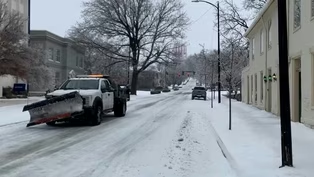
Icy Conditions Leads to Road Closures
Video has Closed Captions
Clip: S4 Ep308 | 3m 34s | Bowling Green-Warren County sees lane closures on interstate and main roads due to icy conditions. (3m 34s)
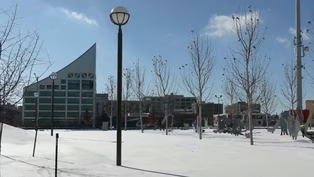
Louisville Remains Largely Shutdown Due to Winter Storm
Video has Closed Captions
Clip: S4 Ep308 | 2m 26s | Louisville officials give update on plans to fully reopen city. (2m 26s)
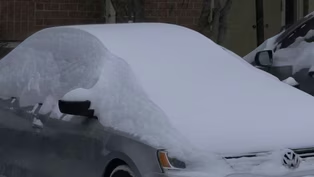
Northern Kentucky Sets Another Snowfall Record
Video has Closed Captions
Clip: S4 Ep308 | 3m | Northern Kentucky communities receive foot of snow, declare snow emergencies. (3m)
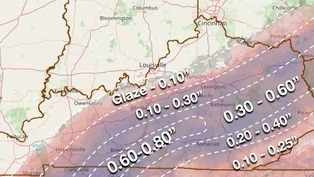
Winter Storm Brings Less Snow Than Expected, More Bitter Cold
Video has Closed Captions
Clip: S4 Ep308 | 4m 10s | National Weather Service explains why the state got less snow than expected. (4m 10s)
Providing Support for PBS.org
Learn Moreabout PBS online sponsorship
- News and Public Affairs

Top journalists deliver compelling original analysis of the hour's headlines.

- News and Public Affairs

FRONTLINE is investigative journalism that questions, explains and changes our world.












Support for PBS provided by:
Kentucky Edition is a local public television program presented by KET