
Tijuana: Cecut & Caesar Salad
Season 1 Episode 13 | 24m 46sVideo has Closed Captions
Jorge learns about Baja's history at the Tijuana Cultural Center (CECUT)
Learn more about the history of Baja at the Tijuana Cultural Center (Cecut) just south of the border. Host Jorge Meraz shows us around the museum, tracing Baja's multiethnic history back to pre-hispanic era. Afterward, Jorge learns about the origins of the famous Caesar salad where it was first invented, right in Tijuana.
Problems playing video? | Closed Captioning Feedback
Problems playing video? | Closed Captioning Feedback
Crossing South is a local public television program presented by KPBS
Tijuana: Cecut & Caesar Salad
Season 1 Episode 13 | 24m 46sVideo has Closed Captions
Learn more about the history of Baja at the Tijuana Cultural Center (Cecut) just south of the border. Host Jorge Meraz shows us around the museum, tracing Baja's multiethnic history back to pre-hispanic era. Afterward, Jorge learns about the origins of the famous Caesar salad where it was first invented, right in Tijuana.
Problems playing video? | Closed Captioning Feedback
Where to Watch Crossing South
Crossing South is available to stream on pbs.org and the PBS app.
Providing Support for PBS.org
Learn Moreabout PBS online sponsorshipPart of These Collections
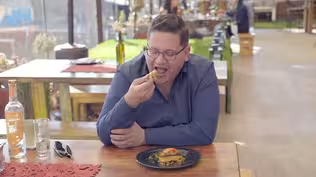
Fine Dining
A collection of episodes featuring some of Baja's Fine Dining establishments.
View Collection
Providing Support for PBS.org
Learn Moreabout PBS online sponsorship>>[Jorge] Today on Crossing South, we go south of Mexicali and take a scenic boat ride, we kayak, we visit a remove village, and of course, we get to eat.
Coming to you right now on Crossing South.
(upbeat rock music) (light instrumental music) Okay, so, 40 kilometers south of Mexicali, on the road to San Felipe, there's a campo called the Cucapah camp.
You can see that's the highway, that's the highway, 40 kilometers south of Mexicali.
That's the way to San Felipe, that's south, and that would be north.
There's this campo called the Baja Cucapah, and it has some interesting tours, and we're gonna take one right now.
We're gonna take a boat ride on the Hardy river, so stay with us.
Let's go check it out.
So, this body of water, friends, all this water you see here comes from the Colorado River, and it makes up the Hardy River right here, and it will end up at the Sea of Cortez in Baja's armpit, if you will.
So let's go to that boat ride right now.
(light instrumental music) In order to go on an actual boat ride, we needed to take a short drive down the road to a boat launch.
There, our local guide, Mr.
Mario, already had his craft fueled up and revved up to go.
I'm not the most aquatic person in the world, but we're gonna go do some water activities today, so let's first, we're on this unstable barge, and now let's go on this boat, (chuckles) so follow us along folks, This is the Hardy River ride.
This turned out to be a silky smooth ride.
The glassy surface was very enjoyable.
(instrumental music) Those mountains are in the middle of Baja.
Separate the Pacific side from the Sea of Cortez side.
In fact, that strand of mountains starts at Cabo and goes all the way through California, Oregon, and Washington, all the way to Canada.
(instrumental music) It is a Chinese delicacy, from what I hear.
Chinese love that bird.
However, it's in the endangered list, so it's illegal to hunt it here in the Baja, so we'll just have to enjoy its beauty and not its taste.
One of the many wildlifes that exist here in the Hardy river.
In fact, birdwatching enthusiasts love the Hardy River because it has so much diversity in bird life, so let's continue exploring this place.
The 16 mile Hardy River is the end result of the Colorado River, which begins in the Rocky Mountains.
(instrumental music) Okay, so the further forward I push the throttle, (speaking in foreign language) It's gonna go faster.
Roads?
Where we're going, we don't need roads.
This is my first time driving a boat, folks.
It was very cool.
(upbeat electronic music) At the speed we were going, I could feel how easily you can flip one of these things if you jerk the wheel the wrong way.
Of course, I didn't.
I wasn't gonna find out.
In fact, I think I took a page out of Driving Miss Daisy in my approach to maneuvers and navigation.
There's an abundance of wildlife in the Hardy River.
Especially bird life, like the Snowy Egret or the Great Blue Heron, and it's all part of a biosphere reserve overseen by a government agency.
Some of the gulls in the region, as is true with the pheasants, are believed to have been introduced by Chinese immigrants who eventually settled in Mexicali.
(upbeat electronic music) I kind of parallel parked.
(laughing) Once finished, we continued our single minded focus south towards San Felipe.
That is, until my A.D.D.
distracted me five minutes into the drive.
We found another camp called Mosqueda, where we could engage in other aquatic activities.
Okay, so during our boat ride, we saw this place.
We were riding here on this lake, and we saw this camp.
It seems to be a really fun place.
Tell me about it.
>>Well, the Camp Mosqueda started since 1960.
>>60, wow.
>>Yeah, that's the one.
My fathers, they start for the build this place.
>>A lot of Americans live here in this camp, right?
>>Yes, yeah, we have the little people camp for the, more than the California.
>>California, okay.
>>Yeah, the first people who came is 1960, when the camp start, with the people that came to Campo Mosqueda.
>>And were they Americans or Mexicans?
>>Only American, all Americans.
>>Only Americans?
1960, oh wow.
>>1960, yeah.
>>[Jorge] Vehicles?
>>You can buggies and cycles and kayaks and jet ski, whatever you want, that's only, it's party.
>>Okay!
So are you gonna allow us to do some kayaking here?
>>Yeah, you can use it.
>>Okay, thank you very much, Mr.
Mosqueda.
Come follow us along, folks.
I'm more of a land lover, but we'll see how it goes.
The owner of the camp was kind enough to lend us his kayaks and allow us to enjoy an early day workout.
(upbeat guitar music) It was a tranquil ride.
A chance to reflect and enjoy nature.
We were having a very good day.
(upbeat guitar music) I was able to get in some much needed exercise and breathe nature.
You know, rowing is hard work.
(chuckles) I mean, you'll work your biceps, I'll tell you that much.
I'm also turning red, roasting.
Slowly roasting.
This is the white part, this is the red part, Rotisserie Jorge, rotisserie Jorge.
You can't use your paddle in here, so you have to guide yourself by pulling yourself through the branches.
(upbeat guitar music) Yes!
(laughing) Thank you so much.
>>No worries.
You did great.
>>[Jorge] But alas, it was time to go.
Okay, now for real, we will make it to San Felipe.
(instrumental music) You know, folks, the official beach of the city of Mexicali is right here.
Now, you're probably saying, wait a second, Mexicali is landlocked isn't it?
Well, yeah, but part of its municipality is this city.
This city is San Felipe, and it's a two hour drive, but it's actually part of the same municipality, part of the same city.
So, San Felipe, folks.
We're gonna explore it right now.
(calm instrumental music) >>[Jorge] So what's your name, my friend?
>>My name is Fili.
>>Fili?
>>Yeah.
>>Fili, what do you do here in San Felipe, Fili?
>>Just take the people go fishin', take on a banana boat ride, you know.
>>Banana boat ride, fishing.
What kind of fish are there here in the Sea of Cortez?
>>Corvina, Calico, sea bass, you know.
There's just pretty good fishing out here, you know.
>>Very good fishing?
>>Yeah.
>>[Jorge] And how long have you been here in San Felipe?
>>10 years.
>>10 years?
>>Yes, it is.
>>Have you liked it?
>>Yes, it's just good shopping and working here, you know.
>>Very tranquil way of life, isn't it?
>>Yes.
>>[Jorge] These guys hit the Sea of Cortez every day.
So what is this, what kind of fish is this?
>>It's a Yellow Croaker.
>>Yellow Croaker?
>>Yellow Croaker.
>>[Jorge] Who consumes this fish?
>>Korea.
>>Korea?
>>And China.
>>Korea and China.
>>Yeah.
>>Okay.
>>25 dollars a kilo.
>>Really, so you export this fish?
>>Export direct to Korea.
>>[Jorge] Well, after hearing some fishing stories from our new friends, and after them gauging my interest, they said they didn't want me to take their word for it.
Okay, this is one of the things that actually will save my life.
So the fishermen have agreed to take us on a quick flash fishing trip.
Dona Charly, Mrs.
Charly.
Okay, there's no going back.
Oh my goodness.
Oh, wasn't the anniversary of the Titanic recently?
(smooth instrumental music) I don't know if this rope here is standard issued safety equipment, but I'm ready.
I'm ready.
I don't wanna die at sea.
I'm a land lover, land lover!
Well, you heard this, how much a trip like this costs, 35 bucks a piece.
It's not bad.
I was kinda nervous about it, but it's not bad.
It's pretty stable.
So that's the San Felipe Bay.
A lot of campos.
A lot of places where you can camp out, RV parking.
Some aquatic activities, obviously, available here.
There, you got the Punta Machorro Mountains.
That's the San Felipe icon.
If you could do a logo for San Felipe, that was it.
After navigating the open sea, we went into the harbor, which is, right now, only used by fishermen.
Okay, so that is the Tony Reyes fishing boat.
It is a legendary fisherman in San Felipe.
Just passed away a couple years ago, but his son is continuing the torch, and if you want to do real fishing in San Felipe, you look up Tony Reyes, and that's the boat to do it on.
So, fishing enthusiasts, behold.
(smooth instrumental music) These boats are the lifeline of the fishing industry of this town.
Their fishing exports are a very important part of their city's economy.
(smooth instrumental music) I have to say, folks.
This is as crusty as they get.
This could be in a Hollywood film.
Hey, casting location managers, check this out.
Don't need to build a prop.
Look at this thing.
These are not museum relics.
These go out to sea today.
These are seaworthy vessels.
Albeit a little bit on the rusty side, but they're seaworthy vessels.
(smooth instrumental music) How you doin' there, mate?
(chuckles) You seen my friend, Nemo?
Well, I mean, I think that owl there is meant to scare 'em away, but as you can see, (chuckles) it has no effect whatsoever.
We've been seeing a lot of natural life on this trip.
Follow them!
I really enjoyed feeling the breeze and the wind on this panga ride.
(smooth instrumental music) We've gotta beach it.
Ramming speed!
He's goin' ballistic!
(laughing) Bet you haven't seen that one before.
(laughing) Both American and Mexican families frolic on San Felipe's beaches.
The kids enjoy it too.
(calm instrumental music) San Felipe has an approximate population of 16,000 people, and an estimated 8,000 foreigners, and they're majority Americans who flee bitter winters, and are thus nicknamed by the locals as snowbirds.
(tranquil instrumental music) San Felipe was founded in 1916 with its still functioning lighthouse that guides fishermen on foggy days.
This town has always had a slow pace of life.
(tranquil instrumental music) There are no stoplights here, and the sandy beaches just go on and on for miles south.
We wanted to know just how far south we could go in one day and come back.
And on a very nice road, we hit the small town of Puertecitos.
(calm instumental music) Folks, we are 70 kilometers south of San Felipe.
This is the town of Puertecitos.
It is really sleepy to the superlative level.
There's no people here.
If you like being secluded where there's almost no people around, this is the place to be for that.
And part of what this place has are its famous hot springs.
Because Mexicali and San Felipe are part of the Ring of Fire, the Earth's Ring of Fire, well, there's volcanic activity underneath.
The sea water and the rock, when the tide recedes, leaves hot bathtubs.
So, some of those you can get in, some of those are too hot, but we'll go check 'em out.
(calm guitar music) So these are the medicinal sulfur hot springs of Puertecitos.
Man, they look nice, don't they?
If I'd only brought some swimming trunks, man!
(calm guitar music) You know, the sulfur smell is really, really strong.
Oh boy.
But the water is so warm.
It's literally like it was heated artificially.
It's nice, it's warm!
This is like your own spa.
You can just feel the heat comin' in.
Ah!
So, the tide has receded, and this normally is covered with water.
So tide has receded and this is what's left for us to enjoy now.
It burns.
Ow, ow!
Oh, wow, it's like I'm going through a gambit.
Like streams of hot water just shooting at me from different crevices, oh!
Well folks, we hope you enjoyed the hot springs.
Now let's see what else is there to do in this place.
Let's go down in the pool now.
(water splashing) After a hot bath, it was time to rinse off and head back.
We did learn that these hot springs are very popular.
But do you know what else is popular?
My seafood diet.
Okay folks, so back in town here in San Felipe.
It's night time.
We wanted to look for a place where we can rest and take in a little of the good stuff, and we found a place.
It's called La Vaquita, so come inside and join us, see what we can find in there.
(upbeat Latin music) You know, folks, the staple of this show is obviously not only enjoying in activities for me at each place we go to, and the culture and the people, but it's the food, and San Felipe ain't gonna be no different.
And we're here with Sergio, Sergio Leon.
How you doin', my friend?
>>Good good, good good.
>>He is the proprietor of this establishment, La Vaquita restaurant.
La Vaquita being the native dolphin of the Sea of Cortez, right?
>>Well, La Vaquita Marina.
>>La Vaquita Marina, that's right.
A vaquita would be just a cow, right?
>>[Sergio] Yeah.
(laughing) >>Thank you for having us here, and I see you've brought some appetizers for us.
Now what's this?
Tell us about this dish.
>>Well, this one is the traditional in San Felipe, the little clams here.
>>Okay.
>>We get, you can walk on the beach and you can get it here.
>>Oh really, I'll be walking along on the sea shore and I'll get that?
>>That's right, that right.
And it's very delicious.
We prepare it with butter, garlic, and white wine.
>>Really?
>>That's right.
>>If you're as hungry as I am, I know this probably looks delicious to you.
So, as you can see, I'm kind of like a novice, but, okay, here we go, here we go, and put it in, right?
>>Put it in there.
There you go, nice.
>>Ooh, oh!
>>Very delicious, huh?
>>Very delicious.
>>Everybody say, more small the clam is more flavor, more flavor.
>>The smaller the clam, the more flavor.
Well, that was really flavorful.
That was really good.
What are these peppers filled with?
Let's show it to the audience.
>>[Sergio] That one is come with cheese.
>>[Jorge] Cheese?
>>Shrimp.
>>Shrimp.
>>[Sergio] Oyster sauce.
>>Oyster sauce?
>>Yeah, that's right.
>>So this one is just straight up, straight up?
>>[Sergio] Straight up.
>>Okay.
>>[Sergio] Mmm, yummy yummy.
(laughing) >>It's yummy and messy.
(laughing) You gonna bring us some kind of fish also?
>>Yes, the fish and the mariscada.
>>Okay, we're ready, folks, we're ready.
(laughing) Bring it, bring it, my friend!
(laughing) Folks, your eyes are not deceiving you.
What you're seeing does not do justice to this epic amalgamation of seafood.
It was truly something to behold.
And he wasn't showing off for our cameras.
These items are in his menu.
I can literally hear an echo from one side of the plate to another.
Okay folks, you're not gonna believe what this guy just brought to the table.
You gotta look at this.
(laughing) Oh my goodness.
You want people to die of a heart attack?
>>I'm sorry, I say for six people.
No, it's for 10 people.
>>Oh, for 10 people, yeah, this is insane!
Okay, these are Vaquita rolls, the Vaquita Marina rolls.
So it's filled with coconut, is that coconut?
>>[Sergio] It's coconut, coconut bread, coconut.
>>[Jorge] Some corvina breaded with coconut, okay.
So what kind of sauce is this?
>>[Sergio] That's a chipotle with a strawberry.
>>[Jorge] Strawberry chipotle!
>>[Sergio] That's strawberry chipotle.
>>Man!
>>We make it here.
>>This ain't typical San Felipe, you got your own niche going on here, right.
(laughing) Let's try this.
Wow!
Everyone loves the coconut shrimp.
>>Everybody.
And that one, we sell a lot of it as coconut shrimp.
A lot of it, hundreds of shrimps with coconut, everybody love it.
>>[Jorge] You might get sick of me saying how good everything is, but it is.
So, okay, we can't stop now.
What's the next stuff?
What's the next one?
There's just too many things.
Can't focus on anything.
Tell me what's the, what haven't I tried?
So this is this corvina fish, and this is the kind of fish you can find here.
>>Yes.
>>Sea of Cortez.
>>Yes.
>>So you're not bringing this refrigerated, you're buying this.
>>No, no, no, no, no.
We have difference, in Summer, the corvina is our local fish in Summer.
This one, we get from Puertecitos.
>>Did you put a whole, a whole octopus here?
>>Yes.
(laughs) >>Can I bite... Can I cut a piece?
>>Yeah, yeah, yeah, that's the-- >>[Jorge] That's the idea?
>>[Sergio] That's right.
>>Okay.
Now how do you prepare this octopus?
Tell me about it.
Talk to me about it.
>>We prepare it on the grill.
>>It's a grilled octopus.
>>With garlic, and enough garlic, eh, with garlic.
>>Okay.
>>And butter.
>>I love octopus.
It's so good.
>>It's like a twin shrimp, twin.
>>A twin shrimp.
>>Because we put both shrimps together.
>>This is two shrimps?
>>Two shrimps together.
And the middle, we use bacon.
>>Bacon.
And what else?
>>And cheese.
>>And cheese.
So it's like a cordon bleu.
>>A cordon bleu.
>>But breaded.
>>That's right, breaded, and shrimp.
>>Man, you know those health conscious people are gonna be looking at this and say Jorge's just gonna drop dead from all these calories, but we have to do it, folks.
It is a dirty job, and somebody's gotta do it.
(laughing) So let's try it.
(chuckles) Yes, it tastes as good as it looks.
This may be, this may be one of my favorites now.
>>Yeah.
(laughing) Man, I haven't eaten a full dish of anything.
Just sampling, I'm done.
But I may be able to fit in a little bit of that fish.
Here you go, folks.
It doesn't get any better here in San Felipe, does it?
So, Sergio, thank you so much for allowing us to enjoy the full gauntlet of your-- (laughing) >>It's a pleasure.
>>Of your offerings, and stay with us, folks.
Crossing South.
Thank you, my friend.
>>Thank you very much.
Thank you.
>>[Jorge] La Vaquita is becoming the place to visit in San Felipe, and I think it's because my friend Sergio here understands food doesn't just need to be good, but it needs to wow you visually.
Our trip along the Hardy River and the Sea of Cortez was packed to say the least.
We hope you join us on more adventures the next time we cross south.
(upbeat rock music) >>[Narrator] Like to know more about the places you've just seen?
Maps, videos, podcasts, and more at CrossingSouth.com.
We also do Facebook, Instagram, and YouTube.
(instrumental music)














Support for PBS provided by:
Crossing South is a local public television program presented by KPBS