
CRT, Michigan Childcare, Workplace DEI, Newsman Bill Bonds
Season 6 Episode 2 | 26m 46sVideo has Closed Captions
One Detroit explores Critical Race Theory, Childcare Costs, DEI, and Bill Bonds legacy.
One Detroit's Bill Kubota meets with Detroit artist Jonathan Harris to talk about his viral painting 'Critical Race Theory' and the conversations its sparking. Then, One Detroit's Will Glover talks to BridgeDetroit's Nushrat Rahman about the high childcare costs and financial assistance. Plus, learn how diversity, equity and inclusion have progressed in the workplace and the legacy of Bill Bonds.
Problems playing video? | Closed Captioning Feedback
Problems playing video? | Closed Captioning Feedback
One Detroit is a local public television program presented by Detroit PBS
CRT, Michigan Childcare, Workplace DEI, Newsman Bill Bonds
Season 6 Episode 2 | 26m 46sVideo has Closed Captions
One Detroit's Bill Kubota meets with Detroit artist Jonathan Harris to talk about his viral painting 'Critical Race Theory' and the conversations its sparking. Then, One Detroit's Will Glover talks to BridgeDetroit's Nushrat Rahman about the high childcare costs and financial assistance. Plus, learn how diversity, equity and inclusion have progressed in the workplace and the legacy of Bill Bonds.
Problems playing video? | Closed Captioning Feedback
How to Watch One Detroit
One Detroit is available to stream on pbs.org and the free PBS App, available on iPhone, Apple TV, Android TV, Android smartphones, Amazon Fire TV, Amazon Fire Tablet, Roku, Samsung Smart TV, and Vizio.
Providing Support for PBS.org
Learn Moreabout PBS online sponsorship- [Announcer] Just ahead on One Detroit.
An up and coming Detroit artist uses his talent and creativity to illustrate black history and the controversy over critical race theory.
Plus, we'll look at where we stand with workplace diversity, equity, and inclusion nearly two years after the murder of George Floyd.
Also ahead, we'll examine a new report about the state of childcare in Michigan.
And an on to Detroit television history, we remember the late news anchor Bill Bonds.
It's all coming up next, on One Detroit.
- [Announcer] From Delta faucets to bear paint.
Masco Corporation is proud to deliver products that enhance the way consumers all over the world, experience and enjoy their living spaces.
Masco, serving Michigan communities since 1929.
- [Announcer] Support for this program is provided by the Cynthia & Edsel Ford Fund for Journalism at Detroit Public TV.
The Kresge foundation, Community Foundation for Southeast Michigan.
- [Announcer] The DTE foundation is a proud sponsor of Detroit Public TV.
Among the State's largest foundations committed to Michigan focused giving, we support organizations that are doing exceptional work in our State.
Visit DTEFoundation.com to learn more.
- [Announcer] Business Leaders for Michigan.
Dedicated to making Michigan a Top Ten State for jobs, personal income, and a healthy economy.
Also brought to you by, and Viewers Like You.
(gentle music) - [Narrator] Coming up on this week's One Detroit.
Childcare in Michigan.
A new report shows many families are not tapping into the financial assistance that's available.
We'll talk with Bridge Detroit reporter Nushrat Rahman about high childcare costs, and the lack of options and educators.
Plus, workplaces across America pledged to make diversity, equity, and inclusion a priority after the murder of George Floyd, nearly two years ago.
American black journal checks in with marketing consultant, Mark Lee to see what progress has been made.
Also, the late Detroit television news anchor Bill Bonds would've turned 90 years old this month.
Detroit Public Television remembers the newsman who was never afraid to voice his opinion.
But first up, emerging Detroit artist Jonathan Harris creates a one of a kind painting that furthers the conversation about critical race theory.
It's one of his many works focusing on social and political issues.
(gentle music) - You think this sharpie is too big.
- [James] December, 2021 signing day for Jonathan Harris.
- So how should I do it?
- It's for one of his paintings on display, but not for sale.
These art collectors at known history would grill in Detroit want their own numbered and autographed print.
- You don't have enough room of framing if you sign-- - Oh no, no, no.
The framer can come in here.
That's why I said don't sign in the white area, sign here.
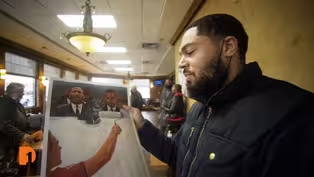
- It was done this year earlier in 2021, and the name of this painting is CRT.
This is a limited edition print, CRT standing for critical race theory, topic of discussion that has permeated through our culture and our community.
I think the importance of a painting like this during this time, can't even be verbally expressed.
- [James] Harris a young emerging artist now in the national spotlight.
Arts journals, newspapers, cable TV, he'd started painting seriously just a couple years ago.
- I had been drawing and painting my whole life.
I never had really taken it serious.
I went to school for graphic design and I was just looking for another outlet to express myself, so I started to paint.
I started like painting celebrities and different people I could just Google online.
- [James] Someone told Harris celebrity paintings might not be the best path to success for an artist.
- That's how I got into painting my story and things I see and was also passionate about.
This is at the far left, hear no evil, the middle see no evil, and the right speak no evil.
Is basically just telling a story about how I feel in America.
- [James] When Detroit last talked to Harris in November for his exhibition at Detroit's Irwin House Gallery.
- We had been speaking with Johnathan about doing a solo exhibition of his work, and he felt that he wasn't ready to do that.
I believe he was ready to do that.
(Misha chuckles) So he saw this as an opportunity not just for himself, but to also bring in two other emerging artists that he had met, whose work he felt passionate about.
(indistinct chatter) - Opening night in the hallway off the main room, there was critical race theory.
It sold immediately.
Who else knew it would go for so big at the time?
And so we are here to witness the signing of these prints by Jonathan, and to further encourage him to continue exploring socio-political issues in his artwork.
He's an artist who I feel is very, very skilled in exploring this aspects of our society.
- I'm happy to be an owner of the first copy of this print and I can't wait to frame it and hang it.
So thanks a lot Jonathan Harris man.
I really appreciate it.
- [James] Did you think it would catch on the way it did?
- I didn't think that it would catch on like this.
I still lack that like the art confidence, so I just didn't think it would catch on like this but it's a blessing, you know.
I'm just excited that the conversation is being heard especially right now.
- [James] Critical race theory.
- A heated debate, in yet another Metro Atlanta School district.
Right now parents are lining up out-- - [James] The idea popped up in the news, then anti critical race theory protests came to school boards last year.
- We will take a five minute recess at this point.
- You're teaching children to hate others because of their skin color.
(protestors cheering) - [James] Like most of America, that's when Harris learned about the CRT fight too.
The painting came soon after.
- When I was just talking to somebody at the show about the piece and the person had said you know, I see you painted Martin Luther King and Malcolm X, but why did you paint Aunt Jemima?
And the person was serious.
- [James] Harriet Tubman, rendered in black and white matching an image more of us should know about, escaped slave, champion of the underground railroad, and much more.
- That's it.
A couple people asked me why Harriet Tubman not smiling because she in the front.
I was like you know, what was there to smile about?
I'm a slave.
- [James] Hope for more awareness of Tubman, President Obama ordered her face on the US $20 bill in 2016.
Didn't happen under the last president, perhaps on track with our new president.
- We're exploring ways to speed up that effort, but any specifics would of course come from the department of treasury.
- [James] No action from treasury yet.
- And this road behind here is important too, because this represents the role that African Americans already traveled, everything that we already went through.
And that's why it's not no sun shining back there.
It's not no trees, it's not no nothing happy.
You know, it kinda actually looks sad like a real jury kinda day.
Just a dirt road and some dried grass.
It wasn't pretty.
- [James] Fine art with a direct message.
We see it conceptually in posters, some capturing a time on canvas like Spain, 1937.
Or right here, right now with critical race theory.
It might bring to mind the problem we all live with by Norman Rockwell back in the 60s.
Inspired by Ruby Bridges, relevant again with concerns in some Tennessee schools about a book telling Bridges' story.
- I wanted you know, just the casual person, if you're not into art, you're into art, whatever it may be.
So just look at it and it catch your attention and you have to question, hey, what's going on here?
Then they say oh, critical race theory.
Oh, what is that?
Oh, you know, this is going on in the south right now, or slowly making its way up to the higher states.
- [James] Most of the painting, a whitewash depicting a future that stops just near the top.
- So this figure right here he represents the America trying to cover up our history.
- [James] Chronologically speaking, Harris has us now at the bottom of the canvas.
- It's right here now, and eventually it's gonna be here.
And then in more years it's gonna be here.
And then here, and then here.
And then we could look up a hundred years from now, or even less and say the talk would be oh, you know, why do we gotta teach about Harriet Tubman if we didn't have to teach about this figure?
Or we didn't have to teach about Marcus Garvey?
Any other historical figures that down here or stories or things that happened, it's covered up by America because it don't make their kids feel good knowing what their ancestors were capable of and that's not fair.
- And he has distilled that whole idea of what they're trying to do in this magnificent painting.
- I don't think that we gonna be done with this anytime soon.
This whole critical race theory thing.
It's a beast that's never gonna be full.
It's just gonna keep going and growing, and growing, and growing and years from now or generations from now, they may get up to the point and say hey, you know, we don't need to teach the kids about Martin Luther King or Malcolm X or Harriet Tubman.
That's what this piece is about.
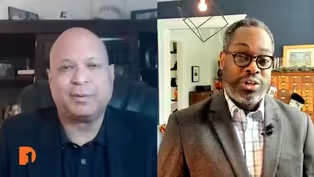
(gentle music) - What's different now, two years nearly after the death of George Floyd and all these promises that got made about change in the workplace, change in the makeup of the of the workplace, change in the dynamics in the workplace.
They were big promises when they were made.
Are they being fulfilled in 2022?
- I think it's still too early to tell.
I can tell you though, there has been some progress since the whole George Floyd situation if you will.
We have noticed an increase in terms of the number of DEI positions over a hundred percent increase in those types of positions were being filled.
We've also noticed an increase... Again, generally speaking now, we've noticed an increase in the resources being allocated by major organizations in this space.
But in terms of have the total objectives and have they been totally fulfilled?
It's still too early to tell.
There's a long ways to go.
- Mmh, so to me, the thing that matters the most in the workplace is the actual diversity of the staff, right?
It's great to have leaders who care about diversity and equity, and inclusion and higher consultants, or even full-time employees to work on those issues.
But if their workplaces themselves are not diverse, then it kinda defeats the purpose, at least for me.
Talk about how much talk there has been about changing the dynamics, and then how much of the outcome that we've seen become different, especially in C-suites right?
Executive suites all over the country still are places that it's hard to break into if you're not white.
- And that's where the gap is.
We're still seeing that gap...
Excuse me, at the senior management level.
They will talk about diversity, there were commitments statements that were certainly put out right after the George Floyd situation, but if you look at the statistical data, the majority of the C-suite level positions are still held by Caucasians.
And a lot more as you filter down into the organization, you will find some diversity at all levels of the organization, but it does not sync up where it needs to be at the senior level.
So there's still that shortfall at the senior level, and it's been statistically proven.
There was a study by the Boston Consulting Group that if you have a diverse senior leadership team, you have an opportunity of generating 17% more revenue.
Because people want to do business with people that look like them.
So it's one thing to talk about diversity, but it's another thing to actually have diverse leaders and then let that filter throughout the organization and engage all the employees throughout the process.
- So I also worried when George Floyd was killed and there was this real surge in attention to DEI issues, that it was happening at the same time that we were dealing with this awful pandemic.
Which of course we are still dealing with.
It looks really different today than it did then, but it is still really shaping a lot of the decisions we make, and the ways we live.
And I guess the reason that, that made me worry was that something like a pandemic is a disruption to people's businesses.
Is a disruption to the workplace.
And I know from experience that even the best intentioned workplaces and managers who are committed to DEI issues fall into the trap of sidelining that, when there are other things.
When there are other things that need to be dealt with.
And the pandemic challenged businesses in financial ways, in management ways, and all these other things and I worried that the DEI issue would get buried at least a little during the pandemic.
I wonder if we have any idea at how well they navigated that.
- I think, again as I stated at the top of this discussion, it is still too early to tell.
Here's my concern.
You are absolutely spot on.
And with the pandemic, it's a natural excuse to say we have other things to focus on.
I would argue that this is another reason why you need to focus in this space.
And because if we don't, you're missing out on business opportunities.
And I think the fact of the matter is we continue to keep our heads in the sand in this space, organizations are not going to proceed.
My other concern is as it relates to the pandemic and people watching their budgets, a lot of the DEI practitioners are going into the organizations, still are not getting the budgets to implement what they need to do.
So now the pandemic becomes a logical excuse to say, let's redirect our resources to other spaces.
Someone inside the organization has to be strong enough, and really challenge the leadership of the organization and say, we still need to invest in this space and the way that we need to invest in this space is have the right people in the right boxes, and to have the financial resources, now is not the time to cut the budget in this critical area.
- Yeah.
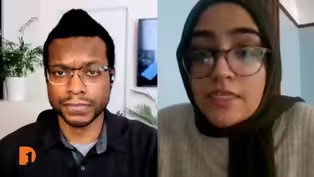
(gentle music) - [Will] Nationwide high costs, accessibility, and lack of personnel are why many say the childcare industry's in crisis.
To get a better look at the State of Michigan childcare, I talked to Bridge Detroit reporter new Nushrat Rahman about her article, "35% of Michigan kids under five qualify for childcare subsidies.
But only 5% use."
- Yeah, so it's a pretty staggering statistic.
And this analysis was done by the Michigan League for Public Policy and Kids Count in Michigan.
- [Will] The mlpp analyzes the impact of state and federal budgets and policies on residents with low incomes.
Including Michigan's 683,798 children under the age of five, as of 2019.
- That's a lot of kids, right?
- Right.
- And so when we look at it, what we find is that roughly one third of children in Michigan under five, qualify for these childcare subsidies, right?
But only 5% actually received those credits.
What this really looks like is just this wide gap between the availability of assistance and families who are able to tap into it.
That's just talking about childcare.
But if we look at food assistance, nearly 50% of young children in Michigan were eligible for food assistance benefits, however, only a quarter were enrolled to get that support.
And if we look at cash assistance, right?
So these are families who need cash assistance.
2% received the cash assistance, despite 11% of kids under five qualifying for it.
- There's also something that you mentioned in your article, which is the childcare desert.
So, just explain really quick what a childcare desert is and how prevalent that is here in Michigan.
- What the researchers from the Michigan League for Public Policy and Kids Count in Michigan found is that, you know, an estimated 44% of Michiganders live in what's called childcare deserts.
So these are places with a lack of childcare providers.
And if we break it down a little bit more, these are places where just the ratio of like kids to childcare providers just isn't like one to one, right?
You know, I talked to one of the folks over at the Michigan League for Public Policy and Kids Count, and they mentioned that, that's one of the reasons that could be behind just like the parents not being able to use these subsidies is the fact that childcare providers... Is just like difficult to kind of get a childcare provider because there isn't that many.
And I think the pandemic just really illustrated the upheaval that the childcare industry went through.
Like, there was already a shortage of early childhood educators, now the industry is facing issues with like recruitment and retention because a lot of the workers make low pay.
So you know, there's been like federal injection of like ways to help the industry out.
But there are multiple factors that are kind of at play here.
- Early childhood education is foundational to a child's social development, academic success, and economic mobility.
It's also a key investment in the future success of our State.
So that said, what type of action is the state taking to try and close these gaps, to try and make these things available?
What is the State doing?
- So last year, governor Gretchen Whitmer, she unveiled a $1.4 billion plan to expand affordable childcare with federal dollars.
And so what that has looked like so far is licensed childcare workers can now get $1,000 bonus, right?
So there's some movement there.
Since then, the State has raised the income eligibility for childcare subsidies.
So these credits to 185%.
Basically what that translates to is like a family of four making more than $49,000.
Basically what that means is that more families are eligible for this child care subsidy through 2023.
And then there's a little bit of a change afterwards, but what researchers say is that, that needs to continue.
It's a good thing that more families are eligible, but we need to kind of continue making strides in order to continue helping the youngest Michiganders.
- [Will] Most recently, governor Whitmer has called for expanding Michigan's great start readiness program that provides free preschool to eligible four year olds to 456 million.
Where do you feel we are headed when it comes to childcare in Michigan?
Are we headed in the right direction?
And are we going to get to a place anytime soon where these these gaps are at the very least, a little lesson?
- You know, I'm not like a policymaker or anything like that, but I think reports like this kind of highlight the gap.
And I think the important thing is to really listen to what's happening on the ground.
So listening to these childcare providers, these local businesses who are doing this work.
I think one of the important things to know is that a lot of the times childcare responsibilities fall on women, like working moms.
And so listening to working moms and working parents, moms and dads to see like what they need in order to kind of help them out.
(gentle music) - February 2022, waking up every day, realizing we are living in well, strange times.
Standing here in this studio, I've been thinking a bit, what would Bill Bonds say about all of this?
- It's gonna be interesting to watch this one and develop.
Good evening everybody, a political storm may be brewing in Lansing as of tomorrow.
- Detroiters of a certain age, some of you know what I'm talking about, Bonds would've been 90 years old this month, he died in 2014.
- Cost of watering your lawn, washing your dog, taking a bath, maybe drinking a stroz or a faygo is going to go up because of a decision by the Detroit city council.
And tonight, there is some serious talk of digging up the body of Elvis Presley for a series of tests.
- [Fred] Some loved him, some loved to hate him, but there was no one else quite like Bill Bonds.
A Detroiter, through and through.
- Good evening everybody, a verbal and indeed a legal bombshell dropped in a Detroit federal courtroom today.
- Bill didn't so much present the news every night, he set it on fire.
Not in a political way, not from the right or from the left side, he was on our side.
His work span five decades, best known for his channel seven newscasts at five, and the Encore every night at 11:00 PM.
- It's Diana Lewis, Bill Bonds, those stories.
- Well, I'm probably here like a lot of people on the airwaves because of him.
Trying to channel that special relationship he had with the TV camera.
- I found myself in a compatible relationship with the me that was performing me.
You know, you have to be slightly exaggerated, but you can't be so over the top that you scare people.
- Extremely talented.
Extremely talented.
He never faltered in the high opinion of his own self.
He really wanted to be the only one.
- Your head gets a little big when you get to it.
- Bonds wanted to be a star newsman.
Well, he got that and a whole lot more.
- The one thing they don't teach you in our society is how to be a celebrity.
Suddenly, you're a celebrity.
(fingers snaps) - There ego, sure.
I'd say a good thing.
Well, usually.
I was looking at some of his YouTube clips last month thinking, if you didn't know about him, you probably wouldn't get it.
- The long lines for new jobs are still forming in this metropolitan Detroit area.
Today, hundreds-- - The most popular YouTube clip you'll find of Billy a messed up uncensored out-take for more than 40 years ago.
- [Man] You all set Bill?
- Yeah, I'm all set.
- Profoundly riffing about a news promo script he didn't like, and cracking wise on coworkers in ways that well you ought not do today.
- What the (beep) is wrong with the short declarative sentence?
Like, what evening I'm Bill Bonds, nothing is new, goodnight.
(people laughing) - For people clicking on this from on the world, people who knew nothing about him, the clip seems a bit unfair.
But there's the other real Billy seen right here a few years ago, on our special program, "Detroit remember when: The history of Detroit Television."
Which defined Bonds as part newsman, part actor.
While he played an anchor man in a "Planet of the Apes" movie, he gave us those commentaries.
He was also part philosopher.
- Now there's nothing like going to dinner with a 23-year old daughter.
This father did just that tonight, and as a purpose overpaid television anchor person, one gets accustomed to offering his profound views on everything from the greenhouse effect, to the Alaskan oils spill, to Nigeria, to Panama.
Dads should have dinners with their daughters at least once, maybe twice a week.
They have a way of reminding men of the things in life.
Not salaries, stock options, not big cars, but the things that are really important.
Things like democracy, freedom, liberty, dignity, love, respect, friendship.
- So I'm left wondering what might Bill Bonds think if he could come back now, take a look around?
Sure, he'd have so much to criticize.
The pandemic, the elections, the media.
Former news executive and his close friend, Alan Upchurch said he'd be looking deeper into just why Americans have gotten so divided and he'd have tough questions about the growing gap between the haves and the have nots.
That shrinking middle class here in Detroit, this can do place with the middle class, got its first leg up.
I'm sure he keep remindings of that with a commentary or two, on just what to do about it.
We miss you, Billy.
- [Announcer] That will do it for this week's One Detroit.
Thanks for joining us.
Make sure to come back for One Detroit arts and culture on Mondays at 7:30 PM.
Head to onedetroitpbs.org for all the stories we're working on.
Follow us on social media and sign up for our weekly newsletter.
(gentle music) - [Announcer] From Delta faucets to bear paint, Masco corporation is proud to deliver products that enhance the way consumers all over the world experience and enjoy their living spaces.
Masco, serving Michigan communities since 1929.
- [Announcer] Support for this program is provided by the Cynthia & Edsel Ford Fund for Journalism at Detroit Public TV, the Kresge Foundation, Community Foundation for Southeast Michigan.
- [Announcer] The DTE foundation is a proud sponsor of Detroit Public TV.
Among the State's largest foundations, committed to Michigan focused giving, we support organizations that are doing exceptional work in our State.
Visit DTEFoundation.com to learn more.
- [Announcer] Business Leaders for Michigan.
Dedicated to making Michigan a Top Ten State for jobs, personal income, and a healthy economy.
Also brought to you by, and Viewers Like You.
(gentle music)
Have DEI Efforts Progressed in the Workplace since 2020?
Video has Closed Captions
Clip: S6 Ep2 | 5m 39s | Mark S. Lee discusses whether DEI efforts have progressed since George Floyd's death. (5m 39s)
Jonathan Harris' Viral Painting 'Critical Race Theory'
Video has Closed Captions
Clip: S6 Ep2 | 7m 37s | Jonathan Harris discusses his viral painting "Critical Race Theory" and CRT in schools. (7m 37s)
Michigan's Financial Assistance for Childcare Remains Untapp
Video has Closed Captions
Clip: S6 Ep2 | 5m 11s | Nushrat Rahman discusses high childcare costs in Michigan & financial assistance available (5m 11s)

Remebering Bill Bonds: Detroit's Most Opinionated Newsman
Video has Closed Captions
Clip: S6 Ep2 | 4m 17s | Bill Kubota and Fred Nahhat discuss Bill Bonds, Detroit's most opinionated newsman. (4m 17s)
Providing Support for PBS.org
Learn Moreabout PBS online sponsorship
- News and Public Affairs

Top journalists deliver compelling original analysis of the hour's headlines.

- News and Public Affairs

FRONTLINE is investigative journalism that questions, explains and changes our world.












Support for PBS provided by:
One Detroit is a local public television program presented by Detroit PBS