
CT Mobley & Scott Millard; Julie Ancis; Stephen Brunquell
5/22/2021 | 27m 16sVideo has Closed Captions
CT Mobley & Scott Millard; Dr. Julie Ancis; Dr. Stephen Brunquell
CT Mobley & Scott Millard share the challenges facing the Paterson community and the need for corporate philanthropy during COVID; Dr. Julie Ancis talks about the connection between cyberpsychology and the crisis and managing misinformation online; Dr. Stephen Brunnquell discusses educating the public about the vaccine and the role social media plays in spreading misinformation about the vaccine.
Problems playing video? | Closed Captioning Feedback
Problems playing video? | Closed Captioning Feedback
Think Tank with Steve Adubato is a local public television program presented by NJ PBS
CT Mobley & Scott Millard; Julie Ancis; Stephen Brunquell
5/22/2021 | 27m 16sVideo has Closed Captions
CT Mobley & Scott Millard share the challenges facing the Paterson community and the need for corporate philanthropy during COVID; Dr. Julie Ancis talks about the connection between cyberpsychology and the crisis and managing misinformation online; Dr. Stephen Brunnquell discusses educating the public about the vaccine and the role social media plays in spreading misinformation about the vaccine.
Problems playing video? | Closed Captioning Feedback
How to Watch Think Tank with Steve Adubato
Think Tank with Steve Adubato is available to stream on pbs.org and the free PBS App, available on iPhone, Apple TV, Android TV, Android smartphones, Amazon Fire TV, Amazon Fire Tablet, Roku, Samsung Smart TV, and Vizio.
Providing Support for PBS.org
Learn Moreabout PBS online sponsorship- [Narrator] Funding for this edition of Think Tank with Steve Adubato has been provided by IBEW Local 102.
Lighting the path, leading the way.
Bank of America.
The Robert Wood Johnson Foundation.
MD Advantage Insurance Company.
NJM Insurance Group.
Serving New Jersey's drivers, homeowners and business owners for more than 100 years.
Operating Engineers, local 825.
New Jersey Sharing Network.
Choose New Jersey.
And by NJ Best.
Promotional support provided by New Jersey Globe.
And by AM970 The Answer.
[MOTIVATIONAL MUSIC] - Hi, I'm Steve Adubato, I wanna kick this show right off because there's so much to talk about.
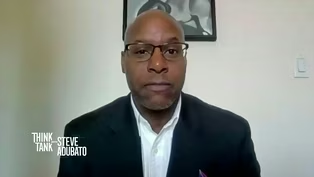
I wanna welcome our two guests, we have Scott Millard, who is CEO of a great organization, it's the Paterson Habitat for Humanity International, but this is the Paterson operation.
And CT Mobley, Division Vice-President of Small Business Services, and Diverse Business Channels at ADP.
Gentlemen, thank you so much for joining us.
- Thank you.
- Thank you for having us.
- So there's a history of ADP and Paterson Habitat working together for 20 years to do what, Mr. Mobley?
- I think our common mission has been really around serving and helping the, you know, sort of the community around Paterson, specifically, but helping the underserved communities, quite frankly, through housing.
- But it's more than, let's go beyond that because Scott, it's more than housing.
Is it not job training, economic development, as well as building homes?
And why are they all connected, sir?
- They're all connected because our mission at Paterson Habitat for Humanity is to build homes, communities, and hope.
Because homes are a very critical aspect of safe, stable communities, but they're not enough.
If the residents in those homes don't have access to quality education, quality food, quality jobs, economic development opportunities, they'll never thrive the way they can.
And so our mission is to do all three using homes as a catalyst for the rest of it.
And ADP has just been such a great partner for well over 20 years, working with us to make those dreams a reality for the families.
we support and work with in these communities.
- And by the way, ADP, one of the underwriters of what we do particularly as it relates to urban communities, issues of diversity, issues of racial and social inequities.
CT, let me follow up with you, talk about Paterson.
Paterson doesn't get enough attention, there are bigger cities, if you will, like Newark and Jersey City.
Paterson, people don't know enough about, what are some of the challenges, particularly in the face of COVID, as we taped this at the end of April, that most citizens in Paterson are facing?
What are some of those unique challenges?
- I would tell you that the challenges of Paterson, although, you know, although it is a unique place, are common to, you know, places that, you know, small town America that we're seeing all over the country, right?
You know, the impact of COVID and the disproportionate impact that it's had on communities of color, as it relates to jobs, as it relates to business, as it relates to education, as it relates to the general workings of the community, I think have been pretty substantial.
And I think through the neighborhood revitalization that Habitat for Humanity is going after, I think this is, you know, it lays right into our mission.
Through this, the last 14 months, ADP has really made a commitment to kind of really getting itself ingrained in the communities, and being from Paterson, we're super excited and motivated to get more entrenched and dig in deeper.
As the scope of Habitat for Humanity widens, we found an opportunity to partner in a much more robust way than we have, as Scott mentioned, over the past 20 years.
- Yeah, by the way, ADP at the founding of it has some very strong Paterson ties.
You can Wikipedia, check it out.
Let me come back to you Scott.
As I'm thinking about this, we keep talking about the role of not-for-profits, a lot of work that we're doing in our broadcasting as a not-for-profit production company focuses on the work of nonprofits, particularly as COVID has devastated so many communities.
And not-for-profits, so many don't even exist anymore, largely because of funding problems, otherwise known as fundraising.
Let me ask you, where does most of your money come from?
- Our money comes from three primary sources.
We are a nonprofit and we look at it in thirds.
We sell the homes that we build to the new homeowner families, they're not given away, they are sold.
They're sold at affordable prices, and our typical cost to develop a new single family home is about $400,000, and those homes sell for 130 to $150,000.
- Hold on, do that again, do that math again, people need to understand that.
- So the cost to develop a new single family home which is why we are the only single family home producer in the city of Paterson for the past 35 years, is about $400,000.
All in, to build a home.
That home sells to keep it affordable for between 130 and $150,000.
So we need to make up a gap on every home we sell of between 250 and $280,000.
How?
- So we make it up with two ways, government subsidy, through subsidy, federal subsidy, which typically accounts for about 30 to 40% of the cost.
And then the rest of it is philanthropy through individual philanthropy, corporate philanthropy, foundation philanthropy.
- Yeah, I'm gonna talk about corporate philanthropy.
CT, why, for corporations, whether it's ADP or so many corporations that support not-for-profits, including frankly, public broadcasts, and let's be candid about that.
It isn't a direct bottom line benefit to the company.
And this isn't a commercial for corporate philanthropy, but as companies have to tighten up, tighten their belts, deal with fiscal challenges, they've been hit by COVID too.
Where does, quote unquote, corporate responsibility fit in while you're trying to meet the bottom line?
- I think it fits in, in that, in order to, you know, as we feel the pain, we recognize that the community feels the pain even more.
And so those are the times that we need to buckle down and actually, you know, redouble our efforts to partner with organizations like Habitat for Humanity.
You know, as we keep mentioning, the 20-year relationship, you know, from Henry Taub to Phil Dezallo right now, you know, chaperoning a relationship to this point.
- Henry, one of the founders of ADP?
- Absolutely.
- I'm sorry, pick up your point, CT. - So I think, you know, in this moment, and when we recognize that we are the community and we're a part of the community.
So when the community is hurting, we're hurting, but we also know that we have resources that we can make available to help support the community, so that when recovery happens we're all stronger because of it, and our relationships are stronger because of it.
- Let's put up the website, because if, for people who want to be a part of Habitat for Humanity, who want to be a part of making a difference in the lives of others who want to, even, by the way, I can't find a beam in any one of our houses but that doesn't mean that I couldn't.
And shouldn't be helpful in this regard.
And all those who don't know anything about housing construction, there's a place correct?
Scott?
- There is absolutely a place, there is a place for everybody to come and be part of the solution, whether it's in volunteering to build our houses, our staff will take anybody, skilled or unskilled and get them productive on a job site.
There's also other ways like our new partnership is we work with ADP to do job training, economic development, other work out in the community as we seek to revitalize entire communities.
So we can help anybody find that stud and put a nail in it successfully, but for other people who have other skills and gifts that they wanna put to use, there's a spot for everybody.
- Yeah, well, Scott and CT, I cannot thank you enough for joining us, but way more importantly, what you're doing every day.
Thanks so much, and we wish you all the best.
- Thank you.
- Thank you so much, Steve.
- I'm Steve Adubato, we'll be right back.
To watch more Think Tank with Steve Adubato, find us online and follow us on social media.
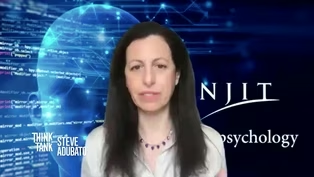
- We're now joined by Dr. Julie Ancis, who is professor and cyber psychology director at the New Jersey Institute of Technology NJIT.
Doctor good see it.
- Nice to see you.
Thanks for having me on your show.
- Well I've been wanting to talk to you for a while because I think about Zoom fatigue, I think about how isolated people have been, we're taping this at the end of April 2021, excuse me 14 plus months as we go into the COVID crisis, if you will, the global pandemic.
What does that have to do with cyber psychology?
- Great question.
I think it has everything to do with cyber psychology.
Cyber psychology is basically the study of how people behave in a technologically oriented environments.
And so that includes social media.
And that includes the study of how social media impacts our well being.
And certainly loneliness.
And we're in a loneliness pandemic now, especially with younger generations, really has everything to do with the study of social media, and its impact on well being and other aspects of cyber psychology.
- Loneliness.
So interesting.
So for our kids who want to be with their friends more there with them, some, particularly as more teenagers, and others are vaccinated.
But I guess, millions of other parents worry about this, we're worried about our kids being lonely.
Okay, but they're online, when they're online playing games interacting with each other.
Are they less lonely?
- Yeah, that's another good question.
And I think its-- - By the way all I have questions, I have zero answers but go ahead.
(doctor laughing) - I think it's a complicated issue.
So I don't come down as social media being all good or all bad.
If you look at the research in this area, it's quite complicated.
So social media, playing games online, interacting with other people online, is an incredible source of social support for many people, including our kids who are engaged in remote learning or have been this entire year.
So it's really about I think, looking at, what are they looking at online?
What kind of games are they playing online?
How frequent are they engaged in their social media versus engaging in face to face in-person interactions with friends or family?
So I think there are a lot of variables to consider when we're looking at the impact of gaming on loneliness, or gaming on anxiety, and depression, or even other aspects of social media use.
- The other thing that I often think about, again, when I say I think about it just means I know other people are thinking about it.
So I think about Zoom fatigue.
To me, I like, I need to see people, and I guess it'd be better have meetings in person, broadcast in person.
Okay, we can't do that.
Let's do this.
But then there are some people who say, I just don't wanna even be seen anymore.
So we're talking about loneliness.
But the paradox, or the thing that's confusing to me is, it's less lonely when you can see and hear people in a Zoom Meeting.
But more and more people are saying I don't wanna be seen, I wanna just be heard, which means they're less engaged.
And trust me, there's a question here.
If they're less engaged, aren't they more lonely?
Doesn't Zoom bring us together?
- Yeah, it certainly has brought us together.
So the fact that-- - When I say Zoom I mean, any platform and we're not promoting Zoom, I mean, any GoToMeeting, whatever it is, but go ahead, I'm sorry.
- Yeah, no, that's okay.
I mean, the invention of these platforms, the creation of technology and technological advances have enabled us to engage across time zones, across geographic regions, in ways we could never have imagined.
So that's been incredible.
And as I mentioned, a moment ago, an incredible source of social support.
At the same time, you know, we really have to question whether these platforms and our engagement in these platforms can really replace face to face interactions, because there are a lot of aspects of, you know, these kinds of engagements that are not necessarily natural and do have an impact on our psychology.
- Okay, so this is a really tough one.
And I don't need you to tell me it's a good question.
Because it's a good question, 'cause no one's ever answered this, okay.
- But you ask good questions.
- Okay, I'm trying but here's the other one.
One of our producers, by the way, when you say good questions, 'cause our producer said it in my ear, but are you ready for this one?
Mindfulness, the term mindfulness gets thrown around a lot.
To me, I've tried meditation a million times, and too many things going on in my mind, which I know is a self defeating, I know the problem there.
But it's not just me again, mindfulness beyond meditation, whether it's just taking a walk, being with yourself, listening to music, reading, what value is there in this thing called mindfulness?
And how do we then determine the difference between mindfulness and loneliness?
I go into myself, okay.
And I feel better, but I'm lonely.
How do we protect ourselves there?
- Well, I'm a big proponent of mindfulness.
And I like you struggle with it.
But I've been practicing it for a very long time.
So I think with the-- - You have?
- Yes.
So folks who are maybe type A and go getters and high achievers like you, perhaps may have a hard time just relaxing.
And being in the present moment.
And mindfulness is all about being grounded, being present, and having a state of mind and body where no matter what is happening around you, no matter whether there's chaos, or not, that you're able to sort of maintain your center and is extremely important.
- We're gonna talk offline about meditation.
By the way, Dr. Richard Carlson, Don't Sweat the Small Stuff has a great chapter called Beware of the Busy Mind.
Read it, check it out.
Hey, ready for this one?
I think back on January 6th, right.
That is the date for the horrific insurrection, the Capitol.
So people came together.
People weren't lonely, but they were also listening to the echo chamber back and forth digitally telling themselves an election was stolen, came together.
And the point I'm making is what about all the misinformation, confusing, contradictory, false?
I'm together I'm not lonely, and I'm with these other people believe what I, the question here is this, how the heck do we manage information, and make sure that what we get is legitimate and accurate?
- That is, the challenge of this century.
We are bombarded with information 24/7, and it's very difficult, even for the most educated and the most informed to make sense of what's true, and what's not true.
So there are a number of interventions and there are a number of-- - About 20 seconds left.
I apologize for doing that to you, Julie, go ahead.
- There are a number of games that have been developed to teach people how to be more critical thinkers with regard to information online and to be able to spot when information is false or misleading.
- By the way, let's make sure I'm post production we put is there a website that people can go to on your end that people can find out more?
- Sure.
One could go to NJIT.edu to learn about the Cyber Psychology Program.
I also have a blog on Psychology Today online the cyber psychology page.
And I've also been leading up webinars related to cyber psychology with some of the leading speakers across the world and one could find that on the YouTube channel NJIT Cyber Psychology Center.
- Dr. thank you so much for joining us and by the way, just to be clear NJIT, one of the higher ed partners that we work with, to promote important public information.
Thank you, Julie, we appreciate it.
- Thank you very much.
- Stay with us, we'll be right back.
To watch more Think Tank with Steve Adubato, find us online and follow us on social media.
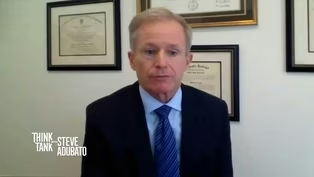
- We're now joined by Dr. Stephen Brunnquell, who is president of the Englewood Health Physician Network.
Good to see you, Doctor.
- Happy to be here, Steve.
- Doctor, the vaccine distribution, as we speak right now at the end of April, 2021, how are we doing, A, and, B, we're about to talk about vaccine resistance.
- So I think the good news is that we've done a pretty good job in getting vaccine out quickly to, first and foremost, our most elderly and our most vulnerable, and, I think, the rest of the population, now that everyone is eligible.
Those who want the vaccine, I think, pretty much have been able to receive a vaccine.
I know, early on, there was a lot of competition.
There's a lot of availability, as we speak right now.
The next challenge is, as you mentioned, the vaccine hesitancy, the portion of the population that doesn't care for a vaccine at this moment.
- So Doctor, what would you say?
I know I've asked so many really smart clinicians, healthcare experts, this question, but there are a fair number of people watching right now, some who say no, no way, some who are still on the fence.
As we do this program, the J & J situation's what it is.
You know, I don't know what the federal government's going to do, in terms of moving forward, but it had an impact.
Let's just say that.
For those who are still hesitant, what is the message you have for them, in general?
Then I'm going to ask you more specifically about women and pregnancy.
- So I divide the hesitant folks into three groups.
One are young people who, you remember being young, we were invincible.
They feel that invincibility now.
They say, well, if I get it, I'll be sick for a few days.
Who cares?
I've heard even some parents say, why don't they just get it and, sort of, develop antibodies?
It's, sort of, like chicken pox, and it's not a big deal.
To which I say, yeah, but you have parents and you have grandparents.
So that's one group.
The second group are those in the Black and Brown communities.
And let's be perfectly honest.
We are very aware of some of the disparities in our healthcare system that have been present for decades.
When I started the vaccine process here at Englewood, I reached out to a number of the religious groups in our area, particularly the black churches, and I was, frankly, stunned that, several times, they brought up the Tuskegee Syphilis Project, which as your viewers may or may not be aware, was a federal program in the 1930s, where the government intentionally inoculated black men in Tuskegee, Alabama, with the syphilis spirochete and deliberately infected them without their knowledge or their permission.
That horror is still very much on the minds of black people in our area, particularly older blacks.
- Rightfully so, rightfully so, Doctor.
- Absolutely, rightfully so.
I learned that in medical school, and I am as horrified today as I was then, but we need to break down that.
And I tried to do that with some education with those folks and basically saying, you're going to get the same vaccine that I got.
This is-- This is-- But we have to understand their hesitancy because of that history.
The third group is a group that either hasn't heard the data, rejects the data, listens to social media, or just says, um, I'll think about it, I'll do it some other time.
That, to me, is the toughest group, because, as you know, there's a lot of misinformation out there.
And if you listen to social media and you'll listen to some of the conspiracy theories and the hoax theories, and that it's going to change your DNA, and the government's going to track you, I'm not quite sure how to get past some of that.
- Yeah, and for women, particularly women who are pregnant or want to get pregnant, what do they need to know from a clinical, medical, safety perspective?
- So this is somewhat personal, since my son and daughter-in-law are planning on starting a family very soon.
And, so, when the vaccine became available, late in 2020, it was a big concern.
And to be very frank, I was unsure of what to say to her.
I think the data has been pretty clear.
There is no evidence of any effect on mother or fetus from this vaccine.
There is no safety concern about a woman who was pregnant, or planning on becoming pregnant, from getting this.
And one of the things I would add to say to them is that it would be far worse for you to be ill with COVID when you're pregnant than to get a vaccine.
- Real quick on this, Journal Square, Jersey City, right?
Englewood Medical Complex opening in the fall?
- Late in the fall, yes.
- What is it and why does it matter, especially as we talk about underserved communities?
- Oh, well, Steve, we're making a huge commitment to the community of Jersey City, which, as you know, is just expanding by leaps and bounds.
We are building about 75,000 square feet.
It's a true multi-specialty office with all the primary care, medical-surgical subspecialties.
We'll have a diabetes center.
We're considering a specific program to address asthma in the city.
We'll have radiology.
We'll have urgent care.
We have a number of practices in the Englewood Health Physician Network in Jersey City now, so we'll be consolidating them and expanding the services to that community.
- We got about 30, 40 seconds left.
By the way, Englewood Health, one of the healthcare organizations that support what we do, but, real quick, for those who say, I'm done, I'm done, literally, I'm done with COVID, as if COVID doesn't have something to say about that, COVID fatigue, 30 seconds, go.
- I think we're all exhausted by COVID fatigue, and the only way out of this is to get a vaccine.
All the people at Englewood Hospital, right now, who have COVID, none of them had a vaccine.
Nobody who's getting a vaccine, zero, nobody's being admitted to the hospital who has had a COVID vaccine.
It's as simple as that.
And you know what, Steve?
The sickest people are my age and your age.
They're not the very elderly.
They are people who have a lot of years left, and it's tragic to see this happen to them.
And there's no good reason for it now.
- I don't know what there is to say after that, because it speaks volumes.
Most importantly, thank you for everything you and all of your colleagues are doing, particularly on the front lines, to protect all of us, and also best to you and your family as it expands.
- And thank you so much.
And thanks for getting this message out about vaccine hesitancy.
It is the most important thing we should do right now.
- It is our honor.
Thank you, Doctor.
I'm Steve Adubato, and we thank you for being with us, and we'll see you next time.
- [Narrator] Think Tank with Steve Adubato has been a production of the Caucus Educational Corporation.
Funding has been provided by IBEW Local 102.
Bank of America.
The Robert Wood Johnson Foundation.
MD Advantage Insurance Company.
NJM Insurance Group.
Operating Engineers, local 825.
New Jersey Sharing Network.
Choose New Jersey.
And by NJ Best.
Promotional support provided by New Jersey Globe.
And by AM970 The Answer.
(Music playing) NJM Insurance Company has been serving New Jersey policy holders for more than 100 years.
But just who are NJM's policy holders?
They're the men and women who teach our children.
The public sector employees who maintain our infrastructure.
The workers who craft our manufactured goods.
And New Jersey's next generation of leaders.
The people who make our state a great place to call home.
NJM, we've got New Jersey covered.
The Connection Between Cyberpsychology and the Pandemic
Video has Closed Captions
Clip: 5/22/2021 | 10m 8s | The Connection Between Cyberpsychology and the Pandemic (10m 8s)
The Importance of Corporate Philanthropy During COVID
Video has Closed Captions
Clip: 5/22/2021 | 9m 20s | The Importance of Corporate Philanthropy During COVID (9m 20s)
Social Media's Role in Spreading Vaccine Misinformation
Video has Closed Captions
Clip: 5/22/2021 | 8m 46s | Social Media's Role in Spreading Vaccine Misinformation (8m 46s)
Providing Support for PBS.org
Learn Moreabout PBS online sponsorship
- News and Public Affairs

Top journalists deliver compelling original analysis of the hour's headlines.

- News and Public Affairs

FRONTLINE is investigative journalism that questions, explains and changes our world.












Support for PBS provided by:
Think Tank with Steve Adubato is a local public television program presented by NJ PBS