21
Cumberland County
10/20/2022 | 7m 46sVideo has Closed Captions
Edgar Aquino-Huerta gives a voice to his undocumented community in South Jersey.
Edgar Aquino-Huerta is using his voice to help his community and push for immigration reform in South Jersey. Providing farmworkers with resources for fair wages, safe living environments, and helping workers obtain their driver's licenses. An emerging filmmaker; inspired by the stories of his coworkers and friends, Edgar introduces us to Cumberland County through the eyes of undocumented workers.
Problems playing video? | Closed Captioning Feedback
Problems playing video? | Closed Captioning Feedback
21 is a local public television program presented by NJ PBS
21
Cumberland County
10/20/2022 | 7m 46sVideo has Closed Captions
Edgar Aquino-Huerta is using his voice to help his community and push for immigration reform in South Jersey. Providing farmworkers with resources for fair wages, safe living environments, and helping workers obtain their driver's licenses. An emerging filmmaker; inspired by the stories of his coworkers and friends, Edgar introduces us to Cumberland County through the eyes of undocumented workers.
Problems playing video? | Closed Captioning Feedback
How to Watch 21
21 is available to stream on pbs.org and the free PBS App, available on iPhone, Apple TV, Android TV, Android smartphones, Amazon Fire TV, Amazon Fire Tablet, Roku, Samsung Smart TV, and Vizio.
Providing Support for PBS.org
Learn Moreabout PBS online sponsorship[upbeat music] - [Edgar] The reason why a lot of the undocumented workers have bags in their eye.
It's not because they're tired, but because they have built up tears of not being able to cry out loud, but to silently scream because they've just been not appreciated, mistreated.
They're afraid to scream and for some reason people forget the farm workers exist in South Jersey and you'd be surprised how people think that like, "wait, farm workers exist in New Jersey?
I didn't even know there were trees in New Jersey."
And I'm like, "Yeah, this is called the Garden State for a reason."
[music ends] I grew up knowing that I wasn't from here.
We came straight to Brighton here in New Jersey, so my mom, she didn't hide the fact that we weren't from here.
Both of my parents were agricultural workers.
Growing up in a low income family, I mean undocumented, we already didn't have enough resources ourselves.
I learned how to be independent at a, at a young age.
I wanna say when I was 13, 14 that's when life hit us really hard.
And my mom, she got sick, she had to go back to Mexico.
I had to help my dad with bills.
The summer after my mom left he sent me to go work in the fields.
My first job was picking peppers.
I would see farm workers on the outside but I was never the actual farm worker myself.
I went to school with another mentality.
I wasn't really a kid anymore.
I had to do both, I had to work in the fields and in the factories.
So a lot of us had to grow up not knowing about our futures, having to learn ourselves.
[Factory Sounds] So one of my many hopes for undocumented workers is that me and other organizers can get more youth to get involved so that we can give undocumented workers that courage to come out and fight for this immigration reform.
With an immigration reform, you know, they can work freely.
They can work without having the fear of getting in trouble or they can travel back to their homes.
They can have that closure.
[thoughtful, melodic music] Undocumented workers have to face many things at work which is workers in general that don't understand English or they don't know how to read English.
They're afraid to speak up because they don't want to get fired maybe because there's no other job out there that will hire them.
[music ends] The few similarities that undocumented immigrants and Americans have is this the American dream?
You know, like what we deserve, like, you know like that respect.
[birds chirping] When I was rushing to get my work done to go to school the coworkers I got would finish for me.
Sometimes they would take turns and they would give me a ride to school and it shows that they wanted to see me succeed.
They had my back and they're not even my family members you know, they became my family.
[upbeat music] When I started working in these fields, I had that same mentality of defending people that are too scared to defend themselves.
One thing I love about working in these many places is encouraging them to use your voice.
I love giving them hope.
I understand a little more now, so I need to give back.
C.A.T.A., this organization that advocates for immigrants.
One of those years DACA was approved, so I was able to apply for that.
That means I finally, for once in my life, had a choice whether I wanted to continue working there or find another summer job.
And another thing, I just became attached to a lot of these people that I would see every summer.
As far as my parents experience, one of the things was having to drive with no license.. [music fades] So me giving back to them is me helping them apply for this driver's license.
[traffic sounds] Even though it's in Spanish, the test is somewhere advanced Spanish where they use words that we don't commonly use.
My boss and I, we were finding ways to make these study guides a little bit easier for them to understand.
I want to say I've helped around 100 or so people.
Now that I can give back to them, help them get a license, it's like, you know, it's something that I feel good about because today's driver's license tomorrow, who knows?
Maybe it can be a work permit.
Then after that residency and then your citizenship they know that, you know, they were here.
When I was very little I've always wanted to be a storyteller.
I went to Cumberland County College but it was hard because I had to pay for my tuition and we didn't qualify for financial aid.
It felt like it was unrealistic, kind of like how I felt about it at first, I took a couple criminal justice classes but at that point I was gonna go straight to be an immigration attorney and so I just went back to film because I'm like, I can still help people through storytelling.
[laughter] When I fell in love with screenwriting and when I found that that was my passion.
I was there and again I was using a lot of stories that I would take from my own experience.
I haven't finished the whole thing yet.
I just need to finish like what we call the "third act".
I think it's very important for immigrants to tell their stories because only an immigrant can tell their story.
Nobody else can tell their story.
[thoughtful, bass guitar music] Voices of the Soil is a project that I started a year ago.
I wanted to create a platform where I can showcase my short films, where I can showcase other people's short films from the community where I can uplift small businesses and tell their story of how they started; give the audience the south Jersey that I see.
I want to show positivity.
I want to show just the good stuff that that we've done as a community.
[music ends] - Wow, it looks good!
- Does where I live affect how I live?
It does to an extent.
[upbeat music] In Cumberland County, I talk about the big population of undocumented people, how a bunch of us are "first gens".
I like representing where, you know, without unity we can't really do much.
Like if I eat, I want my whole team to eat, no matter what obstacle you have, if you have the desire of being somebody in life or a dream that you want to pursue, it's something that we say in Spanish, like with 'con ganas'.
'Con ganas' is meaning like if you really want to do something, you would do it.
There's a quote that my mom told me right before she left.
She said something in Spanish, which is, [speaking Spanish] which translates to: always try your best because what you plan today you harvest later.
And that's something that always stuck with me because I'm harvesting what she planted 23 years ago when we first came into this country.
And her dream was always for me to go to college for me to follow my dream.
You know, we're harvesting this together.
[outro music]
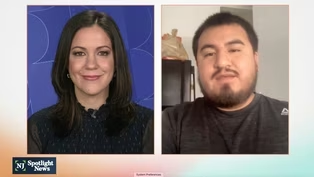
A Voice for South Jersey's Undocumented Agricultural Workers
Video has Closed Captions
Clip: 11/1/2022 | 4m 55s | Edgar Aquino-Huerta of Cumberland County sits down with Briana Vannozzi. (4m 55s)
Providing Support for PBS.org
Learn Moreabout PBS online sponsorship
- Indie Films

A diverse offering of independently produced films that showcase people, places, and topic





About Damn Time: The Dory Women Of Grand Canyon (2025)

Support for PBS provided by:
21 is a local public television program presented by NJ PBS