
Cuomo's Budget Plan, Small Biz Struggles, Tax the Rich
Season 2021 Episode 3 | 26m 46sVideo has Closed Captions
Gov. Andrew Cuomo lays out his plan for closing the state's $15 billion budget.
Keshia Clukey from Bloomberg and Jon Campbell from the USA Today Network give details & analysis on Cuomo's budget plan. Sen. Mike Martucci discusses how New York could be helping struggling small businesses, and other top issues facing the state Legislature. Sen. Jabari Brisport says Gov. Cuomo is wrong in wanting to increase taxes, and other costs, for the wealthy to raise revenue for New York.
Problems playing video? | Closed Captioning Feedback
Problems playing video? | Closed Captioning Feedback
New York NOW is a local public television program presented by WMHT
Support for New York NOW is provided by WNET/Thirteen and the Dominic Ferraioli Foundation.
Cuomo's Budget Plan, Small Biz Struggles, Tax the Rich
Season 2021 Episode 3 | 26m 46sVideo has Closed Captions
Keshia Clukey from Bloomberg and Jon Campbell from the USA Today Network give details & analysis on Cuomo's budget plan. Sen. Mike Martucci discusses how New York could be helping struggling small businesses, and other top issues facing the state Legislature. Sen. Jabari Brisport says Gov. Cuomo is wrong in wanting to increase taxes, and other costs, for the wealthy to raise revenue for New York.
Problems playing video? | Closed Captioning Feedback
How to Watch New York NOW
New York NOW is available to stream on pbs.org and the free PBS App, available on iPhone, Apple TV, Android TV, Android smartphones, Amazon Fire TV, Amazon Fire Tablet, Roku, Samsung Smart TV, and Vizio.
Providing Support for PBS.org
Learn Moreabout PBS online sponsorship[ THEME MUSIC ] >> New York's future is bright.
>> That's from his budget address this week.
Jon Campbell from the "USA Today" network and Keshia Clukey from Bloomberg Law will join me with details.
Then Republican Senator Mike Martucci shares his perspective on how the state should be helping small businesses, and state Senator Jabari says Cuomo's wrong about taxing the rich in New York.
I'll explain.
I'm Dan Clark and this is "New York Now."
>> Welcome to this week's edition of "New York Now."
I'm Dan Clark.
Cuomo released his proposal for the state budget this week, coming in at a price tag of $193 billion.
That plan includes a strategy for filling the State's massive budget gap-- and then some-- and he said it's all going to depend on how much money New York gets from the federal government, which we might not know for a few months.
In the meantime, he's presenting two scenarios for the future of New York's finances, one that's good and one that's not so good.
Take a look.
It was a tale of two states, a New York in peril and a New York made whole.
That was Governor Cuomo's message this week when he unveiled his plan to fill a projected $15 billion budget deficit over two years.
>> So we're asking for fairness, fairness from Washington.
>> Cuomo laid out two very different strategies for curing the State's finances.
Both of which depend on billions of dollars in aid from the federal government.
>> What happened on COVID last spring was a result of federal negligence.
What happened to New York was no fault of New Yorkers.
>> The best case scenario, Cuomo said, would be for the federal government to send the full $15 billion to New York.
That would fill the State's budget gap and allow the state to avoid billions of dollars in spending cuts and tax hikes.
That money could also be used to provide tax credits for restaurants and small businesses, which have been hit especially hard by the State's COVID-19 shutdowns.
>> Restaurants paid a really high price for what happened during COVID.
Many businesses were hurt.
>> It's not unlikely that New York would receive the full $15 billion it's asking for.
President Joe Biden is proposing a new stimulus package that would provide billions in aid for state and local governments, but if they don't come through with a full $15 billion, Cuomo says, New York will sue the Biden administration in pursuit of those funds.
>> The new government didn't cause the damage, but they are legally, ethically, and politically responsible for correcting it.
>> It will be the first time Cuomo goes toe to toe with president Biden, a close ally.
He says he's willing to do it because the alternative would be financial chaos for New York.
>> If the federal government doesn't fund state and local governments, it's going to hurt all New Yorkers.
>> That's Cuomo's second plan for closing the State's budget gap.
In that scenario, he's banking on at least $6 billion in federal aid.
That would leave a $9 billion gap that Cuomo says would be closed through tax hikes on the rich, a delay in tax cuts for the middle class, and massive spending cuts.
>> You then have to cut dramatically.
>> And Cuomo, again, said he'd prefer to not raise taxes on the rich in New York.
Saying that wouldn't raise enough money to avoid cuts in spending.
Leaders from the state legislature took a different position, saying democrats should be ready and willing to raise revenue from the State's wealthiest residents.
In a statement, Senate majority leader, Andrea Stewart-Cousins said the state, quote, must be ready to act as a state to advance efforts to raise revenues, including having the hyperwealthy share this burden.
Republicans in the state legislature feel differently.
They want Cuomo and democrats who control the state legislature to take another look at spending to see if there's anywhere the state could reduce costs without raising taxes.
Senator Tom O'Mara is the top-ranking Republican on the Senate finance committee.
>> New York continues to spend too much and tax too much.
>> Cuomo also wants Congress to repeal a cap installed during the Trump era on the deductibility of state and local taxes.
For New Yorkers that itemize, that would put more money in their pocket, he said.
>> That increases our taxes every year.
If it's dropped, our taxes will go down every year.
>> And he's also seeking to legalize both adult use marijuana and mobile sports betting this year, saying the two industries could generate more than $800 million for the state annually.
Democrats in the legislature will now come up with their own spending plan and hash it out with Cuomo behind closed doors.
The state budget is due at the end of march.
So you can imagine, it's going to be a very interesting next few months.
with me in studio to discuss are Jon Campbell from the "USA Today" network and Keshia Clukey from Bloomberg.
Thank you both for being here.
>> Thanks for having us.
>> So Jon, I want to start with you.
This is a budget plan-- we have two budget plans, $6 billion if we get it from the federal government and $15 billion if we get it from the federal government.
What have we heard from reaction from lawmakers first is what I want to get from you?
>> The number one reaction we have heard from lawmakers so far is they want the== the democratic lawmakers, I should say, they want a higher tax on the wealthy regardless of how much money comes from the federal government.
Whereas, the Governor's plan, which you know, he painted it as two different plans.
Really, it's one plan with some asterisks, really.
It says if we get more money from the federal government, you know, we won't have to increase taxes on the wealthy.
We won't have to do this and we won't have to do that.
But the democratic lawmakers are really making clear that they want to use this opportunity to increase taxes on the wealthy.
Some are not pleased with the Governor's plan as it is, which would increase taxes on people making over $100 million by two percentage points.
People making more than $5 million, the income would be taxed about a half percentage point more.
It's a sliding scale.
So you're seeing some reaction from lawmakers that they want to do the millionaire's tax regardless of how much money comes from the federal government.
>> I should say later in the show we will be talking to state Senator Jabari Brisport about this proposal.
they have a whole package of bills, a whole smorgasbord of billions of dolloars of revenue raisers.
Stay tuned for that.
Keshia, I want to go to you next.
What surprised me about this budget plan is the Governor has these two plans, both rely on aid from the federal government.
What we're not hearing is a situation where we don't get any money from the federal government by the time the budget is due, which is the end of March.
>> Uh-huh.
I think that the Governor, throughout the Coronavirus pandemic and throughout the fall, people kept saying, we have a deficit this year.
I mean, the current fiscal year let alone next year's budget.
We still have a deficit.
How are you going to fill it and continuously, he's waiting on the federal government.
So he's kind of-- I mean, I don't know what happens if we don't get anything.
They kind of seem to think that we're going to get some sort of aid, and it just is a matter of how much and whether or not it's going to be just a really tough budget.
He has a proposal to pause middle class income tax reductions this year, which is something that lawmakers would want to do because it makes them look good in their districts.
>> Right.
>> To have tax cuts.
Major cuts to education, health care, and this is a time of crisis, and so making cuts would only make it worse.
So I think he's just really betting on Biden.
Go ahead.
>> I mean, There's a caveat built into the budget that says if the state doesn't get $3 billion from the feds by August, then the budget Director, Cuomo's budget Director can withhold certain payments to local governments.
Not school aid.
School aid is an exception to that.
But you know-- that suggests to me that they are anticipating that maybe they'll pass this budget with these unknowns still, just like they did last year, and give the opportunity to the budget Director to withhold funding if they don't get that federal money.
>> Which I got to say, I wouldn't be surprised if even if they did get $15 billion from the federal government, if they still put something in the budget that said, by the way, if this $15 billion doesn't quite work out, we're still gonna give power to the budget directer to make cuts as he or she sees fit at the time.
>> That's always a struggle between the legislature and the Governor, how much is the legislature willing to give up in terms of power and authority, and how much does the Governor want?
I mean, the Governor always wants all of it, quite frankly.
That's going to be something that's gonna be hashed out over the next few months of negotiations.
>> We should mention, Keshia or Jon, whichever one of you wants to answer this.
Things look a little better than they projected them to be in the spring, right?
>> Yeah.
Originally, I think it was a $14.9 billion deficit just for the current fiscal year.
16 billion for the next fiscal year which starts April 1st.
And then it's kind of interesting because some of the fiscally conservative lobby groups and political analysts have been saying all along that Cuomo's kind of crying wolf, like making it look worse than it actually is and not taking into consideration certain revenues that are going to come in, federal aid that could close that gap.
Well, the budget comes out, the budget proposal comes out and oh, guess what, we only have 4.7 billion for the current fiscal year and then another 10, so it works out to be about 15 billion total.
So that $15 billion budget gap is for both years and it's presumed that we can fill this year already with a mixture of cuts that the administration has already made for freezes on pay hikes and federal aid.
>> If we don't get the $15 billion as we mentioned before this segment, the state is going to sue the Biden administration.
I think this is a really interesting situation for the state to be in, Jon, because president Biden is a very close ally of the Governor's.
There were points that we thought the Governor would go to his administration and be part of the cabinet.
What does that look like politically?
Do you think the Governor would actually move forward with that?
>> I mean it's-- [LAUGHTER] You know, it's-- it's easy to threaten to sue somebody.
>> Right.
>> You can file any lawsuit you want, but whether that lawsuit has actual legal bearing is another question.
We've seen a similar kind of lawsuit the state filed against the federal government when Donald Trump was in charge about the state and local tax deductions that were rescinded essentially or capped during the 2017 federal tax reform.
And they made an equal protection claim basically saying that it's not protecting states equally under the law.
I don't know exactly what the legal rationale would be.
I mean, as of right now, it's just-- it's a little tidbit that the Governor threw out that Garnered some headlines, but there's not any meat to it.
Who knows what that would be.
They lost the salt lawsuit because the judge said at the time even though this did hurt people in New York, it was still the purview of the federal government to do this.
They had every right to do it.
It was not illegal >> Why would it be any different now?
>> Right.
That's what I'm thinking.
Moving forward, before I run out of time, Keshia, we have a new president, president Biden,as I said, close ally to Andrew Cuomo.
How is this going to change the relationship between New York and the federal government?
and I have to assume things will get better between the Cuomo administration and who is the White House.
>> Yeah, I think Cuomo has continuously said that said that Trump administration had, I think it was, used New York state as a political pinata; and there were multiple things, everything from immigration issues to taxes, as Jon had said, was kind of against New York state and against blue states in general.
So having-- pardon me, having a democratic president will theoretically be a boom to the blue states, but also we have Chuck Schumer as the majority leader in the Senate and that also could be big money for New York state because typically, they try to funnel that money to their home state.
[LAUGHTER] That will be really interesting to watch in the next few weeks.
Jon Campbell from the "USA Today" network and Keshia Clukey from Bloomberg, thank you both so much.
>> Thank you.
>> Thank you.
>> Almost half of small businesses in the U.S. say they will have to close this year if the economy doesn't get better.
That's according to a survey released last month by the national federation of independent business.
And lawmakers are hoping that won't be the case here in New York.
That includes state Senator Mike Martucci, the top-ranking Republican on the Senate commerce committee.
We spoke this week.
Senator Martucci, thanks to much for being here.
>> Thanks for having me, Dan >> Anytime.
So you've been named the top-ranking Republican on the commerce committee which deals with commerce, economic development and small businesses.
Small businesses, obviously, is a top priority of the Republican conference in the state Senate.
Tell me, from your perspective, what the state could be doing right now to help small businesses at such a tough time.
>> Well, first, our state needs to be focused on ways to make sure that the tremendous burden that's been placed on the unemployment insurance system doesn't translate to our small businesses.
So many of our businesses were closed by order of the state and understandably first, to protect folks from the pandemic, but today, this conversation's about translating those unemployment costs back to our small businesses.
We also have to be looking at very practical things that provide immediate relief, a restaurant industry that's absolutely on its knees.
So many of our commercial tenants who need help paying their commercial rents and on and on.
But I would tell you that one of the things this I'm focused on is making sure that we provide immediate relief to our businesses because we don't have time to help.
Once a business closes, it's nearly impossible for a business to reopen.
>> Just zooming out, the committee you're on also deals with economic development in general.
That's been a huge thing for the Cuomo administration over the last decade, trying to boost these different regions of the state through these economic development initiatives.
While you're on the committee, what kind of initiatives would you like to see the state take?
Do you think the Cuomo administration is doing good in the strategy that they've chosen?
>> So I applaud the Governor and his administration for focus on economic development in this state.
I certainly think there are some questions that have to be answered if we're really getting bang for our Buck with respect to all of these economic development dollars.
Just myself, I prefer a method that involves translating those resources down to local IDAs and local LDCs because I feel like every community in New York is very different and each community understands the best way right now to provide support and quite frankly, help save its main street businesses.
And I think as I look at what's going on right now, I want to make sure that moving forward, we're treating small business in the state of New York with the same respect that we're treating our large businesses.
And while I think we've got a good track record of creating incentive for some of our big businesses, right now, it's time for us to save main street, Dan.
because if we don't do it now, we won't recognize a main street anywhere in New York when this pandemic is over.
>> Speaking of big businesses versus small businesses, democrats are considering some tax hikes on the wealthy New York.
We don't really know what that is going to look like.
I'm curious from your perspective, how do you feel about that proposal?
Is that something you can get on board with, or are you against that?
>> What I prefer to look at first is the waste that exists in our current state budget and current state spending plans.
Before I ask any New Yorker to pay more to be here, before I ask anyone to who is I trying to run a business here to contribute more, I think it's time that we take a hard look at the budget, full review of the budget process from top to bottom.
To be honest, I hear all these conversations that hard decisions have to be made in the budget, but when you look at some of the absolute give-aways that exist in the budget.
For example, half a billion Hollywood film tax credit, what is clear to me is that there are some very easy decisions that have to be made, even things like removing tax credits like that.
>> I think the state State's economy is something that we can talk about all day and it deserves to be talked about all day, but I want to ask you about your position.
You're one of two Republicans that were able to flip a seat from a democrat in the last year's elections.
Aside from the committee that you're on, the commerce committee, what other top priorities do you have?
>> So besides commerce, which is a place and protecting our small businesses, which I believe is really important, more important now than ever, I'm focused on taking a look at couple other important things, too.
first, certainly, property tax relief is a huge issue here in the state of New York.
Particularly for our seniors, so here, just in my first week of office, my team has drafted a bill that would help our seniors who earn less than $100,000 a year be able to afford to live in their homes.
Other things that I talked about in the campaign which are center point to issues going on in our state right now is public safety and public health.
I was outspoken against the bail reform changes from the very early phase, which I believe put so many of our residents in our communities at great risk.
We heard from law enforcement and our district attorneys around the state and so many others so certainly public safety is right up on that list, and third and finally, I would say is helping protect our farms.
I'm focused on ways to help our formers here in New York.
>> Speaking on helping farmers, there's another big issue on the table this year, legalization of marijuana.
But there's also the opportunity for the expansion of the hemp industry.
And I'm wondering, from your perspective, because I think people are divided on this issue, do you think that the state should legalize marijuana?
Do you think that expanding hemp requires that legalization?
You know, what I am interested in doing, though, is making sure that we, as a legislative body, deliberate in in the right way and bring the stakeholders in the room who this is going to affect.
I think when you look at the way policies are affected in this state, big public policies, and I use bail reform as an example, you will see that was public policy changes that were made that didn't involve the stakeholders and it wasn't done right.
What I look forward to being part of the conversation and making sure that the Governor outlined that legalizing adult-use recreational marijuana is going to be a priority for this year.
I want it make sure as a legislature, we play our role in terms of bringing in the stakeholders and making sure that we get the details right.
There will be a good way to do this and there will be a bad way to do this.
What I want to make sure we do is we don't do this in typical Albany fashion, which means making decisions in the dark of the night with no public deliberation and excluding the folks, interest groups that need to be part of the conversation.
>> Yeah.
Hope springs eternal that things will change up here in Albany, but we will sigh.
>> As we mentioned, democrats are considering new tax hikes on the rich in New York to help fill the State's budget gap.
Governor Cuomo has pushed back on the idea saying it wouldn't earn enough and could drive businesses and some democrats say he's wrong and they have a package of bills they want to pass immediately.
State Senator Jabari Brisport joined me this week to explain.
Senator Brisport, thanks for being here.
>> Of course, Dan.
Thanks for having me.
>> Anytime.
You say he's wrong.
Tell me why.
>> Well, Dan, I don't just say he's wrong.
I say he lied in saying that.
in the invest more in New York campaign our investment income tax proposal raises up $18 billion by more aggressively targeting the highest income tax proposal in the State of New York, and the entire package leads to increasing revenue by $15 plus.
There's a lot more money in the hands of the rich and we can fund our future here in New York state.
>> So are we just talking about raising income tax rates on the high income earnings in New York state,-- and I think it's a whole package that you have, what else are we looking at?
>> It's a Huge package and this is on personal income.
There's also a capital gains tax on earned income for investments.
There is corporate taxes, which is really restoring the corporate tax rates to where they were before Trump lowered them and also taxing financial transactions like stocks, bonds, derivatives, a wealth tax and constitutional amendment to enact one and one that I will be pushing with Senator standard is an heir's tax, a tax on large inheritances.
>> I know there's some questions about the wealth tax, for example, about the constitutionality of that.
Have you examined those questions?
I know it's kind of preliminary.
These are sort of new proposals.
>> Yeah.
I mean, that's like the constitutional amendment, but I think it's worth saying that many New Yorkers already pay some form of a wealth tax in terms of their property tax.
The difference being that many New Yorkers, the bulk of their wealth is in their home but for the wealthiest people, only a fraction of their wealth in is in their estate.
>> So if the state does get money from the federal government, if we get enough to close the budget gap, do you think the state should still move forward with the revenue actions like raising tax rates on the wealthy, going after Wall Street, et cetera?
>> I think we should absolutely move forward with these taxes regardless of what the federal government does because it's what we need.
New York was hurting before Coronavirus hit us and we still have billions in need for education, for our public housing, for transportation, for energy investment to undo the Medicaid cuts that Governor Cuomo snuck into the budget last spring.
We definitely need all the funding that we can get.
>> So these aren't new ideas.
a lot of these ideas have been floating around the legislature for at least a couple of years.
I'm thinking specifically of raising taxes on the wealthy.
We did this several times throughout the State's history after 9/11, during the recession, the most recession ten years ago.
Why do you think that democrats in the legislature haven't pulled the trigger on this?
You're a first-term member.
>> I like that you said that the lobbies aren't new because this has been (inaudible) and even for a lot of them, Dan, like the thought transfer, the financial transaction has a basis, and we've had a thought transfer tax for decades.
I think we have a moment that we need to strike while the iron is hot right now when having a democratic supermajority in both the assembly and the state Senate and you know, we have leadership in the legislature that is much more Aminable to raising taxes on the wealthy than Governor Cuomo.
I'm excited to push forward and win this for all New Yorkers >> You know, the governor and the Republicans in the legislature have brought up an argument that if we raise costs for the wealthy in New York state, they will move out of the state to another state that may have lower tax rates or a lower cost of living.
>> Yeah.
I like that we bring the tax increases during the last fiscal crisis of 2009 because we have actually doubled the number of millionaires in New York than we did the first time we raised taxes in 2009 and the fact of the matter is, the wealthiest people in the state are the least likely to leave, you know, they are here in New York for the rich social safety net and incredible opportunities and because the businesses they own are here too.
What we should be worried about is not ensuring that we have a adequate social safety net and more and more working class New Yorkers are leaving New York because he can't afford to live here.
>> Republicans in the legislature have said instead of doing these revenue-raising opportunities that democrats should be looking at cuts in spending, looking closer at bigger parts of budget, like education and health care, and trying to weed out where they can save a few bucks, I guess.
I know you that may not agree with all of Governor Cuomo's budgeting ideas.
Are there any ideas where you think democrats should take a closer look?
>> You know, I think, first and foremost, we should just look at the inequality that is in our state right now before we start saying that we'll make cuts to it especially as a former public school teacher, I know that education is already at the bare bones.
We desperately need more money for counselors and textbooks and basic things in our school and would not look at more cuts in that area especially.
So we have deep inequity here.
We have 118 billionaires that made over $77 billion since the pandemic and which is more money than we're trying to raise in this invest in New York campaign.
That's what we will look for >> all right.
It will be really interesting to see see what happens over the next couple of months at governor and legislature continue to negotiate the state budget.
State Senator Jabari Brisport, thank you for being here.
>> Thanks, Dan.
>> There's still a lot of questions about Cuomo's state budget and we'll dig into a few of them next week.
We'll speak with a panel of environmental advocates about the State's goal and hear from the State's school boards association.
Until then, thanks for watching this week's New York now.
Have a great week and be well.
[ THEME MUSIC ]
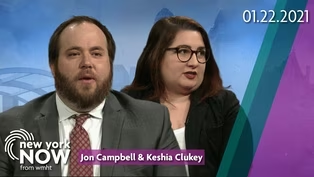
Reporters Roundtable: Keshia Clukey, Jon Campbell, NY Budget
Video has Closed Captions
Clip: S2021 Ep3 | 12m 8s | Keshia Clukey & Jon Campbell join with details and analysis on Cuomo's budget plan. (12m 8s)
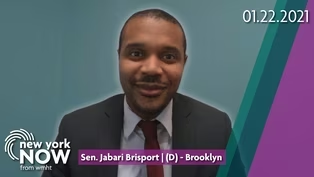
Senator Jabari Brisport on Tax Increases
Video has Closed Captions
Clip: S2021 Ep3 | 5m 30s | Sen. Jabari Brisport says Gov. Cuomo is wrong in wanting to increase taxes & other costs. (5m 30s)
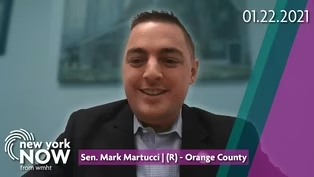
Senator Mike Martucci on Struggling Small Businesses
Video has Closed Captions
Clip: S2021 Ep3 | 6m 31s | Senator Mike Martucci discusses how New York could be helping struggling small businesses. (6m 31s)
Providing Support for PBS.org
Learn Moreabout PBS online sponsorship
- News and Public Affairs

Top journalists deliver compelling original analysis of the hour's headlines.

- News and Public Affairs

FRONTLINE is investigative journalism that questions, explains and changes our world.












Support for PBS provided by:
New York NOW is a local public television program presented by WMHT
Support for New York NOW is provided by WNET/Thirteen and the Dominic Ferraioli Foundation.