
Current Events Roundtable, Remembering Sidney Poitier
Season 50 Episode 3 | 26m 47sVideo has Closed Captions
Current Events Roundtable, Remembering Sidney Poitier | Episode 5003
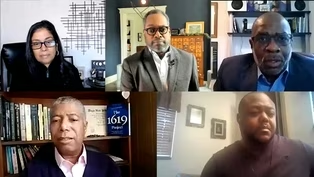
A wide-ranging roundtable discussion around some of the biggest current events catching headlines in the new year. Public relations and political consultants Karen Dumas, Greg Bowens and Brandon Brice, and Kerry Leon Jackson debate about new redistricting maps, discuss the conviction and sentencing in the Amhaud Arbery case, and share their perspectives in the Jan. 6 insurrection. Episode 5003
Problems playing video? | Closed Captioning Feedback
Problems playing video? | Closed Captioning Feedback
American Black Journal is a local public television program presented by Detroit PBS
Current Events Roundtable, Remembering Sidney Poitier
Season 50 Episode 3 | 26m 47sVideo has Closed Captions
A wide-ranging roundtable discussion around some of the biggest current events catching headlines in the new year. Public relations and political consultants Karen Dumas, Greg Bowens and Brandon Brice, and Kerry Leon Jackson debate about new redistricting maps, discuss the conviction and sentencing in the Amhaud Arbery case, and share their perspectives in the Jan. 6 insurrection. Episode 5003
Problems playing video? | Closed Captioning Feedback
How to Watch American Black Journal
American Black Journal is available to stream on pbs.org and the free PBS App, available on iPhone, Apple TV, Android TV, Android smartphones, Amazon Fire TV, Amazon Fire Tablet, Roku, Samsung Smart TV, and Vizio.
Providing Support for PBS.org
Learn Moreabout PBS online sponsorship>>Coming up on American Black Journal our round table guests are back to weigh in on all the big headlines here in the new year.
We'll talk about redistricting and the new maps here in the State of Michigan.
We'll talk about the sentences for Ahmaud Arbery's killers and we'll weigh in on the state of democracy one year after the January 6th Capitol riot.
You don't wanna miss this show, stay where you are.
American Black Journal starts right now.
(chiming music) >>From Delta faucets to Behr Paint.
Masco Corporation is proud to deliver products that enhance the way consumers all over the world experience and enjoy their living spaces.
Masco, serving Michigan communities since 1929.
>>Support also provided by the Cynthia & Edsel Ford Fund for Journalism at Detroit Public TV.
>>The DTE foundation proudly supports 50 years of American Black Journal in covering African-American history, culture and politics.
The DTE foundation and American Black Journal partners in presenting African-American perspectives about our communities and in our world.
>>Also brought to you by AAA, Nissan Foundation and viewers like you, thank you.
(upbeat music) >>Welcome to American Black Journal, I'm Stephen Henderson.
The new year has just gotten started, but already there are some very big headlines that have a huge impact on the African-American community.
We've invited our round table guests back to weigh in on some of these topics here in Michigan and around the nation.
First up, we wanna talk about the Michigan redistricting commissions new maps.
Then we'll talk about the sentencing for the men who killed Ahmaud Arbery.
And finally, we'll take a look at where we are with democracy one year after the January 6th insurrection.
So let's get right to it.
Here's my conversation with Karen Dumas, Brandon Brice, Greg Bowens, and Kerry Leon Jackson.
So I have been waiting literally with bated breath to talk to all of you about the redistricting that took place last year and the maps that we saw just before Christmas, there are a lot of opinions about this.
The big question seems to be, is this a step forward for African-Americans and African-American representation?
Or is this a step backward?
Karen, I'm gonna start with you with that question.
>>Well, I guess that's yet to be seen, Stephen, certainly, we have black elected officials that are pushing back on the redistricting.
Greg did an amazing piece that talked about what it meant in terms of African-American congressional representation and the impact of that.
But people forget that this is also a redistricting plan and map that Barack Obama approved and he thought he was singing its praises and said that it was going to be what black voters and Democrats needed.
I think that overall, we probably need to really look closely at who our options are.
If those people are really representing the interest and the needs of African-Americans, and what we're doing to hold them accountable, and making sure that we're getting out to vote, we still had only 11% turnout in the City of Detroit, which is disappointing regardless of who is representing us.
So I think we need to look at the entire picture.
>>Yeah, so Greg, you have been really vocal about the concerns you have about how this map treats African-American voters and the choices that may give us.
First, walk me through why you think the congressional boundaries in particular wouldn't produce African-American candidates.
The way I see that map, it seems like Black candidates would have the best chance in both of those districts, all things being equal, but tell me why you see it differently?
>>Well, I mean, a couple of reasons.
One is that I think that Black folks here in Detroit, I think we are the fairest voting electorate out there, even though we have super and have had super majority Black districts on the state level and in Congress, we still elect people who are not black to represent us.
And so in some ways I think that the very elections of people I think they're pretty good.
I mean, Stephanie Chang, I think she's great, receded to leave on the congressional level.
It certainly it takes the heat to the man.
But the fact of the matter is that when we make the argument about having Black leadership, one of the things that we keep coming faced with are having good people who can represent our interests, who are not Black, and that to me, that undermines our argument, because that's what we're saying, Black leadership matters.
And the way that these maps are drawn, we've talked about this before this map represents a reality that we're all faced with and that is that there are more Black folks living outside the City of Detroit than are inside the City of Detroit.
And the challenges that we face don't stop because you move across Alta road or eight mile or something like that.
I mean, the systemic racism that exists, the issues and in relationship to economic equity, and all of those things don't disappear, but what does disappear is the support system that has grown up over time in Detroit that allows for us to effectively combat those kinds of things if you get what I'm saying.
And so right now, I mean, with the 13th district, the way that it's drawn now, going from eight mile east all the way down across the points, then all the way down to like Taylor and beyond, the biggest group, or I'm sorry, the guy that seems to have the most money right now is an Indian-American guy, Shri Thanedar he's, and I'm gonna put $5 million of my own money in here.
He spends that kind of money and we have a bunch of Black folks who get in the race who can't compete in that kind of way.
You cut the vote in Detroit, we see that, and now we will be faced with a situation where yes, he's brown, you know, but at the same time we won't have any African-American representation in Congress for the first time since Charles Diggs back in the '50.
>>Yeah, that's a long time and you're right.
I mean, that's a really great analysis of what we have.
And I think if those circumstances play out, that would be a step, and the question that'd be a step backward.
Kerry Leon Jackson, what do you think of these maps?
>>It's been 20 years since I moved out of the city.
The maps now have made the lines a lot more competitive for Democrats and Republicans.
It's definitely going to change the state Senate.
They've definitely have changed on the congressional level as well, but the map takes it.
And the map was not drawn by either party.
They were drawn fairly by citizens, people that decided we want a voice.
And I'm pretty sure that the courts are gonna give great weight to that.
And they still take into consideration exactly what Greg just said, that many African-Americans like myself, left the city, we're in the suburbs and the lines are drawn to bring those of us in the suburbs in and give us in the suburbs some actual power.
>>Brandon?
>>This is a very interesting conversation, just around the whole gerrymandering process.
In this, the voters, it seems are finally the ones who are winning, their voice is finally going to be heard.
The folks who are on the outs, we're going to be honest, the political bosses, the political machines, that too is in jeopardy right now.
And to me, that's a good thing.
And so now the challenge is because here's the thing, this is not a Democrat or Republican issue because they're just as there are some Republican seats that now some Democrats may have an opportunity to win.
So I think if we talk about fairness in elections, this is a good thing.
The challenge though, and I do agree that Black representation matters, but also it's not just the fact that you're African-American, you gotta bring home the bacon.
And if you can't do that, now you've gotta compete for those seats.
>>Yeah.
So, I wanna stay on this subject a bit just because I think it's so important and there are so many different wrinkles here.
What Greg was talking about, these circumstances where you've got this very wealthy non-African-American, but also non non-White candidate, who seems to be making a real claim in the 13th district, is different from the question of whether that district is drawn in a way that would support the election of an African-American.
And maybe the circumstances that we're looking at are about the state of Black leadership in the city, right?
The place we are with Black potentially elected officials and not about the map, which I think we've gotta be able to separate those and talk about them differently.
Karen you're grimacing.
(Kerry giggles) >>Yeah, and I guess I keep going through all these things.
I mean, one, I mean, we need to really understand, I mean, certainly that money does make a difference, but I always go back to the election on the candidacy of Dave Knezek.
I mean, we need to stop putting in people's minds that the person that has the most money is automatically guaranteed to win.
If they weren't buying off certain people in the community, Shri Thanedar wouldn't have had the kind of impact that he did in the governor's race.
Remember he took Detroit.
But I think at this point, we need to... you know, we're saying black leadership matters.
We're in a predominantly African-American city but we have a White mayor that just won, it's there his third term.
So if we're really concerned about leadership that reflects the constituency, it needs to be consistent.
And on the other hand, we've had black leadership.
What have we received in return for that?
I mean, and I say that because 50 years, 60 years in, we're still champion for the same things we don't have.
We're talking about voting rights, we're talking, we don't have an anti lynching law, I mean, we're still circulating the same asks and demands that we have been.
So at some point we need to really sit back and ask ourselves, what is it that we want?
Who are we going to hold accountable and put those people in place, but it can't be a cherry picked if in fact, we're gonna talk about leadership that accurately and effectively represents us.
It needs to be consistently applied.
>>Yeah, Greg?
>>Well, I agree with that.
Let me say this on that point.
Why is it that we are unable to draw maps that actually increased the pie and increase the representation?
Why isn't it that we're able to draw maps that encompass or give the middle Eastern folks the opportunity to be represented at the table as well, or the Asian folks who are largely congregated out in Detroit and up in that area.
>>The question is is why aren't they saying anything about that map?
They've gone under the-- >>Well, that's true.
(indistinct) >>Nobody was talking about the map last.
>>And there're probably not large enough populations to have their own members of Congress, but they certainly could have state legislative districts that could be majority, other ethnicities, but a lot of people, Greg, would say that this map does expand the pie, because what it does is make more districts with significant nonwhite populations.
Now they aren't majorities in those districts, but they have almost 40% and a lot of them, there are way more 40% districts than there were before.
So potentially you could get more African-American representation out of this map than you had before.
Now that's a gamble that some people say you shouldn't be taking, but I think that's the argument that they were focused on here.
Kerry, what do you think?
(indistinct) >>It's also the legal test.
A legal test is whether or not the minority group has also a large enough chunk to also get some white folks and where there's 40% of minorities in each of those districts, if the candidate gets out and works for the white folks, the court's gonna say, "No, those lines are perfectly fine."
>>No, we don't honest conversations about race.
Sorry.
>>Steve, I was actually gonna make a very similar comment to Kerry in that, I think we were getting to the point now where America is saying, and I mean, we're talking about Black America, we're getting more savvy as voters.
They're saying, "should it matter "that my candidate looks like me "versus what he actually is delivering?
"What is he bringing to the table?
"Are we better off now than we were four years ago?"
>>But who are free (indistinct) to the table?
>>I don't know if that's necessarily a bad thing, Stephen, when you really get down to it, you know, is this candidate actually delivering for me?
>>Who's delivering anything for us?
In all honesty at some point, I mean, and when we talk about whether blacks traditionally, both Democratic and Republican and that, what are we gotten for anything that we've done?
I mean, at some point, like Greg said, we've need to really talk about race, but we need to also talk about results and the lack thereof.
We're still sitting here with nothing and we're try to think on.
>>Yeah, Greg, I wanna give you the last word here quickly 'cause we gotta get to our other subjects.
But go ahead.
>>Well, look, we have to have an honest conversation about race and you know, I'm happy for Dearborn, Dearborn just elected a Muslim mayor, and city council, and the same thing in Hamtramck.
Black people live in Dearborn, Black people live in Hamtramck.
How come we're not seeing a representation, our representation increased in those areas.
And I submit to you that that kind of thing happens because it mirrors the discrimination that goes on to a larger extent.
It does us no good to limit the opportunities for folks.
And to be honest with you, I just don't think that black folks should have to lose representation in order for other communities to gain representation.
We need to change that calculus.
(indistinct) >>So Greg, great footnote about Dearborn.
What is the Arab population in Dearborn?
40%.
>>Yeah.
>>40, 40%.
That's the number that got them a control of the mayor's office and a city council.
Okay, I wanna get to our other subjects, Ahmaud Arbery's killers get the stiffest possible sentences.
Obviously there's some form of justice, but is it enough, Brandon Brice?
>>You know, I think we all saw the video.
It's very clear this was a manhunt.
And I'm a conservative saying that because it was very clear.
I think the power of video is going to continue to help bring people to justice.
I mean, these guys.. this was not a case where it was debatable.
This guy was running away, they chased him down, they killed that's what happened.
And so, I don't think that in this case the ruling was stiff if anything, I think it was very clear that this was not a situation where people were actually saying that this guy, there was no question that there was a crime here.
And so I think it was very clear.
I think the verdict was on point.
And I think as I go, I go back to say, the video told the details.
>>Yeah, Karen?
>>That's what we keep saying about everything, the video.
>>Yeah, the video exposed it all but it doesn't always turn out this way, right?
>>I understand.
It does not always turn out this way, and I get it, but let's not forget that first prosecutor recused herself.
The second prosecutor found no reason to charge (giggles) anybody in this case.
Only when that video became public, did it even come to our attention?
So think about, when you talk about the relevancy of the video and the impact that it had, and the judge's ability to have, or show some compassion toward the victim.
The bigger question is that when do we move as a country, as a community, as a society, to a place where you don't see a black man running as a threat, or automatically think that he is a criminal, or has done something wrong and that you don't feel as a non-person of color, the comfort and protection, to be able to shoot this person.
That's when we've got some progress.
So certainly, these three Yahoo's need to be exactly where they're going to be, but we need to also look at the environment and the circumstances that continue to produce these circumstances.
>>Yeah.
Greg, Karen was talking in the previous segment about, we don't have anti-lynching laws.
If we did, would this have looked any different than the way it turned out?
A lot of people think that that's overkill, that we have enough laws on the books to deal with things like this.
But some of the things that Karen's talking about in terms of the messaging that people get about what is okay, what they can get away with, it comes down to that question I think of what is against the law and what penalty will you face?
>>Yeah, there's no doubt about that with the exception of my two Republican friends on the panel with us today, I have great concern about the way the Republicans are engaging in the cultural wars at the local level.
This is relative to the sins that we saw down in Georgia, because we just saw in Birmingham people go crazy about having diversity discussions in class that you would just volunteer for in order to- >>That can't be in Farmington now (laughs).
>>Yeah, yeah, yeah, yeah.
>>I was there last night, it was Farmington Hills.
(indistinct) And might I just say it, they were all very, very comfortable, those folks that were on that side of the Roman on that side of the issue, they feel very, very comfortable saying what's on their minds, which is, "We don't want Black people "benefiting at our expense."
>>Yeah.
(indistinct) >>(indistinct) shoot about this country.
What's the other thing?
>>We don't even wanna have a discussion about racing here or anything that could make us feel bad.
So think about the lens that they view what happened in Georgia before these guys got convicted?
I'm sure that many folks were running around with that stereotype.
Oh yeah, he wasn't really jogging.
He was really casing the place and all this other stuff, right?
Trying to find some kind of ways to justify it.
But if we can't have discussions, honest discussions about race here locally, then we're obviously gonna continue to be surprised when people who obviously murder somebody actually get convicted and maybe they're never gonna change.
>>You know, I mean, we would be remiss if we didn't talk about the strategy that the defense employed in this case, which was to trot out every stereotype about African-Americans in front of that jury to see which one they might take to equip these guys, including basically talking about how dirty Ahmoud Arbery was literally, talking about how dirty his feet were.
I mean, the idea in somebody's head that would sway a jury is exactly what Karen and Greg are talking about in terms of that larger context of sort of where we are and the idea that, "Hey, we gotta drop this out there 'cause all we need is one person on that jury "to believe that, to get these guys off."
Kerry, quickly.
>>I agree with everything you're just saying, (Stephen laughs) the truth is we're still at that point where America feels that way that you can slander, I mean, try and throw money up his name and everything.
I mean, this a standard trial issue.
We've got a cure, we've gotta do what Greg and Karen, said, we've gotta have a comment tape.
We've gotta have a conversation about race first.
>>Yeah, yeah.
Let's quickly talk about the anniversary of January 6th.
And I wanna talk specifically about the words that president Biden and Kamala Harris had that day in the Capitol.
This was a really different message than we've heard from this administration.
And his first 12 months is more aggressive.
It is more accusing, and they have followed it up this week with a pivot toward really pushing for the voting rights legislation to pass and in Congress.
I guess the question is, are we about to see this administration really take on race in a different way?
Karen?
>>No, I don't think so.
>>No?
>>I think (giggles) a lot of that is performative, it is.
I mean, it's all it, I mean, it's sad, but true.
But I just know I don't, because a lot of the things that were talked about that were dangled in front of African-American voters, to secure the vote for the Biden here is ticket have not come to fruition.
So, everybody looks back and says, "Okay, well, this time let's throw something out there.
"Let's talk about this."
I wanna see results.
I wanna see something that's going to make a different.
And even-- >>So if they get VRA this year, I mean, is that a step in the right direction from your perspective?
Or do you just think they can't do it?
>>Right now I'm not so sure what can be done out of here.
It's a very passive, slow, you can call it deliberate if you want to kinda feel to this administration.
So, I mean, I think about student loans and the impact that that can have on black wealth and what it can do.
Okay, well, we're gonna do that.
Well, now we're gonna extend the date again.
We really are gonna do it, we're gonna extend it, like, come on.
So, I'm kinda... everybody's totally fatigued.
I'm kinda like on fatigue on that as well.
>>Hold on, Greg, we're running out of time, but ready to hear.
>>I gotta say is go Joe, my man.
(Stephen and Greg laughs) I mean, look, he went to Morehouse.
He said, "We gotta get rid of this filibuster, in order to pass the Voting Rights Act, "and the John Lewis Act, "because these people out here are acting foolish.
"They are trying to turn back the clock and stop people (indistinct) "from participating in the election."
>>Greg you also-- >>Go ahead Kerry.
>>--realized he already knew that he was not gonna be able to deliver on it.
It was as Karen just said, performative, it's too little too late.
He knows very well that-- (indistinct) >>Yeah, I don't know.
>>(indistinct) going is not enough.
>>(laughs) Yeah, Brandon, we've got a minute.
>>Three words, Joe must go.
Here's the reality, the reality is he's got less than a year to do something because they're all kind of scared Bolsters are already saying that there's a high chance that Republicans are gonna end up taking back the House.
And we all know that if that happens, then that's gonna start war (faintly speaking) >>Then nothing, we get nothing.
>>But here's the other thing about the answer of question-- >>Do we ever get anything?
>>Well, that's true thing.
Here's the other thing, as far as the insurrection, clearly this was something that no one should be supporting.
The problem is that it's been politicized.
And I think one of the challenges that I have is if you're gonna talk about that, you also gotta talk about the federal buildings that were violated in Portland and Seattle.
And no one wants to talk about that.
So (indistinct).
>>Yeah, okay.
Now you see you started something that we can't finish Brandon, (laughs) that's a lot of time, but you are wrong about that analogy and you know it.
(laughs) >>I know, right?
>>To fast, too fast.
>>You guys, it is always great to have you and we never have enough time.
New year's resolution again, we gotta do this more often, more times that the four of you join us here on American Black Journal.
But thanks for being here, Greg, I love the glasses (laughs) >>Go Joe baby.
>>Greg, come on.
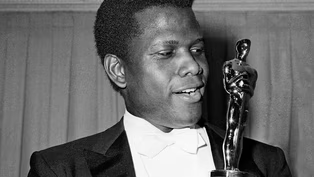
(all laughs) >>Before we go we wanna acknowledge the passing of another African-American trailblazer, Sidney Poitier.
The Bahamian-born actor made history as the first Black man to win an Oscar for best lead performance.
He transformed how black characters were portrayed on screen and often put his own career at risk by refusing to take roles that were stereotypical or offensive.
His influence was also felt off the screen.
Poitier was a civil rights activists who took part in the 1963 March on Washington and was a close friend of Dr. Martin Luther King Jr. President Barack Obama presented him with the presidential medal of Freedom back in 2009.
Sidney Poitier was 94 years old.
We thank him for paving the way for generations of Black actors.
That is gonna do it for us this week.
Thanks for watching.
You can find more information about our guests at americanblackjournal.org, and you can always keep up with us on Facebook and on Twitter.
We'll see you next time.
(upbeat music) >>From Delta faucets to Behr Paint, Masco Corporation is proud to deliver products that enhance the way consumers all over the world experience and enjoy their living spaces.
Masco, serving Michigan communities since 1929.
>>Support also provided by the Cynthia & Edsel Ford Fund for Journalism at Detroit Public TV.
>>The DTE Foundation proudly supports 50 years of American Black Journal in covering African-American history, culture and politics.
The DTE Foundation and American Black Journal partners in presenting African-American perspectives about our communities and in our world.
>>Also brought to you by AAA, Nissan Foundation and viewers like you.
Thank you.
(chiming music)
Current Events Roundtable January 2022
Video has Closed Captions
Clip: S50 Ep3 | 22m 22s | Current Events Roundtable: Redistricting, Ahmaud Arbery, A Year After an Insurrection (22m 22s)
Video has Closed Captions
Clip: S50 Ep3 | 49s | Remembering Trailblazing Actor, Civil Rights Activist Sidney Poitier (49s)
Providing Support for PBS.org
Learn Moreabout PBS online sponsorship
- News and Public Affairs

Top journalists deliver compelling original analysis of the hour's headlines.

- News and Public Affairs

FRONTLINE is investigative journalism that questions, explains and changes our world.












Support for PBS provided by:
American Black Journal is a local public television program presented by Detroit PBS