One-on-One
Curt Weeden; Kaitlan Baston, MD, MSc, DFASAM; Joanna Carroll
Season 2025 Episode 2812 | 26m 33sVideo has Closed Captions
Curt Weeden; Kaitlan Baston, MD, MSc, DFASAM; Joanna Carroll
Curt Weeden, President of Business & Nonprofit Strategies, Inc., talks about curiosity, collaboration, and character. Kaitlan Baston, MD, MSc, DFASAM, Former Commissioner of the New Jersey Department of Health, examines key public health issues in the state. Joanna Carroll, Executive Director of Horizons Newark, discusses the organization’s afterschool and summer programs.
Problems playing video? | Closed Captioning Feedback
Problems playing video? | Closed Captioning Feedback
One-on-One is a local public television program presented by NJ PBS
One-on-One
Curt Weeden; Kaitlan Baston, MD, MSc, DFASAM; Joanna Carroll
Season 2025 Episode 2812 | 26m 33sVideo has Closed Captions
Curt Weeden, President of Business & Nonprofit Strategies, Inc., talks about curiosity, collaboration, and character. Kaitlan Baston, MD, MSc, DFASAM, Former Commissioner of the New Jersey Department of Health, examines key public health issues in the state. Joanna Carroll, Executive Director of Horizons Newark, discusses the organization’s afterschool and summer programs.
Problems playing video? | Closed Captioning Feedback
How to Watch One-on-One
One-on-One is available to stream on pbs.org and the free PBS App, available on iPhone, Apple TV, Android TV, Android smartphones, Amazon Fire TV, Amazon Fire Tablet, Roku, Samsung Smart TV, and Vizio.
Providing Support for PBS.org
Learn Moreabout PBS online sponsorship- [Narrator] Funding for this edition of One-On-One with Steve Adubato has been provided by Horizon Blue Cross Blue Shield of New Jersey.
The New Jersey Economic Development Authority.
United Airlines.
Newark Board of Education.
New Jersey Institute of Technology.
NJIT makes industry ready professionals in all STEM fields.
Community FoodBank of New Jersey.
PSEG Foundation.
The North Ward Center.
And by The Adler Aphasia Center.
Promotional support provided by BestofNJ.com.
All New Jersey in one place.
And by CIANJ, and Commerce Magazine.
- This is One-On-One.
- I'm an equal American just like you are.
- The way we change Presidents in this country is by voting.
- A quartet is already a jawn, it’s just The New Jawn.
- January 6th was not some sort of violent, crazy outlier.
- I don't care how good you are or how good you think you are, there is always something to learn.
- I mean what other country sends comedians over to embedded military to make them feel better.
- People call me 'cause they feel nobody's paying attention.
_ It’s not all about memorizing and getting information, it’s what you do with that information.
- (slowly) Start talking right now.
- That's a good question, high five.
(upbeat music) - Hi everyone.
Steve Adubato.
We kick off the program talking about my favorite subject, leadership with a leadership guru.
He's Curt Weeden, leadership expert, president of business and nonprofit strategies, and author of the book, "6 Pathways."
Lemme get this right, "6 Pathways to Leadership and Organizational Success", Curt.
- That is correct.
- All right, let's jump right into it.
I read about these six pathways, let's go through each one.
Character, character and leadership, go.
- Yeah, character.
We actually to do this book, Steve, we surveyed about 200 leaders in both the nonprofit and the for-profit sector.
Interestingly enough, both sectors came out with the same six attributes or behaviors for successful leaders.
Character being, interestingly enough, one of the more important traits that people look for in a leader that they might select to move up the line to lead an organization.
- Craig, lemme follow up on that.
I'm curious about this.
As we do this program, president Trump's taking office, his cabinet secretary's being nominated, being vetted, and it's interesting, does the issue of moral turpitude, weird word, I know.
Character and someone's, someone's personal relationships who had an affair on their wife who did, who was involved in this or that, is that character or is that private life?
- It's character as reflected in an elected official in this case.
And it is surprising that the American public would sort of put that aside in regard to other issues that led them to make a decision at the ballot box.
But I'll tell you this, Steve, that character, ultimately when a leader gets into the position that in this case, Trump will be in, it will prevail and trickle down through the entire organization based on his leadership behavior.
So we have some deep concerns about what the country may look like based on what Trump actually does.
- I appreciate what you're saying, but also I wanna make it clear, since this isn't a segment about politics, someone might also say it's an issue of character that President Biden, when President said, I would not pardon my son, Hunter, and then did.
Character is also being consistent with your words and your actions.
Just putting that out there.
- Absolutely.
- I love this one.
You have this all over the place, Kurt.
Curiosity is a huge component to being a great leader, explain that.
- So that's the number one behavior that came out of all of this research that we did.
And it basically says that if you have a leader that's stuck in place and not curious enough to go to the next level or the next step, that's not the leader you want.
- Okay, there's a couple of others here.
One of them I find fascinating and people who know our series lessons in leadership know this well.
Communication, in my mind as a leadership coach, I don't separate being a great leader from being a great communicator.
And that doesn't necessarily simply mean a great speechmaker, a great communicator.
Can you be a great leader, Curt Weeden, in your view, if you're not a great communicator, listener, engager, can you?
- Very difficult to do, as you all know in your world, Steve, that knowing your audience or audiences, if you break 'em apart and being able to talk to them directly and effectively, can make a huge difference, not only in your leadership style, but your outcomes.
So the answer is that they're pretty much intertwined, - By the way, the other ones are commitment, competence, collaboration.
But can we do collaboration real quick.
Partnering with others.
Getting others on board who have the expertise that you don't have.
A big part of our not-for-profit organization, we collaborate with other not-for-profits.
We coordinate and work with institutions of higher learning.
All sorts of different folks.
People who believe I'm the smartest, I've got the answer.
I don't need to collaborate with other people.
They cannot succeed, can they?
- No, there's obviously exceptions to the rule, but generally speaking, if you take that kind of isolated position, you know best, and you're gonna stay where you are, I don't need the other guy, generally what happens is you fall back.
You just can't move to the front of the pack.
- You know, there's another issue you raised in researching you that brings up something I'm fascinated by.
I'm gonna go all the way back to the 1980s.
You were connected to Johnson & Johnson, right?
- So yes, I was brought in, actually, Johnson & Johnson acquired my little consulting firm in the year in 1990.
- Okay, so here's the question.
I, along with so many others, I wrote a book years back called, "What Were They Thinking?"
It was about crisis communication.
And I did a case study on James Burke, who was the CEO of Johnson & Johnson at the time of the Tylenol scare when people were frankly poisoning Tylenol bottles.
They were somehow, I think it was with a syringe, putting something in there and people were dying across the country.
And I did a case study on Burke being not just competent, but candid, honest, empathetic, compassionate, upfront leader.
You point him, point out Burke, James Burke, as being the kind of leader we need.
Talk about Burke.
- I read your book by the way, and on that chapter I agreed with everything you... - Oh, so you're the one that read it?
- Yes.
- Go ahead.
- No, he was, I worked for him.
- Directly?
- Yeah, through another guy that you know well, John Heldrich back in the day, and Jim was, that Tylenol decision was one of the most incredibly gutsy moves I think any CEO had to do.
Think about Tylenol being such an important part of a multi-billion dollar corporation.
You pull that product off the shelf.
- Pull them off, tell everyone, took 'em all out.
At no risk, all gone.
- And you potentially threatened the ongoing capabilities of that business.
Or do you just forsake that possibility and say, look, we can't have this out in the public and risk other people's lives.
So he made the decision to pull it and he became so famous for that one judgment, but it was really reflective of his overall leadership capabilities and he was elected to the Businessman's Hall of Fame as a result of that.
he was just a, an extraordinary poster child for what a good leader should be.
- 100%.
And Curt, the fact that he worked with him directly, I personally and professionally, I can appreciate that.
Curt Weeden is a leadership expert, president of business and nonprofit strategies and author of the book, "6 Pathways to Leadership and Organizational Success."
Curt, thank you so much for joining us.
We appreciate it.
- Thanks so much, Steve.
- You got it.
Stay with us, we'll be right back.
- [Narrator] To watch more One on One with Steve Adubato find us online and follow us on Social media.
- We're now joined by Dr. Kaitlan Baston, who is the commissioner of the New Jersey Department of Health.
Commissioner, thank you for joining us.
- Oh, thanks so much for having me.
- You got it.
Public education about, an awareness about critical health issues, more important than ever before.
We're doing this in late January, 2025.
Let's jump into a couple things.
I just mentioned vaccines real quick.
What do people need to know?
Last Friday, I got my COVID and my flu shot.
It may have been too late in the season.
Who knows?
What's true?
What's confusing disinformation?
Please.
- Great question.
I'm so glad vaccines came up.
Primarily just because I don't think we could talk enough about them in the public.
And it's never too late, Steve, I'm really glad you got your flu and your COVID shot.
Just in general, these things are so valuable for families, because we think about, you know, as a mom, right?
I wanna stay healthy.
I do anything I could to keep my kids healthy and keep 'em out of a hospital.
And we take for granted.
I think the fact that vaccines, especially the routine ones, help keep kids from getting really sick.
We used to live in a country where kids could die from illnesses that are now vaccine preventable.
Kids could get polio, measles, and you know, it's really, when I think about it, a bipartisan issue.
And I say that because still over 90% of families in New Jersey get their kids their routine vaccines.
And I think today it's just so important.
As new ones come out and we're getting more information, what people need to know is, Hey, these are safe.
And they can keep my kids outta the hospital.
They can keep families outta the hospital.
They can keep us from missing days of work.
This is really a no-brainer.
And we wanna answer all those questions for folks from the Department of Health.
- And rest assured that as the new federal administration, the Trump administration moves into place, what is being said out of that administration, particularly from health officials, we will monitor, try to make sense of, and have experts who will break it down because it matters to you.
It's not politics, it's people's health.
So Commissioner, lemme try this.
A couple areas that I know you want to talk about.
Can we do reproductive rights first?
And this birth control... Accessing birth control without a prescription in Jersey.
What the heck is that and why is it so important, Commissioner?
- Reproductive rights in general is so critical, and to the majority of people in this country, they wanna protect those reproductive rights.
And as a woman, right, it's so important to me, the fact that when you wanna have a family, you should be able to plan for that.
And you should be able to be in charge of your own body.
And you should make all those decisions with yourself and your healthcare provider.
And the standing order for contraception, which is what that is, which is really, I wrote a prescription that anybody can access in the state of New Jersey, and it sits at pharmacies.
And so you have medical professionals, you know, you have pharmacists there who can walk people through, who come into that pharmacy and want birth control.
They can walk them through how to get that safely, what's the right choice for them and what's available.
And it's right there at the pharmacy.
And what that means is you don't have to go to a doctor's visit or see a doctor or another healthcare provider to get birth control, which is a safe and routine medicine if you know how to take it and who it's safe for.
And it also unclogs your primary care office, right?
You wanna see a doctor when you really need one.
I don't wanna wait as long to get into primary care and this kind of unclogs that system.
So it's great for people, it's easy access, low barrier, and it really unclogs our primary care system.
- You've talked extensively about the opioid crisis and what do you see the Department of Health's role being as it relates to fighting that fight?
A and B, how are we doing?
- Absolutely.
As you know, I'm an addiction doctor, so you know, I have a specialty in this area and it's so critical that we keep talking about it.
We are making great strides.
And I will say that just because it's so important for the public, you've probably heard that.
First and foremost, the CDC puts out amazing information on this, as do we in New Jersey.
It is the number one cause of death for young people still.
In our country.
That's age one to 44, number one cause of death for young people.
The top three causes of death are actually overdose, suicide, and homicide.
Nationally, for people age one to 44.
You know, you've heard we have a mental health crisis in our country, right?
But those statistics really drive it home.
And so it is so critical.
That's why it's so critical to me and why I ended up studying addiction medicine after primary care.
I was doing a lot of women's health and I ended up wanting to do a fellowship in addiction medicine because it also really impacts families and people when they're pregnant too.
It's the number one cause of pregnancy associated death also.
So when we talk about wanting to drive down maternal mortality, we have to treat addiction in order to do that.
We are doing a ton at the Department of Health right now, just to give you a couple things.
Number one, we have to get harm reduction out there because that helps people, keeps people from dying, keeps people from getting infections.
And we have gone full steam ahead with this.
There were only seven harm reduction centers in the state of New Jersey when I came on.
Now we have over 55 approved, and we have one approved in every single county.
We also are getting medication to people because medication is what actually treats these diseases and keeps people from being sick and keeps them from dying.
So, could talk about it all day, of course, but there's a ton that we're doing.
Big picture, we're starting to turn the tide.
We see overdose deaths flattening out and even coming down.
Historically, that was not true for the Black and brown populations in our state.
But we finally have done a ton of focus on those disparities.
And you know, we're still crunching the numbers, but it looks like we're turning the tide now for all populations, which is a huge win.
- Michelle, lemme ask you a big picture question.
I saw a, I would call it a PSA, A public service announcement that you did recently.
It was in the middle of a sports event that I was watching on the air.
How important do you believe it is that public officials, public health officials, are out there creating greater public education and awareness and trying to create more trust, greater trust in the public health?
I hate calling it infrastructure because you're human beings, but why are you out there doing that, and what does it have to do with this public trust issue or lack thereof?
- Listen, I'm a primary care doctor.
I'm a mom, right?
I'm a person.
And the reason I work in this system and for public health is because I learned early on as a primary care doctor that I couldn't work in the system without working on the system.
There's a lot that we need to do to make it work better for people.
People get frustrated because our health system doesn't always work, right?
It's normal human nature to be frustrated when there's ambiguity or we don't see clear answers or we don't have clear information.
And I think during the pandemic, while it was a new disease and we were all learning together, it was very normal that the public had fear and a lot of confusion.
And we did actually, I think, an incredible job of getting on top of that science, learning it, understanding it, and keeping people alive as best we could.
And today, more than ever, it's important just as a routine, right?
As a doctor, as a mom, as the commissioner of health, that I'm out there telling families, "Hey, this is how we can empower you with information so that you can take the best care of yourself."
There's a lot of misinformation.
The internet is now the wild west, right?
You can find anything on there.
And so it's really important that we know who to look to.
You know, Mr. Rogers used to say like, "Look to your neighbors, look to your police officers, look to your teachers, look to your public health officials."
- He didn't say "Look on your phone, on the internet."
- (laughing) He did not say, "Look on social media."
Right?
We have to be that.
Government has, historically, attracted the best and the brightest.
Because they're people that really wanna make a difference for our society.
We show up every day as public servants because we care about our neighbors, right?
I went into medicine because growing up in rural Appalachia in southeast Ohio, I saw poverty every day.
And I saw how the opposite of poverty isn't wealth, right?
That it was health.
That it's people having access to food and clothes, and a house.
And people being healthy physically and mentally so that they can provide for their families.
That's the bread and butter of the United States, right?
That's what we need and that's what I strive for every day.
And I want people to know that that's what we're here doing.
- Commissioner, I cannot thank you enough for joining us.
It will not be our last conversation.
- So excited to hear that.
Always wanna get more information out there.
Good information into the hands of people, which is where it's really needed.
So thanks for the opportunity.
- Thank you Commissioner.
Stay with us, we’ll be right back.
- [Narrator] To watch more One on One with Steve Adubato find us online and follow us on Social media.
- We're now joined by Joanna Carroll, Executive Director of Horizons Newark.
Joanna, good to see you.
- Good to see you.
Thanks for having me.
- You know, we do this ongoing series called Making a Difference, people and nonprofits who make a difference.
It's also part of our Stand and Deliver, Powering Equity, and Social Justice initiative.
Describe Horizons Newark.
- Horizons Newark, we're a nonprofit.
We obviously work in Newark, says the name.
And what we do is we provide after-school and summer programming, both child programming, to students from low-income homes in the city.
We provide them with opportunities they wouldn't have otherwise.
And so, over the summer, it's really targeted towards the learning loss that can happen over the summer in math and reading.
So, we do academics, but we also do things that, outside of that, like swimming.
We teach them to swim for free.
We do golf lessons, we do financial literacy, and we keep that year-round during the school year as well.
- Yeah.
Jump into the, I'm fascinated because I've often said this on the air, I would not have ever learned how to swim if it were not for the Boys and Girls Clubs, doesn't even exist on Broadway in Newark.
And the YMCA is big on that as well.
But one of the things that you're doing beyond swim lessons, which is awesome, is the golf piece.
- Yes.
- I'm fascinated by this.
Are you working with First Tee?
- We are, we are.
I know.
It's- - Tell everyone what that partnership is, 'cause First Tee is awesome.
- First Tee is awesome and we're really, really excited about this partnership.
So, it came about this past summer.
I've been trying to do it for some time as a golfer myself.
My family is all golfers.
Yeah.
(chuckles) And I know the benefits that it can have for students, both just in terms of getting into college and career, but also you gotta be very mentally strong.
You have to have focus, resilient.
- Oh, is that my problem?
(both laughing) - I know, I know.
It's really, it's hard.
- Hold on one second.
Before we go any further.
- Yeah.
- You hit the ball and it's going into the trap, in the bunker.
- Yeah.
- Do you say to yourself, it's in the bunker, I'm fine, I'll get out.
Or do you say, please, God, don't let the ball go in the bunker?
Which one?
- The latter.
(laughs) - I just wanna make sure.
- I don't think I'll ever get out of it.
- Okay.
That you mentioned mentally strong, that's all.
Go ahead, pick up your point.
- Yes, it's true.
Right, I'm not there.
- It's not about my struggling golf game or you not wanting to be in the bunker.
Go back to First Tee and these kids.
- Yes.
So, First Tee, we partnered, we partnered over the summer for the first time this last summer.
And we started with our middle schoolers teaching them to golf.
We really brought it on to compliment our focus on social emotional learning.
As I said, the mental toughness, resilience, confidence, pushing forward with something when it seems hard.
And it was such a success that with funding from the Little Family Foundations, we brought it over into the school year.
And we do weekly tutoring in math and reading, along with a weekly golf lesson, which can cost how much money if we didn't do it with First Tee and providing opportunities for kids who otherwise, they wouldn't be enrolled in something like this.
- Is it tuition?
Hold on.
Is the program free?
- The program is free.
We're funded entirely- - How the heck is it- - by donors.
- You get grants like we, you're a nonprofit that gets grants?
- We're a nonprofit that gets grants and individual donations.
And so, that's how we're able to do it.
So, as I mentioned, the Wilf Family Foundation does the tutoring portion, and then we partner with First Tee and provide this to our students weekly during the school year.
- Do you have a relationship with schools at all?
- Yes, yes.
We partner with 38 different schools in Newark.
We partner with their teachers and principals to recruit them into our program, which we'll say, do you see they have a need for some extra academic support, social emotional support?
'Cause we have a dedicated social worker.
And we do it that way.
And also just through the community and parents, that's how we get our students from the program.
- How do people, particularly the children and the parents of those children that you want to help, how the heck do they find out about Horizons Newark?
- So, there's a couple ways.
One, their principals should shoot something out.
We'll send a message.
It should be in the next couple weeks, so January, February to, say enrollment is open.
They can also visit our website where there is a link, you go to apply, it's in both English and Spanish.
You click through, you fill it out, and then you have to meet the eligibility requirements, which is that you either qualify for free and reduced lunch or demonstrate a financial need for our program, meaning you wouldn't be able to do something like this otherwise.
And so, then we go through and we accept into our program.
We have small class sizes, much, it's only 15 students per class with three teachers.
And really, it's a lot of fun, but also really impactful.
- Let me ask you this, as a not-for-profit leader, other than fundraising, which is always the number one challenge, what's the most challenging aspect of your work?
- Transportation.
Getting people to where we need, and I think that's a challenge for a lot of nonprofits.
So, we operate out of one location.
And in order to get our families, our families have to be able to get their child there.
It's similar to food banks, right?
We're having food distribution, but if I'm in the Central Ward and I live in the South Ward, how am I gonna get, to get the food?
- And you work with the Community Food Bank of New Jersey?
- We do work with the Community Food Bank of New Jersey.
- One of our partners as well.
Go ahead.
So, it's there.
- Yeah.
- You've got to go, they got to get there.
- You have to get there.
And that's something that we are actively working on.
We're raising money for transportation to get students at least who live the farthest from where we are to our program most easily.
Also, we have more students who wanna participate in our program than we have spots.
We need to- - Really?
- Yes, we have a wait list typically of 30 to 40 students each year, but we don't physically have the space.
So, we wanna grow.
We want people interested in having us at their locations, partnering with us, like we're ready to go.
We wanna serve as many kids as we can.
- 1 to 10, I love my job, how much 1 to 10?
- I can't even put a number on that.
And I mean that.
I, as I mentioned, I'm a mom of two little kids, and that's challenging.
And I wouldn't give this up when things get hard for anything.
I love my job.
You are making a difference every day, Joanna.
- Thank you so much.
- Well done.
Looking forward to having you back.
- Thank you.
Appreciate it.
- I'm Steve Adubato, that's Joanna Carroll doing good work.
We'll see you next time.
- [Narrator] One-On-One with Steve Adubato is a production of the Caucus Educational Corporation.
Funding has been provided by Horizon Blue Cross Blue Shield of New Jersey.
The New Jersey Economic Development Authority.
United Airlines.
Newark Board of Education.
New Jersey Institute of Technology.
Community FoodBank of New Jersey.
PSEG Foundation.
The North Ward Center.
And by The Adler Aphasia Center.
Promotional support provided by BestofNJ.com.
And by CIANJ, and Commerce Magazine.
- New Jersey Institute of Technology has supported New Jersey businesses since 1881, when it was founded as the Newark Technical School and through their partnership with the non-profit New Jersey Innovation Institute.
They're igniting innovation and delivering transformative products and services throughout the state.
Learn more at NJIT.edu and NJII.com.
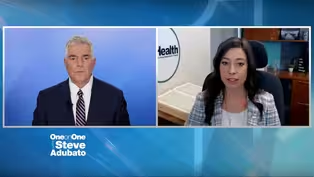
Addressing key public health issues in New Jersey
Video has Closed Captions
Clip: S2025 Ep2812 | 10m 21s | Addressing key public health issues in New Jersey (10m 21s)
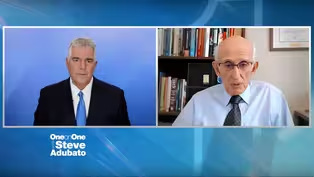
Analyzing the components of being a good leader
Video has Closed Captions
Clip: S2025 Ep2812 | 8m 37s | Analyzing the components of being a good leader (8m 37s)
How Horizons Newark is improving academic achievement
Video has Closed Captions
Clip: S2025 Ep2812 | 8m 13s | How Horizons Newark is improving academic achievement (8m 13s)
Providing Support for PBS.org
Learn Moreabout PBS online sponsorship
- News and Public Affairs

Top journalists deliver compelling original analysis of the hour's headlines.

- News and Public Affairs

FRONTLINE is investigative journalism that questions, explains and changes our world.












Support for PBS provided by:
One-on-One is a local public television program presented by NJ PBS