
Cuts to Nevada’s Share of the Colorado River
Clip: Season 9 Episode 7 | 7m 1sVideo has Closed Captions
The federal government intervenes in the Colorado River dispute. What about Nevada’s share?
The federal government is now stepping into the on going dispute over the Colorado River. What will that mean for Nevada’s share?
Problems playing video? | Closed Captioning Feedback
Problems playing video? | Closed Captioning Feedback
Nevada Week is a local public television program presented by Vegas PBS
Cuts to Nevada’s Share of the Colorado River
Clip: Season 9 Episode 7 | 7m 1sVideo has Closed Captions
The federal government is now stepping into the on going dispute over the Colorado River. What will that mean for Nevada’s share?
Problems playing video? | Closed Captioning Feedback
Where to Watch Nevada Week
Nevada Week is available to stream on pbs.org and the PBS app.
Providing Support for PBS.org
Learn Moreabout PBS online sponsorshipWater levels at the country's two largest reservoirs, Lake Mead and Lake Powell, hit record lows this month.
And according to the U.S.
Bureau of Reclamation, those reservoirs are moving closer to levels that would sharply reduce hydropower generation.
Both Lake Mead and Lake Powell are part of the Colorado River system, and the seven states that depend on that river have yet to agree on how to share its shrinking supply amid a decades long drought.
Last month, in its final environmental impact statement, the Trump administration analyzed several possible approaches for managing Lake Mead and Lake Powell, referred to as alternatives.
The administration also identified its preferred approach, which is a ten year framework that would generally set operating rules two years at a time.
Preliminary rules for 2027 and 2028 would reduce Nevada's share of the Colorado River by 50,000 acre feet a year.
That's about one sixth of the state's legal allotment.
The Department of the interior is expected to issue its final decision, and the first set of operating guidelines before October 1st.
And here to explain what could complicate that final decision is Allen Jalali, water and environment reporter for the Las Vegas Review-Journal.
Allen.
Welcome back.
Thank you for having me.
And the reason that the federal government is stepping in is because the states have yet to agree on a plan, right.
Is there hope they still could.
I don't think anybody is expecting the seven negotiators in the room to come to a consensus.
I think what we're seeing right now is, like you said, this ten year framework, that there are still objections to from two of the states, including Nevada.
So, I think, you know what we're probably going to see in the next month or so is that the federal government is going to hand down an operating plan.
And that could lead to a fight at the Supreme Court between the states as to, how these shortages or shortages are getting allocated.
What is Nevada's stance on what is being proposed, that ten year framework?
Every two years?
New rules?
From what I understand, Nevada is okay with the initial 50,000 acre foot a year, reduction, which, as you said, is about a sixth.
And it's something that we've been well prepared for in our modeling.
However, what this plan does posit is past those two years, it could be up to 3.6 million acre feet between the lower basin states of California, Arizona, Nevada and also Mexico.
And that could mean some pretty steep cuts up to almost 200,000 acre feet, which is two thirds of Nevada's allocation.
just to reiterate, the 50,000 acre feet a year cuts, from 2027 and 2028 that are being proposed, that would not significantly impact southern Nevadans.
It's just not something they should be worried about, right?
Well, to put it in perspective, our use for the Colorado River in southern Nevada came in at about 198,000 acre feet last year.
So, you know, that would still put us well within what we are using to this day.
And one of the things that's really helped us is, as you know, the water recycling that we do here is very extensive, and we're able to cash in credits for water that we return back to Lake Mead.
you know, as much as we're growing, we are continuing to reduce our water use through, conservation.
the Colorado River Indian tribes, they are some of the most senior water rights holders on the Colorado River.
What has their response been to the final environmental impact statement?
what's really interesting, I think about the tribal aspect of this is, you know, the seven states have somebody in the room that's hashing these things out.
Folks like the Colorado River Indian tribes and the other 29 federally recognized tribes within the basin don't have a seat at the table.
And they're like, the public have to rely on the, you know, environmental laws that allow them to submit some public comment.
So I think, you know, in their letter that they submitted to the Bureau of Reclamation, they expressed some hesitance.
I think what they're saying right now is they feel they have not been included sufficiently in this final, iteration of what we're seeing and how do the water cuts stand to impact these tribes?
Well, from what I understand, they do have irrigation.
An irrigation project that's managed by the Bureau of Indian Affairs, which they say in their letter, they have not been able to, you know, use the for their full allocation of the water rights because of, a lack of upkeep and maintenance to that, that project.
So, I think we could see that there unused allocation that they feel they have the right to you, could go elsewhere.
You wrote an article about Lake Mead barreling toward a system crash, right?
What would that look like in Southern Nevada?
What would it mean?
Well, what the those academics were saying in those paper, in that paper was that, you know, below a certain, point that we are nearing moratoriums every month?
It would be right over the river is what they call it.
And what that means is, water managers wouldn't be able to control how much water is moved from Lake Powell to Lake Mead.
It's just what the natural flow of the river would be anyway.
And so it begs the question, you know, we've spent, you know, billions of taxpayer dollars on, network of dams and infrastructure.
You know, it could render it effectively useless.
I think concerning that, you know, we would have less control Last thing you brought up billions of dollars.
Nevada lawmakers are now asking for some money in relation to water.
How what are they want to do?
Well, I think a large part of the frustration with what is being talked about right now is that we're focusing on, the little water that's available rather than finding ways to put water back into the system.
Right.
I think what we've heard from experts is that we're in an era where we're out of cheap water.
It's time to invest the billions of dollars in desalination plants in California and Mexico.
It's time to, see if groundwater pipelines are potentially, a way to bring more water into our desert cities.
And what this funding request is asking for is to, really match what we saw.
Under the Biden administration, about $4 billion was allocated towards drought.
And, you know, while the, the lawmakers, bipartisan, are not quite ready to say which projects they're focused on or what states they would benefit, it is just, a larger question of how are we going to fund these projects and what what is the federal government's role in ensuring that we can keep our taps flowing in these cities?
So that would be a funding request from Congress?
Yes.
Okay.
Allen Hilali, Las Vegas Review-Journal.
Thank you so much.
Thank you.
Nevada week,

Video has Closed Captions
Clip: S9 Ep7 | 4m 21s | A Las Vegas author has a new book that explores the iconic fashion of Elvis. (4m 21s)
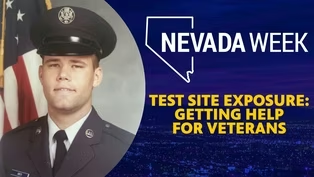
Test Site Exposure: Getting Help for Veterans
Video has Closed Captions
Clip: S9 Ep7 | 13m 55s | A new bill aims to help veterans exposed to radiation at the Nevada Test and Training Range. (13m 55s)
Providing Support for PBS.org
Learn Moreabout PBS online sponsorship New Episode
- News and Public Affairs

Top journalists deliver compelling original analysis of the hour's headlines.
 New Episode
- News and Public Affairs

FRONTLINE is investigative journalism that questions, explains and changes our world.
 New Episode
 New Episode
 New Episode
 New Episode
 New Episode
 New Episode
 New Episode
 New Episode

Support for PBS provided by:
Nevada Week is a local public television program presented by Vegas PBS