
Dads Making It Happen: Volume II
6/13/2024 | 32m 47sVideo has Closed Captions
Stories about four dads raising kids in a world where family structures are ever-changing.
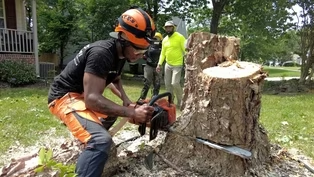
Senior Producer Thomas Todd visits four NC dads—a single father in Charlotte, an arborist in Durham, a volunteer firefighter in Monroe and a business leader in Raleigh—who encourage their kids to be all they can be in a society filled with challenges and opportunities.
Problems playing video? | Closed Captioning Feedback
Problems playing video? | Closed Captioning Feedback
PBS North Carolina Presents is a local public television program presented by PBS NC
Dads Making It Happen: Volume II
6/13/2024 | 32m 47sVideo has Closed Captions
Senior Producer Thomas Todd visits four NC dads—a single father in Charlotte, an arborist in Durham, a volunteer firefighter in Monroe and a business leader in Raleigh—who encourage their kids to be all they can be in a society filled with challenges and opportunities.
Problems playing video? | Closed Captioning Feedback
How to Watch PBS North Carolina Presents
PBS North Carolina Presents is available to stream on pbs.org and the free PBS App, available on iPhone, Apple TV, Android TV, Android smartphones, Amazon Fire TV, Amazon Fire Tablet, Roku, Samsung Smart TV, and Vizio.
Providing Support for PBS.org
Learn Moreabout PBS online sponsorship- [Announcer] Quality public television is made possible through the financial contributions of viewers like you, who invite you to join them in supporting PBS NC.
[piano intro] [lively music] [lively music continues] - [Woman] Here comes the nurse with your baby.
- Here she is.
- [Mother] Oh, she's beautiful.
[tender music] - [Narrator] The moment of life is the first for little Jessica, and the 3,000,000 babies born each day.
It is also a moment of firsts for Jessica's father.
And many other fathers to begin imagining their baby growing up to be the next super athlete, or Hollywood star.
Fatherhood is defined by the role that fathers take in their children's lives.
The father will either embrace the function of being a father, or a dad, to his kids.
- So to define a father and a dad, as they relate to families and children, I mean, there's no hard and fast definition.
But a lot of people like to think about, one, as being more involved and engaged.
And one, being less so.
So, I've heard families talk about dads, as being affectionate and loving, and fathers that are not.
But the bottom line is, trying to lift up what they feel, are essential ingredients for fathers, and that's changed over time.
We used to think about fathers as just contributors, right?
Dollar on the table, money on the table, and that's it.
And that has evolved, thankfully, to seeing fathers and men as whole people that have things to contribute to the lives of children.
- [Narrator] We traveled to various areas in the state to visit with dads who are making the best of fatherhood.
We met four dads who are tackling the challenges of raising kids in a world where family structures are ever-changing.
In Charlotte, we visited Peter Mutabazi, who rose from poverty in Uganda, to become a caring foster dad to over 37 foster kids living in the United States.
- Being a kid in the foster care system, a lot of kids hop around from home-to-home.
I was one of the lucky ones, who was adopted at an early age.
But then, the parents gave me back up.
It still hurt me a lot knowing that, they just like, that they didn't care, and that they just no longer wanted me around.
One of the first things that Peter did when I first arrived, was he gave me some food.
Because a lot of kids, a lot of time, they want somewhere comfortable that they can just eat and relax.
He showed me to my room, and while we were staying at Pete's, he talked with me about the things that I like to do, really comforting to have that whenever you first arrive in a new place.
- For Anthony, he came in as respite.
Because he was left at the hospital.
So, I took him in, knowing that he was leaving on Monday.
I had no clue that he would stay, I was just weekend, dude, I can do that.
So he walks in and he says "Hey, I'm here."
I'm like "Sure, I see you're here."
And I said, you can me "Mr.
Peter."
He said, "But, can I call you my dad?"
I'm like "Hell no, no, no, you can't call me dad, "Because you're leaving on Monday."
I think in my head it was like, 11 kids, 10 kids have called me "Dad" and left.
Don't just walk in tonight and tell me that, you know?
I heard that before.
And then he looked back and said, "Look, I was told since I'm a teenager, "I can choose who my father should be.
So, I choose you."
And I was like "Dude, no."
And then once I got to know his story, it was the next Monday that I knew, okay, this kid has seen me as a dad.
And now, I think I can be his dad forever.
I've been a foster dad for seven years.
I've had 37 children, and now have adopted three of my children.
When I became a foster parent, first of all, I had come from a disadvantaged world.
So I always think I'm gonna have a Hispanic kid, I'm gonna have an African American kid, I'm gonna have a Native American, that's what I thought.
White kids come into foster care.
And they were coming to me, and that's when I realized "Oh, it's every child."
It's every home, despite they're poor, they're wealthy, I sign up for all kids.
So I better be ready for all kids.
I grew up in a small town, or small village at the border of Uganda and Rwanda.
I grew up really poor, poor of the poorest.
I grew up eating two meals, every other day.
Beans and potatoes.
And most time, we couldn't afford both.
You have beans today, and you have potatoes the next day.
So, I didn't really have hope or aspiration, or that there was a future for me.
Because poverty was just so wrath in some way.
At a age of four, I began to realize that my father was different from other fathers, or other men that I knew.
You know, he was just abusive in every shape, form, you could imagine.
And I think being the oldest, I really got to feel that maybe harder than most.
But also, he didn't come towards me, he came towards my mom, as well.
And it wasn't like I was running away to look for a better life.
I think for me it was, I'd rather die, but dying in the hands of a stranger.
But also never give my dad an opportunity to bury me somewhere as a 10-year-old.
I think that was the anger of saying, "I don't like you that much.
"That I would not give you an opportunity to even bury me."
I ended up in Kampala.
And that's my second life, in some way, where I became a street kid.
In my country, you're more or less of a human being.
You're treated like a stray animal.
You're garbage, you just dirty.
And at most time, that's what I had, I was a garbage boy, I was stupider, I was nobody, and I believed it.
I had lived in the streets for five years.
One day I saw a man, I followed him.
I stopped and he looked at me, and he said "Hey, what's your name?"
No one human being ever stopped to ask me my name.
I loved the idea of someone calling me Peter.
I think for me, it reminded me of my mom, because my mom gave me that name.
That day the most coolest, amazing thing was, he knew my name, and that's all that mattered.
And so, he fed me for one year and a half.
And one day he say "Hey, Peter.
"I have two options I can give you.
"I can feed you every other week, "Or, I can take you to a boarding school."
And so, I went to school.
That was the only reason why I went to school, not to be a teacher, or anything.
No, food.
And I think about living at my lowest, also helped me to really help me understand like wait a minute, I'm just a garbage boy.
But have a potential.
Because if he believes I have one, and that really changed my life.
And so, I did well, excelled in high school.
I went to the university in Uganda.
I went to the university in England.
And that's how I came to the United States.
From the kindest of a stranger who didn't know me, who rescued me.
- Peter as a foster parent is different than a lot of foster parents we get, are two-parent households.
The thing that has really set Peter apart, in my experience at working with him at Seven Homes, has been his drive, and his passion for the birth family, as a whole.
To see reunification happen as much as possible.
I have seen Peter drive from Charlotte to the beach, to stay overnight in a hotel, to make sure that kids get weekend visits with their parents that live three hours away, on his own dime.
Which is something that I would never even expect my foster parents to do, but Peter really has gone above and beyond to do that, is the thing that sets him apart, is that he's always looking to go the extra mile.
- He's from trauma, from different places, and he comes with all sorts of trauma that our kids go through.
But I think for me that I have an advantage above most people.
I was that kid, you know?
So, it's easy for me to go back and say, if my kid is putting holes in my wall to know, hey, it's not about me, it's not about my house, but this kid is really, he has a way of speaking that I need to listen.
It might not be the way I like to be heard, but I owe to stop and say, "Peter, you are out of the way, "listen to my kid."
Yes, it can be difficult, but at the end of the day, when you fed a kid, and he says "Dad, I love you, "and the food was delicious."
You're like, phew.
It means all the headache.
It means all the headache.
Or when you get a phone call from a mom say, "Hey, thank you.
"My kid, I can go to see my kid, "and they really, really thank you for doing that."
And you're like "Man, wow."
That's all that keeps me moving.
That if I could help them expand.
- He's helped me cope with my past.
And the emotions that came along with it.
And he's helped me to better manage those, and better identify the emotions, and I'm not as confused anymore.
And, I have a better understanding of life, and what I wanna do with my life.
And that is all thanks to him.
The thing that I admire most about my dad, is how much he truly wants to help kids, and how much he's willing to do.
He travels all across the United States, speaking up for kids, and advocating for them, and it inspires me knowing that he truly cares for them.
I honestly, I haven't seen much in my life, is someone who just truly wants to help out of the generosity of their heart.
[Peter chuckling] - Yeah!
- [Narrator] As Peter continues to open his home to care for and support foster kids, he has been crisscrossing the country sharing advice on adopting and fostering kids, and providing helpful tips on fathering kids.
His book "Now I Am Known," provides readers with insights on his journey to becoming an adoptive, or foster dad.
In Durham, Damon Jones was incarcerated for several years before he returned home to mend the relationship with his son.
And start a new family business.
All right, I want you completely out.
[power sawing buzzing] All right, all right, see it falling?
All right, now what you gonna do next, is you gonna go in there, and finish it, just a little bit.
It's about ready to fall.
My plan, I want to be able to help the young in the City of Durham, that doesn't have a father figure.
[power saw buzzing] I wanna teach people.
You can go out here, you can start your own company.
I wanna teach, the same way I taught my kids, everything that I know, I wanna teach people everything I know.
I did a lot of things, construction, pipe layer, working for other companies.
It didn't give me the satisfaction.
But when I started working in the tree business, it gave me a peace that I now have, working for myself.
[power saw idling] Get the bottom feet.
[chill music] It was great for me, when I had my first born son, Keyon.
But when I look at it, truthfully, I wasn't mentally prepared to be a father.
But the feeling that it gave me seeing him, it was amazing.
And I knew I had to change some of my ways.
I actually struggled with changing.
I did prison time, and I was gone for nine years straight.
With my son, I left when he was probably about two.
And came back, years later, a lot of years later.
I remembered my son at this time, he was about seven or eight.
And I remember him saying, "Dad, you're not gonna go back to that place, are you?"
And I looked at him in his face and I said "No, son.
"I'm not."
Maybe three years later, I went back to the streets.
And, I forfeited my freedom again.
And that devastated him.
And for me, it wasn't long after that, where the light just came on.
And from that point on, I knew I had to, coming up with ideas, of what I could do to rebuild that relationship, once getting released.
So I came from another angle, and the angle was "Okay, I'm gonna be a great friend.
"I'm gonna be a coach, and just be a leader."
Just, I'm gonna be what I should of been from birth.
- Before my dad came back into my life, I feel like I've always been who I am.
But, I was somewhat lost, I gotta admit.
Now that he's in my life, things have been better.
They getting better mentally, physically, and financially.
We came together, we had that talk, we had conversation, that mattered the most.
Just him acknowledging that "Okay, son.
"That's what I did, that's what I messed up in.
"But, I'm gonna make it right."
- [Damon] After being released from the halfway house, and working with other tree companies, so I had gotten to a place where my speed was slowing down.
I couldn't, I went from climbing 10 trees a day, to maybe three.
I began to sit down and realize with the youth that I have remaining, I need to just kind of really put that energy into doing something for my kids.
And now when they- - [Keyon] Work with my dad is good, we have a lot of fun.
Just waking up, going to cut a tree.
I just enjoy it.
[power saw buzzing] It's almost like it's in my blood.
[chuckling] Like it was just meant for me.
- When we had first met, he had really just talked about wanting to start a business, and what that would look like.
And, he wanted to break generation of curses, and how he wanted to create generational wealth.
And so, we just kind of began to talk about it.
Because he really talked about the financial side of it.
And I knew a lot about business, we was speaking the same language.
It really kind of started it from a capital, we didn't have a lot of it.
We had to use our own money.
And then, as time progressed, we began to learn about how to get business loans, or how to go out in the community, and get people to help invest in what we have, and believe in, as well.
- [Damon] So I meet my wife, and we get married.
And of course, she already had four girls.
They completed.
They were the pieces that made Da' Joneses complete.
Because every last one of the, I began to notice, they had different, but unique gifts.
And I was able to recognize that.
And use their gifts for the business.
- I never cut a tree in my life before meeting my bonus father.
And like kind of just started with Da' Joneses.
So it's like, it has been like a new journey for me.
And our business taught me that pulling it for myself, and my stepdad has also taught me other ways to make it easier for myself.
So like, I was cutting down a tree, that chainsaw is heavy, but it's like at the end of the day, I was able to do it.
So it's kind of just always pushing me to do more.
The social media aspect of it, I said Dad would send me videos, 'cause I'm not always here at the time, and it's really just putting videos together, seeing what works and what doesn't.
I started the TikTok, I had the Instagram first.
TikTok is very active right now, especially within my generation.
Allowing more people to see what we're about, and building that network interaction within the community, so both Instagram, TikTok, transfer it to basically, as well.
- At first, I was like I am not picking up a chainsaw.
Like sorry, I love, I mean you know, being, cut, getting down and dirty, using my hands, I love that.
The very first job I was ever on, that was the very time I ever seen a tree come down.
It's like this adrenaline, or this rush that you get, and ever since then I was like, "I might want to do that."
And the arborist business has prepared me for entrepreneurship just as a personal trainer, as a fitness instructor.
[exercise shout outs] Uh-huh.
Working with him has allowed me to pay more close attention to details, one in many ways.
- [Misty] It's so beautiful to just watch him show up.
Like, he gave birth to the girls, that he was a part of their life.
And when I tell you, amazing, amazing father to these children.
I could not have asked for a better father for them, I promise you.
- [Narrator] Damon's entrepreneurial spirit has fueled him to start and turn Da' Joneses Tree Removal Service into an overnight success.
And becoming a special dad, husband, and leader in his family.
In Union County, we visited Dan Beightler, who was considered one of the hardest working dads living in North Carolina.
Dan does not allow working several paid and volunteer jobs, and going to college at age 38, stand in the way of him being a loyal dad to sons, Michael and Colt.
[dispatched vocalizing] [sirens blaring] - The fun part of this position is just to volunteer.
We're solely volunteering, there's no compensation, or anything like that.
And when the pager goes off, we take the trucks, go help people, and bring them back in.
We train hard to make sure we're properly prepared.
We go over the equipment, make sure the equipment is properly maintained.
[sirens blaring] [upbeat music] The Union Academy Charter School, they had a ton of truck events.
The had like Union Power is out there, the had the Monroe Sea Electric, Monroe Law, EMS, and Monroe Fire is out there.
And I was just talking to the firemen on the truck, just kind of shooting the breeze.
"How do you get involved in something like that, "what do you do?"
And they were talking about it, I got a little excited.
He said "Why don't you come talk to me."
So, I went down and talked to him.
He said, "Why don't you join up and see if "you have any interest in it?"
So I joined up, started taking the classes, and it was, it bit me, and I was just so, I could have five calls today, whether they be medical, a car accident, or fire.
You never know what you're gonna get into.
And every time that pager goes off, it's a different scenario.
They'll send us out to resolve the issues.
We've taken cats out of gutters.
We've taken people, picking them off the floor if they can't stand up.
[siren blaring] We've put out structure fires, and we had some car accidents.
All the things that you can imagine.
Where I grew up, it was kind of a rural community.
It was a pretty tight-knit community.
King of little like we've got down here right now, everybody knew everybody, we tried to help each other out.
We had a lot of fun, we worked hard, we played hard.
My dad's always worked extremely hard.
It was important to him to make sure that we knew we were a priority.
It was tough, it wasn't always easy.
Parents divorced, and growing up in a different kind of home.
What I can say, my dad and I are best friends now.
But as any teenager with his dad, sometimes it wasn't always rainbows and lollipops.
I kind of pushed the limit sometimes.
But my dad, has always given me sound advice.
He never judged.
He held me accountable for my actions.
Integrity was everything to him.
And he was all about being ethical.
When Michael was born, I was 25-years-old.
I was in the operating room, I was the first one to hold him.
Tears running down my face.
I couldn't get the smile off of my face.
And I have never felt a greater joy in my life to see my son.
When Michael was born, my life changed.
I really kind of mellowed out, I started taking responsibility.
A little bit more responsibility with my life.
- I would say we have a really good relationship.
Me and him are always open to each other, in talking about things.
Recently about school, my grades and everything, how I can improve in band.
My dad did marching band with his French horn.
And I've always wanted to be in the band, because of him.
He inspired me to.
So, I've been playing trumpet.
And so, when eighth grade comes around, and the chance comes, I'll be doing marching band.
- [Dan] Michael, I try really hard to build that bond today.
Be his father, be firm.
Be holding him accountable to his actions.
So it's under your straps, pick up the nozzle, and start walking it down the apron.
- I wanna be a firefighter.
I help him, I see stuff, how to do things better, because he is more of a firefighter than my mom is.
I know like firefighting, and I'm up here for training.
And helped him with the truck.
I think it's fun.
'Cause most kids don't really get to do this.
- The biggest thing I try to do with Colt, is just to be his friend, right?
He has a dad, I never could ever begin to replace what his dad is for him.
What I wanna be is his friend.
Somebody who he can come and talk to, if he needs to.
Who he knows that has his support.
Who will provide anything he may need in that safe place.
And that's all I try to be.
- The relationships that my sons have with their father, is a pretty good one.
They enjoy helping him with lawn work.
And, they enjoy helping him do stuff around the house that he needs help with.
They love coming up to the fire department and helping do anything we ask at the fire department.
And just helping, and being with each other, playing games together.
Just having a family relationship.
- [Dan] You know it's interesting.
Before you have kids, it's all about what makes me happy?
What's in it for me, right?
And now, all my resources, all my joy and pride comes from watching them succeed.
- [Samantha] A lot characteristics I see my sons adopting from their father are the hard work, the care, being able to care for people, and not just write people off.
Having that hard work and drive to actually go and do things.
- [Dan] Hard work is everything.
There's nothing in life that's given to you.
And that's why I work the way I work.
I want to provide them a better life than I had.
Not that I had a bad life.
But, I want them to have better than what I had.
I think that's every parent's goal for their kids.
In order to do that, you gotta hustle.
I currently work with Union County Communications as a 911 dispatcher.
I work with Union Power Cooperative, here in Monroe, North Carolina.
I'm a Distribution System Operator.
Which is a fancy title, it means I work with controlling outages, and getting power back on.
And I am the Vice President of Operations for Arborstone Capital Partners.
We own three businesses.
A trash business, a laundry business, and a storage business based out of the Midwest, and the West Coast areas.
As well as, the Volunteer Fire Departments, Sandy Ridge Fire Department, and for Griffith Road Fire Department.
- [Samantha] The biggest thing that's important in seeing him do all this stuff.
Having the 911 operator career, having the career with dispatching for Union Power, having the career in the volunteer service, it shows that you can do anything that you put your mind to.
- [Son] I love that he does it, he likes to give back to the community and everyone else.
I feel great because it inspires me to do that to.
- [Dan] Well, the reality is that I'm 38 years old.
I'm not an old man by any stretch of the imagination.
But I'm not getting any younger, either.
And I also know that time is, there's no more of it.
I'm not gonna be able to keep working like I'm working today.
It's going to catch up to me eventually.
So what I'm trying to do is, give myself a better chance of carving down the jobs, and maintaining the lifestyle that my family is accustomed to.
Now, is the idea of going back to school.
The biggest challenge is managing the workload, right?
So I have to log in, and I'm taking three classes at a time right now, which is a lot, considering everything else going on.
So I have to login on Mondays, it's all online, 'cause there's, my schedule unfortunately, in-person learning is just not possible.
So login, and find the assignments, and then filtering when those assignments are due, and what kind of work needs to go into it.
It's just prioritizing those, and fitting them into the schedule, right?
So I have to plan those.
I can do this assignment on Monday, I can do this one on Tuesday.
And just keeping those up, and hitting those targets to meet those deadlines.
'Cause I'm extremely fortunate, because my family's involved in the fire department with me.
If that wasn't the case, there's no way doing what I can do with the community, because that would take too much time away from them.
Between work and everything else, that's paramount.
I can't make every school event that I wanna make, unfortunately.
But, I can make the big ones.
The high level events, the award ceremonies, I can be there for those.
So it's prioritizing, and dividing and conquering.
It's using my vacation time wisely.
We don't take too many vacations.
Because my time off goes to making those events to make it count where I can be able to be graduated in May with my associate's degree.
But the whole plan is to be able to start paring some of this stuff down, and giving some time back to the people who helped me sacrifice to get to this point.
[gentle music] - [Narrator] Dan has managed to keep his work, college, and family schedules balanced.
And he anticipates graduating with an associate degree in business administration in the 2024 spring semester.
For Raleigh's James Montague, his mother's advice at an early age, set him on the path of becoming a successful business person, a compassionate community leader, and an impactful father to his kids and grandkids.
[soft music] [vocalist whispering] - Some of the qualities that my son has adopted, that I can see, that I can appreciate is, his father's a great entrepreneur.
He's in the music industry, as well as, he's in the family business.
So, those are the qualities that I notice when I look at my son doing what he does.
♪ I wanna love from you're gone, I do ♪ ♪ 'Cause I can tell you ♪ - Growing up, the relationship my mother and I had, I wonder why she was so kind of rough on me, I didn't realize that she had to take on dual roles.
So she had to be the provider, she actually had to be the disciplinarian.
And she also had to be the one to nurture.
Now, I know why she had to be so rough.
Because, she had to take on both roles.
The qualities that I got from my mother, that made an impact.
Having a heart to look out for the community.
I developed a mind set of being an entrepreneur when I was about 14-years-old.
I must say, my mother taught me that.
And one day she just said, "Listen, "haircuts have went up to $6.
"We're no longer going to the barbershop.
[chuckling] "You're gonna have to learn how to cut your hair.
"That's gonna be it."
And I started cutting my hair, and I started cutting other kids in the neighborhood's hair for 50 cents a head.
It taught me independence, and how to use what I have to get to the next level.
Well, the next thing I did, went to barber school, then cosmetology school.
- We grew up, he was in Southgate.
I moved to Southgate when I was in third grade.
We just continued on a friendship.
And, as we got to be adults, we were both in the cosmetology field.
And we worked from 7 a.m. to probably nine at night.
And so, we incorporated those same hours, but they were just together at home brainstorming.
And learning different softwares, reading different books.
We just took that time that we spent in the cosmetology field, and put it into our own person real estate business.
- [James] Well next thing I did was open a salon, and it kind of went from there.
And then, I built this building here.
Statue Side Business Plaza, on Rock Quarry Road.
The desire to build and develop Elders Peak Senior Living Center stemmed from when I was doing hair, most of my clients were older ladies.
And some of them said that they were having a hard time trying to find places to live, quality places to live that were safe and affordable, and feel like they were a part of the community.
Montague Plaza, that is a new shopping center that we're building.
That's gonna be a $4 million shopping center on 2718 Rock Quarry Road.
It's right in front of Southeast by the hospital.
So ingrained in the fabric of what we're developing there, helping young people get involved in the skill trades.
Because there's some big money in these skill trades.
Your HVAC, your electrical, your plumbing, mechanical framing, contracting and development, cyber security, level one.
So, they'll be making money directly out of high school.
About Faye Place, we responded to that RP, and actually won the bid for, and to build and develop Faye Place, and the other site on Main Street.
And when I say, we, my partner, Gill Bain and Greystone, which are both big companies, huge development.
That we're gonna do 43 townhouses, as well as an innovation center.
I think the value that we have on it right now, is it's gonna be about $20 million on that first building.
- [Wonza] We wanna build a legacy for our grandchildren's children.
We wanna make sure that they have a sense of entrepreneurship, and they don't have to start from scratch.
They get a blueprint, that we're able to leave.
And for the community, we wanna show all the African American young girls and boys that it is possible, making it out of your current situation is definitely possible.
It's a lot of hard work, but it is possible.
- First child, it's a wake-up call.
Because before you have your first child, you're a kid yourself.
You don't really understand the awesome responsibility.
You don't understand most things about parenting.
But when you have that first child, it kind of wakes you up.
And you say "Hold on, this thing is real."
I didn't have a, really a father that I could go to and "All right, Dad, now what do I do now?"
That wasn't there for me.
So I had to learn a lot of stuff just through the school of hard knocks.
As I got to be an older parent, and now a grandparent, I got 10 grandkids now.
Now, I can be pretty good at it.
But I mean, I'm old now, so it's like, but when you're young, you don't really understand the responsibility that you have.
- If I had to describe what it's like to work for my dad in the S7 business, he keeps me sharp, iron sharp, as iron.
So he offers a wise way of going about things, I would otherwise go about knuckleheadish.
And he helps me see that there's value in that way of thinking, as well.
But, if you merge it with the wisdom, that's how you go at problems headstrong.
Working with S7 has affected my business mindset, in a way that I never even though was possible.
It's helped me to understand what actual professionalism is.
And how much of it is missing in the music business.
Working with a construction business has taught me how to do, holding yourself accountable.
No matter what goes wrong.
The encouragement from my dad with the music, it's funny how you know, I can have a successful music business, and my mentor, not being in the business business at all.
And that's because he's been teaching the principles of just business, in general.
The principles of how to carry yourself as a man.
- What it was like to grow up in a family who believed in entrepreneurship.
It kind of set the stage for me early to kind of see my dad have businesses all over Raleigh.
And even outside of Raleigh.
I've never seen him work for anyone.
I've always seen him have a way to generate some type of income.
If you're doing something that you love, you can monetize it.
It doesn't matter what it is, he's always found a way to monetize something.
When I tasted the juices, I'm like, you know, we can definitely monetize this.
You could be the Midhood Juice Man, just start here.
But it has grown into so much more than just that.
- Being the son-in-law of Mr. Montague has been a blessing.
Seeing him operate in his business, has opened up our minds to know that we can do great things.
Is room for me to be successful.
He basically told me, he said "You're feeding the world something different "than everybody else is."
He was like "You can have any business in the world."
But, you're trying to give people health.
He said "That's huge."
He said "You don't see it right now."
"But believe it, at some point, it's gonna show its fruit."
- Oh, that's good.
- [Tyriece] Love it.
- Yeah, love that, good.
- [Narrator] James is admired by many living in the community for his willingness to share business, leadership, and fatherhood wisdom with people.
James, his family, and the community celebrated the opening of the Montague Plaza in October 2023, to provide job training, retail space, music studio, and office areas.
Our visits with Peter, Damon, Dan and James show us how various dads manage fatherhood in many ways to make it happen, by staying involved in their children's lives.
If you know a great dad who answered the call, overcame challenges, and stayed engaged with his children, maybe we can tell his story.
Visit pbsnc.org/dadsmakingithappen and let us know.
[gentle music] - [Announcer] Quality public television is made possible through the financial contributions of viewers like you, who invite you to join them in supporting PBS NC.
[piano outro]
Preview | Dads Making It Happen: Volume II
Video has Closed Captions
Stories about four dads raising kids in a world where family structures are ever-changing. (30s)
Providing Support for PBS.org
Learn Moreabout PBS online sponsorship












Support for PBS provided by:
PBS North Carolina Presents is a local public television program presented by PBS NC