
Exploring the American Revolution Through Kentucky Stories
Season 31 Episode 8 | 27m 10sVideo has Closed Captions
Kentucky Life explores the American Revolution through Kentucky stories. Hero Daniel...
Hero Daniel Goff was an African American soldier who fought in the War of Independence and later settled in Northern Kentucky; the remarkable bravery of the women of Kentucky's Bryan Station Settlement; Jack Jouett's heroic act and his Woodford County historic home; and Chip joins the reenactment of the Blue Licks at Blue Licks Battlefield State Resort Park.
Problems playing video? | Closed Captioning Feedback
Problems playing video? | Closed Captioning Feedback
Kentucky Life is a local public television program presented by KET
You give every Kentuckian the opportunity to explore new ideas and new worlds through KET. Visit the Kentucky Life website.
Exploring the American Revolution Through Kentucky Stories
Season 31 Episode 8 | 27m 10sVideo has Closed Captions
Hero Daniel Goff was an African American soldier who fought in the War of Independence and later settled in Northern Kentucky; the remarkable bravery of the women of Kentucky's Bryan Station Settlement; Jack Jouett's heroic act and his Woodford County historic home; and Chip joins the reenactment of the Blue Licks at Blue Licks Battlefield State Resort Park.
Problems playing video? | Closed Captioning Feedback
How to Watch Kentucky Life
Kentucky Life is available to stream on pbs.org and the free PBS App, available on iPhone, Apple TV, Android TV, Android smartphones, Amazon Fire TV, Amazon Fire Tablet, Roku, Samsung Smart TV, and Vizio.
Providing Support for PBS.org
Learn Moreabout PBS online sponsorshipThis week on Kentucky Life, we're going to celebrate an important milestone in our nation's history, America's 250th birthday, coming up on July 4, 2026.
Now, on that date in 1776 when the Declaration of Independence was signed, Kentucky was part of the Colony of Virginia, and our country was just about a year into the Revolutionary War against Great Britain.
What happened and what would later become Kentucky played a key part in the conflict that helped the United States gain its independence.
On the show, we'll take a look back at some stories on how the colonists who lived here helped our young country fight for its future.
That's up next on Kentucky Kentucky Life.
[music playing] Hey, folks, and welcome to Kentucky Life.
I'm your host, Chip Polston.
It's good to see you again.
Now, back when you were in school, odds are you learned the tale of the midnight ride of Paul Revere and how he warned colonists of an impending British invasion at the beginning of the Revolutionary War.
But Revere wasn't the only person who rode horseback and provided warnings to help save the effort.
And that's what brings us to this small yet important home in Versailles.
This was the home of Jack Jouett.
On the night of June 3, 1781, Jouett rode 40 miles through the backwoods of Virginia to warn the governor and legislature there of 250 British troops who were approaching.
His heroic act is credited with saving the American Revolution by preventing the capture of its most important political leaders.
After the war, Jewett came to this area, where he settled and built this home.
He went on to play an important role in the Kentucky statehood convention and served in our state's general assembly.
We'll learn more about Jouett later in our show.
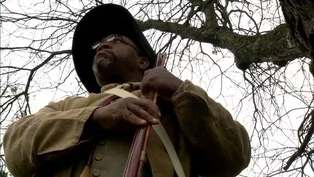
But first, Daniel Goff was born in Virginia in 1754.
Under the commands of Generals, George Washington and Lafayette, Goff was one of the thousands of African-Americans who fought for our country in the War of Independence.
He even suffered through the brutal winter encampment at Valley Forge under the command of General Washington.
Goff later made his way to Northern Kentucky, where he is widely regarded as an American hero.
There were eight known African American Revolutionary War veterans that died in the State of Kentucky.
Daniel Goff is the only African-American Revolutionary War veteran that we know of to have died in Boone County.
When Daniel Goff was born in 1754 in Cumberland County, Virginia, his parents were free people.
Daniel Goff began his military career in Virginia, enlisting in Chesterfield County, and he ended up changing regiments a couple of times when regiments would come together and then split apart again.
He did serve at Valley Forge.
He was camped at Valley Forge and in his pension, he talked about having known both General Washington and Lafayette.
He was serving at what we now know as a pivotal point during the Revolutionary War under these men.
I think people would be surprised at the number of free Blacks and slaves that actually contributed to the war effort during the American Revolutionary War.
They fought alongside White colonists in integrated units in a way that would not be seen again until the Korean War in the 1950s.
The treatment of African-Americans who were involved at Valley Forge was they would be treated as if they were just regular soldiers at that time.
Because the issue is that you do not - at that time, you don't have what's called a professional military.
Folks were just leaving the military because they couldn't take it.
It was so cold, it was so brutal, and they just didn't want to fight.
While there, Goff, like the other soldiers, would have endured the same source of hardships, lack of adequate food, adequate clothing, adequate shelter, and up until the arrival of Baron von Steuben, inadequate training.
And after the training at Valley Forge under Baron von Steuben, we became a formidable continental army, and we were able to start standing toe-to-toe with the British regulars, and it culminated in trapping them at Yorktown.
He saw several battles, the largest of which would have been the Battle of Monmouth.
He was a private when he entered in a private when he left service, not unusual at all.
But what I find interesting about the Revolutionary War records is that if we didn't have the accompanying information from Virginia, we wouldn't have known that he was African-American.
There was no separation.
It was an integrated force fighting.
Fighting did not change the minds of folks long-term.
Reading letters, reading documents, yes, people respected folks who had your back as if it was a life or death situation, obviously.
But after the war ended, those attitude resurfaces real quick.
At the time that Daniel Goff lived here, we were in sort of the early quarter of the 1800s and there were free people of color that lived in Northern Kentucky.
They didn't have the same rights as the people who were white and free, but they also had freedom of movement.
Sometime in the mid-1820s, we believe that Daniel Goff made his way to what is now the Florence area right off Gunpowder Road.
Alexander Marshall was the man that owned this property, and it was a large farm.
He owned slaves, so it was a little unusual for Daniel Goff to go that way.
And so, it seems like it wouldn't be a beneficial situation for Alexander Marshall, who already had enslaved people to do the work that he needed done, for him to invite a man who was aging who he would have to pay essentially to work there.
The inventory of Alexander Marshall's estate, of course, included his enslaved people.
There were two women who were in the right age range to have been partners of Daniel Goff.
There was also a young adult male whose name was Daniel.
That might be a hint as to why he went to the Marshall farm.
We suspect that he could have had this family.
In 1833, Daniel Goff applied for a pension for his Revolutionary War service.
The man who gave the longest and most information-filled affidavit on behalf of Daniel Goff to prove his was General James Taylor.
James Taylor was a General in the War of 1812.
General James Taylor was a son of Virginia, born in Caroline County.
He came to Kentucky in 1795.
When he came here, he owned 1,500 acres.
500 of it became the City of Newport.
He was the founder of the City of Newport, founder of Campbell County, Kentucky.
He was also a banker, industrialist.
He operated ferry boats and mills in the area.
At this point, Daniel was living on the Marshall farm.
And so, General Taylor would have come to Boone County to speak on his behalf.
He expressed within the text of the pension that he had concern for this man who was becoming old and, in his words, infirm.
He urged him to go for this pension.
It appears that they had a fairly close bond, that he seemed to have affection for Daniel Goff.
The relationship that we have record of between James Taylor and Daniel Goff is in a ledger, and basically it's a list of the number of days that he worked at a mill that the general owned.
In 1840, he's named on the census as living on the property of Alexander Marshall, and he's listed as a veteran of the Revolutionary War.
Sometime between March and September of 1843 is when Daniel Goff died.
They would have had a section where enslaved people were buried, and that's where we believe Daniel Goff would have been buried.
The marker for Daniel Goff is being placed on what was originally the Alexander Marshall farm.
Saturday, September 29th, was the ceremony to honor Revolutionary War veteran, Daniel Goff.
The day had members of the Sons of the American Revolution there along with elected officials.
The Sons of the American Revolution, who are in period uniform for the Revolutionary War, they displayed flags, and we get this beautiful salute with muskets.
It feels less like a funeral and more like a celebration.
Honoring Daniel Goff lets us connect our area to that time in history, but also allows us to understand more about African-Americans who were also involved.
Daniel Goff symbolizes an example that we could hold up as this man participated in probably the most important war in the history of the country because it defined the country for the first century with not only American Revolution, but the Constitution that comes out of the war itself.
[music playing] In times of war, women have taken on many challenges.
Whether single-handedly keeping the family farm going, working on the production line in factories or shipyards, or serving tours of duty in war zones, women have always stepped up to answer the call.
This was especially evident during the Revolutionary War when the Women of Kentucky's Bryan Station settlement displayed remarkable bravery in the face of danger.
In a little-known place along the southern bank of the Elkhorn Creek, not far from the bustle of downtown Lexington, there lies a simple memorial from 1896.
The first monument in the world built by women to honor women.
Women about whom author, Virginia Webb Howard wrote, in an era when men and their deeds were what made history, their story captured the imagination of generations to come.
The area is known as Bryan Station, a fort founded in 1779 and populated with brave men and women who were settling the frontier.
It was said that Kentucky was settled with the axe and the rifle.
The axe to fell trees and build cabins and guns or rifles with which to hunt, as well as to defend their homes.
Life was tough, especially for women.
Women had to be incredibly resilient.
These women helped with the agriculture, the tending of livestock.
They made clothes, they cooked, and they bore incredible quantities of children.
It was a life that required them to take many different roles.
We're looking at women as workers as well as warriors in the 1780s.
Later on, those roles are pulled back, but in the 1780s, we see women as industrial workers.
Bryan Station is a really good example of the kind of enterprising women that's coming into Kentucky at that time.
It was a violent time around the fortified settlement.
Despite the end of the Revolutionary War in the East, Native Americans and British Canadian forces still roamed the frontier.
There were very few battles on the frontier.
There were lots of skirmishes, ambushes, massacres, chases.
Bryan Station was in the midst of an international conflict.
Really what we're talking about is raiders coming down and trying to take a stand against all of the people coming in from the East.
In August 1782, the battle came to Bryan Station under the British Canadian captain, William Coldwell.
The settlers were outgunned and outmanned.
There were only 44 gun-bearing men against a force of 50 or 60 American and British loyalists and a force of what's estimated to be about 300 Indians.
Historians write the settlers knew the Native Americans were there and wanted the men to come out of the fort to be ambushed.
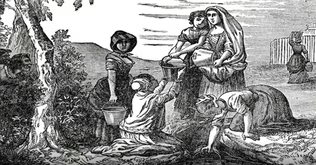
They created a plan for the women to come down to the well and get water just like they normally would.
Just like they had been watching them and watching them, a pattern.
They agreed to come down to the well and pretend like everything was okay, but they were scared to death.
They didn't really know if they would make it back.
They bring back enough water using wooden pails and piggins, and noggins, all different kinds of water-carrying equipment to outfit the fort for several days.
Women in that fort were very brave.
Living on the frontier was an act of bravery in itself, and many of them suffered and fought alongside the men.
Whether that story of leaving the fort and, in fact, playing a ruse in order to secure the water, which they very much needed inside the station, that to me is a wonderful story, and I hope it's true.
The Native Americans and British Canadian troops later attacked the fort.
Fierce fighting raged for two days.
The troops withdrew when they heard reinforcements were on the way and made their way north.
The settlers pursued the Native American and British Canadian troops for about 60 miles to Robertson County.
They then faced off during the Battle of Blue Licks, which ended up being a devastating loss for the settlers.
It wasn't until the War of 1812 that many Kentuckians would feel safe on the frontier, and it wasn't until 1896 that the importance of the women who risked their lives to carry the water was recognized by the Daughters of the American Revolution with a monument near Bryan Station and their crucial water source.
Those daughters and those women are the ones that really kept this country going.
They recognized the importance of history, family, God, and country, and they formed ladies societies to preserve and protect history.
The memorial stands just five feet high and 12 feet in diameter, but the words from historian, George Rank stand the test of time.
The women of ancient Sparta pointed out the heroic way.
The women of pioneer Kentucky trod it.
Rank's memorial and his inscription that he wrote for the memorial describes, I think, in a beautiful way, how in the 1890s, the Daughters of the American Revolution offered a story about the importance of women in Kentucky history.
[music playing] [music playing] We're having a great time here today at the Jack Jouett House Historic Site.
This is Linda DeRosett.
She's the Executive Director.
Linda, thanks so much for letting us be here today.
My pleasure.
So, I'm a lifelong Kentuckian.
Before we started working on this, I had not heard of Jack Jouett.
Who was he and what's his importance?
Jack Jouett was incredibly important to Kentucky history and our country's history.
Jack's story and his claim to fame really begins on the night of June 3, 1781.
He's a young man of 26.
He's a soldier, a member of the Virginia militia.
He is visiting friends in the Cuckoo Tavern in Louisa, Virginia.
Nightfall comes.
He's tired.
He lays under a tree and falls asleep.
Wakens to the sound of many horses, many men, looks around the tree, and sees King George's army.
Approximately 250 of his soldiers, led by a man named Banastre Tarleton, who was also known as Bloody Ban for his savagery.
Jack very quickly guessed what they were going to do.
They were going to head to Monticello and capture Thomas Jefferson.
Go on to Charlottesville, where the Virginia Assembly had decided to meet after they had left Richmond, thanks to Benedict Arnold, and they would capture all of these men.
So, he gets on horseback and warns everybody.
Oh, he gets on the fastest steed in seven counties, Sally, named after his childhood sweetheart, and she was quite an amazing horse.
Jack was 6'4” and weighed about 230 pounds.
And he began a 40-mile ride through the Virginia backwoods, over logging roads, through branches, trees.
He's cut.
He's hit by branches.
He's knocked off Sally at least once.
He's crossing streams, but this is the only way that he is going to beat the King's troops to Monticello to warn Mr.
Jefferson So, he got there and warned them, and in doing some background research on this, a lot of people said that he really saved the American Revolution by being able to do that.
At that time, Virginia especially was undermanned.
They were hungry.
They were tired.
They'd been fighting a very long time.
The loss of Thomas Jefferson, the writer of the Declaration of Independence, fore-signers of the Declaration of Independence, and Patrick Henry, who was already famous for saying, “Give me liberty or give me death," these are very important men to the colonists.
And to lose them in that way █ Would have been huge.
Would have been a horrible blow.
So, how did he end up in Kentucky?
How did he come to rest here?
Well, we were still part of Virginia when he came over.
He, in fact, was instrumental in us becoming a separate state and becoming Kentucky.
So, he came over.
He got a land grant as a Revolutionary War soldier.
Settled in a few places before finally coming here to Woodford County in 1797 and building this beautiful home.
And when people come here to see the historic site, what do they get to experience?
What do they take away?
What they get to experience if Jack and his wife, Sally walk through these doors right now with any one of their 12 children, they're walking on the same floorboards that Jack and Sally and the children walked on.
The house was donated in the 1970s to Woodford County.
The Woodford County Fiscal Court and the Woodford County Heritage Committee take wonderful care of it.
They could come in today and except for the electricity and the air-conditioning, they could feel right at home.
They would recognize the place.
Yes.
It really is a remarkable story and a facility here, and we're enjoying checking it out today.
Thanks so much for letting us be a part of it.
Oh, my pleasure.
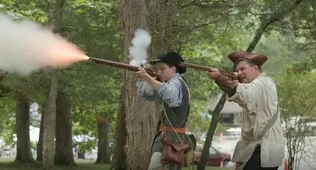
[music playing] Every August, the Blue Licks Battlefield State Resort Park marks the anniversary of an important conflict that took place there.
The Battle of Blue Licks is recreated right on the grounds where the actual fight took place.
Now, the reenactors there take their roles very seriously and recently gave me a chance to go into battle beside them.
So, join me as I grab a musket, throw on some pantaloons and a three-cornered hat, and commemorate what's considered to be the final battle of the Revolutionary War fought right here in Kentucky.
[reenactors mimicking the battle] These reenactors do put a lot into providing a living look look at the battle, which transpired right here.
And I was surprised by the number of people who showed up to see this historical interpretation.
The Battle of Blue Licks reenactment weekend is a major event at the park, and the staff is proud to memorialize such an important event.
We're here with Matthew Dollar.
He is the park naturalist here at Blue Licks Battlefield State Park.
Matthew, thank you so much for having us here today.
Chip, I'm over the moon for you being here today.
Thank you for coming.
We appreciate it.
So, what is Blue Licks?
For folks who don't know about it, what is this place?
The Battle of Blue Licks occurred August 19, 1782.
A lot of people consider this the last battle of the Revolutionary War.
It certainly was the last large military open-field conflict where British native forces and Virginia militia came together.
The heat of the conflict is pretty close to where we're standing at right now.
You said it was Virginia militia.
Is that because this was considered Virginia at that time?
So, 1782, the Virginia Territory still included.
They were calling this the Kentucky Territory, but the Virginia Colony was still included with West Virginia and the Kentucky Territory.
So, statehood for Kentucky didn't come until 1792.
Got it.
The significance of the battle here, why was it so important?
And why is it important to remember it?
A lot of the fighting for the Revolutionary War occurred on the Eastern Front, but Revolutionary War soldiers were here in Kentucky fighting against tribal Indians that had sided with the British Rangers that came out of Canada.
So, we want to make sure that we maintain our part in the historic viewpoint of the Revolutionary War.
So, how did the battle begin, and how did it make its way to this area?
There was a guy named William Coldwell.
He was born in Ireland.
Whenever he was 34 years old, he ended up being a captain with the Butler's Rangers out of British Canada at that time.
He crossed the Ohio River in early August and made his way to Bryan Station.
He tried to overtake that settlement.
He was there for a couple days with his 300 or 400 Native Americans.
They couldn't get in the fort, so they vacated that ambush, and they made their way up the Buffalo Trace.
So, he got up here, probably right around where the campground area is, August 18th, and he camped out, and the very next day, 182 guys got to the far side, the south side of Licking River over there.
One of them was Daniel Boone.
He was in this battle.
They looked across, and they saw some of the Natives that they felt like were the ones that had been there at Bryan Station that were trying to attack.
So, they made a decision to cross the river.
Those 182 Virginia militia made their way up this ridge, and eventually they started to enter a tree line, and they heard a war whoop.
And as soon as they heard that first war whoop, then they heard war whoop all up and down in ravines on either side of them.
And basically, they had said that Coldwell had set an ambush for them.
This battle didn't last very long, 10-15 minutes.
It was an absolute devastation for the Virginia militia.
Seventy-plus men got killed on the American side, and just a handful on the British side.
So, the Buffalo Trace, how did it get that name?
This Buffalo Trace historically was 8 to 10-foot wide, and that's better than tromping through the woods.
There's different salt licks from Big Bone down to Drennan Licks, Stamping Ground close to Lexington, and then it loops up here to Blue Licks.
So, there was a very well-defined, what we call Buffalo Trace, but it was a wild game trail for any type of woodland creature that would be coming through there, hitting these different salt licks and licking up that salt to provide minerals for bodies.
So, that's why it got well known as it did.
Well, it's a beautiful sight.
It really is.
Well, I'm all kitted out for the reenactment.
I'm ready to go.
You think we're ready for this?
Yeah, man, I think we should do it.
I think we'll have fun.
Let's give it a shot here.
Okay.
[reenactment of war] So, clearly I did not know what I was doing here, so I stayed on the hip of a guy who seemed to know.
And when he was felled by a redcoat bullet, I did what I thought was the most logical thing and hid behind a tree.
It really was powerful, though, being a part of something that had happened where lives actually been lost.
And I appreciated the opportunity to walk in their footsteps.
[music playing] We've had a great time exploring the Jack Jouett House Historic Site here in Versailles.
Now, even though I'm a lifelong Kentuckian, I had never encountered his story before working on this show.
It's been great not only to learn about him, but how Kentucky contributed to the War of Independence now some 250 years ago.
If you've enjoyed our show, be sure to like the Kentucky Life Facebook page and subscribe to the KET YouTube channel for more of what we like to call Kentucky Life Extras, where you'll have access to lots of other great videos.
Until next time, I'll leave you with this moment.
I'm Chip Polston, cherishing this Kentucky life.
[music playing] [music playing]
Video has Closed Captions
Clip: S31 Ep8 | 5m 4s | Chip learns about the battle of the Blue Licks. (5m 4s)
Video has Closed Captions
Clip: S31 Ep8 | 7m 25s | Learn about the fascinating life of African-American Revolutionary War soldier Daniel Goff. (7m 25s)
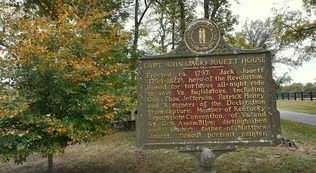
Jack Jouett House Historic Site
Video has Closed Captions
Clip: S31 Ep8 | 3m 34s | We’ll learn more about Revolutionary War hero Jack Jouett in this story. (3m 34s)
Video has Closed Captions
Clip: S31 Ep8 | 6m 7s | Learn about the siege at Bryan's Station. (6m 7s)
Providing Support for PBS.org
Learn Moreabout PBS online sponsorship













Support for PBS provided by:
Kentucky Life is a local public television program presented by KET
You give every Kentuckian the opportunity to explore new ideas and new worlds through KET. Visit the Kentucky Life website.