
Daniel Goff
Clip: Season 31 Episode 8 | 7m 25sVideo has Closed Captions
Learn about the fascinating life of African-American Revolutionary War soldier Daniel Goff.
Learn about the fascinating life of African-American Revolutionary War soldier Daniel Goff.
Problems playing video? | Closed Captioning Feedback
Problems playing video? | Closed Captioning Feedback
Kentucky Life is a local public television program presented by KET
You give every Kentuckian the opportunity to explore new ideas and new worlds through KET. Visit the Kentucky Life website.
Daniel Goff
Clip: Season 31 Episode 8 | 7m 25sVideo has Closed Captions
Learn about the fascinating life of African-American Revolutionary War soldier Daniel Goff.
Problems playing video? | Closed Captioning Feedback
How to Watch Kentucky Life
Kentucky Life is available to stream on pbs.org and the free PBS App, available on iPhone, Apple TV, Android TV, Android smartphones, Amazon Fire TV, Amazon Fire Tablet, Roku, Samsung Smart TV, and Vizio.
Providing Support for PBS.org
Learn Moreabout PBS online sponsorshipBut first, Daniel Goff was born in Virginia in 1754.
Under the commands of Generals, George Washington and Lafayette, Goff was one of the thousands of African-Americans who fought for our country in the War of Independence.
He even suffered through the brutal winter encampment at Valley Forge under the command of General Washington.
Goff later made his way to Northern Kentucky, where he is widely regarded as an American hero.
There were eight known African American Revolutionary War veterans that died in the State of Kentucky.
Daniel Goff is the only African-American Revolutionary War veteran that we know of to have died in Boone County.
When Daniel Goff was born in 1754 in Cumberland County, Virginia, his parents were free people.
Daniel Goff began his military career in Virginia, enlisting in Chesterfield County, and he ended up changing regiments a couple of times when regiments would come together and then split apart again.
He did serve at Valley Forge.
He was camped at Valley Forge and in his pension, he talked about having known both General Washington and Lafayette.
He was serving at what we now know as a pivotal point during the Revolutionary War under these men.
I think people would be surprised at the number of free Blacks and slaves that actually contributed to the war effort during the American Revolutionary War.
They fought alongside White colonists in integrated units in a way that would not be seen again until the Korean War in the 1950s.
The treatment of African-Americans who were involved at Valley Forge was they would be treated as if they were just regular soldiers at that time.
Because the issue is that you do not - at that time, you don't have what's called a professional military.
Folks were just leaving the military because they couldn't take it.
It was so cold, it was so brutal, and they just didn't want to fight.
While there, Goff, like the other soldiers, would have endured the same source of hardships, lack of adequate food, adequate clothing, adequate shelter, and up until the arrival of Baron von Steuben, inadequate training.
And after the training at Valley Forge under Baron von Steuben, we became a formidable continental army, and we were able to start standing toe-to-toe with the British regulars, and it culminated in trapping them at Yorktown.
He saw several battles, the largest of which would have been the Battle of Monmouth.
He was a private when he entered in a private when he left service, not unusual at all.
But what I find interesting about the Revolutionary War records is that if we didn't have the accompanying information from Virginia, we wouldn't have known that he was African-American.
There was no separation.
It was an integrated force fighting.
Fighting did not change the minds of folks long-term.
Reading letters, reading documents, yes, people respected folks who had your back as if it was a life or death situation, obviously.
But after the war ended, those attitude resurfaces real quick.
At the time that Daniel Goff lived here, we were in sort of the early quarter of the 1800s and there were free people of color that lived in Northern Kentucky.
They didn't have the same rights as the people who were white and free, but they also had freedom of movement.
Sometime in the mid-1820s, we believe that Daniel Goff made his way to what is now the Florence area right off Gunpowder Road.
Alexander Marshall was the man that owned this property, and it was a large farm.
He owned slaves, so it was a little unusual for Daniel Goff to go that way.
And so, it seems like it wouldn't be a beneficial situation for Alexander Marshall, who already had enslaved people to do the work that he needed done, for him to invite a man who was aging who he would have to pay essentially to work there.
The inventory of Alexander Marshall's estate, of course, included his enslaved people.
There were two women who were in the right age range to have been partners of Daniel Goff.
There was also a young adult male whose name was Daniel.
That might be a hint as to why he went to the Marshall farm.
We suspect that he could have had this family.
In 1833, Daniel Goff applied for a pension for his Revolutionary War service.
The man who gave the longest and most information-filled affidavit on behalf of Daniel Goff to prove his was General James Taylor.
James Taylor was a General in the War of 1812.
General James Taylor was a son of Virginia, born in Caroline County.
He came to Kentucky in 1795.
When he came here, he owned 1,500 acres.
500 of it became the City of Newport.
He was the founder of the City of Newport, founder of Campbell County, Kentucky.
He was also a banker, industrialist.
He operated ferry boats and mills in the area.
At this point, Daniel was living on the Marshall farm.
And so, General Taylor would have come to Boone County to speak on his behalf.
He expressed within the text of the pension that he had concern for this man who was becoming old and, in his words, infirm.
He urged him to go for this pension.
It appears that they had a fairly close bond, that he seemed to have affection for Daniel Goff.
The relationship that we have record of between James Taylor and Daniel Goff is in a ledger, and basically it's a list of the number of days that he worked at a mill that the general owned.
In 1840, he's named on the census as living on the property of Alexander Marshall, and he's listed as a veteran of the Revolutionary War.
Sometime between March and September of 1843 is when Daniel Goff died.
They would have had a section where enslaved people were buried, and that's where we believe Daniel Goff would have been buried.
The marker for Daniel Goff is being placed on what was originally the Alexander Marshall farm.
Saturday, September 29th, was the ceremony to honor Revolutionary War veteran, Daniel Goff.
The day had members of the Sons of the American Revolution there along with elected officials.
The Sons of the American Revolution, who are in period uniform for the Revolutionary War, they displayed flags, and we get this beautiful salute with muskets.
It feels less like a funeral and more like a celebration.
Honoring Daniel Goff lets us connect our area to that time in history, but also allows us to understand more about African-Americans who were also involved.
Daniel Goff symbolizes an example that we could hold up as this man participated in probably the most important war in the history of the country because it defined the country for the first century with not only American Revolution, but the Constitution that comes out of the war itself.
[music playing]
Video has Closed Captions
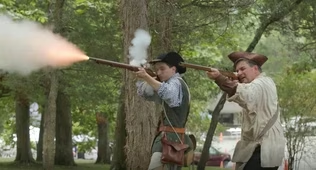
Clip: S31 Ep8 | 5m 4s | Chip learns about the battle of the Blue Licks. (5m 4s)
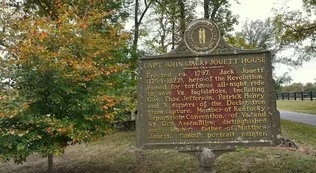
Jack Jouett House Historic Site
Video has Closed Captions
Clip: S31 Ep8 | 3m 34s | We’ll learn more about Revolutionary War hero Jack Jouett in this story. (3m 34s)
Video has Closed Captions
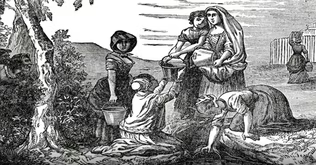
Clip: S31 Ep8 | 6m 7s | Learn about the siege at Bryan's Station. (6m 7s)
Providing Support for PBS.org
Learn Moreabout PBS online sponsorship













Support for PBS provided by:
Kentucky Life is a local public television program presented by KET
You give every Kentuckian the opportunity to explore new ideas and new worlds through KET. Visit the Kentucky Life website.