One-on-One
Daniel Semenza; Making a Difference: Addressing Gun Violence
Season 2024 Episode 2727 | 27m 34sVideo has Closed Captions
Daniel Semenza; Making a Difference: Addressing Gun Violence
Daniel Semenza, Ph.D., Director of the Interpersonal Gun Violence Research Center at Rutgers University, discusses gun violence and concealed carry laws. Two Russ Berrie Making A Difference winners to highlight their personal commitment to addressing gun violence. Panelists include: A’Dorian Murray-Thomas, Founder & CEO, SHE Wins Inc. Al-Tariq Best, CEO & Founder, The HUBB Arts & Trauma Center
Problems playing video? | Closed Captioning Feedback
Problems playing video? | Closed Captioning Feedback
One-on-One is a local public television program presented by NJ PBS
One-on-One
Daniel Semenza; Making a Difference: Addressing Gun Violence
Season 2024 Episode 2727 | 27m 34sVideo has Closed Captions
Daniel Semenza, Ph.D., Director of the Interpersonal Gun Violence Research Center at Rutgers University, discusses gun violence and concealed carry laws. Two Russ Berrie Making A Difference winners to highlight their personal commitment to addressing gun violence. Panelists include: A’Dorian Murray-Thomas, Founder & CEO, SHE Wins Inc. Al-Tariq Best, CEO & Founder, The HUBB Arts & Trauma Center
Problems playing video? | Closed Captioning Feedback
How to Watch One-on-One
One-on-One is available to stream on pbs.org and the free PBS App, available on iPhone, Apple TV, Android TV, Android smartphones, Amazon Fire TV, Amazon Fire Tablet, Roku, Samsung Smart TV, and Vizio.
Providing Support for PBS.org
Learn Moreabout PBS online sponsorship- [Narrator] Funding for this edition of One-On-One with Steve Adubato has been provided by The Russell Berrie Foundation.
Making a difference.
The Healthcare Foundation of New Jersey.
RWJBarnabas Health.
Let’s be healthy together.
Newark Board of Education.
PSEG Foundation.
NJM Insurance Group.
Serving New Jersey’s drivers, homeowners and business owners for more than 100 years.
The North Ward Center.
New Jersey Sharing Network.
And by Veolia, resourcing the world.
Promotional support provided by Northjersey.com and Local IQ.
Part of the USA Today Network.
And by ROI-NJ.
Informing and connecting businesses in New Jersey.
- This is One-On-One.
- I'm an equal American just like you are.
- The way we change Presidents in this country is by voting.
- A quartet is already a jawn, it’s just The New Jawn.
- January 6th was not some sort of violent, crazy outlier.
- I don't care how good you are or how good you think you are, there is always something to learn.
- I mean what other country sends comedians over to embedded military to make them feel better.
- People call me 'cause they feel nobody's paying attention.
-_ It’s not all about memorizing and getting information, it’s what you do with that information.
- (slowly) Start talking right now.
- That's a good question, high five.
(upbeat music) - Hi everyone, Steve Adubato.
This entire program dedicated to the issue of gun violence.
Causes of it, who's being disproportionately impacted and affected by it and what some are doing to make a difference and deal with gun violence.
We kick off the program with Dr. Daniel Semenza, who is Director of the Interpersonal Gun Violence Research Center at Rutgers University.
Their website will be up.
Doctor, good to see you.
- Good to be here.
- Let's break this down a little bit.
There are different types of gun violence in different communities.
Let's go through it.
Suicide, let's start with suicide.
Different in the white community, particularly with white men versus minority community.
- Yeah, it's really important to get at the distinction here.
So when people talk about gun violence, they kind of talk about it like a capital G, capital V situation.
Where it's one big issue and I think it's really important to break it down into its constituent parts and when we talk about suicide, that represents basically, you know, on any given year almost two-thirds of the gun deaths in the country.
- Two-thirds.
- And gun suicides, they disproportionately impact older white men living in rural areas throughout the country.
So they bear way more of the burden of firearm suicide than any other demographic group in the country.
- What about urban gun violence?
- So urban gun violence is very different.
People will also call it community gun violence.
This is typically gun violence that happens, you know on often a day-to-day basis in a lot of cities, particularly disadvantaged neighborhoods, in neighborhoods of color.
So predominantly made up of Black and Hispanic individuals and community gun violence or urban gun violence where people are shooting one another rather than shooting themselves, that is impacting young black men in the biggest way.
So roughly 15 to 30 years old have a far, far greater risk of homicide and non-fatal shooting by somebody else than any other demographic group in the country.
- By the way, thank you for breaking down gun violence into different categories because it's not just simply gun violence all the same across the board.
But mass shootings, there are more and more there appears, there aren't they appear to be, there are more and more mass shootings.
What do we know about the dynamics behind a mass shooting or is it different in every case because a variety of factors and variables please.
- Yeah, mass shootings, you know depending on the estimate we're talking about make up roughly 1% of the deaths related to firearms in the country on any given year.
And so there's some evidence that mass shootings are increasing and that the numbers of fatalities or injuries in mass shootings is going up in part because more of them involve AR-15s and assault style weapons.
But you know, despite the fact that it represents a small portion of the overall gun deaths in the country doesn't make it any less meaningful or impactful.
I grew up in a community right next to Sandy Hook so I know very well what it does to people who live, you know, far, far away from the events let alone the actual communities that are impacted by these shooting.
What we do know is that there's a lot of differences from one shooting to the next.
So this idea of trying to profile or trying to create a character type of who's going to be the next mass shooter is really really difficult, if not impossible.
But there are some patterns that go into mass shootings.
There often is some kind of grievance, right?
Something that somebody has really taken issue with.
And then over time they may plan, they decide to commit shooting they do a lot of research, they acquire firearms.
So there is a pathway, there is a grievance kind of pathway towards a mass shooting.
But creating a profile and saying this is the type of person that is a mass shooter is a farce.
- So domestic violence as well right, and by the way if people wanna find out more about Dr. Semenza's research, go on the website to find out more.
Domestic violence, 'cause I wanna get into some of the reasons for this very complex but gimme 30 seconds on domestic violence.
- Yeah, I would say that this is kind of the fourth big box of gun violence in the and these are shootings that are happening between intimate partners.
So that could be folks who are married or people who are not, but are partners in some way.
Oftentimes there's a firearm already in the home and there's an argument happening and the gun comes out whether it's initially just to threaten somebody or actually intended to be used, but these domestic shootings that are happening between partners often arise after escalating arguments, whether that's over time getting worse or throughout the course of a day and a firearm is present and then becomes available.
- So the courts are involved, legislators are involved in making policy or not making policy.
The courts, particularly decision in June, 2022.
What's the name of that case?
- The Bruin decision.
- The Bruin decision.
That is a United States Supreme Court decision.
- That's right, yes.
What did it say about the ability to carry firearms in public?
What did it say?
- What it's doing is it's making it easier for individuals to carry guns in public.
There's less of a barrier to entry in order to do that.
So they don't necessarily need to prove that they have a specific reason like they have to have a gun for their job or something.
But rather they can go out and they can get a gun as long as they do the proper paperwork and then carry it in public.
- Do the statistics show that it's created more gun violence?
- Concealed carry is associated with higher risk in homicide and shootings.
So we know when a state has concealed carry on the books which allows people to carry guns in public, there's good evidence to show that that is more dangerous.
- But to be clear, I’m sorry for interrupting.
In New Jersey, what exactly is the status of concealed weapon?
Can you carry a concealed weapon in New Jersey?
What is the status?
- Yes.
In New Jersey you can carry a concealed weapon currently in most jurisdiction, that requires having due cause, a very specific reason for doing so.
The concern is liberalizing that and not requiring that anymore.
So concealed carry would become a lot more common.
- So to be clear, is it a federal court decision or a policy that allows a state like New Jersey to have some degree of concealed carry or is it state law that does that?
- It's a state law.
- Is it state by state doctor, these decisions?
- Yes, concealed carry permitting decisions are state by state.
- And finally, ultimately does a federal law supersede any state law?
Or does that adjudicate in the courts?
- Ultimately, there is not a federal law around concealed carry.
It is ultimately gonna be decided at the state level.
- One more quick one, Stand Your Ground's getting a lot of media attention right now.
There are too many, there shouldn't be one but there are a lot of cases of people walking up to the wrong door or driveway.
I felt threatened.
I'm gonna stand my ground.
Blow somebody away through the door.
Horrific.
Stand Your Ground laws.
Obviously that's not the case in New Jersey but it is in other places.
The direct impact or any impact on gun violence.
- Most states actually have a Stand Your Ground law.
There are different flavors of it.
Some are more kind of liberal than other.
But yeah, the, the good evidence that we have would suggest Stand Your Ground laws are associated with increased shootings and increased homicides.
And so these concealed carry and Stand Your Ground laws are two of the best research policies that we know are bad for gun violence.
Not good.
- And the research being done by the Interpersonal Gun Violence Research Center Rutgers University talks about, and go on the website to find out firearm storage, safe firearm storage, firearms storage.
And also the way to do that because people will often say, my gun is stored my rifle is stored, but stored safely is a different issue.
And go on the website to find out more about what you can do if you are going to have a gun in your home how to store it safely.
Doctor, I want to thank you so much for joining us.
We appreciate it.
- Thank you so much.
Appreciate being here.
- We'll be back right after this with a panel discussion that is really important about gun safety and gun violence.
Right back.
- [Narrator] To watch more One on One with Steve Adubato find us online and follow us on Social media.
- We continue our conversation about gun violence with two leaders who are making a difference every day.
A'Dorian Murray-Thomas is the founder and CEO of SHE Wins.
She's been with us many times, and a board member of the Newark Board of Education.
And Al-Tariq Best is the CEO and founder of the HUBB Arts and Trauma Center, which stands for Help Us Become Better.
Al-Tariq and A'Dorian, thank you so much for joining us.
- Thank you for having us.
- You know, you can talk about the statistics in gun violence, and people debate it on a policy level, but both of you, unfortunately, have experienced this on a very personal level and chosen to take that tragic experience in your past and do something meaningful with it.
You're both Russ Berrie awardees/honorees for Making a Difference, and that's how we met.
A'Dorian, please share with folks your personal experience and then the transition to creating SHE Wins, please.
- Thanks, Steve.
Really, really happy to be here.
My father, who was raised and born in the great country of Guyana, came to this country for the American dream and was granted an American nightmare.
Him and my mother had me, and then, at seven years old, though, when I was seven, he was gunned down two blocks from our house on his way to pay my school tuition.
And so, a lot of my work right now with youth mentoring work and anti-violence through Youth Violence Prevention starts from that story and really wanting to create a space where other young women like me, who lost a parent or sibling to gun violence, wouldn't have to suffer alone and would be able to use their stories to transform their lives and their communities.
And so, it's really from having a network of supports when I was growing up, even in the midst of my trauma, having folks like my mother, having really great teachers, folks who prayed for me, thought about me, I seek to create that same exact system rooted in sisterhood, service, and self-actualization for young women affected by violence today - As you look at the website for SHE Wins, go on and find out more, because A'Dorian is a leader that we've featured many times on our programming, making a difference every day.
Find out more about what they're doing.
Al-Tariq, please share a bit about your experience and its connection to creating the HUBB Arts and Trauma Center.
- Yes, so, about 17 years ago, me and my sons were in Newark.
I grew up in Newark, raised in Newark, and survived a lot of the traumas in Newark.
But I would always brag about how proud I am of Newark, and my children's mother just didn't like Newark because of the violence.
And I convinced her to let me take my children to a cookout that day, and, unfortunately, coming across Bergen Street right before you get to Clinton Avenue, these guys was beating up another guy right in front of my car, and my sons seen this whole situation.
At this point, my sons was frantic and started saying, "Dad, there's blood."
You know, "They're beating him up.
There's blood all over the place."
But at one point he said, "He has a gun, Dad, he has a gun."
And so I swerved around another car, got my sons out of harm's way.
We seen a cop on the next corner, right before Bigelow.
I told the cop exactly what was going on.
He made a big swerve.
As he was going back towards where the violence was happening, we heard a gunshot go off.
Something inside of me snapped.
I start yelling and screaming at my sons, "Don't ever let me catch you in these streets, blah, blah, blah."
My 14-year-old son at that time says, "Dad, you always talk about being part of the solution, not part of the problem.
What are you doing about it?"
And at that moment, from the mouths of babies, my son put a challenge on me, and I felt like he called me a hypocrite because I was talking about doing something for the community and wasn't doing anything.
I took everything I knew from the music business and started a nonprofit.
Didn't know what I was doing, I just knew that I wanted to serve and never be in a position ever again where anybody, especially our children, asks us what we're doing for our community and not have an answer.
And 17 years later I've been a response to that question ever since and just created a space where children can understand their purpose in life, understand that their situations don't have to dictate their destinations, and here we are.
- I'm a student of leadership.
You're seeing it right in front of you, folks, making a difference, stepping up, not being a bystander jumping in to make a difference, particularly in your own community.
Real quick, A'Dorian, could you talk about some of the services that SHE Wins provides?
And then I'll do the same thing with Al-Tariq, particularly as it relates to gun violence.
- Yeah, so our goal is to really make sure that young people don't have to suffer alone.
What we know is that, when we look at the data, young people who lose a loved one, particularly prematurely by gun violence, domestic abuse, et cetera, they're more likely to drop out of high school more likely to abuse substances, more likely to have real reactions to the traumas that they experience, and those real reactions negatively impact the quality of their lives.
But the data also shows that, when you have resources in place that are protective factors, like mentors, like access to quality schools, like connections with other young people who are doing positive things in your community, those same things that they were at risk of before are erased, and so, at SHE Wins, that is our goal.
This is what we do.
We create systems of support through pipelines of sisterhood, service, and self-actualization that make sure that young people who are most proximate to the issues of gun violence and other issues of trauma in our city are more likely to do well despite.
And so, we have a summer leadership academy that's free, rooted in having women come and mentor the young ladies, having peers mentor other peers.
Most of our programs in the summer are completely youth-ran, high school students, college students serving as youth leaders and facilitators to their young women.
And then, of course, social action and service, making sure our young people are in the community being the change they want to see.
At SHE Wins, we believe that young people don't need saving.
When given the tools and resources, they can save themselves.
And so, what does it look like to have a city that's being transformed by young people?
It looks like having young people create social action projects that improve childhood literacy.
It looks like having young people volunteer every year at the HUBB's Thanksgiving for the home-insecure communities in the park.
So that's really our work, Steve.
It's creating these interventions during the summer and school year that support young people to support themselves and transform their communities.
- By the way, having known A'Dorian for many years now, and one of the first interviews she ever did was with us, to see her grow to be the leader she is, making a difference every day, I want to thank the folks at the Russ Berrie Foundation for introducing us, as I've been honored to host that event for 27 years and meet leaders like you.
But Al-Tariq, as you listen to your colleague and friend talking about what SHE Wins is doing, what is the connection between providing those services?
Because your organization, HUBB, provides services as well.
What's the connection between those services each one of you and other not-for-profits provide and gun violence?
- Yes.
Everything that Dorian said is exactly, and that's why she's my sister partner.
Like, we grew up in this game together and understanding the traumas that we grew up in Newark with.
Unfortunately, we both had these personal experiences that turned into passion for us.
And I took a dilapidated space, 9,000 square feet of dilapidated space, and turned it into a safe haven.
For the last 11 years, youth have been growing up in the HUBB, but we take them, we take the credible messengers, we take art therapists, we take social workers, and we create this plan for them to understand what it is that they've been going through, peeling back the layers of the trauma that they've been going through.
And most of the young people that are sent to us are sent through the Newark Police Department or Newark Public Schools, the ones that are out there causing havoc, right?
Unfortunately, we don't give up on them.
Society have given up on them and we take them and show them the better side of themselves.
We take them through interest-based mentoring, right, and show them that they can be anything that they want through financial literacy, health and wellness, grooming and self-efficacy.
We built the studio with all of these things that they love, so we use that as incentives to come off the street.
Don't do that.
You can do this and not have to look over your shoulders by doing that other thing.
And it's been great that we've been able to change them, because they get to talk with their peers, that's credible messages that have changed their life around, right?
So we couple them with the social workers.
Steve, I've seen you.
- Yeah, let me, I wish we had twice, three times the amount of time we have, but I want to follow up on something.
So, as I listen to two of you, two people I've gotten to know in my work, and, obviously, as I said many times, I respect so much, there are some people who are listening, saying, well, wait a minute, but what's all the debate about gun violence having to do with public policy around assault weapons, which is important, and concealed carry laws, which is important, and Stand Your Ground laws, which are important.
Each one of you are talking about the work you're doing in urban, not urban communities across the board, but Newark in particular, and some folks are saying, well, that's not a discussion about gun violence.
That's a discussion about two not-for-profit leaders who are trying to make a difference.
First A'Dorian, then you, Al-Tariq, I'm arguing that is connected to gun violence.
Please make the connection more precisely than I'm doing, A'Dorian, please?
- There's some who say that every murder can create more murderers, but what do you mean?
That means that when we don't deal with the after-effect of the violence, the people who lost the kid, who lost the brother, who lost the friend, if we don't nip that in the bud and find resources to wrap around that community, you can create more violence than the initial violence itself.
And so, to your point, Steve, the work that myself, that Al-Tariq, that folks like those at the City of Newark's Anti-Violence work, the work that we're doing is critical because it is trying to gut out the violence at the root, one, by making sure that there isn't more offshoots of violence from the initial moment of violence that we're responding to, but also trying to create systemic solutions that contribute to the systemic issues of violence.
- It's about breaking the cycle of, I'm sorry for interrupting, is it about breaking the cycle?
Because say someone says, well, just let's have fewer guns.
Let's cut down on the number of guns matters, but you're talking about breaking the cycle of gun violence, right?
- That's right.
That's right.
And you can only break the cycle, too, if you get at the root causes.
And some of those root causes are lack of support from homes and families, lack of quality schools, poverty.
These are the things that contribute to violent behavior and violent incidents.
And so, our work is not only trying to help young people who are intimately affected by violence, but also trying to help young people make sure they're not in positions where they are more likely to be engaged in these behaviors.
At SHE Wins, we take girls every year on free college tours across the country.
We take them to the United Nations Foundation, where they participate in leadership conferences with girls across the world.
When you help young people see who they are and who they can be, they will rise.
- And what's possible.
- And that's what's possible.
- That's right.
- I cut you off, A'Dorian.
Finish your point, I'm sorry.
- Yeah, no, you hit it right on the nail, when you help young people see what's possible, my mom would always say that no one rises to low expectations.
And so, when you have the expectations become higher for young people, they rise to them.
And when you do that, they not only transform their lives, but they transform the lives of those in their communities.
- Al-Tariq, jump in, connected to gun violence specifically.
- Yes, and you hear many of those people say hurt people hurt people.
Yeah, they do, but I don't let it stay there, right?
Hurt people hurt people, but healed people and healing people can heal people.
So our job is to create some healing around them and make them understand that they don't have to be out there doing those things.
I get the shooters.
I get the shooters, and they're putting their guns down.
They're putting their guns down and picking up a microphone.
They're putting their guns down and picking up a camera.
They're putting their guns down and they're picking up tools that's gonna help them in their life to not be out there shooting anybody, and it's all about peeling back the layers and understanding what traumas that they face and change those behaviors.
We have to change the behaviors, because our parents didn't teach us.
A lot of those parents didn't teach us, and you can't teach what you didn't know, right?
So we gotta change that behavior.
We gotta reconstruct their mindset to know that that's not the right way to do things.
A'Dorian, 30 seconds left.
The greatest satisfaction, I've asked you this before, I'll ask you again, in doing what you do every day at SHE Wins, particularly as it relates to stopping the cycle of violence, is?
- Seeing young people lead and seeing young people heal.
At SHE Wins, I have girls who used to be the ones engaged in violent behavior in their school.
- In gangs as well?
- Some, some were and some were not.
But, often, the issue is, when you don't know how to deal with your own traumas, you react and you don't respond, and you create and engage and perpetuate systems of violence.
And so, some of those same young people who used to be creating violence are the ones helping, creating healing circles within our organization and beyond.
And so, seeing young people who were once hurt now doing the healing, and they were hurt and they were therefore hurting people, they're healing other people.
That's the greatest satisfaction.
- Thank you.
Al-Tariq, your final words, your satisfaction greatest is?
- I love A'Dorian.
The healing is in the wound, right?
So once we are able to tackle that and see them change their behavior, seeing them change their mind about how things are done and how they lead other people.
A'Dorian hit it on the point.
You know, they're the ones that's leading the charge.
They're the ones that's leading the healing circles.
They want different, but they have to be shown different, right?
We have to love on them and not take away that, just because they made some bad decisions.
We've all made bad decisions and we've grown from it, 'cause we're still here today.
If you wake up today, it's another chance to do something right, and that's what we're doing, providing safe havens for them to understand their potential to do better.
Help us become better.
- Al-Tariq, A'Dorian, just thank you, thank you for every time you've been with us, every time you've shared, every time you tell your story and the story of others, but also for the work you do every day in your two very important not-for-profit organizations making a difference.
You honor us being with us, and you also honor the Russ Berrie Foundation for being winners of the award for Making a Difference.
Thank you so much.
- Thank you.
- And I promise, folks, we'll continue our conversation about gun violence from a variety of perspectives.
We don't check off the box and say, "Hey, we did that program."
It's not a program, it's an ongoing conversation.
I'm off my soapbox.
See you next time.
- [Narrator] One-On-One with Steve Adubato is a production of the Caucus Educational Corporation.
Celebrating 30 years in public broadcasting.
Funding has been provided by The Russell Berrie Foundation.
The Healthcare Foundation of New Jersey.
RWJBarnabas Health.
Let’s be healthy together.
Newark Board of Education.
PSEG Foundation.
NJM Insurance Group.
The North Ward Center.
New Jersey Sharing Network.
And by Veolia.
Promotional support provided by Northjersey.com and Local IQ.
And by ROI-NJ.
The North Ward Center continues to expand their services and outreach in Newark, from the childhood years to the golden years, Offering programs like preschool, youth leadership development, Casa Israel Adult Medical Day program our Family Success center, as well as a gymnasium.
And most recently Hope House, a permanent home for adults with autism, supporting and nurturing our autism community with Hope House 2 coming soon.
The North Ward Center.
We’re here when you need us.
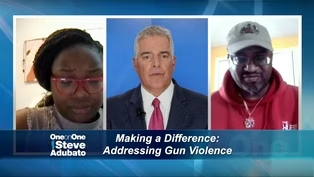
Making a Difference: Addressing Gun Violence
Video has Closed Captions
Clip: S2024 Ep2727 | 16m 40s | Making a Difference: Addressing Gun Violence (16m 40s)
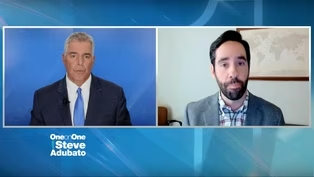
The Prevalence of Gun Violence and Concealed Carry Laws
Video has Closed Captions
Clip: S2024 Ep2727 | 10m 24s | The Prevalence of Gun Violence and Concealed Carry Laws (10m 24s)
Providing Support for PBS.org
Learn Moreabout PBS online sponsorship
- News and Public Affairs

Top journalists deliver compelling original analysis of the hour's headlines.

- News and Public Affairs

FRONTLINE is investigative journalism that questions, explains and changes our world.












Support for PBS provided by:
One-on-One is a local public television program presented by NJ PBS