
Protecting Iowa’s Night Sky: Light Pollution and Dark Sky Solutions
Clip: Season 3 Episode 309 | 6m 42sVideo has Closed Captions
Explore how light pollution is changing the night sky and its impact on people and wildlife.
Explore how light pollution is changing the night sky, its impact on people and wildlife, and what Iowans are doing to bring the stars back. We'll learn how dark sky compliant lighting is benefiting the environment and providing energy efficiencies, and we'll visit one of Iowa's darkest sky locations, Whiterock Conservancy near Coon Rapids.
Problems playing video? | Closed Captioning Feedback
Problems playing video? | Closed Captioning Feedback
Iowa Life is a local public television program presented by Iowa PBS
Protecting Iowa’s Night Sky: Light Pollution and Dark Sky Solutions
Clip: Season 3 Episode 309 | 6m 42sVideo has Closed Captions
Explore how light pollution is changing the night sky, its impact on people and wildlife, and what Iowans are doing to bring the stars back. We'll learn how dark sky compliant lighting is benefiting the environment and providing energy efficiencies, and we'll visit one of Iowa's darkest sky locations, Whiterock Conservancy near Coon Rapids.
Problems playing video? | Closed Captioning Feedback
Where to Watch Iowa Life
Iowa Life is available to stream on pbs.org and the PBS app.
Providing Support for PBS.org
Learn Moreabout PBS online sponsorship♪♪ [Steven Spangler] One can go out and look at the night sky and just be amazed by it in the same way that the people of the late woodlands culture who lived here in Iowa a thousand years ago certainly did and used it to keep track of the time.
♪♪ [Steven Spangler] People are really intrigued about the vastness of space.
Are there other planets like the Earth out there in the universe?
♪♪ [Steven Spangler] Questions of whether life exists there.
♪♪ [Steven Spangler] What you need for ground-based astronomy is a dark sky.
Galaxies that we're seeing as they were billions of years ago.
Worldwide two-thirds of research observatories are now in environments where the light pollution exceeds what is recommended.
♪♪ [James Bruton] Light pollution has changed our ability to see the night sky.
Over the past 20 years, light pollution in Iowa has increased substantially.
The cities have grown, technology has improved, the nights have just become brighter and brighter and brighter.
Back in 2020, we had a derecho here in Iowa and power was cut off.
We were finally able to see those night skies.
And then as soon as the lights came back on, those stars were gone.
I started the Dark Sky Initiative because I wanted to help bring the night sky back to Iowa.
I'm on the Board of Iowa Wildlife Federation and they have taken the Dark Sky Initiative under their wing because dark skies help to protect the habitats of wildlife.
Light pollution has had a profound impact on wildlife.
It has affected their ability to find food, their ability to understand even when it is night.
The impact on migratory birds is really significant.
There are cities around the country and around the world that during times of bird migration will actually turn their lights down.
[David Rayer] Several years ago, the Dark Skies Alliance actually introduced a model lighting ordinance.
Ames was one of the first ones in Iowa.
They started adding shields to a lot of the street lights.
The old style of street lights throw a lot of light up into the sky and above the horizontal plane, which was essentially wasted light.
So, my job as a lighting designer, people pay me to light things at night.
So, my job is to create those lit environments, but to really minimize the amount of light that is present.
Des Moines University first came to RDG Planning and Design because we were a design firm that could really take the challenge of creating a brand new 88-acre college campus, introducing something that is fairly new in the Des Moines community especially was a 3,000 Kelvin, which is a very warm light, light source.
And that really helps in the nighttime environment where we have seen so much with the bluish-white LEDs, that is very bad for our human circadian rhythms at night.
[David Rayer] One of the principles of Dark Skies is putting light where it needs to be and actually reducing lighting levels.
As you can see in the plaza behind me, with the use of uniform lighting levels your eye can adjust to the lack of contrast and it gives you the perception that there is a lot more light there than there really is, allowing us to dial in lower lighting levels.
Another principle of Dark Skies is using light only when it is needed.
So, at DMU we actually use occupancy sensors to dim the lights down when there is no one present in the parking lot.
Once a student exits a building or a car drives by, the lights will dim back up for 20 minutes.
This also saves a lot of energy for DMU.
♪♪ [David Rayer] One of the things that was important to us when we came to this basically virgin site was really being respectful of nature, so understanding we needed to have the safety of a college campus, but mitigate any of the light pollution that we would have.
All of our lighting systems basically maintain a narrow lighting distribution just on the trail system with very minimal spill out into the natural habitats.
♪♪ [James Bruton] There is a growing trend around the world towards astro-tourism that means that people are traveling to dark sky areas to be able to see the night sky.
Iowa has the exact same stars above us.
There's no reason that astro-tourism couldn't be a part of our economy.
Right here in Central Iowa we have Whiterock Conservancy.
They have a star field already established that attracts amateur astronomers from all around the state and beyond.
♪♪ [Kate Compton] Whiterock Conservancy partnered with Iowa State University for a Dark Skies study and it was determined that Whiterock was one of the darkest sky locations in the state because of our location away from the metro hubs.
Every year we partner with the Ames Area Amateur Astronomers to bring the Iowa Star Party to Whiterock Conservancy in the fall based on the moon phases and they set up multiple scopes and focus them on different aspects of our dark sky.
And we have really amazing interpreters from the Ames Area Amateur Astronomers that will walk you through what their scopes are focused on.
♪♪ [Kate Compton] Whiterock continues to improve upon our Dark Sky Initiatives and last summer in 2025 we were able to upgrade a lot of our older facilities with dark sky friendly lighting.
Whiterock has done a lot of work to be designated as a Dark Sky location and they are very simple things that you can even do at home.
Turning down or off unnecessary lighting or changing your lighting to shielded or downward facing lights.
♪♪ [Kate Compton] Whiterock Conservancy has recently submitted an application to Dark Sky International to be the first recognized Dark Sky location in the state.
I am optimistic about our future.
We can make the changes that we need to bring back our dark sky opportunities.
♪♪ [James Bruton] It's about smarter lighting that saves money, protects wildlife, improves safety and helps boost our local economy.
Each of us can be a part of the solution to create a positive change.
♪♪ (nature sounds)
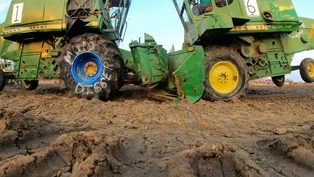
Bremer County Fair Combine Demolition Derby: Iowa Farm Machines Collide
Video has Closed Captions
Clip: S3 Ep309 | 6m 50s | Retired harvesters roar back to life at the Bremer County Fair Combine Demolition Derby. (6m 50s)
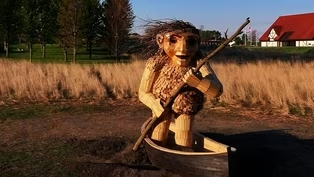
Elk Horn Welcomes Giant Troll Sculpture, Fjord Ferryman, by Artist Thomas Dambo
Video has Closed Captions
Clip: S3 Ep309 | 3m 18s | Elk Horn welcomes a giant troll sculpture, Fjord Ferryman, by recycle artist Thomas Dambo. (3m 18s)
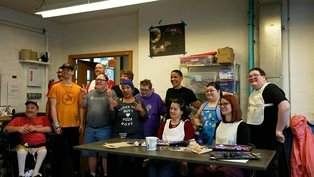
These Artists are Proof that Art is a Universal Language
Video has Closed Captions
Clip: S3 Ep309 | 7m 15s | Hear from artists of all abilities as they share their work as part of the Freedom of Expression Pro (7m 15s)
Providing Support for PBS.org
Learn Moreabout PBS online sponsorship











Support for PBS provided by:
Iowa Life is a local public television program presented by Iowa PBS