Here and Now
David Helpap on Serving in Local Government in Rural Areas
Clip: Season 2200 Episode 2239 | 7m 36sVideo has Closed Captions
David Helpap on dwindling participation in local government in rural areas of Wisconsin.
UW-Green Bay political science professor David Helpap describes factors contributing to dwindling participation in local government among rural Wisconsin communities as populations age and decrease.
Problems playing video? | Closed Captioning Feedback
Problems playing video? | Closed Captioning Feedback
Here and Now is a local public television program presented by PBS Wisconsin
Here and Now
David Helpap on Serving in Local Government in Rural Areas
Clip: Season 2200 Episode 2239 | 7m 36sVideo has Closed Captions
UW-Green Bay political science professor David Helpap describes factors contributing to dwindling participation in local government among rural Wisconsin communities as populations age and decrease.
Problems playing video? | Closed Captioning Feedback
How to Watch Here and Now
Here and Now is available to stream on pbs.org and the free PBS App, available on iPhone, Apple TV, Android TV, Android smartphones, Amazon Fire TV, Amazon Fire Tablet, Roku, Samsung Smart TV, and Vizio.
Providing Support for PBS.org
Learn Moreabout PBS online sponsorship>> In a sign of the times, a candidate for Douglas County Board in Superior won two seats as a write-in in a spring election that had four board races without any candidate on the ballot.
Our next guest has studied the declining interest in service in local government, especially in rural Wisconsin.
David Helpap is a UW-Green Bay professor of political science.
Professor, thanks very much for being here.
>> You bet.
Thank you for having me.
>> So how increasingly common and widespread is the kind of situation that we saw in Douglas County with too few people running for local office?
>> Well, I think what we've seen over the last few years is that there's just been sort of a declining interest in participating in politics more broadly.
But when we start talking about rural areas, we have a situation where the population is declining in a lot of those areas.
It's getting older, and there has been some significant concern from those who are currently in office that once they retire or move on from public service, that there really isn't going to be the next sort of cohort of individuals to take their place.
That the next generation, the next group doesn't really have an interest in taking on that role.
>> Why doesn't the next generation want to step up in that way?
>> Well, I think there are a number of reasons and from some of the research that I've produced in the state of Wisconsin, one, that these roles take up a lot of time.
There's a big time commitment, particularly in the evenings, evening meetings, and there really isn't much pay.
Most of these positions, the pay is limited or it is entirely voluntary.
And so to take up time and to not be compensated for it, that can be difficult, particularly if you have a family.
And there's also concern about just sort of the overall role and the fact that it takes a lot of time, it can take a lot of effort, and the only time that it really gets attention is when something goes wrong and people are beginning to critique what's happening.
And that can lead to not a lot of incentive for people to wanna take on those positions.
>> Yeah, for sure.
So what are the implications for areas where there is a waning interest in helping run the place?
>> Well, I think, as we've talked about, all the way back to "Bowling Alone" and Putnam and there is this need for social connection, for social capital, to have people involved, to feel like they're a part of a community, and feel comfortable taking on those leadership roles within that community.
And when that sense of community goes away, particularly in rural areas where there isn't a huge population anyway, and sort of that sense of community may not be there or it may have declined over the years, that makes the situation even more challenging, I think, where you're sort of trying to build up that sense of community, and we are this community, but if people don't wanna be a part of that, that's hard.
>> And meanwhile, many of these communities face rather daunting problems for which they need this kind of leadership.
What are those kinds of particular issues related to rural local government that they're having to deal with?
>> So in some of the research I've worked on, I was really interested in some of the challenges that rural governments are facing with the expectation that some of those concerns, some of those challenges may be more urban than these communities are typically used to.
And what I was able to find is that a lot of the challenges that have been plaguing rural local governments for a long time continue to exist.
So limited resources, lack of capacity, challenges with delivering good-quality services.
But then there are some more recent challenges, like affordable housing.
There was a lot of concern about just good quality, affordable housing in their community, access to high speed internet, substance abuse, those types of issues.
And it is, I think, a challenge for some communities because there isn't necessarily that capacity there to address them or the expertise to address that.
Where for larger communities that have been dealing with some of these problems for some time, there's infrastructure in place to address it, but that may not be the case in smaller communities.
>> So what are the ideas about how to address this?
>> So there are a few ways I think.
One is that there was a lot of concern about the resources that the state was providing.
So revenue limitations and just a lack of shared revenue in general.
Now, some movement was made in the most recent budget to address that, but it isn't necessarily gonna be a silver bullet for all of these communities.
So getting I think more state support would help address one of the biggest concerns.
I think 98% of communities said that they could use more resources.
Not surprising, right?
But at the same time, there may be opportunities to partner with other local governments, counties.
Counties in Wisconsin typically provide a lot of services anyway.
So that's a possibility.
And if there are available non-profit organizations in the region to perhaps provide or help provide some services as well.
But again, in rural communities that may not necessarily be the case, and other governments may be the best route in terms of cooperation and collaboration.
>> So is is there movement toward that?
I feel like there is these kinds of cross-governmental partnerships or collaborations.
>> I think there is this growing recognition that in order to solve a lot of the problems, big societal problems we have, regardless of if you're in an urban area or a rural area, that some of that cross-sector collaboration is needed.
That you need to bring in multiple different levels of government, non-profit organizations, private businesses to really sort of move ahead with social welfare issues, infrastructure issues.
It is valuable to have those types of partners.
>> All right, we leave it there.
Professor David Helpap, thanks very much.
>> Yeah, you bet.
Thank you for having me.
[no audio]
Here & Now opening for April 12, 2024
Video has Closed Captions
Clip: S2200 Ep2239 | 1m 25s | The introduction to the April 12, 2024 episode of Here & Now. (1m 25s)
How Often Do non-US Citizens Vote in Wisconsin Elections?
Video has Closed Captions
Clip: S2200 Ep2239 | 2m 54s | Wisconsin's elections agency notes its policies in response to concerns raised over fraud. (2m 54s)
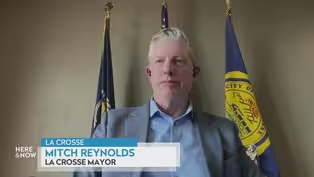
Mayor Mitch Reynolds on Homelessness, Housing in La Crosse
Video has Closed Captions
Clip: S2200 Ep2239 | 8m 32s | Mitch Reynolds on La Crosse's goals to support people experiencing long-term homelessness. (8m 32s)
Retirement Shakes Up 2025 Wisconsin Supreme Court Race
Video has Closed Captions
Clip: S2200 Ep2239 | 2m 25s | Ann Walsh Bradley announced she won't run for another Wisconsin Supreme Court term. (2m 25s)

Wisconsin School Libraries Navigate Rise in Book Challenges
Video has Closed Captions
Clip: S2200 Ep2239 | 8m 14s | Organized campaigns to ban books in Wisconsin's school libraries have grown considerably. (8m 14s)
Providing Support for PBS.org
Learn Moreabout PBS online sponsorship
- News and Public Affairs

Top journalists deliver compelling original analysis of the hour's headlines.

- News and Public Affairs

FRONTLINE is investigative journalism that questions, explains and changes our world.












Support for PBS provided by:
Here and Now is a local public television program presented by PBS Wisconsin