
At Glencoe Mill
Season 2 Episode 2 | 24m 50sVideo has Closed Captions
David Holt meets with bluegrass legends.
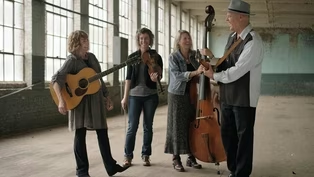
David meets bluegrass legend Alice Gerrard, fiddler Rayna Gellert, and singer-songwriter Laurelyn Dossett at a 19th-century cotton mill to play traditional mill songs and share stories.
Problems playing video? | Closed Captioning Feedback
Problems playing video? | Closed Captioning Feedback
At Glencoe Mill
Season 2 Episode 2 | 24m 50sVideo has Closed Captions
David meets bluegrass legend Alice Gerrard, fiddler Rayna Gellert, and singer-songwriter Laurelyn Dossett at a 19th-century cotton mill to play traditional mill songs and share stories.
Problems playing video? | Closed Captioning Feedback
How to Watch David Holt's State of Music
David Holt's State of Music is available to stream on pbs.org and the free PBS App, available on iPhone, Apple TV, Android TV, Android smartphones, Amazon Fire TV, Amazon Fire Tablet, Roku, Samsung Smart TV, LG TV, and Vizio.
(bright banjo music) ♪ ♪ (mid-tempo fiddle music) - [David Voiceover] Cotton has always been important in the Southern economy.
But it was after the civil war that cotton mills became a major employer for people coming off the farm.
By 1923, there were 350 mills in North Carolina.
One of them was Glencoe Mill, built on the banks of the Haw River in 1880.
And Glencoe, raw cotton was spun, dyed, and woven into fabric.
Men, women, and children worked at the mill tending its spindles and looms.
Wages were low and hours were long.
But it was steady work compared to farming.
The mill was owned by a distant relative of mine, but my branch of the Holt family moved to Texas several decades earlier and we didn't see any of that textile money.
Today, Glencoe Mill and its surrounding village are being restored.
I came to Glencoe to play music and talk with Alice Gerrard, Laurelyn Dossett, and Rayna Gellert.
Three generations of women who are making significant contributions to old time music.
Rayna Gellert grew up in a house filled with traditional music.
Her father, Dan Gellert, is a fine old time fiddler and banjo player.
I met Rayna when she was in college and in 2000 asked her to come on a State Department tour with us to South America.
Laurelyn Dossett is a singer songwriter who is specialized in writing songs for musical theatre with a strong traditional feel.
Her compelling voice gets right to the heart of a song.
I first met Alice Gerrard when she was married to Mike Seeger.
They were a formidable couple, both musically and personally.
In the late 60s, she started performing with West Virgina singer Hazel Dickens, and their soulful, laser-like harmony influenced everybody in folk music.
In fact, Hazel and Alice are credited with being the first female-led bluegrass band.
Now in her 80s, Alice Gerrard is still a force in traditional music.
- [Alice] ♪ Well, I worked in the cotton mill ♪ all o' my life ♪ I ain't got nothin' but a Barlow knife ♪ It's hard times, cotton mill girl ♪ Hard times everywhere ♪ 1915 we heard it said ♪ Move to cotton country and get ahead ♪ Lord, it's hard times, cotton mill girl ♪ Hard times everywhere ♪ Hard times, cotton mill girl ♪ Hard times, cotton mill girl ♪ Hard times, cotton mill girl ♪ Hard times everywhere ♪ From Gilmer to Barts was a long long way ♪ Down Cartacay from the LNJ ♪ Lord, it's hard times, cotton mill girl ♪ Hard times everywhere ♪ Us kids worked 12 hours a day ♪ For 14 cents of measly pay ♪ And it's hard times, cotton mill girl ♪ Hard times everywhere ♪ Hard times, cotton mill girl ♪ Hard times, cotton mill girl ♪ Hard times, cotton mill girl ♪ Hard times everywhere ♪ Lord, when I die don't you bury me at all ♪ Just hang me up on the spinnin' room wall ♪ Pickle my bones with alcohol ♪ It's hard times, cotton mill girl ♪ Hard times, cotton mill girl ♪ Hard times, cotton mill girl ♪ Hard times, cotton mill girl ♪ Hard times everywhere - Now, all of us love traditional music and play traditional music, but didn't grow up in the country or in the mountains.
I'm just curious how each of you first discovered traditional music and fell in love with it.
- [Alice] I went to Antioch College for a while, 'till I dropped out.
And, first heard people sitting around playing guitars and banjos.
- In the 60s, 50s?
- In the 50s, and also somebody turned loose the Harry Smith Anthology of American Folk Music and I just fell madly in love with that.
I just started listening to that music and then I met people who were also listening to traditional music and kinda guiding me down the path of Clarence Ashley as opposed to The Limelighters.
Something like that.
So that's kind of how I got into it.
- Once you get in, you sort of find your tunnel.
- Then I moved to Washington, DC which was a hotbed of country people who had moved up to work in Baltimore.
And kids like myself, who were kinda getting into the music, and there was a big cultural mix.
Lots of bluegrass bands and one thing and another.
People brought their music with them when they moved up from the South to get work.
- It was a real heyday... - [Alice] Yeah, it was really amazing.
- We should really mention about the Harry Smith Anthology, 'cause that was a super big influence on me too.
- [Alice] Lots of people, yeah.
- Harry Smith had put this together in 1952.
Multiple 33 rpm records and they were all from old 78s recorded between 1927 and 1933, so it was like you had access to old 78s you really wouldn't have had access in any other way.
Same here, and it was a variety of stuff.
It was blues, it was Cajun.
It was incredible, wasn't it?
- [Alice] It was everything It was amazing, amazing.
- [David] I think a lot of people were influenced by that thing.
- Oh, I know.
- I wanna talk to you about one of your mentors, Hazel Dickens, somebody you sang with for a long time.
What kinda things did you learn from Hazel?
She wasn't like a formal teacher or anything.
What did you learn?
- Well, none of us learned this music formally from anybody.
But Hazel was one of those people who moved up with her family from West Virginia to Baltimore during the Second World War to get factory work.
She became part of this whole group of people who were getting interested in the music.
And I met Hazel and I listened to her for a long long time before I ever started singing with her.
- What kind of stylistic things did you learn from her?
Or did you add to your repertoire?
- Power.
Kind of trying to get that laser quality in your voice.
It's not breathy, it's very focused vocal.
She was a very soulful singer.
She bent notes in certain ways.
I just absorbed that, I think.
Calling Me Home I wrote, inspired by all the people that I spent so much time with to kind of pay tribute to their generosity and their music and their lives.
♪ An old friend lay on his dying bed ♪ Held my hand to his boney breast ♪ And he whispered low as I bent my head ♪ Oh, they're calling me home ♪ They're calling me home, I know ♪ You'll remember me when I'm gone ♪ Remember my stories, remember my songs ♪ I'll leave them on earth, sweet traces of gold ♪ Oh, they're calling me home, they're calling me home ♪ So friends gather 'round and bid me goodbye ♪ My body's bound but my soul shall fly ♪ My little light shining from the sky ♪ Oh, they're calling me home, they're calling me home ♪ My time has come to sail away ♪ I know you'd love for me to stay ♪ But I miss my friends of yesterday ♪ Oh, they're calling me home, they're calling me home - Rayna, now your dad is a great musician, Dan Gellert.
I love his banjo playing and his fiddlin'.
Was that a huge influence on you?
- Yeah, I mean, I was just absorbing that music from the time I was in the womb.
- But a lot of kids, you know, run away from what their parents are doing.
They don't want to have anything to do with it.
But you didn't.
What was it about it that made you think, "that's for me"?
- I think I'm a little bit of a weirdo.
- Stop the camera.
(laughter) - I just always loved it from the time I was a tiny kid I always loved it.
- And then where did you go with it from Indiana, 'cause that's where you're from?
Did you find a group of people that played?
Just listening.
- I was listening, I was playing classical violin and I was obsessed with old time music.
The reason I hadn't been playing it was because I was intimidated by it, because my dad is such an amazing fiddler.
I thought old time music was over my head.
A lot of classical musicians think folk music is very simple.
That really is the first bit of advice I would give to any classical musician is just to see how complex old time fiddling is.
So that you're actually looking for all the sublelty and nuance.
The Swannanoa Waltz is a tune that I wrote when I was in college.
My college, Warren Wilson, which is in Swannanoa, North Carolina.
And I was away from campus, back home in Indiana working during the summer and wrote that tune.
So named it after Swannanoa, the river, the town.
Just because I was missing it there.
(old time waltz music) - Now Laurelyn, songwriting has kinda been your forte, but from a traditional base.
How did that happen?
- I've been thinking as you all have talked about it.
I grew up, my family's from Alabama and I grew up in a fairly traditional, primitive church.
I think the singing and the harmonizing, I love singing harmony.
That's kind of what got me through church five times a week.
(laughter) Well, it wasn't always five times a week, but it was a lot.
So I think that it was an easy transition into folk music with the harmonies and some sort of familiarity of the chord patterns and the songs.
It just felt like home to fall into that music.
I went to Penn State.
Lynn Morris had a band in central Pennsylvania at the time called Whetstone Run.
I used to go hear them in college and kinda got the bug a little bit that way, and then when we moved south, I started hearing old time music and loved it.
- And kind of writing your songs a little bit in that fashion.
- Yes, partly just because it was what I was absorbing and then partly from some of the work I've done with theatre, where that's the job to kind of set time and place.
So the songs need to sound of the region and of the time.
- Leaving Eden is a great song.
Tell us about that.
- I wrote Leaving Eden when they closed the last textile mill in Eden, North Carolina which is just north of where I live in Greensboro.
At the time, my children were still young and still at home.
I just remember thinking about the people that lived in Eden and what they would do in a town with no jobs and what I would do.
Would I stay?
'Cause to stay in the home place and try to keep the home fires going or would I leave to find a better future.
And I thought I was probably a leaver and I wrote that song.
♪ Hush now, don't you wake up ♪ We'll be leaving at first light ♪ Mama's buying you a mockingbird ♪ To lull you through the night ♪ We'll cross the Dan by mornin' ♪ Here's a blanket for you to share ♪ They're buildin' down in Georgia ♪ Daddy hears we'll find work there ♪ And the mockingbird can sing ♪ Like the crying of a dove ♪ And I can't tell my daughters ♪ All the things that I'm scared of ♪ But I am not afraid of that bright glory up above ♪ Dyin's just another way to leave the ones you love ♪ The ones you love ♪ No work for the workin' man ♪ Just one more empty mill ♪ Hard times in Rockingham ♪ Hard times harder still ♪ Crows are in the kitchen ♪ The wolves are at the door ♪ Our fathers' land of Eden ♪ Is paradise no more ♪ And the mockingbird can sing ♪ Like the crying of a dove ♪ And I can't tell my daughters ♪ All the things that I'm scared of ♪ But I am not afraid of that bright glory up above ♪ Dyin's just another way to leave the ones you love ♪ My sister stayed in Eden ♪ Her husband's got some land ♪ The agent for the county ♪ Thinks that they can make a stand ♪ It's a hard life a-workin' ♪ With nothing much to show ♪ It's a long life of leavin' ♪ With no where to go ♪ And the mockingbird can sing ♪ Like the crying of a dove ♪ And I can't tell my daughters ♪ All the things that I'm scared of ♪ But I am not afraid of that bright glory up above ♪ Dyin's just another way to leave the ones you love ♪ The ones you love - In the 1920s and 30s, so many people were coming off the farm to work in mills that traditional music changed.
New bands were being formed, like Charlie Poole and the North Carolina Ramblers.
J.E.
Mainer's Mountaineers.
The Dixon Brothers.
The Carolina Buddies.
They were playing mountain tunes, tin pan alley songs, and songs they had made up about mill life.
Now, over a hundred years later, as the mills continue to close, songs are still being written about how mill life and the lives of the mill workers are intertwined.
- Payday At The Mill is a song that I wrote for Tommy Jerrell's daughter, Ardeni Moncus, who lives in Mount Airy, North Carolina, and she used to work at Spencer's hosiery mill there before it shut down.
She love to flat foot dance, and she was a really good flat foot dancer, who, every time Tommy would start a tune she would hit the floor in the kitchen flat footing away.
So that was kind of the spirit of the song.
♪ I got a swing in my walk ♪ I got a song in my talk ♪ I'm a week day workin' woman, weekend queen ♪ A time clock lady with a lazy dream ♪ I ain't got no fancy furs ♪ Diamond rings or silks ♪ I'm just alright for Saturday night ♪ It's payday at the mill ♪ It's eight hours sewing up collars and sleeves ♪ The pay's too little and I gotta live cheap ♪ So I stitch and I sew, I sew and I stitch ♪ And all I get's tired while the boss gets rich ♪ But look out now, I'm counting the hours ♪ 'Till I break outta this old jail ♪ I'm just alright for Saturday night ♪ It's payday at the mill, Rayna (old time fiddle) ♪ Hard to be a workin' woman in a boss man's world ♪ If I slow down they'll find another girl ♪ Saturday's comin' and the only time I'll keep ♪ Is to the rhythm and the beat ♪ Fancy duds, fancy shoes ♪ Good times a'workin' (music drowns out lyrics) ♪ I'm just alright for Saturday night ♪ It's payday at the mill, David (dobro) ♪ Now there's some weary mornings at quarter to six ♪ When I wish I had a man to bring a pay check in ♪ But you can't have it all, you can't disagree ♪ That I come when I want, go when I please ♪ So fast step, the good ole boys ♪ I'm kicking up my heels ♪ I'm just alright for Saturday night ♪ It's payday at the mill ♪ I'm just alright for Saturday night ♪ It's payday at the mill Woo, yeah.
(laughter) (old time music) - [Announcer] David Holt's State of Music is available on DVD.
Music from the program is available on CD.
To order, visit shoppbs.org or call 1-800-Play-PBS [slide whistle and spring boing] ♪
Episode 2 Preview | At Glencoe Mill
Video has Closed Captions
Preview: S2 Ep2 | 30s | Alice Gerrard, Rayna Gellert, Laurelyn Dossett and David Holt at a 19th-c. cotton mill. (30s)
Providing Support for PBS.org
Learn Moreabout PBS online sponsorship













Support for PBS provided by: