
Doyle Lawson and the St. John Unity Choir
Season 2 Episode 6 | 24m 50sVideo has Closed Captions
Visit with the legendary Doyle Lawson, and hear music from the St. John Unity Choir.
David checks in with Doyle Lawson and Quicksilver and gets some stories from Doyle’s years on the road; also, a visit to the St. John AME Zion Church in Kinston, North Carolina, where the Unity Choir performs.
Problems playing video? | Closed Captioning Feedback
Problems playing video? | Closed Captioning Feedback
Doyle Lawson and the St. John Unity Choir
Season 2 Episode 6 | 24m 50sVideo has Closed Captions
David checks in with Doyle Lawson and Quicksilver and gets some stories from Doyle’s years on the road; also, a visit to the St. John AME Zion Church in Kinston, North Carolina, where the Unity Choir performs.
Problems playing video? | Closed Captioning Feedback
Where to Watch David Holt's State of Music
David Holt's State of Music is available to stream on pbs.org and the PBS app.
(bright banjo music) ♪ ♪ - One, two, three, four, ♪ Let's have us a talk, sit down Wilma Walker ♪ I've got some land ♪ And a cabin with a front yard needing flowers ♪ I'm a good man, I'll do everything I can in my power ♪ It don't sound like very much, but I own it all ♪ And I'll share it all with you, darling it's your call ♪ Hey, Wilma Walker, will you marry me?
♪ I ain't got much to offer, thank God love is free ♪ Wilma Walker, will you marry me?
♪ I work hard, but I'll tell you ♪ There is more in life than money ♪ So, here's my heart, could that be enough for you honey?
♪ I promised your daddy I'll take care of you ♪ And I'll swear it on the Bible if you want me to ♪ Hey, Wilma Walker, will you marry me?
♪ Let's have some sons and daughters, make a family ♪ Wilma Walker, will you marry me?
♪ We can help each other get around in our old age ♪ But it all depends on how you answer me today ♪ Hey, Wilma Walker, will you marry me?
♪ I ain't got much to offer, thank god love is free ♪ I love you and you wanna answer yes indeed ♪ Wilma Walker, will you marry me?
♪ Wilma Walker, will you marry me?
- Doyle Lawson has been a driving force in bluegrass music for over fifty years.
He's a mandolin virtuoso, who's played with some of the very best: Jimmy Martin, J.D.
Crowe, and The Country Gentlemen.
As the leader of his own band, Doyle Lawson & Quicksilver, he's taught many aspiring bluegrass musicians the value of rock solid rhythm and tight harmony singing.
And what it means to be a professional.
- Doyle, you grew up around Kingsport, Tennessee -- - Yep.
- And, uh, when you were five, you heard bluegrass for the first time.
- Well, we were like all other families, we listened to the Opry on Saturday night.
- Sure - And I heard Bill Monroe & The Bluegrass Boys.
I didn't know who it was, obviously, and well, I asked my mother, she told me who it was, and I was so intrigued by the mandolin, and then that high voice.
I said that's, that's what I want to do when I grow up, and -- - At five?
- At five.
- That's great.
- Never changed my mind.
- Well, now you've had the good fortune of having Jimmy Martin be your neighbor, and so at fourteen you went over to learn some mandolin from him.
- Well, Jimmy was from that area, of course he was already gone.
And he left and, we were living in Hancock County where my dad was from.
And Sneedville being the county seat.
But, he would come home for Christmas.
His brother-in-law lived on the next farm up from ours.
And he saw that I was playing music, and he asked me if I'd to like go meet Jimmy when he came home from Christmas.
So, in 1958, Christmas, I got to meet Jimmy, and he kinda took me under his wing, and he gave me some pointers about, well, I was playing mandolin then, and, I couldn't it play fast and he said, well, you're playing with your stiff arm, and he showed me how to use my wrist.
And to keep my hand and my fingers close to the finger board so I wouldn't play lazy or late.
And he said, go home and practice tremolo.
Don't try, don't worry about your left hand.
Practice two to three weeks, and then start playing.
I did that and when I went to start playing again, it was from here out and I could never play in any other way.
What he said was, he said, I learned this from Bill.
And, cause he worked for Monroe for five years.
He said, I learned this from Bill, and I'm gonna show it to you.
- Wow, nice.
- So, indirectly, I got my wrist action from Mr. Bill.
- And you played with J.D.
Crowe, you played with, The Country Gentlemen at the time that they were just the king of the heap at that point.
- Well, I had a good fortune, David, to, to step in and be able to land a job with, with J.D.
who was at the top of his game in his nearly 60s.
And, February 3rd, officially, in 1963, was when I went to work as a pro.
And I assumed after six or seven months, I was a little disillusioned about the whole thing, because I'm an 18-year-old, barely turned 19.
And I wasn't prepared, I don't think, as well as I should have been, because I never traveled with a professional group.
And I was pretty much in awe of the whole thing, and a little intimidated about it, I think, and, but, but I left Jimmy and I wound up in Kentucky.
I played around Louisville, local stuff, but J.D.
Crowe and I were teaching a guy banjo, he'd take lessons from me in Louisville, and go to Lexington to take a lesson from J.D., and I asked him one time, I said, you're sure that you're taking lessons from there?
He's going right down there and asking J.D.
if I'm teaching you right.
- But, anyway, but J.D.
kept saying, well, tell him to come down, I'd like to meet him, and so, one weekend I had a free weekend, I went down, and we just immediately hit it off.
Became friends.
I sat in and played guitar that night, and then shortly after, he called wanting to know if I'd fill in for his guitar player.
And that fill in position with him lasted five and a half years.
- Wow.
What made you finally decide to leave the Country Gentlemen and go on your own?
- If I wanted to try something, I wanted, I didn't want to say, well, I can't do that, because the people won't like what I'm doing, you know, I didn't want to be one dimensional or two, I wanted to have total freedom.
- Well, you do a lot of modern songs.
You don't just do traditional songs at all.
- Well, no, it's not where the song comes from, it's the treatment of songs.
I don't, you know, I take songs from everywhere, you know, my last album had an old Ames Brothers song, called You, you, you that was popular in the early 50s.
And I love harmonies, you know, I'm a big fan of the Ames Brothers, The Sons of the Pioneers, obviously, and groups like that.
I'm a harmony freak, you know, but I've never let where the song comes from stand in my way.
- How do you think the black gospel music affects the Anglo bluegrass gospel?
- One of the earliest records, I remember my dad bringing home was a song called Let's Talk About Jesus by The Bells of Joy.
And I wore that, I think it was on the Peacock label, I wore that thing, the grooves, I'd have to put it in one spot for it to, where I could understand it, but I wore it out, you know, and I, listen, I've got it now.
I went and looked for it and I found it, and now I've got that record, you know, and, uh -- - You do a good bit of that material.
- I do, and when I was a kid in Kingsport there, there used to be a black quartet which would come visit our church.
- My dad and his quartet would go visit theirs, and I don't remember who they were but, I do remember that, you know, and so, the differences in the music was ever a barrier for me.
- Yeah.
- I don't understand it, and I love all kinds of music.
I hate racket and their style, but, there's probably something like it out there, but music is, anywhere from Dixieland, to James Cohen, Repelli, the big band music, the gospel music, both black and white, southern gospel, country gospel, bluegrass, bluegrass country.
- You love it all.
- I like it all.
- I just, I've never, I enjoy music.
Music is lifting, it's uplifting, it lifts your spirits, you know.
Why would anybody put themselves, well I'm not going to listen to that, and I'm not going to this.
I only listen to this.
In my opinion, and it's my humble opinion, people are missing a lot of joy.
♪ Brother, have you heard ♪ Have you heard about the world ♪ They're coming to an end, Lord, a mighty end ♪ Brother, have you heard ♪ Have you heard about the world ♪ They're coming to an end, Lord, a mighty end ♪ Son will be running from door to door, my lord ♪ They won't have no place to go ♪ Brother have you heard ♪ Have you heard about the world ♪ A-coming to an end, Lord, a mighty end ♪ Sister, have you heard ♪ Have you heard about the world ♪ They're coming to an end, Lord, the mighty end ♪ Sister, have you heard ♪ Have you heard about the world ♪ Coming to an end, Lord, a mighty end ♪ Some will be crying for the rocks to fall ♪ There won't be no help at all ♪ But sister, have you heard ♪ Have you heard about the world ♪ Coming to an end, Lord, a mighty end ♪ Mother, Mother, have you heard ♪ Have you heard about the world ♪ A-coming to an end, Lord, a mighty end ♪ But Mother, have you heard ♪ Have you heard about the world ♪ A-coming to an end, Lord, a mighty end ♪ On that final judgement day ♪ My Lord, it'll be too late to pray ♪ Mother, have you heard ♪ Have you heard about the world ♪ A-coming to an end, Lord, a mighty end ♪ Well, Father, have you heard ♪ Have you heard about the world ♪ A-coming to an end, Lord, a mighty end ♪ Well, Father, have you heard ♪ Have you heard about the world ♪ A-coming to an end, Lord, a mighty end ♪ All of us same, Lord, rise to fly ♪ To meet Jesus in the sky ♪ Well, Father, have you heard ♪ Have you heard about the world ♪ A-coming to an end, Lord, a mighty end ♪ Deacon, have you heard ♪ Have you heard about the world ♪ They're coming to an end, Lord, a mighty end ♪ Deacon, have you heard ♪ Have you heard about the world ♪ A-coming to an end, Lord, a mighty end ♪ Some will be running from door to door, my lord ♪ They won't have no place to go ♪ Deacon, have you heard ♪ Have you heard about the world ♪ A-coming to an end, Lord, a mighty end ♪ Preacher, have you heard ♪ Have you heard about the world ♪ A-coming to an end, Lord, a mighty end ♪ Preacher, have you heard ♪ Have you heard about the world ♪ A-coming to an end, Lord, a mighty end ♪ Some will be running from door to door, my lord ♪ They won't have no place to go ♪ Preacher, have you heard ♪ Have you heard about the world ♪ A-coming to an end, Lord, a mighty end ♪ Blessed assurance ♪ Jesus is mine ♪ O what a foretaste ♪ Of glory divine ♪ Heir of salvation ♪ Purchase of God ♪ Born of His Spirit ♪ Washed in His Blood ♪ This is my story ♪ This is my song ♪ Praising my Savior ♪ All the day long ♪ This is my story ♪ This is my song ♪ Praising my Savior ♪ All the day long ♪ Perfect submission ♪ All is at rest ♪ I in my Savior ♪ Am happy and blessed ♪ Watching and waiting ♪ Looking above ♪ Filled with His goodness ♪ Lost in His love ♪ This is my story ♪ This is my song ♪ Praising my Savior ♪ All the day long ♪ This is my story ♪ This is my song ♪ Praising my Savior ♪ All the day long ♪ Amen - This is the Unity Choir of St. John AME Zion Church.
They're not a show choir.
They sing for the congregation every Sunday morning in Wilson, North Carolina.
Now the church's musical director is Bill Myers.
On Saturday nights, Bill leads his secular band The Monitors.
With members that've played with James Brown, The Monitors can play any type of music from funk to gospel.
Talk about the different kinds of black gospel that we can, that we're gonna hear today.
- The man who's given credit as being the father of gospel music.
was a man named Thomas A. Dorsey.
- Right, Flaming Tampa Reds.
- You know what he did, he was a blues writer at first.
- Right.
- But then he wrote his, a song called, Precious Lord, Take My Hand, which has become very, very popular over years.
But that kind of music has stayed with the church.
But even after that kind, here comes other people, like Andrae Crouch and some others who said, we gonna alter this a little bit.
Little bit more rhythm again, we're gonna alter some of the chords.
And people have named that contemporary gospel music.
And that's been my dilemma as minister of music, is trying to keep a balance in the church, now.
As what people who want to still hear the old-time hymns, and the people who want to do the style of Kirk Franklin and some others on this.
And I'm very careful to not to try to tell people how to worship, that's not my job.
If this is what makes you praise, this kind of music, then I, as the minister of music, will provide some of that.
But, at the same time, I want you to remember where it came from.
- Now, you have been in a group called The Monitors, which is very famous around North Carolina.
You play all sorts of music.
- The Monitors were organized in 1957, by myself and my housemate at the time, a fella named Cleveland Flow who is now passed away.
But we wanted a band that would be different from others bands that were playing at that time.
Bands would either play country, they'd play rock n' roll, or whatever like this, and they could only do one type of thing.
But we wanted a band that would have some, would be versatile.
As someone came up and said, I want to hear polka.
I want a cha-cha.
I want a piece by Mozart, you know, whatever, you know, let's do this.
- And you'd do it, huh?
- I want to do this for you, that we're gonna have that kind of musicality here.
That kind of expertise that we can play any kind of music that you want.
- I bet a lot of people out there would be surprised to hear that some of your band members who were in the church band and in The Monitors played with James Brown.
- Yes, our drummer, Sam Lathan, played with James Brown for several years.
Dick Knight played first trumpet player, he was his first trumpet player.
Dick's originally from Miami, but got with James Brown through Nat Jones, who was the musical director for James Brown, and Jones hired Dick and Sam.
They went on the road together and stayed for many years.
- Now how do you think that The Monitor sound has affected the gospel music?
- Well, we try to have some separation, but it's hard, you know.
You can't, it's in your mind sometimes, and when you're playing some chords on the keyboard to something like this, and instead of playing it straight up like, I'll give you an example, like a C major chord would be C, E, G, something like that with a C major chord, that you think of maybe adding a sixth to it, which it gives it a little more flavor, so it now becomes C, E, G, A, in this, which gives it a little, if I were to use the word jazzy flavor, a little bit.
Instead of just plain chords, we're now doing extended chords.
- How about the rhythm?
I would think that would be pretty important.
- Rhythm so much, yes, indeed.
I had an incident another time when I was playing at another church, and then lady said, play Blessed Assurance.
So I played it exactly as it was in the book And the lady said, Mr. Myers, you aren't playing that song right.
And I said, I think I am, I mean it's in the key of D, I'm playing it what I see.
So she said, make it louder!
Yeah, and no problem, I can pull out some stops here, and make it louder, so I lined them up, you know, she said, no, that's still not right.
She said, can't you kinda jig it up a little bit, or something like that?
I said, I think I can jig it up for you, I guess.
So I jigged it up for her, that was her words, can you jig it up some?
I put some more rhythm to the song, she said, that's it, that's it, that's what we want!
She said,that's the way we worship over here.
- We always hear about musicians who have a Saturday night gig and a Sunday morning service.
But you're one of the few that really do.
- I played many, many Saturday nights.
Two, three, four o'clock in the morning.
But I had this sense of obligation that I need to be at church on a Sunday.
If I can play in the club that late, I need to be at church Sunday morning.
And so, that's what did, I made a point to do that.
That I provide the music in church as I provide it for the folks who were doing the shag at the club.
- What is it, what is the key element about keeping a choir together?
- I don't have no professional singers.
These people who worked in offices, some school teachers, some bus drivers, these people come from all walks of life, but what they have in common is they love this church, they love the Lord, and they want to come and praise together, and they do it through song.
- Bill, you're a wonderful keyboard player, but I know the saxophone is your main instrument.
And I know that each instrument has its own feel and changes the feel of the tune when you play it.
Could you play us something?
- Sure, sure.
This particular saxophone I'm going to play is a soprano saxophone.
It's become quite popular right now, I think, Kenny G is probably one who's made the resurgence possible.
But, people long time ago like Sidney Bichet and others played this instrument a long time ago.
So, it's come back and I'm happy to do it.
So occasionally I play this in church.
And I'll play a tune here for you, this is an old piece, Amazing Grace.
- Sure.
- This gives it another little flavor.
- Something different in church, it says, praise the lord with these symbols, the hops, and everything else.
We praise it with the saxophone.
♪ I must confess ♪ Lord, I've been blessed ♪ But yet my soul's not satisfied ♪ Renew my faith ♪ Restore my joy ♪ And dry my weeping eyes ♪ Oh, Lord ♪ Take me back ♪ Oh, Lord ♪ Take me back ♪ To the place ♪ Where I first received you ♪ Oh, Lord ♪ Take me back ♪ Take me back ♪ Where I first believed ♪ I tried so hard ♪ To make on my own ♪ I need your help ♪ Just to make it home ♪ Take me back, oh Lord ♪ Take me back ♪ Well, I got to get back, Lord ♪ To the place ♪ Where I first received you ♪ Take me back ♪ Take me back ♪ Where I first believed ♪ Oh, take me back, Lord ♪ Take me back ♪ Take me back ♪ To the place where I first received you ♪ Take me back ♪ Take me back ♪ Where I first believed ♪ Take me back, Lord ♪ Take me back ♪ Got to get back, Lord ♪ Take me back, oh Lordd ♪ To the place where I first received you ♪ Take me back, Lord ♪ Take me back ♪ Take me back, Lord ♪ Take me back, oh Lord ♪ Where I first believed ♪ Oh, I got to get back, Lord ♪ Take me back ♪ Take me back, oh Lord ♪ To the place where I first received you ♪ Take me back, Lord ♪ Take me back ♪ Take me back, oh Lord ♪ Where I first believed (audience cheers) ♪ Take me back ♪ Take me back, oh Lord ♪ Where I first believed ♪ Take me back ♪ Take me back, oh lord ♪ To the place where I first received you ♪ Take me back ♪ Take me back, oh Lord ♪ Where I first believed - [Male announcer]: David Holt's State of Music is available on DVD.
The music from the program is available on CD.
To order, visit shopPBS.org, or call 1-800-PLAY PBS.
[slide whistle and spring boing] ♪
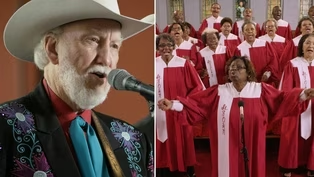
Episode 6 Preview | Doyle Lawson & The St. John Unity Choir
Video has Closed Captions
Preview: S2 Ep6 | 30s | A visit with the legendary Doyle Lawson, and music from the St. John Unity Choir. (30s)
Providing Support for PBS.org
Learn Moreabout PBS online sponsorship
- Arts and Music

Art21 showcases today's contemporary visual artists and their groundbreaking creations.







 New Episode



Support for PBS provided by: