
Bruce Molsky and Balsam Range
Season 1 Episode 4 | 24m 54sVideo has Closed Captions
Enjoy Holt’s performance with Bruce Molsky and his interview of Balsam Range.
Enjoy Holt’s performance with fiddle virtuoso Bruce Molsky and his interview of bluegrass supergroup Balsam Range.
Problems playing video? | Closed Captioning Feedback
Problems playing video? | Closed Captioning Feedback
Bruce Molsky and Balsam Range
Season 1 Episode 4 | 24m 54sVideo has Closed Captions
Enjoy Holt’s performance with fiddle virtuoso Bruce Molsky and his interview of bluegrass supergroup Balsam Range.
Problems playing video? | Closed Captioning Feedback
How to Watch David Holt's State of Music
David Holt's State of Music is available to stream on pbs.org and the free PBS App, available on iPhone, Apple TV, Android TV, Android smartphones, Amazon Fire TV, Amazon Fire Tablet, Roku, Samsung Smart TV, LG TV, and Vizio.
Providing Support for PBS.org
Learn Moreabout PBS online sponsorship[banjo playing peppy old-time tune] ♪ ♪ ♪ [meandering bass riff] ♪ If you wanted to find the oldest folk music still being performed in America today, you'd have to find ballad singers.
And of all the old traditions, ballad singing is the one most in danger of dying out because it's not fast or flashy or even very rhythmic, but it's full of soul and goes all the way back to the British Isles.
See, the English and Scotch-Irish brought their old story songs with them to America.
They were usually sung unaccompanied and solo.
The old-timers would use these songs whether they were workin' in the fields or sittin' around the fireplace at night.
Now, in 1916, English folklorist Cecil Sharp heard there were English ballads still being performed in the southern mountains of America, and when he got here, he found that one of the best places to find these old ballads was right here in Madison County, North Carolina.
Now, the old singers I used to know, like Dellie Norton and Cas Wallin, are long gone, but there's a new generation of singers in this small community carrying on this rare tradition.
Josh Goforth is from this part of North Carolina and related to all these folks.
Now, I first met Josh when he was 12 years old and a good musician then, but since that time, he's developed into one of our great traditional musicians.
He excels on fiddle, mandolin, guitar, and banjo, but he's also learned to sing these old, ornate, unaccompanied ballads.
Now, Josh, when did you first hear those old ballads?
I guess when I was five years old.
My granddad, he would take us out to the fields to work, and my grandfather, as he would plant rows of tobacco, he would sing these old songs-- love songs, as he called 'em.
They were long, so you had a chance to do a lotta work.
Absolutely, it made the time pass really quick.
Why do you think they survive so much in Madison County, particularly in Sodom Laurel and Lonesome Mountain?
I think all these communities were so secluded and people rarely traveled out, so I think the closeness of the community.
It was so tight-knit.
Everyone knew everyone, and everyone got together to play music and sing.
So it was just natural that other people picked it up in the community, and it survived.
I'd like you to sing one of those old, sorta quirky ballads the old-timey way.
Yeah, lemme sing one that I learned from Sheila Kay Adams, and she learned it from Dellie Norton in Sodom.
It's called "Young Emily," and it's got those twists and turns like you're talkin' about, so-- ♪ Young Emily was a pretty, fair miss♪ ♪ She loved the driver boy♪ ♪ Who drove a stage through the Golden Gate♪ ♪ Way down in the lowlands low♪ ♪ Young Edmund took to drinkin'♪ ♪ From drinkin' to sleep♪ ♪ He did not know they swore last night♪ ♪ That they'd cut off his head♪ ♪ It's fish that swam in the ocean♪ ♪ Swim o'er my true loves breast♪ ♪ It rocks him in a gentle motion♪ ♪ And I hope his soul's at rest♪ That's a powerful kinda singin'.
Absolutely.
Cas Wallin used to tell me he would go out and sing to the mountains as loud as he could.
Yeah, there's a wonderful sound that you get by singin' in those hollers and hills.
Yeah, now, when the instruments came in the mountains, a lotta people took those ballads and sorta straightened 'em out by adding chords and rhythm with the instruments, and you learned a very unusual banjo style-- tell us about that-- that fit those.
I did; one of my friends, Jerry Adams, who grew up in Sodom there, he played a very unique two-finger banjo style.
And he took many of the ballads that were just a little bit less ornamented and kind of straightened those out, as you say, and, you know, put the timing to the music, and it worked out really, really well.
[banjo leading easy tune] ♪ ♪ ♪ As we march down to Fennario♪ ♪ As we march down to Fennario♪ ♪ Our captain fell in love with a lady like a dove♪ ♪ And the name she was called was Pretty Peggy-o♪ ♪ Come along and go with me♪ ♪ Pretty Peggy-o♪ ♪ Come along and go with me♪ ♪ Pretty Peggy-o♪ ♪ 'Cause in coaches your shall ride♪ ♪ With your true love by your side♪ ♪ Just as grand as any lady in the are-a-o♪ ♪ ♪ You're the man that I adore♪ ♪ Sweet William-o♪ ♪ You're the man that I adore♪ ♪ Sweet William-o♪ ♪ You're the man that I adore♪ ♪ But your fortune, it's too small♪ ♪ I'm afraid my mother would be angry-o♪ ♪ Well, if ever I return♪ ♪ Pretty Peggy-o♪ ♪ If ever I return, Pretty Peggy-o♪ ♪ If ever I return♪ ♪ Then your city I will burn♪ ♪ And destroy all the ladies♪ ♪ In the are-a-o♪ ♪ ♪ ♪ ♪ Come trippin' down the stairs♪ ♪ Pretty Peggy-o♪ ♪ Come a-trippin' down the stairs♪ ♪ Pretty Peggy-o♪ ♪ Come trippin' down the stairs♪ ♪ Combin' back your yeller hair♪ ♪ Bid a last farewell to Sweet William-o♪ ♪ 'Cause our captain, he is dead♪ ♪ Pretty Peggy-o♪ ♪ Our captain, he is dead♪ ♪ Pretty Peggy-o♪ ♪ Our captain, he is dead,♪ ♪ And he died for a maid♪ ♪ And he's buried in Louisiana country-o♪ ♪ (Holt) Ballads are songs that tell a story, and it's always been kinda funny to me that even though these old stories were filled with murder and mayhem, the old folks call these love songs-- heh!
(Goforth) It's the classic formula for ballads.
You know somebody's gotta die.
That's right.
In fact, there's one ballad I learned from Steve Rice over in Sodom, North Carolina, called "Lily of the West."
Now, in this song, boy meets girl and falls in love, girl meets richer boy and falls in love, boy gets jealous and kills richer boy, and then boy gets thrown into prison.
So a story like this was very, very popular in the British Isles, in fact, so popular that the troubadours in the 1700s had the lyrics printed on broadsides.
That's the way the song made its way around the country.
Yeah, it actually made it to this country.
Now, all the place names changed, but the story remained the same.
[moderate guitar plucking] ♪ ♪ When first I come to Louisville♪ ♪ Some fortune there to find♪ ♪ I spied a fair young maiden there♪ ♪ And she was pleasing to my mind♪ ♪ Her rosy cheeks, her ruby lips♪ ♪ They like arrows pierced my breast♪ ♪ And the name she bore was Flora♪ ♪ The Lily of the West♪ ♪ I courted lovely Flora♪ ♪ Some pleasure there to find♪ ♪ But she turned unto another man♪ ♪ Which sore distressed my mind♪ ♪ She robbed me of my liberty♪ ♪ And deprived me of my rest♪ ♪ Then go, my lovely Flora♪ ♪ The Lily of the West♪ ♪ ♪ Now, way down yonder in the shady grove♪ ♪ Oh, a man of high degree♪ ♪ Conversin' with my Flora there♪ ♪ It seemed so stange to me♪ ♪ And the answer that she gave him♪ ♪ It sore did me oppress♪ ♪ I was betrayed by Flora♪ ♪ The Lily of the West♪ ♪ So I stepped up to my rival♪ ♪ Oh, my dagger in my hand♪ ♪ I seized him by his collar♪ ♪ And I boldly bade him stand♪ ♪ Being mad to desperation♪ ♪ I pierced him in the breast♪ ♪ Then go, my lovely Flora♪ ♪ The Lily of the West♪ ♪ ♪ ♪ ♪ ♪ I had to stand my trial♪ ♪ Oh, I had to make my plea♪ ♪ They placed me in a criminal box♪ ♪ And they then said they'd stone me♪ ♪ Although she swore my life away♪ ♪ And deprived me of my rest♪ ♪ I still love faithless Flora♪ ♪ The Lily of the West♪ ♪ When the early settlers came to America, they began writing their own ballads about things that were happening here, like this song based on an actual incident in St. Louis in 1895.
Yet I was able to collect a version of the song a hundred years later in Surry County, North Carolina: "Stagger Lee."
[leading] ♪ [harmonizing] ♪ Somewhere in the alley♪ ♪ I heard a bulldog bark♪ ♪ Musta been old Stagger Lee♪ ♪ Just shootin' in the dark♪ ♪ He's a bad man♪ ♪ That cruel Stagger Lee♪ ♪ Billy Lyons in the barroom♪ ♪ Just talkin' to his friend♪ ♪ Barroom door swings open, old Stagger Lee steps in♪ ♪ He's a bad man♪ ♪ That cruel Stagger Lee♪ [improvising] ♪ ♪ Oh, Stagger Lee, Stagger Lee♪ ♪ Please don't take my life♪ ♪ I got two little children♪ ♪ And a darlin', lovin' wife♪ ♪ He's a bad man♪ ♪ That cruel Stagger Lee♪ ♪ Oh, gotta take care o' your children♪ ♪ I'll take care o' your wife♪ ♪ You stole my brand new Stetson♪ ♪ And I'm bound to take your life♪ ♪ He's a bad man♪ ♪ That cruel Stagger Lee♪ [improvising] ♪ ♪ Oh, Stagger Lee shot Billy Lyon♪ ♪ What do you think of that?♪ ♪ Shot him through the heart♪ ♪ 'Cause he stole his Stetson hat♪ ♪ He's a bad man♪ ♪ That cruel Stagger Lee♪ ♪ Well, they took him to the gallows♪ ♪ Tied his hands behind his back♪ ♪ They pulled the trap on Stagger Lee♪ ♪ But his neck refused to crack♪ ♪ He's a bad man♪ ♪ That cruel Stagger Lee♪ ♪ [mellow bass riff] ♪ (Holt, voice-over) We're in the 18th-century Moravian village of Old Salem, North Carolina.
That's not a place you'd expect to hear great black gospel music, but Old Salem is the home of St. Philips African Moravian Church.
St. Philips was built in 1861.
It's the oldest standing African-American church in North Carolina and one of the oldest in the country.
Now, it has great acoustics, so people like to use it for musical performances.
It was here that I first heard the soulful gospel music of the Branchettes.
The Branchettes are Lena Mae Perry and Wilbur Tharpe.
Their style and repertoire have roots in the congregational hymn singing in the holiness church, where the music comes from the depths of your soul.
(Lena Mae Perry) ♪ I'll tell of the Savior♪ ♪ I'll tell of, oh♪ ♪ His favor, oh-ho!♪ ♪ I'll tell it, yeah, wherever♪ ♪ Wherever I go♪ [rollicking gospel piano accompanies] ♪ I love Him♪ ♪ I adore Him♪ ♪ A good life, oh♪ ♪ I'll show Him, oh-ho!♪ ♪ I'll tell it, yeah, wherever♪ ♪ Wherever I go♪ ♪ Oh, oh!♪ ♪ If I was dying♪ ♪ With just one word to say♪ ♪ I'd speak it for Jesus♪ ♪ I'd breathe my life away♪ ♪ Oh, He'll be there♪ ♪ Come on and meet me there♪ ♪ I'm going to that place where He's prepared♪ ♪ I'll tell it, hey, wherever♪ ♪ Wherever I go♪ ♪ Oh, oh!♪ ♪ If I was dying♪ ♪ With just one word to say♪ ♪ I'd speak it for Jesus♪ ♪ Then I'd breathe my life away♪ ♪ Oh-oh-oh♪ ♪ He'll be there♪ ♪ Come on and meet me there♪ ♪ I'm going to that place where He's prepared♪ ♪ I'll tell it,♪ ♪ Oh, wherever♪ ♪ Wherever I♪ ♪ Go, oh, oh, oh, oh, oh, oh♪ ♪ Yeah, yeah, yeah♪ ♪ Yeah, yeah, yeah, yeah, yeah♪ ♪ Yeahhhs♪ [rising piano conclusion fades] ♪ You guys are so soulful in your music.
I'm just guessing that you both grew up playing music as children.
How 'bout you, Lena Mae?
Yes, I did, uh.
I was a little bitty girl singin' with my sister and my brother, and we used to love goin' to church with our grandparents.
So they would come and pick us up, we'd go to church, and the people would say, "Let those little bitty three sing!
Let 'em sing!
Let 'em sing!"
So all right, we so small, they'd have to stand us up on boxes and buckets or whatever they could stand us up on so that the congregation could see us and hear us sing, and oh, we just loved that!
Now how 'bout you, Wilbur?
How'd you learn to play piano like that?
That's a incredible style, by the way.
It's somethin' that I'm very thankful for, uh.
When I was very, very small, I found out I had an ear, and I could almost mimic a sound whatever you heard, anything, uh...
Listened to the radio quite a lot, so forth, and retaining a lot of stuff, you know.
Were there other people that played that style in your community?
No, but I did hear that type on the radio.
We had a few, yes.
Really?
You picked it up from the radio!
Uh-huh, it would stick-- it would stick just like a tape recorder.
And it was this little store near us-- lady named Mrs. Simmons-- and my mother went to the store, and says, "While your mother and you're over here, why don't you play a tune?"
My mother says, "Oh, he can't play."
She says, "Yes, he can!
Show her, Wilbur."
So I went to the piano and started tryin'.
My mother's eyes got-- "Oh, my goodness!"
You're doing all this by ear, not by reading.
Totally--I never took a lesson in my life.
(Holt) Wow, that's just absolutely amazing.
(Tharpe) I consider it one of God's gifts to me.
(Holt) As you should.
Lena Mae, you were telling me, the music is a healing music for you and for the audience.
How do you choose what songs to sing?
(Perry) Well, David, um, sometimes we, on our way to church, and we try to...think what we're gonna sing today.
(Holt) mm-hm So Wilbur will get the list, and-- and, uh, he'll look at it, "This is what we're singin'?"
I said, "Yeah, I think so."
But once I get into the church and I look around the congregation and I sorta look at the people, and I get a feel that there's something here that they need, and-- "Lord, give me a song that will, you know, "lift up their hearts so these people that are here," uh-- And, see, I just forget about that list, and in my mind, He give me a song to sing... to lift all these burdens and all these weights and thing that's goin' on in the hearts and minds of people.
And so we'll begin to sing, and they'll sit there, and they'll look, but after a while, you can see a different expression on these people face, and deep down on the inside, I said, "Lord...Lord, "we have accomplished what we come here for today."
(Tharpe) That's right.
[bold chords introduce hymn] ♪ [Perry leading] ♪ Je...sus loves me♪ ♪ [Tharpe accompanies] ♪ This I know♪ ♪ ♪ For the Bi, Bible♪ ♪ Tells me so♪ ♪ And little ones♪ ♪ To Him belong♪ ♪ Whoa, oh, they♪ ♪ They are weak♪ ♪ But He♪ ♪ He is strong♪ (Tharpe) ♪ Mmm♪ [Tharpe accompanies] ♪ Yes♪ ♪ Jesus♪ ♪ Loves me♪ ♪ Whoa, oh, oh, yes♪ ♪ Jesus♪ ♪ He loves me♪ ♪ And I'm so thankful, oh, whoa, oh, oh♪ ♪ Yes♪ ♪ Jesus loves me♪ ♪ Yeah♪ ♪ For the Bi...ble tells♪ ♪ Tells me so♪ ♪ [Tharpe accompanies] ♪ He loves me♪ ♪ Yes, He loves me♪ ♪ Whoa, oh, oh, He loves me♪ ♪ Jesus loves me♪ ♪ Whoa, oh, oh, yes♪ ♪ Jesus, he loves me♪ ♪ I'm a witness, witness♪ ♪ He loves me♪ ♪ Yes, He loves me♪ ♪ Whoa, oh, oh♪ ♪ He loves me♪ ♪ Jesus loves me♪ ♪ For the Bible tells♪ ♪ Tells me so♪ [delicate piano cadence concludes tune] ♪ [twanging mouth bow supports melody] ♪ [slapping string] ♪ (male announcer) David Holt's State of Music is available on DVD.
Music from the program is available on CD.
To order, visit shopPBS.org or call 1-800-PLAY-PBS.
♪ My old hen is a good ole hen♪ ♪ She lays eggs for the railroad men♪ ♪ Sometimes a-one, sometimes a-two♪ ♪ Sometimes for the whole damn crew♪ ♪ Cluck old hen, cluck and sing♪ ♪ Ain't laid eggs since late last spring♪ ♪ Cluck old hen, cluck and squall♪ ♪ Ain't laid eggs since late last fall♪ [twanging] ♪ One more time.
(female announcer) More information about David Holt's State of Music is available at pbs.org.
Captioning by Will Halman and C.A.
Satterfield Caption Perfect, Inc. www.CaptionPerfect.com ♪ Yeah.
(woman) Cut.
That was cool.
(man) Very good.
(woman) OK, now we'll reset for Rhiannon.
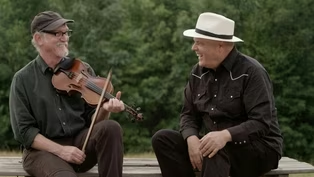
Episode 4 Preview | Bruce Molsky and Balsam Range
Preview: S1 Ep4 | 30s | Enjoy Holt’s performance with Bruce Molsky and his interview of Balsam Range. (30s)
Providing Support for PBS.org
Learn Moreabout PBS online sponsorship













Support for PBS provided by: