
Bryan Sutton and Rhiannon Giddens
Season 1 Episode 2 | 24m 54sVideo has Closed Captions
Holt performs with guitarist Bryan Sutton and breakout star Rhiannon Giddens.
Delight in Grammy-winner Holt’s performances with guitar phenomenon Bryan Sutton and breakout star Rhiannon Giddens of the Carolina Chocolate Drops.
Problems playing video? | Closed Captioning Feedback
Problems playing video? | Closed Captioning Feedback
Bryan Sutton and Rhiannon Giddens
Season 1 Episode 2 | 24m 54sVideo has Closed Captions
Delight in Grammy-winner Holt’s performances with guitar phenomenon Bryan Sutton and breakout star Rhiannon Giddens of the Carolina Chocolate Drops.
Problems playing video? | Closed Captioning Feedback
How to Watch David Holt's State of Music
David Holt's State of Music is available to stream on pbs.org and the free PBS App, available on iPhone, Apple TV, Android TV, Android smartphones, Amazon Fire TV, Amazon Fire Tablet, Roku, Samsung Smart TV, and Vizio.
Providing Support for PBS.org
Learn Moreabout PBS online sponsorship[banjo playing peppy old-time tune] ♪ ♪ ♪ Let's talk about what to call this music that grew up in the Southern mountains: traditional music, mountain music, old-time, bluegrass, hillbilly music, string band music, roots music, folk music.
It's been called all that and more, but no matter what you call it, it's one of our great cultural treasures.
Welcome to the State of Music.
I'm David Holt.
[voice echoing] I've been playing what I call mountain music for the last 40 years-- on my own, in bands, with Doc Watson, on the radio and television, in other countries, and right here at home.
In fact, these are some of the pictures I've taken of my mentors, but I didn't start out here.
It was 1969, and I was in college in California, and the great bluegrass legend Ralph Stanley came and did a concert.
That night changed my life.
I went up and asked him, "Where can I go to learn that old mountain music?"
He said, "Son, you need to go to the Blue Ridge Mountains."
So I traveled all over southern Appalachia and settled in Asheville, North Carolina.
I fell in love with the music and the people and the culture.
Now, in those days, there were still musicians living who were born in the late 1800s.
I found myself in a treasure trove of music, history, and great people, folks like Tommy Jarrell, Byard Ray, Etta Baker, and so many more.
And the music is still going strong today.
I want to introduce you to a few of my friends.
These are people I've played with and been inspired by and are some of the very best in the world of folk and mountain music, and they're some of the people responsible for the healthy state of music today.
And they're carrying it into the future, and I got good news: the future looks bright!
♪ When you think of folk music, you probably think of the guitar.
The guitar became the preeminent instrument of rock and folk music in the 20th century, but the guitar came to the Southern mountains fairly late in the game.
Rural and mountain folks finally got access to guitars when the Sears and Roebuck and Montgomery Ward catalogs began selling them in the early 1900s.
Guitars really changed folk music by adding chords and a steady rhythm.
Before guitars, people would sing the songs unaccompanied or with a banjo or fiddle just playing along with a melody.
Now, of course, there's guitars everywhere now.
There have been some great fingerstyle guitar players, like Merle Travis and Chet Atkins, and fantastic flatpickers, like Doc Watson.
It was Doc Watson who really brought the flatpicking style of guitar into the mainstream.
While working with a local square dance band in Johnson City, Tennessee, in the 1940s, Doc learned to play complex fiddle tunes note for note on his guitar with a flat pick because the band didn't have a fiddler.
The sound caught the ears of guitarists everywhere, and they started to copy Doc's approach.
Since then, there've been many amazing flatpickers: Clarence White, Tony Rice, and Dan Crary, just to name a few.
But one of the very best playing today is Bryan Sutton.
Bryan grew up in western North Carolina and today is a first-call studio musician in Nashville.
You've heard Bryan on hit records with Harry Connick, Jr., Diana Krall, Tim McGraw, Blake Shelton, Ricky Skaggs, and he won a Grammy with Doc Watson.
Bryan is also considered one of the best in the bluegrass world.
I feel fortunate to work with Bryan and with T. Michael Coleman in our group Sutton, Holt and Coleman.
[gentle guitar picking] Today, Sutton, Holt and Coleman are going to do a live radio show with Martin Anderson at WNCW in Spindale.
It's one of the best radio stations for traditional music.
[easy bass, guitar, and banjo tune] ♪ [male vocalists harmonizing] ♪ Feel like cryin'♪ ♪ S ince she's gone♪ ♪ Feel like cryin' since she's gone♪ ♪ She's solid gone♪ ♪ [quiet, indistinct dialogue] (man) I'm Martin Anderson down in Studio B.
We've got Sutton, Holt and Coleman live here.
It's Bryan Sutton; it's David Holt.
It's T. Michael Coleman all here together.
Welcome, guys.
What do you wanna start off with here?
This is a great Doc Watson song, also from Wade Mainer, and it's "The Train That Carried My Girl From Town."
One, two, three, four.
[animated bluegrass tune] ♪ [leading] ♪ ♪ ♪ Now, where you when the train left town♪ Lord, I was standin' on the corner♪ ♪ With my head hung down♪ ♪ And I wished to the Lord♪ ♪ That the train would wreck, kill the engineer♪ ♪ And break that fireman's neck♪ [harmonizing] ♪ Well, hey, that train♪ ♪ That carried my girl from town♪ ♪ Hey, hey, hey, hey♪ [banjo improvising] ♪ Yeah!
♪ ♪ Well, rations on the table♪ ♪ And the coffee's gettin' cold♪ ♪ Some dirty rounder took my jelly roll♪ ♪ If I had my gun, I'd let that hammer down♪ ♪ You know I'd shoot that rounder♪ ♪ Took my gal from town♪ [harmonizing] ♪ Well, hey, that train♪ ♪ That carried my girl from town♪ ♪ Hey, hey, hey, hey♪ [improvising] ♪ ♪ ♪ (Holt) Yeah!
♪ ♪ Now, there goes the train♪ ♪ That carried my girl from town♪ ♪ If I'd knowed her number♪ ♪ Lord, I'd flag her down♪ ♪ Hello, Central, give me 609♪ ♪ I wanna talk to that woman of mine♪ [harmonizing] ♪ Well, hey, that train♪ ♪ That carried my girl from town♪ ♪ Hey, hey, hey, hey♪ Pick it together.
♪ ♪ ♪ [Coleman supporting] ♪ Well, ashes to ashes♪ ♪ And dust to dust♪ ♪ Can you show me a woman that a man can trust♪ ♪ There goes my gal♪ ♪ Somebody bring her back♪ ♪ She had her hand in my money sack♪ [Holt joins] ♪ Well, hey, that train♪ ♪ That carried my girl from town♪ ♪ Hey, hey, hey, hey♪ [improvising] ♪ ♪ Well, hey, that train♪ ♪ That carried my girl from town♪ ♪ Hey, hey, hey, hey♪ [introducing new melody] ♪ [chord fading slowly] [softly] heh, heh...heh Mountain music often follows through families, not every time, but you're one of the families that has lots of musicians goin' back.
Yeah, for me, you know, the most immediate influence was my father, who's a great guitar player, played banjo, um, in a band with his father, Grover Sutton, my grandfather, a fiddler, yeah.
And Dad also played bass, uh, with my sister and-- and me in a little band called the Pisgah Pickers.
As a kid, I, you know-- had my sights set pretty high, to be able to go play a lot of festivals.
I would look at guys like Jerry Douglas or Stuart Duncan, Sam Bush.
I would see them, oh, playin' on this.
I'm a big fan of this artist, this record.
Yet I see 'em at MerleFest, and it's like, I wanna do that, and so, you know, Nashville was the place for me to move and pursue that kinda work.
And you know, I've been fortunate to have achieved a lot of my goals.
I feel like a North Carolina musician first, and, you know, it's really not something that I just wear on a T-shirt.
I really do feel that, really feel connected.
I know that my family is here and the music that I play and the musicians that I grew up around, and when you think about these mountains and the mountain music and the families, it's really more about the culture and the community.
No matter how, you know, commercial or big what I might be doing is, I still feel very connected to my roots, and I feel like that ultimately informs what I do in Nashville.
Most of what I do as a session player is playin' acoustic guitar, playin', uh, banjo, uh, playin' mandolin, and so I feel like I'm able to sorta keep a lotta those sounds alive, you know, and even in the face of, you know, real contemporary kinda music, still be a, you know-- a traditional sound.
OK, I gotta ask you 'cause there's a lotta guitar players out there wonderin', OK, they're sayin', "I can play the chords; I can play pretty good, but how do I play that fast and that accurately?"
'Cause you're just amazing with that.
Because it's a motor skill, there are components of that, of just, you know, finding good habits and repeating that, you know, so that's when I say, you know, years and years of just, [repeated note] you know, finding where the best tone is... Now, would you really practice something that slow?
Oh, yeah, when I teach, we talk about that.
It's all about a sustain.
You know, just getting there is one thing.
Bein' able to keep it there, that's the other thing as far as just the physical nature of this kinda guitar playing.
Can I play a whole song like this as opposed to just a few bars?
It's an endurance kinda factor, so a lotta muscle development, and yeah, just, you know, starting with simple exercises and string changing.
[alternating notes] ♪ [quickly picked note] [flurry of notes] ♪ (Holt) Hah, hah...hah!
But you would think your muscles would just be like a knot by the time you finished.
How do you keep that from happening?
How do you keep relaxed?
When you're playing fast bluegrass, especially if you're in a situation-- you know, the guitar's the quietest instrument compared to the banjos and fiddles.
Um, you know, the-- the tendency is to wanna push and to play hard, and the paradox is that to play fast, to play clean, to play toneful, it's actually a result of learning to settle, learning to relax.
As far as, you know, approaching those kinda tempos, and again, with these fundamentals of always wantin' to be toneful and musical and melodic, you know, like, I don't wanna just play fast to play fast.
I wanna be able to say something musically.
Yeah, that's where your real skill comes in.
You said to me something one time, that just to relax and pretend like you're in the audience listening to yourself rather than you're here thinkin', "Oh, what am I gonna do next?!"
You sorta sit out in the audience in your mind and watch yourself play.
Yeah, and again, it's sorta like this, you know, learning to be aware of yourself.
I call that engaging as a listener, and so I do this a lot in sessions as well.
If I'm more aware of more local, small things, then I make it harder.
Thanks for those tips, Bryan.
It'll help; it'll work every time!
[moderate banjo tune] ♪ What gives Southern music its distinctive sound is the blending of music from the British Isles with the music of Africa.
Now, that began to evolve in the 1800s in the South and has affected American music ever since.
Black string bands featuring banjo and fiddle have been playing in the South since before the Civil War.
The Thompson cousins from Mebane, North Carolina, carried on that tradition into the 21st century.
Luckily for us, a group of young black musicians was inspired by the Thompsons and started the Carolina Chocolate Drops.
The group has been wildly successful, due in large part to the talents of Rhiannon Giddens as a singer, banjo player, and fiddler.
Today, I'm meeting Rhiannon here at the historic Horne Creek Farm in Pinnacle, North Carolina.
You know, I think people think of the banjo as the quintessential American instrument, but tell us about it coming from Africa.
Well, there's a lot of string instruments, lute instruments, in West Africa, and so when Africans came over to the Americas, they either brought the instruments or the memory of the instruments with them, and in the Caribbean, in particular, that was the first sort of meshing of Anglo and Celtic and African sort of cultures, music, and dance.
And so the instrument that sort of came out of that synchronization, we, you know-- we now call the banjo, and it traveled up to North America with the slaves and became, you know, a well-known, you know, plantation instrument.
So first, say, hundred years of its existence in the Americas, it was known as a black instrument, and that's how people considered it.
Then how did it get into the white community?
Well, in the 1840s and '50s, some entertainers started to-- to look at the banjo and go, "that's pretty cool."
One in particular, Joel Sweeney, which we know-- maybe he wasn't the first white man ever, but he was the first we know of to pick it up.
He made some changes to it.
Whereas instruments before would've been more handmade, sort of gourd-type instruments, he made some changes to it, and--and also his colleagues, you know, one thing being the wooden rim, um, and so they started to take the banjo out, performing with it all over the country.
They went to the U.K.; they went to Australia; they went to Europe.
Spread it around the world.
It was the first American cultural export a hundred years before rock and roll.
One reason we don't talk about this is they were in blackface as part of the minstrel show, and for various reasons, that's really hard for us to talk about.
A lotta negativity goes along with that.
But look at the fact it was the most popular form of entertainment in American for over 50 years.
It's at the root of our culture, music, dance-- It's what started Broadway.
It started everything, you know.
Syncopation-- There really was not much syncopation in American music.
Give us a little example of something, and I'll play the bones.
Yeah, so this was originally published in 1855-- the very first banjo tutor called the Briggs' Banjo Instructor, so this is a little piece from that.
[accelerating, syncopated plucking] ♪ [clacking] ♪ Yeah, that's great.
The other thing about the minstrel show is that's actually how black performers started getting into show business.
Yeah, I mean, after emancipation, that was the only way they could be entertainers was to actually blacken up, to put on blackface.
Sometimes the blackface was lighter than their actual skin tone, but that was the only way that they could get into the entertainment industry.
And that was a really great industry for a lot of-- a lot of African Americans because of just-- if you had ability, you could get into it.
So long as you blackened up, you could do it, instead of so many other things that were closed to them, you know.
So that was definitely a way to make a living.
And when white people actually saw black people performing and saw how talented they were, they just wanted to see more.
Yeah, I mean, that was where, I think, the blackface minstrel show started to kinda go downhill.
You could see it in the press at the time.
People started going, "Why are there white folks "being in blackface, and there's actually these black performers doing it," you know, and in the black community, the blackface minstrel show sort of, you know, was subverted.
Some of the comedy that comes out of that, I mean, when that's your only outlet-- you know, and it's such a sort of negative thing, you have to sort of turn it to--to, you know-- you have to turn it, or otherwise, you can't survive.
So some of black humor and some of the oldest, you know, things in black entertainment come out of that sort of subversion of the minstrel show.
So it's extremely important to talk about.
[clawhammer style] ♪ ♪ Georgie Buck is dead♪ ♪ Last word he said♪ ♪ Don't you put no shortenin' in my bread♪ ♪ Georgie Buck is dead♪ ♪ Last word he said♪ ♪ Don't you put no shortenin' in my bread♪ [clacking] ♪ ♪ ♪ Georgie Buck is dead♪ ♪ Last word he said♪ ♪ Don't you let your woman have her way♪ ♪ If she has her way♪ ♪ She will go and stay all day♪ ♪ Don't let your woman have her way♪ Oh, we know what we're doin'!
♪ ♪ ♪ Down the line♪ ♪ Down the line♪ ♪ Down the line I would see♪ ♪ Trouble in my way♪ ♪ Trouble in my way♪ ♪ Trouble in my way down the line♪ ♪ ♪ ♪ Georgie Buck is dead♪ ♪ Last word he said♪ ♪ Don't you put no shortenin' in my bread♪ ♪ Don't you put no shortenin' in my bread♪ ♪ Now, now♪ ♪ Don't you put no shortenin' in my bread♪ ♪ [layered introduction] ♪ ♪ ♪ Julie, oh, Julie, won't you run♪ ♪ 'Cause I see down yonder the soldiers have come♪ ♪ Julie, oh, Julie, can't you see♪ ♪ That them devils have come to take you far from me♪ ♪ ♪ Mistress, oh, mistress, I won't run♪ ♪ 'Cause I see down yonder the soldiers have come♪ ♪ Mistress, oh, mistress, I do see♪ ♪ And I'll stay right here till they come for me♪ ♪ ♪ ♪ ♪ Julie, oh, Julie, you won't go♪ ♪ Leave this house and all you know♪ ♪ Julie, oh, Julie, don't leave here♪ ♪ Leave us who love you and all you hold dear♪ ♪ ♪ Mistress, oh, mistress, I will go♪ ♪ Leave this house and all I know♪ ♪ Mistress, oh, mistress,♪ ♪ I will leave here with what family I got left♪ ♪ They're all I hold dear♪ ♪ ♪ ♪ Julie, oh, Julie, won't you lie♪ ♪ If they find that trunk of gold by my side♪ ♪ Julie, oh, Julie, you tell them men♪ ♪ That that trunk of gold is yours, my friend♪ ♪ ♪ Mistress, oh, mistress, I won't lie♪ ♪ If they find that trunk of gold by your side♪ ♪ Mistress, oh, mistress, that trunk of gold♪ ♪ Is what you got when my children you sold♪ [musical complexity thins] ♪ ♪ Mistress, oh, mistress, don't you cry♪ ♪ The price of stayin' here is too high♪ ♪ Mistress, oh, mistress, I wish you well♪ ♪ But in leavin' here♪ ♪ I'm leavin'♪ ♪ Hell♪ ♪ Hell♪ ♪ [street noise] Everything that's alive changes.
Like this state and the people in it, traditional music is always changing.
It's never been static.
Every generation has to discover it, learn it, play it their own way, and then pass it on.
[upbeat clawhammer tune] ♪ [fiddle leads] ♪ [spirited introduction] ♪ [twanging mouth bow supports melody] ♪ (male announcer) David Holt's State of Music is available on DVD.
Music from the program is available on CD.
To order, visit shopPBS.org or call 1-800-PLAY-PBS.
♪ ♪ My old hen is a good ole hen♪ ♪ She lays eggs for the railroad men♪ ♪ Sometimes a-one, sometimes a-two♪ ♪ Sometimes for the whole damn crew♪ ♪ Cluck old hen, cluck and sing♪ ♪ Ain't laid eggs since late last spring♪ ♪ Cluck old hen, cluck and squall♪ ♪ Ain't laid eggs since late last fall♪ [twanging] ♪ One more time.
(female announcer) More information about David Holt's State of Music is available at pbs.org.
Captioning by Will Halman and C.A.
Satterfield Caption Perfect, Inc. www.CaptionPerfect.com ♪ Yeah.
(woman) Cut.
That was cool.
(man) Very good.
(woman) OK, now we'll reset for Rhiannon.
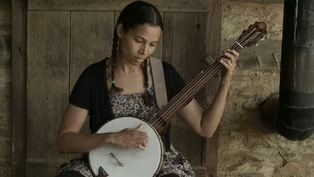
Episode 2 Preview | Bryan Sutton and Rhiannon Giddens
Preview: S1 Ep2 | 30s | Holt performs with guitarist Bryan Sutton and breakout star Rhiannon Giddens. (30s)
Providing Support for PBS.org
Learn Moreabout PBS online sponsorship












Support for PBS provided by: