One-on-One
David S. Birdsell, PhD; Trinity Jagdeo; Amy Osborn
Season 2025 Episode 2840 | 27m 59sVideo has Closed Captions
David S. Birdsell, PhD; Trinity Jagdeo; Amy Osborn
David Birdsell, Provost and Senior VP for Academic Affairs at Kean University, talks about current challenges in the media landscape. Trinity Jagdeo, Founder of From We Can’t to We Can, discusses her inclusive book series and the importance of representation. Amy Osborn, CEO of NJ Vietnam Veterans’ Memorial & Museum, highlights her passion for veteran advocacy.
Problems playing video? | Closed Captioning Feedback
Problems playing video? | Closed Captioning Feedback
One-on-One is a local public television program presented by NJ PBS
One-on-One
David S. Birdsell, PhD; Trinity Jagdeo; Amy Osborn
Season 2025 Episode 2840 | 27m 59sVideo has Closed Captions
David Birdsell, Provost and Senior VP for Academic Affairs at Kean University, talks about current challenges in the media landscape. Trinity Jagdeo, Founder of From We Can’t to We Can, discusses her inclusive book series and the importance of representation. Amy Osborn, CEO of NJ Vietnam Veterans’ Memorial & Museum, highlights her passion for veteran advocacy.
Problems playing video? | Closed Captioning Feedback
How to Watch One-on-One
One-on-One is available to stream on pbs.org and the free PBS App, available on iPhone, Apple TV, Android TV, Android smartphones, Amazon Fire TV, Amazon Fire Tablet, Roku, Samsung Smart TV, and Vizio.
Providing Support for PBS.org
Learn Moreabout PBS online sponsorship- [Narrator] Funding for this edition of One-On-One with Steve Adubato has been provided by The Russell Berrie Foundation.
Making a difference.
Horizon Blue Cross Blue Shield of New Jersey.
RWJBarnabas Health.
Let’s be healthy together.
Eastern Atlantic States Regional Council of Carpenters.
The Turrell Fund, a foundation serving children.
New Jersey Sharing Network.
The North Ward Center.
Valley Bank.
And by EJI, Excellence in Medicine Awards.
A New Jersey health foundation program.
Promotional support provided by NJBIZ.
Providing business news for New Jersey for more than 30 years, online, in print, and in person.
And by NJ.Com.
Keeping communities informed and connected.
- This is One-On-One.
- I'm an equal American just like you are.
- The way we change Presidents in this country is by voting.
- A quartet is already a jawn, it’s just The New Jawn.
- January 6th was not some sort of violent, crazy outlier.
- I don't care how good you are or how good you think you are, there is always something to learn.
- I mean what other country sends comedians over to embedded military to make them feel better.
- People call me 'cause they feel nobody's paying attention.
_ It’s not all about memorizing and getting information, it’s what you do with that information.
- (slowly) Start talking right now.
- That's a good question, high five.
(upbeat music) - Hi everyone, Steve Adubato.
We kick off the program with Dr. David Birdsell, who's Provost and Senior Vice President for Academic Affairs at Kean University, one of our higher ed partners.
Dr. Birdsell, good to see you.
- It's great to be here.
Thanks for having me.
- Let's jump into this.
We are doing a series called Media Leadership.
The graphic will come up right now.
You understand media, you understand the role of media in a small D democratic society.
As a scholar, as an expert on media, and also you've done a lot of commentary on ABC 7 in New York, Fox 5 in New York, other places.
Where do you see the media, particularly mainstream media in 2025, in terms of what we should be doing to support and protect our representative democracy?
Loaded to question, I know.
- Media has a challenge before it at this point in time, like none other that has occurred in my lifetime, and that has to do with restoring credibility.
It has to do with dealing with the systematic attack on democratic norms in a way that sounds even handed to people who may support some of the politicians who are launching that assault, but do not believe that that's the ultimate impact.
It's a question about being able to provide people with a factual basis for making decisions at a time when the facts themselves are often contested.
So trying to find stories and people to speak with who are relatable to different aspects of an audience, recognizing that almost anything that is said can be taken out of context.
And so always thinking about how that specific sentence, that specific image, that line potentially feeds narratives that may be very different from the one that's intended by the people producing that particular media segment.
- Well said.
And I also wanna follow up on this, Kean University is part of something called the New Jersey Civic Consortium.
Let's put up the website team so people can find out more.
This consortium involves six public institutions of higher ed, including Kean University, my Alma Mater, Montclair State, whole range of others.
What is this civic leadership consortium and why does it relate to what you were just talking about, David?
- Well, this is a terrific program that does several things.
It provides grants to community-based organizations that are trying to cover the news often in different ways from the way that legacy media organs would do so.
And I hasten to add, sometimes that's because those legacy media have had to trim their sales for budgetary reasons.
So just to take one example, it used to be the case that the New York Times, the Wall Street Journal, the Washington Post, all the major national newspapers would have a dedicated nonprofit beat reporter.
And although David Fahrenthold does that for the New York Times right now, he's also split with all kinds of deep dives into financial issues that have nothing to do with nonprofits directly.
So we've lost that lens into an extraordinarily important part of our civil society fabric.
And one of the things that this project does, the consortium funds organizations on a competitive basis that present a compelling rationale for how they want to cover the news.
And many of them are finding different ways to involve non-traditional actors, very young people, very old people who haven't worked in media during the course of their careers.
People who are deeply engaged in topics that matter to members of the community, such as the Chalk Beat group covering education with a single focus.
So there are lots of good things to support in the community.
The consortium also works, as you pointed out, it's six public universities and those universities work with their students to place them in internships, to develop coursework that acquaints them with the dearth of local media that we have today.
It does great, great work and I hope that it continues to be funded.
Right now we're looking at a zeroed out budget.
- Let me also clarify the College of New Jersey, Montclair State University, Kean University, Rutgers, New Jersey Institute of Technology and Rowan University, all part of the consortium, lemme lemme try this.
Kean University, the role of a public university, particularly at Kean University.
In fact, your university has been designated as the Urban Research Institute, excuse me, the Urban Research entity in higher education in New Jersey, at a time where so many are attacking the world of higher education for not for whatever, doesn't matter the reasons.
What do you see the role of the public higher ed university looking to have a positive impact in the community?
- I'm so glad that you asked this question, Steve, because I think there is nothing more important.
There is nothing that I believe to be more directly existential to the future of public higher education than the answer to this question.
And I believe what public institutions should be doing at this point is reaffirming the multiple value propositions that we offer to the taxpayers of the state, to the residents who are adjacent to our universities physically, to the industries that are adjacent to our universities conceptually.
We traditionally are known for educating students and that's obviously job one.
People come to our doorstep, they're seeking a leg up through polishing their skills with education, developing new attitudes and aptitudes.
And we're gonna continue to do that.
But we need to do more.
We need to reach out to employers to make sure that they have the right experiential component to their education, good internships and other forms of engagement with organizations so that they have a clearer pathway to a job.
We need to help them understand and adapt to new technologies such as artificial intelligence.
So critical right now for students graduating into a job market where AI has become a huge issue for people seeking particularly entry level positions in knowledge work jobs.
We need too, to help people understand that the research work that universities like ours do.
I'm proud to say that Kean was designated in February as an R2 research institution.
- R2, explain for us what that means, Dr. - Sure.
So there are about 4,000 colleges and universities in the United States and they're classed based on what they do.
Community colleges, four year baccalaureate colleges, graduate programs.
And within that there is a small number of colleges, about 8% of them overall that are classed as R1 or R2 institutions, which means that they are highly research intensive.
R1s are the biggest.
Think your Harvards, your Johns Hopkins, your Stanfords, the R2s are a level down from that in terms of spending, but critical because they're closer to communities.
And that gets me to this point that I think is so important for people to understand and for universities to embrace that the research work that we do provides direct value to businesses, to government, to nonprofits, to community members themselves in the areas of healthcare and service delivery, in the areas of business development and economic opportunity.
In the areas of finding out which new technologies are going to be most impactful for a region and how they can be developed in ways that benefit the people who live there.
This is the value proposition that universities in many cases are embracing, need to embrace and the R2s as institutions close to community and with an institution such as Kean, with that urban research commitment, this is a natural component of what we offer to the people in New Jersey.
And I think people are beginning to see that under the leadership of Dr. Repollet and the dynamic work that we're doing throughout the state.
- Lemme also clarify.
You mentioned Dr. Lamont Repollet, the president of Kean University, who will be joining us in a future program.
He's also the former head of the Department of Education in the state of New Jersey.
He'll be talking about a whole range of issues, higher education as well as education on the local level as well.
Before I let you go real quick, gimme a minute on your, when you were in college, you did an internship, where was it and what impact did it have on your life David?
- I did an internship with a daycare center in the city of Charlottesville where I went to school that actually turned into a job running volunteer services for 18 daycare centers throughout that city.
And it was eyeopening to me to see the different economic circumstances, to understand that as a university we had this terrific asset to offer, in this case thousands and thousands of student labor hours offered for free to our community partners, but that the university had just as much to learn about how we could be most effective, how we could engage respectfully.
And that lesson, that set of lessons for me negotiated among these 18 institutions and hundreds and hundreds of volunteers over the time that I was doing that work.
Taught me a lot about politics, a lot about social organization, and a lot at a very early age about what a university could do for its community, for people who would never enroll in that university.
That's a commitment that has lived lifelong for me.
- Higher ed, more important than ever before.
Even while some folks questioned the value of it.
You just listened to Dr. David Birdsell talk about the impact of a college internship he had that changed the course of his professional and personal life.
Dr. David Birdsell is Provost and Senior Vice President for Academic Affairs at Kean University, one of our higher ed partners.
David, great to have you with us.
We appreciate it.
- Steve, thanks so much for having me.
- You got it, stay with us, we'll be right back.
- [Narrator] To watch more One on One with Steve Adubato find us online and follow us on Social media.
- Hi, I am Jacqui Tricalcic, senior correspondent for One-on-One Joining us now is Trinity Jagdeo, who is the founder of a terrific organization called From We can't to We can.
Trinity, it's so great to have you with us.
- So nice to be here.
I'm super excited to be at this opportunity.
- Well, thank you, and I have to mention, you're a Russ Berrie Making a Difference winner.
Russell Berrie Foundation, a partner of ours, has been awarding unsung heroes throughout New Jersey for many, many years now.
And last year, you were an honoree, so congratulations on that.
- Thank you so much.
I really appreciate it.
- I wanna talk about all the incredible things that you are doing for children with disabilities through your organization, but first, I just think it's so important for us to talk about your best friend, Alexis.
Can you tell us a little bit about Alexis and how she was the person that really pushed you and helped you create this organization?
- Yeah, so Alexis was diagnosed with spinal muscular atrophy at the age of two.
It's basically a degenerative disease that robs all muscle strength.
So I met her elementary school when we were five years old, and she was playing hopscotch just with the rest of the kids like it was nothing.
Even though she was in this big clunky wheelchair, she was weaving in and out of these hopscotch wears like it was nothing.
And it just really, I don't know what in that moment it did for me, but I just knew that I just really wanted to be her friend.
And so we've been best friends for the past 20 years and it's been just like any other friendship.
But I also got to experience a lot of the things that she went through, like the lack of resources, the lack of funding for some of the things that she needed, and of course, lack of accessibility and representation.
So I'm grateful that I am her friend because I'm able to figure out ways to empower her and be by her side.
- And I've seen that through your social media pages, just hanging out with Alexis and being there with her, especially during her stays in the hospital.
And you can just see from those videos how powerful your friendship is and your bond.
And like you mentioned, the lack of representation is something that really drove this for you.
And starting off by creating children's books, right?
There's five books so far that you've created using the organization to promote those.
Talk about some of those books.
One of them called "Savvy Sammi."
Tell us about that.
- I wrote "Savvy Sammi" a few short years ago, actually.
And I started creating these books because of the lack of representation in the entertainment industry.
So we have five books out to date, and one of them being "Savvy Sammi" who is based on Sammi Haney, and she is an Emmy nominated actress.
May have seen her in Netflix's "Raising Dion."
But the important part of the series is that they're based on real kids with disabilities.
And they're starred as superheroes because of how superheroes are so relatable to all of us.
It doesn't matter what their abilities are, anybody can look up to any sort of superhero.
So we started creating that representation through superheroes and through children's books.
And "Savvy Sammi" specifically, again, is about Sammi Haney, and her superpower is teleportation, which again drives the nail in about the importance of the accessibility.
Because she chose that superpower because of the fact that there is lack of accessibility and she wishes that she had access to everything.
And the teleportation superpower gives her that ability.
So just super cool things like that are in the book.
We get to personalize it.
So there are things that she loves, like her sidekick, Zeke, who's on a lizard that kind of stays on her shoulder, is an actual imitation of Sammi Haney's real pet lizard, Zeke.
So it's really cool that we're able to adapt these books.
- And so you're working with these people that you choose to be able to write the stories about these real people dealing with real situations.
How do you choose who you're gonna be working with and how do you work with them?
- It's definitely hard because we get a lot of people that wanna be nominated for our books and wanna be a part of this series.
I don't necessarily have a specific process.
I think I have more of a story in my head and those characters kind of align with those stories.
I've always been creative, I've always loved to draw and write.
And so those two worlds collided with the this book series.
So I come up with all of our stories and with the nonprofit, I'm always surrounded by kids within the disabled community.
So I've been inspired by quite a few of them.
So I think I have plenty of inspiration.
- Like you said, five books.
Another one called "Zappy Zane."
- Yeah.
- And several others.
I love the names.
You can find them on Amazon and through Trinity's website, which has been up throughout the interview as well, that you can check out.
So the organization started out with these books and these incredible children's books and the inspiration there, but it's evolved a little bit too.
Tell me what else you're doing.
- Yeah, we have done quite a lot.
When I think about it, my head spins a little, but we started out with the books and then we transitioned into creating accessible events.
I really just kind of wanted to solve all the issues that I saw Alexis is experiencing.
So we started hosting seasonal events.
So they are a range of different things.
We have accessible Christmas events, accessible Easter events, and then we might throw in a few other ones here and there.
But our biggest one that we have coming up is our fashion show fundraiser where we host at Rowan University.
And we have incredible people like Everett Jackson, which is the arena host for The Flyers.
We are inviting out some incredible leaders and local celebrities like Mara Justine from Maverick City Music.
So the opportunity of the fashion show gives us a time and a place to celebrate individuals that we support while inviting other people without disabilities on stage with them, because we imagine a world of unity.
And people with disabilities belong in the same spaces as people without disabilities.
So we make that happen on our runway in addition to raising funds for our non-profit.
And our overall goal is to eventually raise enough money and have enough funds to move into a building space to fully operate our resource recycler program, which is a program that gives new and used medical equipment to families who have been denied insurance coverage.
- That's incredible.
So much that you're doing so much on the horizon.
Last.
- Thank you.
- What does Alexis think about everything that you've accomplished so far?
What are those conversations with her like?
- I think it fuels her to keep going.
She's been in the hospital since December 13th, so it's been some time.
She's still in there.
And when she sees all the things that I'm doing, she knows I can't do it without her.
So she's my backbone.
So in turn, it's really just the work that she's doing and that's how I see it.
So she's thrilled.
She loves it.
(both chuckle) - Well, we can't wait to see what's next for the organization and for your journey.
Thank you so much for joining us today.
We really appreciate it.
- Thank you so much, Jacqui.
I really appreciate being here.
- We'll be right back after this.
- [Narrator] To watch more One on One with Steve Adubato find us online and follow us on Social media.
- We are honored to be joined by Amy Osborn, Chief Executive Officer of the New Jersey Vietnam Veterans Memorial and Museum.
Amy, great to have you back.
- Thank you for having me, Steve.
It's good to be back.
- Well, it's been a little over a year that we had you, so update us.
As the website goes up for the museum and memorial, tell us what it is, and why people should know more about it, please.
- Well, the New Jersey Vietnam Veterans Memorial and Museum is the only one of its kind in the country, and I think that's a really important thing to know.
And this year, we're celebrating our 30th anniversary of the dedication of the memorial, which was of course dedicated by Governor Christie Whitman, along with General Schwarzkopf and Governor Whitman's late husband, John Whitman, who raised the money for it.
So this is our 30th anniversary coming up on Monday, and it's gonna be a big celebration and a full circle moment.
We've got Governor Whitman as our keynote speaker, and we also have former Senator Ed O'Connor, who was the first Vietnam veteran elected to the New Jersey State Legislature.
And he wrote the legislation, he authored the legislation to put a memorial here in New Jersey.
So we're so honored to have him back, and another one of the committee members from the '80s who was here on board with this place before it was even built.
And it's gonna be a real full circle moment and a really special day on Monday.
- Amy, how'd you get connected to this extraordinarily important initiative?
- Well I've been working with veterans for about 30 years in one capacity or another.
I worked for the Department of Military and Veterans Affairs, I worked for the USO during my early career, and everything in between, I did a little bit of everything.
And two of my former bosses were on the board of directors here, former state Senator Nick Asselta, who you know, - That's right.
- and retired Colonel Michael Warner, as you also know.
And they were on the board and there was an opening, and they thought I'd be a perfect fit for it.
And I came aboard a little over two and a half years ago.
- Veterans who served in Vietnam are of a certain age, in their 70s, into their 80s, early 80s.
Are they connected to each other?
Meaning, and I always wonder about this with Facebook and social media, their high school friends that some of them are great to see, and others, you're like, you know, whatever.
But I think much more significantly, I often wonder about ways in which veterans of Vietnam can stay connected, and whether Facebook or Instagram allows for that.
How are they connected, if at all?
I just, I've been thinking about that lately.
- You know, a lot of the veterans stay in touch with their brothers that they served with in Vietnam, and I learned that from our docents.
We have boots on the ground docents that serve as our tour guides here.
And that was a question that I had for them too.
Do you stay in touch?
And a lot of them do, and not necessarily through social media, because a lot of them are of that age where they're not real savvy with social media.
And maybe if they are, it's mainly Facebook, and most of our followers are on our Facebook page for that reason.
But they do stay in touch with each other.
They do consider each other brothers and sisters, and regardless of what direction their lives have taken them in after they've returned home from Vietnam, they still are bonded by the fact that they served in country together and had each other's backs.
And the stories are incredible, and I hear them every day, so, absolutely.
- I'm sorry for interrupting.
Tell us about the documentary, "A Place of Honor."
- When I started here, I was trying to think of a creative way to promote the museum and the memorial, because it's the only one of its kind in the country.
And I was told when I started this job, "Oh, this is the best kept secret in New Jersey."
And that was not music to my ears.
You should not wanna be a best kept secret.
So I thought to myself, what would be a really good way to promote the place?
And I came across this filmmaker.
Her name is Vanessa Roth.
She is a very well-known documentary filmmaker.
Her father is Eric Roth, who won a Academy Award for "Forrest Gump."
So he's in the business himself, and she had done a piece on World War II Veterans that really just brought me to tears.
And we started talking to her and we ended up hiring her to do a documentary to tell the story of this place because it hadn't been told before.
I wanted people to know how it got here, which was a bipartisan effort, and a complete labor of love.
What we do here, which is so important, which is educating all these school kids and preserving the memory of the fallen.
And then also why it's important that we receive the funding so that we can stay here, because all these people worked so hard for so long, and it's got to stay here as a part of history.
And this documentary film called "A Place of Honor" tells that story.
And we are getting recognized by so many different groups now.
We just got back from San Diego.
We were nominated for three awards at the GI Film Festival in San Diego.
This weekend, I'll be flying back to California.
We are gonna be at an award show in Beverly Hills, believe it or not.
I can't even believe I'm saying that.
But we are nominated for best documentary film.
This is a feel-good documentary.
It's a short film, it's only 35 minutes, but it's impactful.
- I'm sorry.
Where can people see it, Amy?
- Not yet, they can't see it yet.
So Vanessa made us three short films as well.
And they can all be found on our website.
The first short is called "Remembrance."
And it follows a Gold Star mother through her journey of becoming a Gold Star mother.
The second one is called "In Our Shoes."
And it talks about the artifacts and the objects that mean so much to these Vietnam veterans or that hold some sort of story them.
And that's what we do here is we display their artifacts and we tell the stories.
And the third one is called "Why It Matters."
And that's mostly our publicity film.
And it's a short version of our long film.
So "A Place of Honor" is our longer film and "Why it Matters" is our shorter film, and all three of the short films can currently be found on our website.
"A Place of Honor" is still getting nominated.
So after Beverly Hills on June 7th in New Brunswick at Voorhees Hall, we'll be playing "A Place of Honor."
We're included in the New Jersey International Film Festival, so we're really excited about that.
- Congratulations, before I let you go, you mentioned funding before.
Your dollars come from where?
- Private donations.
We do get a little bit of state funding.
It could always be more.
And we have a partnership now with Horizon Blue Cross Blue Shield of New Jersey, which has been a life saver for us.
And, well, we can't thank them enough for everything that they've done for us.
They also have a really fantastic product for our Vietnam veterans through a company called Braven Health, which is a part of their organization.
- And Horizon, big supporters, underwriters of public broadcasting.
Amy, to you and your colleagues continuing to do important work, thank you for your service, thank you for what you're doing.
And make sure you stay connected with us so we can continue to share the story.
Wish you all the best, Amy.
- Thank you.
You too.
Thank you, Steve.
Bye-bye.
- Our Pleasure.
I'm Steve Adubato, That's Amy Osborn.
I'll see you next time.
- [Narrator] One-On-One with Steve Adubato is a production of the Caucus Educational Corporation.
Funding has been provided by The Russell Berrie Foundation.
Horizon Blue Cross Blue Shield of New Jersey.
RWJBarnabas Health.
Let’s be healthy together.
Eastern Atlantic States Regional Council of Carpenters.
The Turrell Fund, a foundation serving children.
New Jersey Sharing Network.
The North Ward Center.
Valley Bank.
And by EJI, Excellence in Medicine Awards.
A New Jersey health foundation program.
Promotional support provided by NJBIZ.
And by NJ.Com.
- (Narrator) Whatever your cancer journey, there's one place in New Jersey where our discoveries become your care.
You'll have access to advanced treatments, including clinical trials, thanks to our renowned scientists and multidisciplinary teams at New Jersey's only NCI-Designated Comprehensive Cancer Center, the one world class cancer program that's close to home.
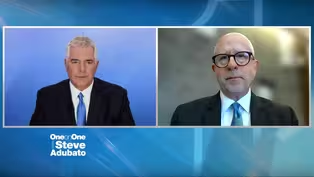
Examining the current challenges in media & local journalism
Video has Closed Captions
Clip: S2025 Ep2840 | 11m | Examining the current challenges in the media landscape and local journalism (11m)
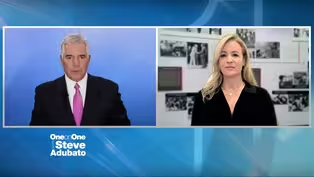
How NJ Vietnam Veterans’ Memorial & Museum preserves history
Video has Closed Captions
Clip: S2025 Ep2840 | 8m 44s | How NJ Vietnam Veterans’ Memorial & Museum preserves history (8m 44s)
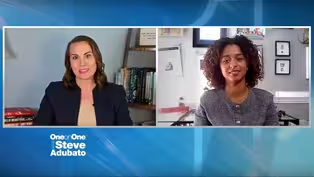
Providing representation for differently abled individuals
Video has Closed Captions
Clip: S2025 Ep2840 | 8m 46s | How this nonprofit is providing representation for differently abled individuals (8m 46s)
Providing Support for PBS.org
Learn Moreabout PBS online sponsorship
- News and Public Affairs

Top journalists deliver compelling original analysis of the hour's headlines.

- News and Public Affairs

FRONTLINE is investigative journalism that questions, explains and changes our world.












Support for PBS provided by:
One-on-One is a local public television program presented by NJ PBS