
Dayton Duncan
Season 2 Episode 2 | 26m 55sVideo has Closed Captions
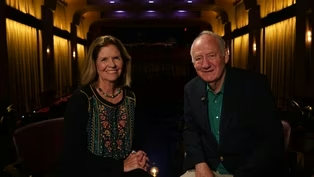
Becky Magura asks author and producer Dayton Duncan what he’d do with a clean slate.
Dayton Duncan is an award-winning writer and documentary producer whose many collaborations with Ken Burns include The National Parks, The Civil War and, most recently, The American Buffalo. Learn about his journey as an author and filmmaker on this episode of Clean Slate with Becky Magura.
Problems playing video? | Closed Captioning Feedback
Problems playing video? | Closed Captioning Feedback
Clean Slate with Becky Magura is a local public television program presented by WNPT
Dayton Duncan
Season 2 Episode 2 | 26m 55sVideo has Closed Captions
Dayton Duncan is an award-winning writer and documentary producer whose many collaborations with Ken Burns include The National Parks, The Civil War and, most recently, The American Buffalo. Learn about his journey as an author and filmmaker on this episode of Clean Slate with Becky Magura.
Problems playing video? | Closed Captioning Feedback
How to Watch Clean Slate with Becky Magura
Clean Slate with Becky Magura is available to stream on pbs.org and the free PBS App, available on iPhone, Apple TV, Android TV, Android smartphones, Amazon Fire TV, Amazon Fire Tablet, Roku, Samsung Smart TV, and Vizio.
Providing Support for PBS.org
Learn Moreabout PBS online sponsorship(uplifting music) - [Becky] Sometimes life gives you an opportunity to reflect on what you would do with a clean slate.
Our guest on this episode is Dayton Duncan, an award-winning writer and documentary filmmaker.
♪ But I've thrown away my compass ♪ ♪ Done with the chart ♪ ♪ I'm tired of spinning around ♪ ♪ Looking for direction ♪ ♪ Northern star ♪ ♪ I'm tired of spinning around ♪ ♪ I'll just step out throw my doubt into the sea ♪ ♪ Oh, what's meant to be.
♪ - [Becky] Dayton Duncan has been involved for more than 30 years with the work of documentary filmmaker Ken Burns.
He has authored 14 books, including "Out West, A Journey Through Lewis and Clark's America", "The National Parks, America's Best Idea", and "Country Music".
Many of these were companion books to the documentary films he wrote and produced.
For "Country Music", a PBS favorite, Duncan was the writer and lead producer for the 16 hour series.
He has also served as a consultant or consulting producer on many of Burn's other documentaries, beginning with "The Civil War" and including "Baseball", "Jazz", and "The Vietnam War".
Dayton Duncan has also had an amazing career in politics, serving as Chief of Staff to New Hampshire governor Hugh Gallen, as well as on many presidential campaigns.
In addition, he has served on many national historical boards and was named by the National Park Service as an honorary park ranger, an honor bestowed on fewer than 30 people in history.
Born and raised in Iowa, he has spent the last 50 years in New Hampshire where he makes his home with his wife Dianne.
Dayton Duncan was at the Franklin Theater for a special screening of his latest work, "The American Buffalo".
- I've been fascinated with the story of the American buffalo for 30, 40 years.
It resonates on so many different levels.
It's a incredibly dramatic story.
Just the notion that a magnificent animal that once was uncountable at least 30, maybe 40, 50, 60 million at one time, could be in a century taken down to fewer than 1,000.
How does that happen?
- Dayton, what a treat this is to be at the Franklin Theater with you and to be here for the screening of your latest work.
How exciting is it to be back in Tennessee?
- Oh, I love Tennessee.
You know, I spent so much time here when we we were working on "The Country Music" series that it'd be an overstatement to say it's a second home, but it's close to it.
- Well, I hope you know that people here feel that way about you.
You do feel like family, you and Ken and the whole crew.
You just mean so much to us.
- We made so many friends working on that series, you know, well, I think probably more than any other series we ever did.
It was the state and the country music family, if you will, just opened their arms to embrace us and helped us all along the way.
And we so appreciate it.
And we hope that the film that we made sort of paid it back a little bit.
- Oh, of all the work that you've done, which is prolific, it is the thing that people stop me about the most.
They resonate with it.
It's so about us.
You know, I know Ken talks about the little us and the big us, and it is so about that.
And Kathy Mattea, of course, is your good friend and she's gonna be on the series.
And Ketch Secor was on the series up with us.
- [Dayton] Brother Marty.
- [Becky] Yes, yes.
And- - [Dayton] Marty Stuart.
- So how did you capture those people, those iconic names, to sort of help you tell that story?
- Well, you know, part of our process is to go out and try to talk to as many people as we can about the topic we're pursuing, and just see where that leads.
And in the case of, you know, I bumped into Ketch Secor backstage at the Grand Ole Opry and started talking to him a little bit.
And I realized that here's this young guy, but he knew so much history of country music, particularly in the earliest days of it.
And I thought, we gotta interview this guy.
And I arranged to go and meet with him for like three hours at his house just to say, "Here's what we're thinking about doing.
What advice can you give us?
What are the stories?
Who are the people that we ought to do?"
And he was so enthusiastic and so knowledgeable that we knew that this was a person we wanted to interview.
Kathy Mattea, I first met her doing a screening of "Dust Bowl" in Nashville.
And she, because of her devotion to public television, showed up with her husband, John Vezner.
And I was doing a typical fan, you know, rave to her about when Dianne and I went to see her in, I think, 1989 or something at the Kemper Arena in Kansas City when I was out working in Kansas on a book at the time.
And that the song that she sang, "Where Have You Been" became sort of a theme song for Dianne and me when I would come back from long trips.
And it turned out I didn't even know the story behind that John, her husband, wrote it.
And I learned the story that, you know, one of those things where you can't make this up- - Right.
- Moments when he said that the moment that he first sang "Where Have You Been" in public was at the Bluebird Cafe.
And on that very same evening, Garth Brooks was discovered and got his contract.
And I thought, wow.
I mean, you know, this is, I've gotta be, if I can't connect those dots in a a series, then I need to, you know, give up writing.
And Marty Stuart wrote to us when he heard that we were gonna be embarking on it, said, "Anything I can do, let me know."
And I went out and spent half a day with him in his office and, you know, five, six years before the film came out.
And we just became really good friends.
And I treasure that.
- Yeah, well, they feel that way too.
And, you know, you were instrumental in Nashville Public Television, picking up a couple of stories and going deeper in depth because of that experience.
We finished with Barbara Hall, our, a producer of that we finished the documentary on Minnie Pearl.
And then, we're working on a documentary on Little Miss Dynamite, Brenda Lee.
Why did you pick those two iconic really champions for us?
- Well, you know, our films, we think, you know, we do as good a job as we know how to go as deep as we can, but there's so much more depth there, particularly in a big series like "Country Music".
You know, we had to cover a lot of space, and there's just, there are a lot of great stars that we don't even mention.
There are a lot of great stars that we mention and that's it and we move on.
And some that we could rest a little bit and tell their story.
And even those, like Minnie, and like Brenda Lee, we tell their story, but for our purposes in a series like that, that's like saying we're devoting 10 minutes to it.
- Right.
Right.
- And both of those ladies, we didn't get to interview Minnie because she had passed, but both of those characters are, they are something.
- Yeah.
Well, it's so fabulous and we're excited about it, and thank you.
Thank you for shepherding us in that direction.
- Well, let me also just say- - [Becky] Yes.
- In the making of that film, we came to Nashville all the time to do interviews and to do other things.
And NPT you know, your crew, your staff people were just terrific for us.
You know, whatever we did to help you is nothing compared to what you did to help us.
- Thank you.
Well, anytime, Dayton, anytime.
You know, I just want to, you are an Emmy, well a multi award-winning documentarian and writer.
You've written 14?
- 14 books, uh-huh.
- Books.
Man.
And, you started focusing on the West, right?
How did that start?
How did it start that you focused on the West?
- Well, you know, when I was, I grew up in Iowa in a little town, and the first, and essentially the only family vacation my family was ever able to take was when I was nine, turning 10.
And we borrowed my grandmother's car, which by that point was nine years old.
It was the same age as me.
And, but it was better than the car we had.
And we borrowed camping equipment from some friends and my older sister and me and my parents.
And we headed west because well, you know, that's what you do.
- Right.
- And we went to national parks, because that's something you could afford.
- Right.
- And that was a very big experience for me, seeing those different landscapes, going to the Little Bighorn National Battlefield, which I had read books about.
The going to Yellowstone, going to Dinosaur National Monument.
- [Becky] Right.
- I mean, I could still almost take you day by day.
My mom very craftily, you know, let me believe that I was involved in the itinerary.
And so, she had me write off to all the state tourist bureaus.
And I got stuff and looked at maps and- - Oh wow.
- Helped decide, you know, where we would be going.
At the time, when I got through with that, you know, it was a very memorable experience.
And, but only later in life did I look back on it, and I thought, well, a great deal of my adult life has been spent traveling the United States, particularly the west, in this sort of expedition of my own, to try to come to grips with us as a people, as a nation and our relationship to the land, and particularly the westward expansion, our movement west.
And I'm also a mapofile, you know?
- Oh yeah.
- I mean, I do sometimes rely on Google if I'm in a city, but I hate doing that.
- Right.
- And I look back on that and I think, you know, that trip probably started me.
- Right.
That's so- - Down that road.
But, you know, the West, it was a landscape that transfixed me when I was nine.
And when I as an adult started doing my first, I did a magazine piece about retracing the Lewis and Clark Trail and what they would've found 180 some years later, and my experiences versus theirs and the history of the West in between to explain those differences.
And that's where my true love, I think of the West and its place in our history began.
And so a lot of my films, a lot of my books have have dealt with that.
- You know, it speaks volumes about your family and what, what a treasure that is.
And what a lesson, really a lesson it is for all of us about how we can empower our own children- - Yeah.
- To take part in those kind of family expeditions, right?
- Yeah, well, I did a, in 1998, the year after our "Lewis and Clark" film came out, I took our family and what was our first really big vacation from New Hampshire, where that's where our kids grew up and where I've lived for so many years.
But, so I drew this big map of where we're gonna go.
It was gonna be like a three week trip to certain national parks.
I had to do some things related to the "Lewis and Clark Adventure".
And I said, "Okay, here's the places we're gonna go, and each of you can pick one place that you want to go to."
And so our son, who's the younger, well looked over.
He decided, he wanted to go to Dinosaur National Monument.
I said, "That's great.
I was there when I was your age and you're really gonna like it."
He sort of thought that he'd see real dinosaurs, but I didn't wanna break him of that right at that moment.
- Right.
- And our daughter, who was Emmy, who had just turned 12, looked at it all and said she wanted to go to Minneapolis St. Paul, which was in the circle that I drew 'cause that's where they were flying into, I think, or something like that.
And, I picked them up in our car, and 'cause that's where the Mall of America was.
So, you know- - Everybody has their own journey, right?
- So, I said, "Fair enough.
That's the promise made."
But I said, "Here's the thing.
That's where we go last.
And so, if you complain too much about are we there yet during the three weeks going to all these national parks and everything, then we'll just cut that one out of the itinerary."
But, you know, she loved that thing.
My kids are road warriors of the highest order.
- [Becky] Wow.
- They drive across the United States all the time, going from one place to another.
They love going to National Parks.
I took them with me and Dianne on a number of production trips, and so I would do my work, but we'd be staying in the same place.
And, sometimes Emmy or Will would come out with me on a shoot.
But, it was, and that all dates back to that, you know, trip that my parents and I took.
- You know, you were a treasure.
Ken is a treasure.
The whole team at Florentine Films.
- [Dayton] Oh, thank you.
- [Becky] You've been together 30 years, right?
- [Dayton] Yeah, a little longer.
Oh, we've been friends for longer than that.
- [Becky] Oh wow.
- You know, we met in 1979 and we started not collaborating, but he was working on his early films in the mid 1980s.
And I was starting on my first books, and we lived in the same part of New Hampshire.
We realized we both had this passion for American history.
We both believe in the promise of America and the journey that our nation's been on, this uncertain and unfulfilled journey to live up to the ideals of the Declaration.
And we both believe in storytelling as a way to impart historical information.
I was doing it in books, and he was doing it in films.
And so, he'd invite me in to look at his films in progress, and I'd invite him to read the books that I was doing in progress.
And then I moved out to Kansas for three years to work on my third book, "Miles From Nowhere".
And as I was driving all the way around to these sparsely settled counties that I was covering, I came up with a list of ideas for him of film topics I thought he ought to do.
And including that was, you ought to do a film about the settlement of the West, the westward expansion.
You ought to do one on Lewis and Clark, which I'd written a book about.
You gotta do one in about Mark Twain.
You ought to do one about the first automobile trip across the United States.
And you ought to do one on the American buffalo and Benjamin Franklin.
And so, he started on the West in the early 1990s and he said, "If I'm gonna do this, I want you involved in it some way."
And so, I became the consulting producer and co-writer of that.
And that's how I ended up 30 years later, still writing and often producing films with him.
I'm the luckiest person on earth to, you know, I actually got paid to do it.
So- - I love that.
- Which is surprising in its own right.
- No, no.
- But anyway, it's been quite a journey.
And the American buffalo was something that was a topic that appeared in our film on the West.
It appeared in "Lewis and Clark".
That segment was about how many there were.
In "The West", it was about the slaughter of the buffalo.
It appeared in the "National Parks" in terms of saving the last remnant herd at Yellowstone.
But, I'd always wanted to do it as the whole story.
It's a biography of an animal, but it's really not.
I mean, it's really, once you understand that if you wanna tell the story of the American buffalo, you can't tell that without telling the story of native people and their long, long, long term relation to it.
And if you're telling the story of the buffalo, you can't omit the story of how it intersects with our nation's westward expansion.
And you can also then tell the story of the people who decided to try to save it from final extinction.
So, it's a window, I think, into so many other parts of our history.
It's a morality tale- - Right.
- Of our ability to destroy nature like we told in "The Dust Bowl".
- Right.
- But it's also a story about when we're at our best, we can change directions and do something differently as we did with creating national parks instead of destroying those precious landscapes, with the buffalo, certain individuals decided not to let it happen.
And eventually, and again, it's a bottom up story, as the parks were.
- Right.
- It wasn't top down, government down.
It was individuals up saying, "You can't let this happen."
- Yeah.
- And that's a story for us for today too.
- Yeah.
It's the little us with the big us.
- Yeah.
- So, we're gonna run outta time 'cause I could spend hours with you and I know our viewers could too.
But, you know, the premise of this show is what would you do with a clean slate?
And the last time I talked to you in person, I thought you were retiring.
- Yeah.
- So tell me, what would you do with a clean slate?
- Well, in that sense versus if I had a clean slate, but if my list is done of the films that I really wanted to do with Ken.
And in doing those films, I also had a list of books that I was putting off writing.
And so, while my intention is now not to make films, Ken's got plenty of other people that he can do it with, and he's got plenty of projects underway.
And I don't have any more on my list, but I do have a list of books I'd like to write.
So, I don't have a clean slate.
I'm just continuing what I'm doing minus these other things.
If I had a clean slate in my life of things to do over, I'd be a little bit afraid that in following those things, the serendipitous things that happened to me, that actually led to whatever it is that I became and have done might've been missed.
But, you know, I have regrets.
I wish that when I was in college that I'd taken more advantage of the banquet of knowledge spread before me.
I got hooked into what my, I majored in German literature and, you know, that wasn't a waste of time, but I then I decided halfway through, I should have done it in American literature.
It was too late to change my major.
But, I just wish that I would've, you know, taken just been more voracious and omnivorous of all the other courses that I didn't take.
And I guess if I'd done that, maybe I wouldn't have spent so much of my lifetime since then, you know, going down rabbit holes after rabbit holes to learn everything I could about the history of the American West or to learn about the American buffalo or to study all of the stories that led to the creation of "The National Parks".
So, that's a regret.
I, you know, everyone has their other personal regrets.
My mom, who I mentioned was such an important person to me in the times before the internet and before cell phones.
I think of the months at a time that would go by when I was a young man before I became a parent, which a light bulb went off about how did you let this happen?
But, months would go by that I never bothered to call, or I'd only write an occasional letter, and I wish I had that time back.
- Those are gifts.
Those are just gifts for all of us.
And, you know, something that I think we can all experience.
And I think often, especially at this point in life and I get so much out of all of your writing in your, you know, I know that if there's not room in the film, there's room in the book.
- [Dayton] Right.
- To tell the deeper story.
And I think about that a lot.
I've been reading a lot of Dickens because he captures the essence of a place, like, that's so unbelievable.
- [Dayton] Right.
- And I think about you, Dayton, and the impact you've had on people.
So, I hope you never forget that, really.
And you're so approachable.
So, what is it about you that makes you approachable?
- Well, I grew up in a time in Iowa where it was, you know, our sort of joke was be that we send young people out of Iowa to become missionaries of being nice.
And I was sent to New England where the difference between, in those days at least, I was raised that, that you meet somebody and they're your friend unless they prove otherwise.
And New Englanders, the tradition there was you're not a friend until you prove that you can be.
It's just a, you know, I grew up in a rural area too, which I think is a different thing.
I am a curious person.
I mean, in saying that it means, I guess in both ways.
But, the way I meant it was that I have a great curiosity about how things work and why and what lies behind this.
That's why I became a reporter.
And so, I learned early on in my reporting and then magazine writing, then book writing, that everybody has a story to tell if you just give them the opportunity.
And as I tell aspiring nonfiction writers or reporters or filmmakers, I said, you know, "It just, if you keep that in mind that everybody's got some things that they would love the chance to say."
And I said, "And they're more likely to tell you that if they think that you're actually interested in what they've got to say.
And you are more likely to convince them of that if you actually are interested in what they've got to say."
And that's just part of my makeup.
- Yeah.
- I guess.
My dad was very, you know, very open and you know, everybody's friend.
- Yeah.
- And my mom was very polite and also everybody's friend.
So, I got it genetically and in the home as well.
- That's what makes you such a good southerner there, Dayton.
So we're out of time.
- Southern Iowa.
- Southern Iowa.
That's right.
Well, listen, thank you so much.
We love you, and we hope you'll be back to see us.
- I hope I'm back too.
Thank you.
♪ I've thrown away my compass ♪ ♪ Done with the chart ♪ ♪ I'm tired of spinning around ♪ ♪ In one direction.
♪ - Hey Dayton, I heard something about you that you actually write country music?
- Yeah, I started writing melodies on the piano and on the guitar when I was my teens.
And then I started writing lyrics for them in my late teens and then much more in my 20s and my 30s.
You know, I sang in a folk quartet, the New Frontier Four.
You haven't heard of 'em?
- Not lately.
- Well, they were really big in Warren County, Iowa in the late '60s.
They could play all of the Peter, Paul and Mary songs and all of those things.
So I was a big folkie, but I decided that I wanted to write some too.
And then I got hooked on a bit of country music.
The thing I like about country music is that is a way of expression of telling things in compression.
You know, I write really long books.
- Yeah.
- And I write films that themselves are never short.
- Right.
- And the challenge to try to put something into like two verses and two choruses is a nice exercise.
(uplifting music)
Dayton Duncan | Episode Trailer
Video has Closed Captions
Preview: S2 Ep2 | 30s | Becky Magura asks author and producer Dayton Duncan what he’d do with a clean slate. (30s)
Providing Support for PBS.org
Learn Moreabout PBS online sponsorship













Support for PBS provided by:
Clean Slate with Becky Magura is a local public television program presented by WNPT