
Death Personified
Season 27 Episode 5 | 56m 10sVideo has Closed Captions
Four short films from students at USC, CCSF, and CalArts.
A hospice nurse helps patients navigate end of life in USC documentary “A Good Death.” LGBT activists protest AIDS treatment options in drama short “Silence = Death” from USC. An AI assistant promises to bring order to a woman’s life in sci fi short “ADDIE” from CCSF. Sent to purgatory after an allergic reaction, a girl bonds with death personified in CalArts animated "Death is a Giant Peanut."
Problems playing video? | Closed Captioning Feedback
Problems playing video? | Closed Captioning Feedback
Fine Cut is a local public television program presented by PBS SoCal
Death Personified
Season 27 Episode 5 | 56m 10sVideo has Closed Captions
A hospice nurse helps patients navigate end of life in USC documentary “A Good Death.” LGBT activists protest AIDS treatment options in drama short “Silence = Death” from USC. An AI assistant promises to bring order to a woman’s life in sci fi short “ADDIE” from CCSF. Sent to purgatory after an allergic reaction, a girl bonds with death personified in CalArts animated "Death is a Giant Peanut."
Problems playing video? | Closed Captioning Feedback
Where to Watch Fine Cut
Fine Cut is available to stream on pbs.org and the PBS app.
Providing Support for PBS.org
Learn Moreabout PBS online sponsorshipNarrator: Funding for "Fine Cut: Festival of Films" is generously provided by The Bridges Larson Foundation.
[Upbeat music playing] [Pouring rain] Mark: I'm glad we could do this by Zoom today.
Karen: Yes.
Mark: Thank you.
Thank you for coming.
Karen: It's much easier and it's a rotten day outside, so... Mark: Yeah.
Just another update.
Um, I do have my paperwork from UCLA for the Body Donation Program.
Karen: Oh, good.
Mark: As you know, this is something I've been thinking about for four years, four and a half years.
And, um, so I'm just so grateful that things are in place.
When I got your email that you have the prescription, um, it gave me an enormous feeling of relief.
[Dramatic music playing] News reporter: And after being diagnosed with terminal brain cancer at the age of 29, Brittany chooses to die.
News reporter: Only ten states and Washington, D.C.
have laws that allow Medical Aid in Dying.
News reporter: California's legislature passed a bill that grants terminally ill patients the right to end their lives with a doctor's help.
Mark: When a family member is nearing death, it can be very difficult to sort out what the right thing to do.
Karen: Oh, and there you-- you asked for a nurse-y picture.
Here's my nurse-y picture.
I'm too embarrassed to show it.
Woman: No.
It's beautiful.
Karen: I knew I had it out here somewhere.
Yes.
But I told her, you know, no one wore a nurse's hat.
You just put it on for the graduation picture and that was it.
It wasn't even my hat.
That was just part of it.
Yes.
There you go.
I worked first in radiology and taking care of, you know, 90-year-old people on these hard x-ray tables.
I just always felt like I was torturing people.
And so many times there were these tests and studies that didn't need to be done.
You know, you ask people how-- where and how would you wanna die.
No one's raising their hand and say, "Oh, yeah, put me in the ICU with as many tubes and, uh, machines as possible."
Nobody wants that.
For a lot of hospices still, you know, they don't want their nurses talking about it or doing it for whatever the reason.
[Indistinct chatter] Karen: Tell me your first name again.
Sharon: Sharon.
Karen: Okay, Sharon.
Do you have a policy for Medical Aid... Sharon: Medical Aid?
Yes.
Karen: in Dying?
Okay.
If I--at some point if I could just get a copy... Sharon: Okay.
Karen: so I--so I know what your--oh, shoot.
What did she say her name was?
Because if we don't write it down, I'll never gonna remember.
Woman: For anyone who doesn't remember or know Karen, this is Karen Morin from LA Patient Advocates.
Karen: Hello.
Woman: So she's here and doing in-service for us on Medical Aid in Dying.
Karen: I got involved with Medical Aid in Dying because of all of my experience with death and dying, both in AIDS and oncology, and I lost my own husband to a brain tumor.
So when I heard that they were trying to legislate Medical Aid in Dying, I became very involved politically.
Do not wait for all the family.
The--this is a patient-centered decision.
This is about what the patient wants, not the family.
How do we make out with the pain meds?
Mark: Oxycodone is the main opioid pill that I'm taking, and then, occasionally for breakthrough, I have the morphine liquid, fentanyl patch.
Karen: Oh, good.
Mark: Um, I must thank you again for, uh, suggesting that.
Karen: Good.
I'm glad.
I'm glad.
Mark: Compared to cancer treatment, this is-- this is just [Indistinct] [Laughs] Karen: How--how's Rachel doing?
Mark: Oh, my darling wife.
Good.
She's doing well.
She's strong.
This is something we've both been preparing for.
Um, I think she is as ready as she can be.
Karen: Are you still thinking on the weekend or?
Mark: Approximately four or five weeks from now is what I expect.
Karen: Okay.
I remember.
I said I would be very irritating 'cause I'll say, are you sure?
Are you sure?
And you can always change your mind or change the date and-- Mark: I'm ready.
And I need--I need my darling wife by my side and I need you by my side, and that's it.
Karen: You know, being let in at this most intimate of times is really, you know, a gift.
And you take away something from each of these, uh, patients and their families.
That's what we gain from it.
I remember each of them.
Yeah.
There's a special lady who gave me a pair of shoes and I always can't--I can't look at them without, you know, thinking of everything about her and what was so special and unique about her.
So, yeah.
Ginger: [Indistinct] So this is a photo of us at our friend's wedding in North Carolina.
And this was just four months before Matt was diagnosed, his initial diagnosis of melanoma.
Yeah.
Oh, this is Matt right here.
Yeah, this is Matt.
I have him with me.
I just--I wanted him to be with me always, so he's always with me.
Um, and I just have him here because he can be with me watching movies.
And I have him a little, um, little vial of ashes that I put in my purse that I carry with me wherever I go.
Back then, it was called the end of life option.
So it kind of, you know, it made sense.
It's like, this is an end of life option.
A lot of times it's like, you don't just get better or you don't just die.
There's so much in the middle of like doctor's appointments and, um, and radiation and treatments, and just, you know, so many side effects.
Yeah, it was just scary to think about Matt is not gonna be here anymore.
And I was so grateful to have Karen with me to explain, um, the breathing and the change in color of his skin, like he turned kind of gray, um, and then, like these red lines appeared, and Matt used to say too, he's like, "People can take their own lives.
It's, you know, if they want to, they can do it.
You know, people figure out a way to do it."
But this is, like, you know, this is the legal way and the--it's the, um--it's a good death.
It's supposed to be a good death instead of a bad death.
And other people I had talked to had said they'd seen bad deaths and that's--I mean, for someone who's already gone through so much like Matt did, he deserved a good death.
[Bell dinging] Mark: I thought it's, um, maybe a little absurd to put it this way, but I was kind of expecting the dying process to be a little bit more fun.
And it's not.
There is more kind of pain and a little more psychological distress than I was expecting.
It's not nearly a medical crisis.
It's an epistemological crisis.
It's a breakdown of new meaning.
There is this kind of crude axis of quality versus time.
The quality of my life versus how long I might live.
I think part of the horror, it's not merely the sensory stuff, but it's the existential threat that we have not lived meaningful lives.
I'm asking myself very seriously, well, what were the moments of my life that gave me joy?
What are they?
Did I have any at all?
What are those moments that gave me great meaning and great beauty and great joy?
[Rain pattering] [Dramatic music playing] Karen: We were young, we were in our 50s when my husband was diagnosed with a brain tumor.
Karen's husband: Shh.
Hmm.
Hmm.
Karen: Look at that coat.
Let me see.
Karen: And, uh, and he died 13 months later.
Karen's husband: [Indistinct] It's Tuesday night.
Karen: All right.
All right.
So I, again, I think it goes back to, um, having had the experience and be able to support the patients and the family, and let them know that we'll be there to help them.
Melinda: This one is my favorite.
This is my mom as a chemist.
This was West Virginia University in 1967.
So she was doing, I think, a post-doc there, and she was teaching.
And, um, this is how I like to remember her, you know, like super competent, PhD, chemistry boss lady.
[Laughs] And she woke me up like Monday morning of Labor, like, Labor Day itself, shouting into the phone at 5:30 in the morning, "I want to die, I want to die."
Uh, when I got there and she was in such a state, she was like shaking, she was lying on the covers, she, you know, by then had been incontinent for a long time.
So, you know, like here's your mom in like a little undershirt and a diaper, and in agony, clutching bedsheets and saying that, she was like, "Where's my heart?
I've been doing this all night, like thumping, like I've been trying to give myself a heart attack all night.
Why doesn't God take me?"
And, um, I said, "Okay, let's call the social worker."
So, um, we did and, uh, Karen Morin came, and she was wonderful.
Martha: Martha, I'm in a position where you have either you piss or you get off the pot.
[Laughs] I write it down.
Melinda: You wrote it down?
Martha: Yeah, I wrote it down.
Melinda: Uh-huh.
Martha: It's another of his sayings.
Melinda: Uh-huh.
Martha: That's pretty good, huh?
[Laughter] [Dramatic music playing] Melinda: The medication, I guess, has a bitter taste and it was kind of a thick slushy, so they had to give her a big straw through this kind of like green medicine bottle.
And I thought that maybe she would sip it or grimace at a taste or something like that, but instead she like slurped it like with such gusto, like she was ready.
And then, they took away the bottle and she just kind of settled back and held our hands, and very quickly, you know, she started to drift off.
And my brother and I were whispering that we loved her and she right at the end had, you know, kind of leaned against both of us and said, "Love you.
Love you," to both of us.
And I am sure that the next second she opened her eyes, she was in heaven.
I have no doubt of it.
And she was completely joyous and ready.
It was great.
It was spiritually very profound and, uh, you know, really moving as somebody who believes in God to feel like, oh, it can be that kind of certainty at the end.
It was so peaceful.
It was great.
Everybody should have such a passing.
Mark: When I was having a very, very hard time with some chemo, and I realized, um, that at that moment, the most rebellious thing I could possibly do at that moment would be to love my life.
Karen: I like that for you.
Mark: Because I am so in love with life.
I am so in love with life.
And this is an extraordinary, compassionate, and giving act, an extraordinary gift that I'm so grateful to receive.
I cannot tell you how meaningful this is.
This is exactly what I need after five years of brutal cancer treatment, this is exactly what I need in my life now at this point.
And I receive it as a gift.
I receive it as the gift that it is.
That's all I needed to say.
[Laughter] Mark: All right.
Bye-bye.
Karen: All right.
Bye-bye.
Bye-bye.
Mark: Thank you.
Karen: Talk soon.
Okay?
Okay.
[Sighs] So hard, so hard.
So many young patients lately.
Very, very difficult.
[Keyboard clacking] Karen: I am going to, um, one of my patient's homes and he has chosen today as the day that he wants to ingest the medication.
So I had been talking with him a couple of times during the week, sort of planning for today and planning for the timing.
So he very much said that, you know, he was ready, that he didn't want it to be a day longer, that he was really starting to feel uncomfortable.
So, I think knowing that it's going to be peaceful and, um, that's what--that's all we can do.
And we just be present and be there to support him.
Yeah.
[Dramatic music playing] [Wind gusting] [Birds chirping] Karen: When it's over, uh, yeah, you just--you want to, I don't know, um, pet the dog and, you know, wish the sun would come out, or take a walk, but, you know, enjoy, uh, and planning dinner with the grandkids tomorrow night.
[Dramatic music playing] Woman: Are you all set?
Boy: Why is Daddy still getting the car?
Woman: Finish it.
[Laughter] [Indistinct chatter] Karen: Grief changes but that person is always there with you.
There's always something that reminds you that this person isn't in your life anymore.
Woman: And it's like... Ginger: Oh.
Hey.
Woman: [Laughs] Ginger: Hey, silly.
What are you doing?
Karen: So, you know, you keep your own memories alive.
People have such a hard time bringing up, you know, the loss of someone.
You know, they don't wanna ask.
They don't wanna mention it.
And that, to me, the biggest thing is just remembering to mention them and think about them.
Martha: [Indistinct] the doctor's hand.
[Laughs] Woman: Wait.
Is this related to stuff you do for work or what?
Woman: Yeah.
Woman: Oh, okay.
Woman: Yeah.
Karen: [Indistinct] what do you guys want for dinner?
You could say what you want versus... Woman: Yes.
[Indistinct chatter] [Laughter] [Dramatic music playing] [Upbeat music playing] Dr.
Fauci: A very severe device [Indistinct] society where wearing masks a lot where [Indistinct] has become sort of a political statement of where you are in your ideology.
It's quite different in what we went through with HIV, where we had activists who were confrontative, they were theatrical, they were iconoclastic.
But what they were trying to say was very important and they wanted to gain our attention, my attention, and when I listened to them, which is one of the best things I've done, it became clear that what they were saying made absolutely good sense.
Nurse: Jamie Holland.
Dr.
Fauci: That our government needed change.
Nurse: All right, that's 15 minutes.
You feeling all right?
Any immediate symptoms?
Jamie: No.
Nurse: All right, you're good to go.
Stay safe.
Dr.
Fauci: The end result was a very positive thing.
We embraced the community.
The community was value added.
They made contributions.
And the AIDS effort was on the [Indistinct] as you can see... Jamie: Anthony Fauci, you are a murderer.
[Alarm buzzing] Jamie: You are responsible for supervising all government-funded AIDS treatment research programs.
In the name of right, you make decisions that cost the lives of others.
I call that murder.
The gay community has, for five years, told the NIH which drugs to test because we know in here first what's working on some of us somewhere.
Linda: We tell you what the good drugs are, you don't test them.
What tragic pomposity.
Maxine: There are more AIDS victims dead because you didn't test drugs on them than because you did.
Peter: Who besides yourself are you covering for, Tony?
Dr.
Fauci: "You may be the best that will be given us.
The cries of genocide from this Cassandra will continue to remain unheard.
And our noble but enfeebled community of the weak, the dying, and the dead will continue to grow until we are diminished."
This is who they think I am, Dan.
Some bigoted Republican suit who sits around twiddling his thumbs.
I mean, we're trying to help them, for Christ's sake.
Here they come marching.
Dr.
Hoth: Who wrote this?
Dr.
Fauci: Larry Kramer.
Dr.
Hoth: Oh.
Dr.
Fauci: Of course.
Two full pages in the San Francisco Examiner and now Storm the N.I.H.
Dr.
Hoth: It's just their usual theatrics.
Ignore them.
Business as usual and they'll go away.
They'll thank you one day, Tony.
Jamie: Hey.
Patrick.
Here's the two.
Patrick: You ready?
Jamie: I think so.
Patrick: Don't let me down.
[Upbeat music playing] [Phone ringing] Maxine: Yeah?
Dr.
Fauci: Hi, hi.
May I speak with Peter, please?
Maxine: Peter, phone.
[Indistinct chatter] Peter: Thanks, Maxine.
Hello?
Dr.
Fauci: Peter, it's Tony.
Please don't do this.
Peter: Uh, I'm a little busy right now, Tony.
Dr.
Fauci: Listen, let's just-- let's just talk.
Just come to my office.
Peter: I'm hanging up now, Tony.
Dr.
Fauci: Hey, hey, you're wasting your time.
Peter: Tony.
Dr.
Fauci: This is just-- this is useless theater.
Come to my office.
Bring Mark.
Peter: You want this to stop?
Test new drugs.
Get us involved in the ACTG.
You need us on those committees.
Stop closing them off.
Dr.
Fauci: I think that-- nothing personal, I think that you may be naive in understanding how you can get things done.
In Washington, you do not get many shots, Peter.
You get one shot.
Peter: Tony, you have power.
You are a politician as much as you are a scientist.
Dr.
Fauci: I am not a politician.
My decisions are all scientific decisions.
Okay.
My only concern is the medicine.
Peter: Which is why we're knocking down your door.
See you, Tony.
Hey, just for you, I might get myself arrested.
Maxine: Should have told him to [...] off.
Peter: Maxine, he's not a bad guy.
Oh, geez.
Jamie: I'm sorry.
Sorry.
I didn't see you there.
Peter: All right, everyone, we are heading out in 15 minutes.
Grab your... Maxine: Behind you.
Hey.
How's Patrick?
Jamie: He's fine.
He's talking to Fauci?
Maxine: Yeah, one last squabble.
Jamie: Do you, uh, think he'll come out to meet us?
[Upbeat music playing] Maxine: Hopefully we'll get in.
Protester: Ready Jamie?
Jamie: Just one sec.
Rolling.
[Air horn blares] Protester: Basically, what we're doing is blasting the horns every 12 minutes to remind people that statistically right now, every 12 minutes someone in America is dying from AIDS.
This particular action is a result of about a year's work on trying to get the National Institutes of Health to restructure, to actually do what the vice-- what the now president has said, to put AIDS research on a wartime footing.
And we think it can be done and we think if we make enough noise, and if we get the message out clearly to the media, 10 years of work, $1 billion, one drug, and it doesn't work very well.
That's our message today.
Protesters: ...someone dies.
... your stupid Nobel Prize.
Every 12 minutes someone dies.
... your stupid Nobel Prize.
[Indistinct chatter] [Protester chanting] Protesters: The whole world is watching.
The whole world is watching.
The whole world is watching.
The whole world is watching.
The whole world is watching.
The whole world is watching.
The whole world is watching.
The whole world is watching.
Linda: Coat.
Guys in position.
How do I look?
Maxine: Hook.
Good?
Linda: Good.
Maxine: Good.
Let's go.
Linda: All right.
[Protester chanting] Protesters: We charge you with genocide.
NIH, you can't hide.
We charge you with genocide.
NIH, you can't hide.
[Upbeat music playing] Linda: Hello.
[Indistinct] [Protester chanting] Man: We die.
We die.
We die.
We die.
We die.
We die.
[Air horn blows] [Knocks on door] Maxine: Hello?
[Upbeat music playing] Linda: Medicine.
[Upbeat music playing] [Telephone ringing] Dr.
Fauci: Yeah?
Maxine: Dr.
Fauci, it's Maxine [Indistinct] we demand that you follow women's committee dedicated to researching drugs for women with AIDS.
The current list of our [Indistinct] Dr.
Fauci: How did get you it?
Maxine: And the CDC definition-- Dr.
Fauci: Do not call this number again.
I'm calling the security.
Maxine: Pulmonary tuberculosis-- Dr.
Fauci: You leave the building or you will be arrested.
March, get me security on the line.
Your line, not mine.
Man: We just had reports that a building has been taken.
Woman: We're here today because it's ten years, a billion dollars, one drug.
Woman: Sexism equals scam.
Man: Anthony Fauci, I'll piss on you.
Dr.
Fauci: Where are we with the DdI and ddC drugs?
Dr.
Hoth: We're optimistic about the potential pairing of didanosine with AZT, but as expected, patients continue to develop a rapid resistance.
Dr.
Fauci: Uh-hmm.
And if we combine them with the protease inhibitors?
Scientist: Well, we can't.
The FDA's dragging their heels-- [Man laughs] Scientist: Oh, my.
Man: NIH.
[Indistinct chatter] Woman: When are you gonna [Indistinct] Man 1: Where's your badge number?
Your badge, where's your badge?
Where's your badge?
Man 2: Calm down.
Calm down.
Dr.
Fauci: All right.
You can let him go once he's outside.
Man: No can do, Dr.
Fauci.
Dr.
Fauci: Hey, gentlemen, please.
I can vouch for him.
Peter: What did I say, Tony?
Man 2: Come on.
Dr.
Fauci: Hey, hey, hey, hey.
[Protesters chanting] NIH, you can't hide.
We charge you with genocide.
NIH, you can't hide.
[Indistinct shouting] Jamie: Dr.
Fauci, wait.
Wait, Dr.
Fauci!
[Indistinct shouting] [Indistinct clamoring] Jamie: Okay.
Okay.
Um... Patrick: Good?
Jamie: One sec.
Patrick: Jamie.
Can we--I'm getting tired.
Jamie: Okay.
Do you wanna, uh... Patrick: This is--Jamie.
Jamie: take a break or-- Patrick: Even if he watches it, he's never gonna change his mind.
Jamie: Hey, hey, hey.
This is-- this is good.
It's a great idea, babe.
Patrick: I don't even know if you'll see him and--what's the point?
Jamie: Patrick.
Hey.
Patrick: I can't do anything.
Jamie: That's not true.
You can show him the life we're saving.
A beautiful, brilliant, unbreakable life that can be born.
[Patrick sniffling] And I can record it.
[Patrick sniffling] Jamie: I will make you immortal.
[Man 1 coughs] Man 2: I knew because I have to be involved in a scientific policy standpoint that it's been... Man 1: Uh-huh.
Man 2: you know, many respects.
[Upbeat music playing] [Gentle music playing] [Fly buzzing] Keely: Sorry, I don't know how I missed your text, Dad.
Father: Sweetie, your mom and I are just worried about you.
Maybe come home just for a little bit.
Keely: Dad, we've been over this, okay?
I need my own space.
I need the lights, and the late nights, and the anonymous people all around me.
I need all the things that living in Novato isn't.
Father: You also need to pay your bills and do your laundry and eat something that isn't a package of carrots for dinner.
Your mom and I could help if you'd like.
Keely: I know I'm supposed to pay my bills, Dad.
It's just not something that I'm equipped to deal with at the moment.
But I may have found something that might help.
Father: And are you going to tell me what that something is?
Keely: Right, sorry.
Um, it's called Adultalyzr.
It's only in beta right now, but I qualified for early access.
It's your context-sensitive, environmental AI grown-up friend who will virtually guide you into the world of adulthood.
Father: Uh-huh.
And how are you planning on paying for this thing?
Keely: It's called a, uh, a pay-when-you-can model.
It's free up front.
Father: Well, how does that even work?
Keely: I don't know.
How does any of this work?
[Clattering] Keely: "Allow access to all phone functions."
Done.
Audio device.
Audio device.
Yeah.
Okay.
"Install Adultalyzr's proprietary AR ocular interface."
Addie: Hello, and welcome to your personal Adultalyzr companion.
Keely: Hi, who are you?
Addie: I'm your personal Adultalyzr companion, and I'm here to help.
You may call me Addie.
Please wait a moment while I run internal diagnostics and updates.
Keely: Whoa.
Freaky.
[Laughs] Addie: Congratulations.
Firmware updated to V.045.A.
What is your name?
Keely: Uh, Keely.
Keely Moran.
I can't do this.
Can you just take everything off of the screen?
Addie: Are you ready to start adulting now, Keely?
Keely: Uh, I'm actually kind of tired.
Uh, could we start tomorrow, Addie?
[Alert tone] Addie: Are you ready to start adulting now, Keely?
Keely: Not really.
How about later, Addie?
[Sniffles] [Alert tone] Addie: Are you ready to start adulting now, Keely?
Keely: Later, Addie.
Okay?
[Alert tone] Addie: Are you ready to start adulting now, Keely?
[Keely breathes deeply] All right, Addie.
Let's start.
What should we do about this one?
Addie: It would be best to call them and see if you can settle your debt.
Would you like me to talk to them?
Keely: What?
Can you do that?
Yes.
Addie: You will call them and talk to them, but I will tell you the words to say.
[Scoffs] [Metal clanking] [Alert tone] Keely: Should we, uh, call the landlord?
Addie: We could, but it may be more instructional if you learn to fix it ourselves.
I can help.
First, we must go to the hardware store for tools and supplies.
[Alert tone] Addie: Apologies.
First, we must get you dressed like a human being who lives in a society.
Keely: These clothes are perfectly fine for going to the hardware store.
Addie: Nevertheless.
[Water gushes] Keely: Addie, I could kiss you.
Mwah.
[Laughs] Is that the time?
I have to work.
Addie: Do you not wanna change?
Keely: No, no time.
Addie: Don't forget your name tag.
Keely: Thank you.
[Upbeat music playing] [Laughter] Sagan: Oh, my God.
[Keely laughs] Tess: But then what happened?
Keely: Well... Addie: That is when I remembered the bikini.
Keely: That's when I remembered the bikini.
[Laughter] Sagan: All right, let's get this party going.
[Alert tone] Addie: Do you not think you have had quite enough to drink tonight?
Keely: What?
Sagan: That's a party foul.
You need to drink.
Addie: You're an adult now.
You need to show some restraint.
Keely: No, I'm fine.
But maybe you're right.
Addie: I know I'm right.
Sagan: I am right.
Keely: Not you.
Tess: Are you okay?
You don't seem to be entirely here all of a sudden.
Keely: No, I'm-- it's just that Addie... [Alert tone] Tess: Addie?
Who's that?
[Alert buzzing] [Keely clears throat] I meant Daddy.
Uh, my dad.
Uh, he worries about me too much sometimes.
[Dramatic music playing] [Alert tone] Addie: Keely, who's coming for dinner?
Keely: Huh?
Oh, uh, yeah, someone that I met at the bookstore a while ago.
We've, um, we've been talking, and I finally had the courage to ask 'em out.
Addie: Them?
When did this happen?
Keely: Oh, right, you were updating, so you wouldn't have heard.
Uh, and yes, them.
Don't be so old-fashioned, Addie.
Addie: I'm the latest in context-sensitive environmental AI.
I am not old-fashioned.
Keely: I can't tell if you're mad or offended or if that was a joke.
Hello?
Addie?
[Doorbell chimes] Keely: Cooper, I'm so glad you came.
[Laughs] Thanks.
Thank you so much.
Uh, yeah, yeah, okay.
Um, sorry.
Uh, come on in, come on in.
So this is me.
Welcome.
[Laughs] Cooper: Lasagna?
That's my favorite.
How'd you know?
Keely: Uh, well, I saw you... [Clears throat] looking at the lasagna recipe in that cookbook at the bookstore, so I made it.
Uh, sit.
Yeah.
Okay.
Cooper: I shouldn't.
I have work tomorrow.
But tell me more about this novel you wanna write.
If you need a suggestion, I do love a cozy mystery.
Keely: Well, it's not a mystery.
But the only thing I want to cozy up to is you.
[Cooper laughs] [Gags] [Keely laughs] Cooper: Dad jokes?
I knew you were too good to be true.
But if you keep doing that, you might just get your wish.
[Laughter] [Romantic music playing] Keely: Bye.
Addie, are you back?
I had the most wonderful time with Cooper.
I wish you would have been there.
Addie?
[Alert tone] Addie: This Cooper, she's no good for you.
I scanned her face and ran it through my database.
Keely: They, not she.
And you did what?
Addie: Did you know she was arrested for protesting the president?
Attacking a police officer?
Keely: But they were nice and sweet, and Cooper laughed at my stupid joke.
Addie: You have to trust me.
You have been an adult for only a few weeks.
You need me to guide you into proper adulthood.
Do you trust me?
Do you?
Keely: I-- yes.
Addie: Excellent.
Let us wrap up the leftovers.
You probably will never hear from this Cooper again.
That is how people like her are.
Keely: Okay.
[Suspenseful music playing] [Alert tone] Addie: While we are tidying up, we can talk about applying to the data science program at UC Berkeley.
Keely: Data science, but I wanna be a novelist.
Addie: Nevertheless.
Keely: I'm not good at math.
Addie: I can help with that.
You need to think about your future.
Position yourself as a woman of value.
Keely: A woman of my future.
[Dramatic music playing] [Upbeat music playing] [Device beeping] [Indistinct chatter] [Sharp crunch] [Suspenseful music playing] Peanut: Hello.
[Door opens] [Eerie music playing] [Wind howling] Peanut: Do you wanna go somewhere with me?
Girl: Yes.
[Bench creaks] Peanut: I can't help but notice you're trying to avoid me.
I thought you might wanna talk.
Girl: You brought me to my grandma's funeral to talk?
Peanut: Yes.
I thought it would be constructive.
Did I make you feel bad?
Girl: No, I'm fine.
It's just weird.
Peanut: Because it's sad?
Girl: Because it's my grandma's funeral.
Peanut: And that's sad?
It's fine.
We don't have to talk.
[Object squeaking] Girl: I wanna go now.
[Car chirping] Girl: You can drive?
[Car engine revving] [Window squeaking] Peanut: It's hurtful to insinuate someone can't drive.
Girl: Oh, I was just confused because you were flying and, like, teleporting around everywhere.
Peanut: I enjoy driving.
[Static noise] Girl: Are you hollow?
Do you, like, have stuff inside you?
Peanut: I don't know.
I think there must be some stuff inside of me.
Girl: Oh, probably, yeah, probably peanuts.
Peanut: People usually cry at funerals.
Why didn't you?
Girl: You don't know if I did.
Peanut: I do.
Girl: You should be looking at the road.
Peanut: Sorry, I'm just curious.
I guess some people don't cry, but you haven't cried.
Girl: Maybe I'm waiting for the right moment.
Can you just look at the road?
You're supposed to look at the road.
[Girl gasps] Peanut: Why are you here?
I know I'm freaky-looking and big and probably hollow, but you can talk to me.
You should talk to me.
I'm an active listener and I'm listening actively right now.
You seem hurt by this terrible thing and that's normal, but you're alone now.
So you should just try and tell me how you're feeling.
Maybe I can help you find some peace.
[Wind howling] Peanut: We're running out of gas.
[Wipers clicking] [Keys jingling] Peanut: Now, there should be some cash in the glove compartment if you can find it.
I don't think they take card here.
[Keys beeping] Peanut: Don't worry, the card worked.
[Car engine revving] [Tires screeching] [Suspenseful music playing] [Shell cracking] [Girl gasps] [Car engine revving] [Wind howling] [Girl panting] [Footsteps] [Dramatic music playing] [Girl gasps] [Sniffling] [Dramatic music playing] [Sinister music playing] [Upbeat music playing] Narrator: Funding for "Fine Cut: Festival of Films" is generously provided by The Bridges Larson Foundation.
 New
NewVideo has Closed Captions
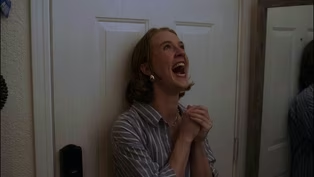
Clip: S27 Ep5 | 11m 36s | A young woman turns to an AI assistant that promises to bring order to her chaotic life. (11m 36s)
 New
NewVideo has Closed Captions
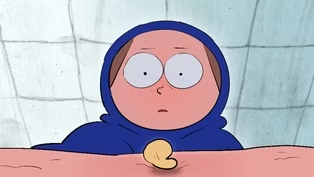
Clip: S27 Ep5 | 6m 48s | In purgatory after an allergic reaction, a girl forms a bond with the apparition of death. (6m 48s)
 New
NewVideo has Closed Captions
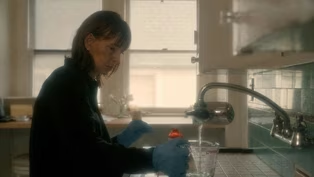
Preview: S27 Ep5 | 44s | "A Good Death" follows nurse Karen Morin as she helps terminally ill patients. (44s)
 New
NewVideo has Closed Captions
Preview: S27 Ep5 | 39s | A young gay filmmaker scrambles to deliver a message to Dr. Anthony Fauci. (39s)
Providing Support for PBS.org
Learn Moreabout PBS online sponsorship New Episode
- Arts and Music

Innovative musicians from every genre perform live in the longest-running music series.










 New Episode
 New Episode

Support for PBS provided by:
Fine Cut is a local public television program presented by PBS SoCal