
Debating Data Centers in Clark County
Season 9 Episode 4 | 26m 46sVideo has Closed Captions
Data centers in Clark County and UNLV researchers study brain damage in athletes.
The Clark County Commission recently approved another data center on the Switch data center compound, but commission chair Michael Naft says Swift and the county’s regulations are the ‘gold standard’ of data centers. Plus, researchers are working with former football players and professional fighters to track head injuries and brain damage.
Problems playing video? | Closed Captioning Feedback
Problems playing video? | Closed Captioning Feedback
Nevada Week is a local public television program presented by Vegas PBS
Debating Data Centers in Clark County
Season 9 Episode 4 | 26m 46sVideo has Closed Captions
The Clark County Commission recently approved another data center on the Switch data center compound, but commission chair Michael Naft says Swift and the county’s regulations are the ‘gold standard’ of data centers. Plus, researchers are working with former football players and professional fighters to track head injuries and brain damage.
Problems playing video? | Closed Captioning Feedback
Where to Watch Nevada Week
Nevada Week is available to stream on pbs.org and the PBS app.
Providing Support for PBS.org
Learn Moreabout PBS online sponsorshipWho should regulate data centers and how?
Clark County is grappling with those questions, and its commission chairman joins us to discuss that and more.
Plus... (Dr.
Jeff Cummings) What we would like eventually is to make these sports as safe as possible because, of course, the best competition is by people who are completely cognitively intact.
-How former football players and current MMA fighters are helping UNLV researchers understand traumatic brain injuries.
That's this week on Nevada Week.
♪♪ Support for Nevada Week is provided by Senator William H. Hearnstadt and other supporters.
-Welcome to Nevada Week.
I'm Amber Renee Dixon.
Data centers are powering the AI boom, but concerns about their energy and water use have prompted some local and state leaders to ask: Should we regulate them more closely?
Among those leaders are Clark County commissioners, who recently approved a data center expansion project from the Las Vegas-based technology company Switch.
Joining us to discuss that decision and potential data center policy, along with housing, animal welfare, and other issues impacting the county, is Clark County Commission Chairman Michael Naft.
Welcome back to the show.
-Thank you for having me back.
-Tell me what you think about data centers.
(Michael Naft) Well, here's what I think.
I think it is important, like with anything in life, that we be clear with people about the facts and the details, and that not all things are created equal.
My colleague Commissioner Becker referred to our approval as the gold standard when it comes to these things.
There is significant impact; you can't deny that.
But you have to look at what's been improved in unincorporated Clark County, and it's something that since 2016 has been 100% renewable.
There's a closed loop system, which means the water consumption is just not there.
It's hitting the drain, the water that's being used.
It is-- There's a prohibition that we were the first in the valley to mandate on evaporative cooling, so that issue is not as pronounced in what we approved.
And, you know, it's been there for 20 years.
My office hasn't received any noise complaints.
They have worked effectively with the neighborhood.
Unlike some of these things where we just don't know the answer to those questions, this one actually employs 1,500 people here in the valley.
So there are, you know, more than just nuances.
There are real significant differences from one to the other.
My board approving what we did a couple weeks ago-- -What did you approve specifically?
-We approved-- Essentially this was the 19th SUPERNAP, the 19th Switch building in the complex, where they've existed now for so many years.
And so this is really what has always been planned for them in that space and just continued growth of what they're already doing.
-And explain again the water use.
Let's start with that, water use by Switch in unincorporated Clark County.
-Well, several years ago, Clark County and my board took a variety of significant measures when it comes to protecting our water usage in this valley, all of which we took before any of our sister municipalities.
Pleased to say that they have now all followed suit.
But at that time, we were the first to put in a prohibition on evaporative cooling, in concert with the Southern Nevada Water Authority's recommendations.
That means that you cannot build one of these data centers, or frankly anything else, using cooling that runs the water over the cooling tower and creates loss to evaporation.
That's not happening in the valley with new construction any longer.
That is the second most pronounced usage of water in the valley after sprinklers, and so it's something that we tackled early on.
And it's something that, because of that work, this building or any other industrial use will not have.
-So water usage, you talk about that being cut down by that measure.
What about energy use?
That's only going to increase as a result of no longer using water to cool.
-That's right.
All things have consequences, and this is absolutely something that we grapple with and we have to put in place restrictions on as well, because with everything that we do, there's a reaction.
When you no longer-- When you cut back on evaporative cooling, AC is being powered through energy.
And so with the specific data center-- Again, everything is laser focused on the details.
With that project, they had already brought in the power that, frankly, much of enterprise is benefiting from at the developer's cost.
So this notion that in that case there was a significant impact on the rate payers, with this specific data center that was, that is not the case.
Now-- -Just the one you approved-- -I'm just talking about the one.
- --or the 19?
-I think every single one of these have to be looked at uniquely and separately-- -Each building?
- --and must stand alone, yes.
-We're talking about each building within Switch?
-Each building within Switch has to be looked at separately.
That's why they come before boards like mine and our municipalities so that people who are elected can look at the distinctions from one to the other.
But it's also why at Clark County in response to some questions that the board raised, that I raised and residents raised, we are going to enhance what we are doing from a land use perspective.
That is really the key for us, right?
We don't-- I don't have authority over power.
That's the Public Utilities Commission.
There are things that are outside of our control.
But the things that are within the control of local government, we ought to make sure that we are being as transparent as possible, the board has all of the information that they need to make sound decisions.
And so we have had a discussion item related to this.
We are going to ask-- We have asked already that our staff come back with some recommendations.
But I think included in that, you'll likely see a special use permit for these types of buildings.
Where historically they were by right entitled to be in industrial zones and industrial areas, I think you might see that require a special use permit so that the people can be notified, my board can know what's coming, and the people who are impacted know exactly the details of what's coming.
I'd also point out there's been a lot of discussion in our community about what's going on in Boulder City.
And I think that is a really clear example of why local government is so critically important when it comes to the nuance of land use.
When you get the Federal Government mixing in, all of a sudden all these protections, all the ones that you and I just talked about, frankly, go out the window when you see that piece moving to federal land.
-And so, if we could summarize what's going on in Boulder City, there was a piece of land that had city-- that was part of the city.
The City voted no, let's not put a data center there, after hearing a lot of concerns from their residents.
But then now a Bureau of Land Management piece of land is being used for that same thing.
-Yep.
And the impact to the neighbors will be the same.
The impact to the broader community will be the same, but they will lose all of their ability to regulate and control it the same way everything else in incorporated cities or unincorporated Clark County is once it is on federal land.
-Okay.
Some of the concerns expressed by people at the county commission meetings is that, yes, you are saying that the water is being used-- that's being used is less and the energy that's being used is from non-renewable sources, right?
But how can you prove that?
These companies, do they have to make public those numbers?
-Well, I'll speak to it from the water reclamation perspective.
We are fortunate in this valley, very fortunate.
Something that I get no credit for, but well before I joined the board, people put a lot of thought into how our water is going to be consumed, treated, and then repurposed.
So in this case, the Clark County Water Reclamation Agency, which is the essentially our sewer system, they have worked with Switch for many years, almost since the beginning, to get to a point where they are comfortable with what is hitting the drain.
That can all be validated.
That is something that the Water Rec District takes incredibly seriously and has been an important partner on.
-So perhaps-- -And by the way-- excuse me.
When it's-- when that's happening, it's hitting the drain, it's being treated, it's being repurposed, and the community is benefiting from the return tax flow credits.
-What about the energy use?
Should these companies be required to report how much energy they are using?
-Should they?
I think it's important if it's going to impact ratepayers that we know what both the benefits and the drawbacks of everything that we're approving is.
Power is not something that we regulate at the local level.
But would I like to see the PUC get involved and be more transparent?
Absolutely.
I think that's critically important as we face a time when the more we do to control our water usage, the impact is going to be on the power.
Because power consumption is not in our authority, we don't get to dictate that in local government.
But I will point out that the things that we can regulate and dictate have been regulated for data centers to a pretty significant degree, and I think we will continue as staff comes back with their recommendations to see that even expanded upon.
-Any timeline on when those recommendations will come back?
-I've asked for it to move pretty quickly.
This was probably a few weeks ago that we had initial discussions and staff got direction from our board.
So I think we're probably, you know, 60 days away from seeing something.
-Okay.
What are your thoughts on their value, data centers' value, to economic diversification efforts?
-I would say again, you you can't lump all of these things together.
There are so many of these that are big centers where nobody on two legs walks around, there aren't a lot of jobs being created.
There's significant impact to our resources, and then there are some-- You want to talk about the economic impact of Switch as an example?
They have paid millions and millions of dollars, tens of millions of dollars into both the state and county revenue that we are able to fund the work that local government and state government does.
They employ 1,500 people.
I can answer for them, but does that apply to every data center out there?
Absolutely not.
And I think it's something that the public demands and should get accountability for.
-Okay.
I want to move to housing.
-Sure.
-Like you just talked about, the commission has limitations on what it's able to do.
And in terms of affordable housing and the creation of it, what is the county's role?
-Well, a couple things.
One, Clark County is the social safety net provider for this entire valley.
Whether you're in Laughlin to Bunkerville or anywhere in between, Clark County is your regional service provider.
And social safety net falls under that: human services, social services, and in this case, affordable and then obtainable housing.
On the affordable housing front, we have focused a lot of energy in sort of COVID and post-COVID days of building up our capacity of non-congregant care, expanding the number of beds that we have for, you know, this is really emergency sheltering.
-Non-congregant care is?
-So these are not what you think of as mass shelters.
So you got Catholic Charities, then you have non-congregant care.
If you think of it as a sort of continuum and a stair step as you go up the stair step from say Las Vegas's Courtyard to actual sheltered space and sheltered beds to more independent congregant cares and then up to independent living.
That's sort of the spectrum here that we're talking about.
At the sort of end of that affordable housing spectrum, there's been more work done in the last five years than I would just say in the history of Clark County.
You look at things like the Community Land Trust, which is a fairly innovative way that we have made sure we're not just putting people on a perpetual cycle of renting but giving them a pathway to home ownership through financial literacy, through a--fairly unique for Nevada, though this exists elsewhere in the country--this model where the local government, in this case Clark County, is the landowner in perpetuity.
The real estate or the home is an asset that an individual can buy and then get the equity out of over time, and then it stays-- that real estate stays in the system.
And when they sell it, they can sell it to somebody else who qualifies for it.
But they're able to actually get some equity out of their home and not just go from rental to rental.
-Wow!
-That's pretty innovative.
For Nevada, we have over 300 units that are in the marketplace right now under that model.
And so that's, you know, one of the more innovative things that we have done as it relates to home ownership.
Something that I'm particularly prideful in is the number of senior affordable units that we have put out into the inventory.
I feel very strongly that no senior should have to face housing insecurity.
That's, that's kind of a fundamental thing that we should hopefully all agree, that elderly people in our community don't belong on the street and we've got to do something to help them sustain themselves in their later years.
And so we have supported through gap funding, through various financing mechanisms the creation of thousands of affordable senior communities in this valley.
-Yes.
The County plays a big role in funding a lot of these projects, which are private-public partnerships.
-Correct.
-Anything in the new legislation that was passed, the 21st Century Road to Housing Act, that will impact Clark County, even as you have zoning restrictions, for example?
-Well, I think it's-- I'm very enthusiastic that after 30 years, our Congress has stepped up for what is the first significant housing initiative federally in that amount of time.
I think that's a wonderful thing.
I think it's a recognition that in local government we need a little bit of backup in the work we're doing in affordable housing, and particularly here in Clark County, where half the people living here cannot afford a home.
In the federal legislation, a lot of this will sort of crank out over a long period of time.
What I am interested in right now is the opportunities it creates for infill developments.
Streamline some of the NEPA processes for those smaller acre communities.
-NEPA?
-Some of the environmental work that needs to be done, it helps expedite and speed that up.
So we in Clark County, where we have a significant land shortage, particularly larger swaths of land, I think that may help with some redevelopment and infill development for this purpose, and that'll be a good thing.
-Yes.
Where there are already-- Where there's infrastructure already in place.
-Exactly right.
-Right.
Okay.
Animal welfare, this is something near and dear to you.
We had you on in the past when Clark County enacted the ban on pet stores.
Now you are leading efforts for a new animal shelter?
-You know, first off, I wish there was no need for an additional animal shelter.
I wish there was no need for any animal shelter.
We wish every animal had a safe and long-term home of their own.
But the reality is our community has grown in significant ways.
Nationally you've seen capacity issues at shelter across the country.
And when there's capacity issues, it creates all kinds of terrible impact.
And so we've realized that we need some redundancy when it comes to our sheltering system.
For many decades, we've had the Animal Foundation.
They are located in downtown Las Vegas.
They're a partnership between Las Vegas, the city, and unincorporated Clark County.
But unincorporated Clark County has now decided that we are going to fund and move forward with a, essentially a redundant or supplemental animal shelter.
It's going to be a little bit more than that, though.
It's going to be a full animal resource center, not just a place where animals go and stay in perpetuity, but we're going to have a big backdoor to make sure that these animals are adopted and fostered out as quickly as possible.
Some of the work that we've done in Title 10 has already had some impacts on improving length of stays at the Animal Foundation and at rescues, but we're going to make sure that that continues to apply to the Animal Resource Center, which is going to be at Jones and Post in the Southwest.
-And the Title 10 that you're talking about, that's the county ordinance that oversees animal welfare, as you told me off camera.
And the big effort was microchipping, right?
You've seen some good results.
-Yes.
Cracking down on backyard breeding and mandatory microchipping are two things that I think have had a significant impact on the animal population here.
Microchipping is a safe and effective way to rehome animals when they're out in the field.
It also has some really consequential impact on our staffing when a animal control officer is spending an entire day transporting an animal from one part of the valley to the far other part of the valley, only to be taking that animal farther and farther away from where they were lost.
It has consequences for that animal, and it has significant consequences for staff time.
Microchipping is helping that, being able to hopefully rehome more animals in the field versus putting them through that lengthy transportation process will be a good thing.
Part of that expansion is microchipping scanning stations that are going to be available in the coming days are strategically placed around the valley at county assets like community centers where if you find an animal that is lost out there in the community, in addition to or maybe even in lieu of, if you're comfortable calling animal protective services, you could bring that animal, scan their microchip from a kiosk, and hopefully help lead to the animal being rehomed.
-Okay.
And the last topic: There were plans for a an emergency pop-up shelter at Sam Boyd Stadium.
That's not going to happen anymore.
Why not?
-Well, last February when we were doing Title 10, when we were starting to put the funding behind the Animal Resource Center, we also set aside $3 million for an emergency pop-up shelter.
At the time, I thought it was a prudent approach.
What we have learned since is that we really need to be dedicating all of our time and energy towards this permanent shelter.
The pop-up shelter that was to be located at Sam Boyd, it ballooned in cost.
And more than the cost, it didn't have any mechanism to get these animals out.
It would just become a holding facility for animals in perpetuity.
That doesn't help the animal.
It doesn't help the population here.
Making sure that we have good partners in rescues, good partners to adopt and foster out the animal is critically important in the cycle of animal sheltering and animal welfare.
Those dollars that we allocated will continue to stay in a fund that if the need arises for a truly emergency situation, I'm talking about outbreaks at the existing shelter, a facility will be able to be stood up in very short order so that these animals have a place to go.
But for the long-term investment and, frankly, the fiscal responsibility and the responsibility to the animal population, it just didn't make sense to continue to go down that road.
So that's why we decided to put all of our investment into a long-term solution.
-And that permanent long-term solution is expected to open...?
-2028.
-2028, okay.
Clark County Commission Chairman Michael Naft, thank you for joining Nevada Week.
-Thank you, and thank you for covering these important topics.
-We appreciate you as well.
And we move now to this month's "Your Brain Health Matters."
Chronic traumatic encephalopathy, or CTE, is a degenerative brain disease associated with repeated hits to the head.
And right now doctors can only diagnose it after death, but researchers are looking for ways to recognize the effects of repeated head impacts while athletes are still alive.
At UNLV, Dr.
Jeffrey Cummings and researcher Brooke Conway Kleven are analyzing data from two long-term studies involving former football players and professional fighters.
They're studying changes in cognition and behavior, along with brain imaging and proteins found in the blood.
(Dr.
Jeff Cummings) Charlie Bernick, who is at the Cleveland Clinic Lou Ruvo Center for Brain Health, has done a fabulous job of studying longitudinally fighters from the UFC and boxers, because we know that these kind of contact sports can give rise to chronic neurological disease.
The observations of the football players happened about simultaneously.
We started that trial eight-- that study eight years ago.
We're looking at the cognition.
How does that look?
Does it look like Alzheimer's or something else?
We're looking at the behavior because we know that athletes can have these rage attacks that are known to occur.
And then the exciting thing that Brooke has been analyzing is the blood biomarkers that we have collected in the study, because they're the most likely aspect of the study to be able to reveal who has these different forms of neurological disease coming from their athlete experience.
(Brooke Conway Kleven) Most of the blood tests we look at are different proteins in the blood that can measure either, one, the amount of structural damage that has happened to the neurons or the amount of injury or inflammation to the surrounding supporting tissue in the brain.
-When are you doing these tests?
-We do it at different time points.
So with the football players, it's baseline and then eight years later.
With the professional athletes study, we do it every year.
So unlike with the football players that they have to be former--no longer playing--with the professional athletes study, we have a lot that are currently actively fighting.
So we do once-a-year blood work, MRI, cognitive measures, behavioral, and measure-- monitor them annually.
So that's something very interesting with that study because we not only get to see once they're done having the exposure, but how does it look when we back up even further and actually see while they're currently having the exposure, when they then transition out of the exposure, and then long term how do those outcomes look?
So this gives us a very long range of being able to observe that.
-And I think you told me before we started recording that you've taken it up to another level where you're beginning before a fight camp and then immediately after a fight?
-Yes.
One of the benefits of the longitudinal study is we can see over a longer period of time how things change, but that doesn't give us a very good idea of what's happening clearly with the exposure.
So what we're looking at more acutely with UFC is in fighters as they're leading up to a fight, we're doing every two weeks throughout this camp leading up to their fight so we can see fluctuations of these blood markers while they're sparring, while they're training, and then after their fight.
So, theoretically, how do they fluctuate over time, and does it look the same as whether they're concussed and/or symptomatic or not?
-Those blood tests are not yet a standalone test for CTE.
But when researchers combine them with brain imaging, cognitive testing, and years of observation, they can begin to identify patterns associated with repeated head impacts.
And some of their findings are challenging common assumptions about CTE.
-We are starting to see that the behavioral explosivity may not necessarily be directly related to CTE like we thought it was.
And a lot of the studies have been showing that the cognitive impairment actually has a greater relationship with the likeliness of CTE than the explosive behaviors.
And that, in my mind, is a very big finding because traditionally in the media, everybody always talks about suicide or domestic abuse and how that's caused from the sport and it's related to CTE.
But a lot of these recent findings from diagnosed CTE actually leans that, yes, neurobehavioral dysregulation is very much associated with head impact in itself but not necessarily with CTE.
-And one other very interesting difference has been that Parkinsonism has often been related to chronic traumatic encephalopathy.
And what we see is some of the boxers get a Parkinson's disease-like syndrome, and that is very rare in the football players.
So we can see that there are differences clinically emerging from the different types of head impact that athletes get.
-Conway Klevin says this research could also help protect members of the military who can experience repeated head impacts or blast exposure.
Her long-term goal is to develop objective measures that could help determine when someone has experienced too much exposure, even if that person is not showing symptoms.
To see all of our stories from "Your Brain Health Matters," along with any resources discussed in this show, go to vegaspbs.org.
And we'll see you next week on Nevada Week.
♪♪♪

Video has Closed Captions
Clip: S9 Ep4 | 5m 55s | UNLV researchers work with former and current athletes to track head injuries and brain health (5m 55s)
Video has Closed Captions
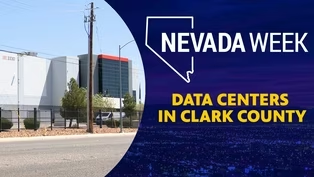
Clip: S9 Ep4 | 19m 30s | Many communities are pushing back against data centers, but where do they stand in Clark County? (19m 30s)
Providing Support for PBS.org
Learn Moreabout PBS online sponsorship New Episode
- News and Public Affairs

Top journalists deliver compelling original analysis of the hour's headlines.
 New Episode
- News and Public Affairs

FRONTLINE is investigative journalism that questions, explains and changes our world.

 New Episode
 New Episode
 New Episode
 New Episode
 New Episode
 New Episode


 New Episode
Support for PBS provided by:
Nevada Week is a local public television program presented by Vegas PBS