State of Affairs with Steve Adubato
Deborah Visconi; Bernie Flynn; Keith Strudler, PhD
Season 9 Episode 9 | 27m 6sVideo has Closed Captions
Deborah Visconi; Bernie Flynn; Keith Strudler, PhD
Deborah Visconi, President & CEO of the Bergen New Bridge Medical Center, discusses challenges within the healthcare sector. Bernie Flynn, CEO of Mercer Street Friends, discusses federal cuts to SNAP benefits. Keith Strudler, PhD, Dean of the School of Communication & Media at Montclair State University, examines misinformation and censorship.
Problems playing video? | Closed Captioning Feedback
Problems playing video? | Closed Captioning Feedback
State of Affairs with Steve Adubato is a local public television program presented by NJ PBS
State of Affairs with Steve Adubato
Deborah Visconi; Bernie Flynn; Keith Strudler, PhD
Season 9 Episode 9 | 27m 6sVideo has Closed Captions
Deborah Visconi, President & CEO of the Bergen New Bridge Medical Center, discusses challenges within the healthcare sector. Bernie Flynn, CEO of Mercer Street Friends, discusses federal cuts to SNAP benefits. Keith Strudler, PhD, Dean of the School of Communication & Media at Montclair State University, examines misinformation and censorship.
Problems playing video? | Closed Captioning Feedback
How to Watch State of Affairs with Steve Adubato
State of Affairs with Steve Adubato is available to stream on pbs.org and the free PBS App, available on iPhone, Apple TV, Android TV, Android smartphones, Amazon Fire TV, Amazon Fire Tablet, Roku, Samsung Smart TV, and Vizio.
Providing Support for PBS.org
Learn Moreabout PBS online sponsorship- [Narrator] Funding for this edition of State of Affairs with Steve Adubato has been provided by Horizon Blue Cross Blue Shield of New Jersey.
Community FoodBank of New Jersey.
EJI, Excellence in Medicine Awards.
A New Jersey health foundation program.
NJM Insurance Group.
Serving New Jersey’s drivers, homeowners and business owners for more than 100 years.
The New Jersey Education Association.
PSEG Foundation.
The Fidelco Group.
The New Jersey Economic Development Authority.
And by NJ Best, New Jersey’s five-two-nine college savings plan.
Promotional support provided by NJBIZ.
Providing business news for New Jersey for more than 30 years, online, in print, and in person.
And by NJ.Com.
Keeping communities informed and connected.
[INSPRATIONAL MUSIC] - Hi, everyone.
Steve Adubato.
We kick off the program talking about the world of healthcare with one of the top healthcare leaders in the State of New Jersey.
Deborah Visconi is President and Chief Executive Officer of Bergen New Bridge Medical Center, one of our partners in the world of healthcare.
Deb, good to see you first.
- Good to see you too, Steve.
And thanks for having me on.
It's always a pleasure.
- You got it, I was saying right before we got on the air, not that anything big is happening in the world of healthcare.
We're taping on the 18th of March.
Number one challenge you and your colleagues in the world of hospitals and healthcare face today is?
- Funding and financing.
- Oh, that money, huh?
- Money.
- How, let me ask you this, how challenging is it to lead at Bergen New Bridge with so much uncertainty around us?
- So, you know, we're used to uncertainty in the world of healthcare.
So, it is always a challenge, but challenges present opportunities.
And so, you know, the key for us here and as leaders in the healthcare space is to make sure that we're always engaging with our stakeholders, with our communities, with our employees, with our patients, to make sure that we continue to be a beacon of health, hope and healing for those that we serve.
So, the ability to lead through change and opportunity, you know, is extraordinary.
Especially these days where, you know, there's threats to our basic funding sources.
So, keeping an eye on the focus, which is to provide extraordinary healthcare for our communities is paramount.
And to, you know, put some of the noise behind us while we continue to engage and embrace the reason why we're here and fulfill our mission.
- Let me ask you this Deb.
We're doing a series called "Tomorrow's Physicians," the graphic will come up, looking at the physician shortage and also the pipeline, if you will, for future physicians, medical school, cost of medical school, et cetera, et cetera.
Talk to us about this physician situation in 2025 for you and your colleagues.
- Yeah, it's definitely a challenge.
There is extraordinary shortages throughout the country in specific specialties, but across every physician type there's shortages.
We have been doing a lot of innovative things, really looking at the pipeline, partnering with medical schools, fellowships, identifying, you know, those that are graduating so we can give them opportunities at our medical center.
We have tremendous partnerships.
We're a clinical affiliate of Rutgers New Jersey Medical School.
So, that partnership does help us recruit providers and doctors to our medical center.
We are looking for loan forgiveness programs, implementing those kinds of things.
We're looking at, you know, the way of life workforce, flexible scheduling, implementing telemedicine, telehealth platforms, leveraging our allied health professionals, like nurse practitioners and physician's assistants, giving our physicians what they need to be successful and to wanna come work with us, whether it's technology, new EMRs, other types of technology that will help make their lives easier and better for them so they can provide that hands-on care.
- The whole question of the aging population, people are living longer and some might say, "Well, that's great, people are living longer."
But healthcare, medical needs become obviously much greater as people get older.
How is Bergen New Bridge dealing with the aging population in and around the community you serve?
- So, you know, we have a very large nursing home here on our grounds.
We have over 400 residents that live here in our long-term care facility.
So, we are very in tune and recognize the growing needs of our aging population, and we're committed to providing that comprehensive, accessible, high-quality care for the older adults.
You know, you mentioned it, but over 17% of Bergen County's population is 65 years or older.
And I'm sure you know this too.
By 2030, all the Baby Boomers will have reached the age of 65.
So, operating one of the largest nursing homes in the state, we serve thousands of low income and vulnerable seniors, many of whom are dependent on Medicare and Medicaid for their care.
And what we're doing is making strategic investments.
Like we have an assisted living that's part of our extended care programs.
We're about to open a PACE program, the program for all inclusive care for the elderly on site right here at Bergen New Bridge, which is a program that offers coordinated, comprehensive healthcare services, allowing seniors to age in place safely while receiving the medical, social, and rehabilitative support that they need.
- The question of trust or distrust in the public health, I don't like saying infrastructure.
I don't know what that, we're not building roads.
The public health universe, your world, the level of distrust, the question about, the graphic will come up: Vaccines, What You Need to Know.
It's a public awareness initiative we're doing.
You've been involved in this healthcare community for a few years.
What is the most important message you would like to share to folks about vaccines, safety, and trusting the system?
- So, as a steward of public health and healthcare in our communities, I would tell our communities that vaccines and really public health are critical in protecting our communities.
Vaccines are one of the most effective tools in preventing serious illnesses, hospitalizations, and deaths from infectious diseases.
You know, we strongly support vaccination efforts, not just for COVID and flu, but all other preventable diseases.
- Measles.
- Measles.
- How the heck did this ever become something other than a public health issue, Deb?
- I think there's, you know, we talk a lot now, and which is a good thing.
We talk a lot about vaccines and their efficacy, and there's a lot more awareness in our communities, which I look at as a good thing.
The more- - It is a good thing.
- The more educated we are, the better decisions we can make.
So, I think, you know, especially with COVID, you know, the advent of COVID and the COVID vaccines and those conversations that we had for the last several years, I think our communities are becoming more engaged and more informed about the right thing to do.
And so I think that has really led to a lot of the conversation around vaccines.
- Deb, when you join us next time, because this is a moving target, as I said, we're taping late in March.
Next time you join us, give us an update on where we are in terms of Medicaid, Medicare cuts, because we don't know where they are right now, and taping a program today that airs later is risky in that regard.
So, come back in a few months when it's clearer where we are and give us an update.
Deb Visconi, I wanna thank you so much for joining us.
We appreciate it.
- Thank you for having me.
- Thanks, that's Deb Visconi, President and Chief Executive Officer Bergen New Bridge Medical Center.
Thank you, Deb.
All the best.
- Thank you, Steve.
Take care.
- You got it.
Stay with us.
We'll be right back.
(grand music) - [Announcer] To see more State of Affairs with Steve Adubato programs, find us online and follow us on social media.
- We're joined once again by our good friend Bernie Flynn, the CEO of Mercer, Mercer Street Friends, I'll get that out.
The graphic will come up.
Bernie, good to see you again.
- Good to see you Steve.
- Give us an update.
We're going into the spring 2025, lots of changes.
Biggest concern you have about federal funding to food related, food insecurity related issues, particularly the SNAP program.
What's your biggest concern?
- Well, the biggest concern is SNAP Steve.
I mean, we are the food bank for Mercer County, so we're a smaller food bank.
But when you consider that, that SNAP.
- SNAP stands for, Is it supplemental?
- Supplemental Nutrition Assistance Program.
It is formally food stamps.
- Got it.
- So, so SNAP is available to millions of people throughout the country.
850,000 or so benefit from SNAP here in New Jersey, and it's, it's an EBT card.
You get so much money for food a month.
So it actually, you know, spurs the economy because it's very efficient with regard to, you know, all SNAP money is expended within that monthly period.
But given the change of administration and the discussions that are going on down in Washington, DC SNAP is at the top of my list as an area for concern.
- How does it impact the people you serve every day?
- Well, here- - And in the, by the way, the geographic area, remind everyone, Bernie, the geographic area you serve.
- Yeah, well for us it's Mercer County, but we work with all the other Feeding America food banks in the state of New Jersey.
And frankly, across the country, we're part of that nationwide network.
But there are five of us here in Jersey.
And the stark numbers are that for all the good work that we do in the food banking world and the food pantry world, food agencies, churches, soup kitchens and such, for every, every 10 charitable meals, that network I just talked about supplies one for the nine meals that are covered by SNAP.
So it's a nine to one ratio.
So SNAP is the most important food security program in the country.
- You know, you have said, Bernie, let's stay on this.
Food as medicine.
What do you mean by that, what is meant by that?
- Well, health and nutrition need to be married to the work that we do.
So we need to, as, as a, as a collective group of food security organizations, we have to try and provide the most nutritious food possible.
And we all know we don't need a bunch of studies to tell us this.
We all know that fruits and vegetables are better for you than the junk food.
And we don't provide junk food to those that we serve.
But we are always trying to get more fresh produce, more eggs, more good protein out to those that we serve.
So food as medicine kind of encapsulates that effort.
- PS, Mercer Street Friends is also tied to the Community Food Bank in New Jersey, one of our long time partners dealing with greater public awareness and education around food insecurity.
Let, lemme try this.
Growing healthy, Growing Health Pantries, what is that program?
- Yeah, that's part of the good news, Steve.
And that is- - You mean there's some good news, Bernie?
- Yeah, there is some good news because of the efforts that are being undertaken by the food banks.
But the Growing Healthy Pantries initiative is a couple years in the making and really a lot of credit goes to Horizon Blue Cross Blue Shield because they see nutrition and health as a partner in the work of the food banks and other food agencies.
- Are they funding that initiative?
- So they are funding this initiative and we are benefiting from several other funders now, but it was the seed funding, from Horizon Blue Cross Blue Shield, that was the catalyst for this Growing Healthy Pantries initiative.
And it's about providing healthier choices to those that we serve, providing more than food Steve.
We need to provide other resources in addition to food when we have that opportunity for our community in need.
- Lemme, lemme press on this issue.
I appreciate you saying that about Horizon, a long time supporter of public broadcasting as well.
And, and, and again, I said this last time you were with us, that Bernie Flynn, when he was the CEO of New Jersey Manufacturers, he's been, he's moved on from that position about seven years ago.
You were just telling us.
Bernie was part of a group of corporate executives who led the effort to help support privately public broadcasting in the state.
Why am I bringing in that up now?
When you talk about this Growing Health Pantries program, the support from the corporate and foundation community, is the need for corporate private support more important than ever before in this food insecurity problem, Bernie, because of the uncertainty and concerns around public government funding.
- Yes.
Now all of our concerns, first of all, the corporate community, the private philanthropic community is critically important in this food security space, as you mentioned.
So, you know, that is tremendously appreciated.
And we're gonna need more, you know, as time goes on, because of what's happening down in Washington DC, food is a nonpartisan issue.
You know, Steve, I've always been an advocate for, you know, different public policy initiatives including, you know, public media.
But I have come to appreciate just how overarching a public policy issue food security is.
It should be, we're the richest country in the world and it should be a given that all of those citizens of the United States of America have enough nutritious food to lead their best lives.
And that is, that is what we are battling right now in Washington DC because there doesn't seem to be an awareness of the, the dramatic impact on, on food security that certain initiatives are, you know, really undermining.
And SNAP is one that is under fire right now, and we'll see, you know, what happens with SNAP.
But we cannot make up the difference if SNAP is cut significantly down in Washington DC.
- To Bernie's point, food insecurity, people not having enough healthy food for themselves, their families.
That's not political, that's not partisan.
And I'm not on my soapbox because that's just a fact.
Bernie Flynn, the CEO of Mercer Street Friends.
Thank you Bernie, we'll talk again soon, my friend.
- Thank you, Steve.
- You got it.
Stay with us, we'll be right back.
(grand music) - [Announcer] To see more State of Affairs with Steve Adubato programs, find us online and follow us on social media.
- We're joined once again by Dr. Keith Strudler, who is Dean of the School of Communication and Media at the Montclair State University, my alma mater.
Good to see you doctor.
- It is a pleasure to be here, thanks for having me back.
- You got it.
Real quick, 30 seconds or less, what is the School of Communication Media at MSU?
- School of Communication and Media at Montclair State University, is a comprehensive school where you can become well-versed and expert in anything from, filmmaking and animation, to sports media, to journalism, to comm studies, advertising, and everything in between.
We are one of the only such places where you have everything from an agency to a sports network, to a streaming platform, all under one roof, where students get their hands dirty, and we help them to reach their fullest potential.
And most importantly, the School of Communication and Media.
will become next year, the College of Communication and Media, which just affirms our growth and our commitment to this discipline.
- It has been said by Jeff Jarvis, who, you know, Jeff is a media scholar, he is been talking about these issues over the years.
We're engaged in a, quote, "A totalitarian coup", that the administration right now, the Trump administration is trying to crack down and control media that they do not like, if not eliminate us.
You say, overstatement, accurate, what?
- I think yet to be determined.
I mean, I think the intentions are clear, perhaps the question is whether it's feasible.
So yeah, I think it's pretty obvious that they want to control the narrative.
Now, to be fair, he's not the first president that's wanted to control the narrative.
And of course, in fact, you know- - Richard Nixon comes to mind.
- But there are many others.
- Absolutely, - Absolutely.
And look, as some accused Obama of wanting to having a tight lid on the messages to get out.
- Absolutely.
- Right?
But, never before has this been in, have we seen this intentionality, and clear crossing of what we assume to be bright lines.
And what you start to realize is those bright lines are just words on paper.
So, I don't know necessarily if we can say for sure that's going to happen, but I think maybe part of the more chilling parts of this is there seems to be an acquiescence of people, in positions of leadership.
So, when Jeff Bezos kind of comes along for the ride, - Jeff Bezos, "The Washington Post", and we'll talk about the LA Times in a second.
They have folks who own those media and, those media entities who have a lot of money.
When you say acquiesce, Keith, what do you mean?
- Look, when you decide that a newspaper is going to limit the kinds of opinions and editorials that are gonna be part of their pages, because, seemingly of a relationship and intentionality of national government, your self-censorship kind of does the work for them.
And I'm not saying that there's an easy answer to this because, certainly the newspaper industry has been cash strapped for some time, but, so, it's a lot easier for there to be kind of the end of a free press when we seem to be walking ourselves into the gallows.
- Let's talk about self-censorship.
So, those of us connected to public broadcasting, we don't, we're not officially a part of public broadcasting, but we're partners with our partners in public broadcasting.
So because the FCC, and the chairman there have made it clear they're investigating public broadcasting, NPR, CBS, what should we be doing, Keith?
What is smart business for us?
Should we not be having conversations that are somewhat questioning, and if someone comes on as critical of the administration, or is that bad business and dangerous for us?
I mean, what should we be doing?
- I think the answer is fundraise.
No, but it's in all seriousness, because in so many ways, it does come down to the financial wherewithal to be able to continue to operate your business.
And particularly if the federal government's threatening to take money.
- You said for private money.
Private money.
- Yep, absolutely.
Which is getting even, which is challenging as well, because there's a chilling effect on donations when the federal government makes it clear that they're not particularly fond of public broadcasting.
Look, I don't have a better answer than probably anyone else, because in the end of the day, when you are speaking truth to power, you are making yourselves vulnerable, particularly when you're reliant on those resources to continue your business.
The only thing I've heard this from someone much smarter than I is, I think, I think everyone in positions of authority, and in positions of, you know, news makers and so forth, need to be careful about the fights they pick, and how they engage.
And so, I think there is a responsible way to do journalism and then there is an antagonistic way of doing it.
And so I think, perhaps more than ever, it's really important to rely on facts, to not go looking for the fight.
And don't I mean that as, kind of cowering from from power, but I just think there's smart journalism that probably is really important.
Look, I think the other elephant in the room is, regardless of the reporting that happens in public broadcasting or otherwise, you know, it is the avalanche of mis and disinformation, in social media and so forth, that's making even that good work more challenging in today's environment.
So there's- - Well, stay on that Keith.
I'm sorry for interrupting.
If someone says, listen, I get my information from an influencer from social media, so I don't need Adubato, I don't need, and it's not me, I don't need public media, I don't need legacy media.
I'm getting all the stuff I need from the sources I count on, because they tell me I'm right.
What's the problem with that, in a larger small-d democratic society, Keith?
- Yeah, it's really tough when the echo chamber's that loud, right?
And so, again, there's no easy answer, and we all need Steve, so we know that, but- - We all need to be raising money, nonstop 24/7.
And you said, harder than ever, and P.S., sorry for jumping in here.
How the heck are you teaching the students who are going into this universe, and how much of it has to do with business and economics?
- Yeah, we're really, we're increasingly focused in all of our degree programs on the business of media.
And we really like to say, you need to know who's paying your paycheck, and where that money's coming from.
It's really, really important.
So, I think, look, you're talking about so many different ways in which the press and democracy is under attack.
Obviously, the simple answer, is it all comes down to education, right?
Because, in the end of the day, if people are better informed about where their news comes from and what mis and disinformation is, and how they can be more attuned to that, it makes it a lot easier.
But, that's much easier said than done.
And it doesn't necessarily happen at the university level.
These are things that need to be embedded in public school curriculums from genesis.
If a kid has a phone when he's four, you know, it's gonna be a lot too late to at 18 to be like, hey by the way, what you're seeing on TikTok may or may not be true.
So, I think that literacy has to happen at a young age, which again, is really tough when, not only is the federal government, kind of, meddling in media, but also in public school curriculum.
And, I'm sure you know, and as most of your viewers know, just even the discussion of disinformation has become a bit of a hot button word in- - Just talking about it, Keith?
- Absolutely.
- How is that a hot?
I got a minute left, how is that a hot button?
- I just think, because of the way in which, particularly in the last election cycle, when we were increasingly criticized for calling out the obvious, which is the results of the past election.
So, I think, even some work around what's mis and disinformation, gets called into the question by the federal government.
But I do think that is the answer.
The answer is people understanding, where their information is coming from, and what reliable news sourcing is.
- Last point, and Keith will appreciate this, we're involved in an initiative called Vaccines that you need to know.
And by the way, Stephanie Silvera, one of your colleagues at MSU, is an excellent public health expert, and she'll be part of that.
Why am I saying that?
Not a political point of view, it's not ideological.
They are facts.
That's science.
And if someone gets peeved at you for sharing important information about one's health, I'm not sure what's left.
I'm off my soapbox, Keith Strudler, that's not my job to express my point of view.
That is Keith Strudler who's doing important work with his colleagues at MSU, Montclair State University.
He's the Dean of the School of Communication Media, which will soon be a College of Communication Media.
Keith, thank you so much for joining us.
We'll continue our conversation about media leadership.
P.S., two of our best producers, some of our top producers come from MSU, they produce some great students.
Thank you, Keith.
- Thank you very much.
- You got it, I'm Steve Adubato.
I talked about how great we are in in public broadcasting, I wasn't sure it was the end of the show.
That's it folks, see you next time.
- [Narrator] State of Affairs with Steve Adubato is a production of the Caucus Educational Corporation.
Funding has been provided by Horizon Blue Cross Blue Shield of New Jersey.
Community FoodBank of New Jersey.
EJI, Excellence in Medicine Awards.
A New Jersey health foundation program.
NJM Insurance Group.
The New Jersey Education Association.
PSEG Foundation.
The Fidelco Group.
The New Jersey Economic Development Authority.
And by NJ Best, New Jersey’s five-two-nine college savings plan.
Promotional support provided by NJBIZ.
And by NJ.Com.
- (Narrator) New Jersey is home to the best public schools in the nation, and that didn't happen by accident.
It's the result of parents, educators and communities working together year after year to give our students a world class education.
No matter the challenge, because parents and educators know that with a shared commitment to our public schools, our children can learn, grow and thrive.
And together, we can keep New Jersey's public schools the best in the nation.
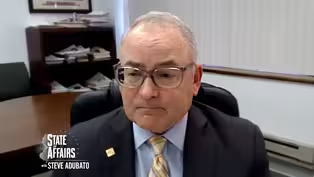
Addressing the impact of federal cuts to SNAP benefits
Video has Closed Captions
Clip: S9 Ep9 | 8m 51s | Addressing the impact of federal cuts to SNAP benefits (8m 51s)
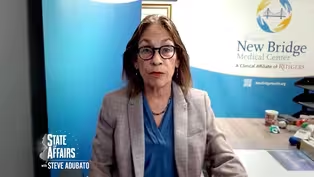
Bergen New Bridge and their approach to end-of-life care
Video has Closed Captions
Clip: S9 Ep9 | 8m 35s | Bergen New Bridge and their approach to end-of-life care (8m 35s)
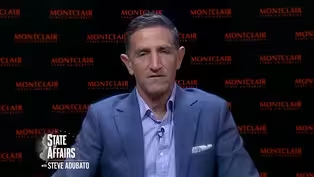
Navigating misinformation in this era of journalism
Video has Closed Captions
Clip: S9 Ep9 | 10m 22s | Navigating misinformation in this era of journalism (10m 22s)
Providing Support for PBS.org
Learn Moreabout PBS online sponsorship
- News and Public Affairs

Top journalists deliver compelling original analysis of the hour's headlines.

- News and Public Affairs

FRONTLINE is investigative journalism that questions, explains and changes our world.












Support for PBS provided by:
State of Affairs with Steve Adubato is a local public television program presented by NJ PBS