State of Affairs with Steve Adubato
Michael Goldstein, MD; Linda M. Czipo; Matthew Sarkees, PhD
Season 10 Episode 17 | 26m 46sVideo has Closed Captions
Michael Goldstein, MD; Linda M. Czipo; Matthew Sarkees, PhD
Dr. Michael Goldstein, Director of Organ Transplantation & Program Director of Kidney & Pancreas Transplantation at Hackensack University Medical Center, explains the organ donation process. Linda Czipo, President & CEO, NJ Center for Nonprofits, discusses the demand for nonprofits. Dr. Matthew Sarkees, Dean of the Rowan University College of Business, explores the financial planning workforce.
Problems playing video? | Closed Captioning Feedback
Problems playing video? | Closed Captioning Feedback
State of Affairs with Steve Adubato is a local public television program presented by NJ PBS
State of Affairs with Steve Adubato
Michael Goldstein, MD; Linda M. Czipo; Matthew Sarkees, PhD
Season 10 Episode 17 | 26m 46sVideo has Closed Captions
Dr. Michael Goldstein, Director of Organ Transplantation & Program Director of Kidney & Pancreas Transplantation at Hackensack University Medical Center, explains the organ donation process. Linda Czipo, President & CEO, NJ Center for Nonprofits, discusses the demand for nonprofits. Dr. Matthew Sarkees, Dean of the Rowan University College of Business, explores the financial planning workforce.
Problems playing video? | Closed Captioning Feedback
Where to Watch State of Affairs with Steve Adubato
State of Affairs with Steve Adubato is available to stream on pbs.org and the PBS app.
Providing Support for PBS.org
Learn Moreabout PBS online sponsorship- [Narrator] Funding for this edition of State of Affairs with Steve Adubato has been provided by Horizon Blue Cross Blue Shield of New Jersey.
New Jersey Sharing Network.
The Fund for New Jersey.
NJM Insurance Group.
Serving New Jersey’s drivers, homeowners and business owners for more than 100 years.
PSE&G.
Powering progress.
Robert Wood Johnson Foundation.
Working to create a future where health is no longer a privilege, but a right.
The Russell Berrie Foundation.
Making a difference.
Valley Bank.
And by New Jersey Manufacturing Extension Program.
Promotional support provided by ROI-NJ.
Informing and connecting businesses in New Jersey.
And by CIANJ, and Commerce Magazine.
[INSPRATIONAL MUSIC] - Hey, everyone, Steve Adubato here.
Welcome to a very special interview that you're about to see with my colleague, Jacqui Tricarico, who is our Senior Correspondent.
Jacqui, you attended the June 7th 5K Celebration of Life, if you will, for the New Jersey Sharing Network.
Tell folks what they're about to see.
- Well, New Jersey Sharing Network is an organ and tissue procurement organization here in New Jersey, and the event was all about honoring those that we have lost that were organ and tissue donors, remembering their lives, and also bringing awareness to those who are still waiting for organ and tissue donations.
So many people, 4,000 here in New Jersey, are on the waiting list for a lifesaving organ.
So this event was just so impactful in its 16th year.
16 years, it's been going on.
It's a huge event in New Providence, New Jersey, and I was lucky enough to be there.
Again, I've been doing this over a decade, and I get to go there every year to share their wonderful, impactful, important stories.
Yeah, it's 4,000 in New Jersey waiting, 100,000-plus in the United States.
Important, compelling, powerful interviews.
Here's one of Jacqui's right here.
- Hi, I'm Jacqui Tricarico, on location at the New Jersey Sharing Network 5K event here in New Providence, New Jersey.
So excited now to be joined by Michael Goldstein, who's the director of the Division of Organ Transplantation and the Program Director of Kidney and Pancreas Transplantation at Hackensack Meridian Hackensack University Medical Center.
Big mouthful.
We're going to get into what all that means, Dr.
Goldstein.
- Good morning.
- Good morning.
- Thank you.
- Thank you for joining us.
So I want to talk about the relationship between hospital and nonprofit New Jersey Sharing Network organization and how the synergy needs to be just so in tune to make sure that the process of organ donation is done smoothly on the hospital end.
- So the relationship between hospitals and the New Jersey Sharing Network or Organ Procurement Organization, as we also call them, is somewhat of a mandatory relationship for all Medicare-supported hospitals to become donor hospitals.
So the hospitals in the surrounding community have to partner with an OPO or organ procurement organization for part of Medicare certification.
And that's one mandate that we have as a hospital to support organ donation and support our community.
At the same time, Hackensack University Medical Center is also a transplant center.
So we have a dual role.
So we not only support organ donation at our hospitals within our health system, but we also save lives with the organs that we receive through organ donation.
So it's a kind of full spectrum support of our community.
- And heading these transplantation teams for you, how important is it that on the hospital end, you are really honoring the donor and the donor families and helping them during such a difficult time in their lives?
- It's incredibly rewarding and probably one of the most difficult things you can do in our society.
Supporting a donor and supporting a donor family at this critical time in their life to make one of the most complex decisions about saving other lives at the end of someone's life is extremely complicated.
Our system does it very effectively, focusing on the patient and focusing on really the big picture of how to support the patient and their wishes at the end of their life.
You cannot have donation without transplantation and you can't have transplantation without donation.
It's a partnership.
So for us as a transplant center and for our transplant teams, it's extremely important to support the donor teams and the donor community so we can save more lives.
- When we're talking about the actual transplantation itself, talk about the advancements in the technology that's really helping you do even more now.
- So the most important advances that have happened... Transplantation's been around for about 70 years now.
The operation itself for the most part has been about the same.
We take organs out, we put them in, they're surgical procedures, but what's really changed in terms of helping people live longer and healthier with organ transplants has been the industry support that we receive from pharmaceutical companies that can make the complex medications to change the immunosuppression, to make it healthier and reduce rejection rates, as well as the technology parts of what we do, bringing robotic assistance and bringing machines that help resuscitate and make organs last longer outside of the body.
So those two things have really changed the outcome of kidney transplant.
When I started in this field about 25 years ago, kidneys I would tell patients would last between 5 and 10 years and then they'd have to do it again.
Now I tell patients a living donor kidney may last for 20 years on average.
So the amount of time that people can be saved from these organs has really increased and that's because of, I would say, a multi-modality approach, both with biopharma, hospital-based programs as well as industry support in the technology components.
- Let's talk a little bit more about the living donor.
I've heard these stories many times.
I actually have a neighbor whose husband is getting a kidney from his wife in the next couple of weeks.
The living donor aspect of this, what should people know about that?
Because even if you're not a match for your loved one who might need this life-saving organ, you can do other things to still become a living organ donor, correct?
- That's correct.
So living donation is really the marquee effort of what we can do for kidney and liver transplantation.
If you have a living donor, there are some really great benefits for the recipient.
One is you don't have to wait a long time on a waiting list.
Second, that organ is one of the healthiest organs, so it's going to function right away.
And third, it has the potential to last longer than a deceased donor organ.
So for a patient, living donation is really the most important effort they should focus on.
How do you find a living donor?
It's somewhat difficult.
It's a difficult question to ask someone.
We don't like to ask for a cup of coffee.
It's hard to ask for an organ from somebody.
- And then you need to be a perfect match.
- And you need to be a reasonable match.
It doesn't necessarily have to be perfect, but those are difficult things to ask for.
So we spend a lot of time educating patients about how to ask the question and make more awareness the fact that we all can be living donors.
We don't have to wait till our end of life to become an organ donor.
We can donate right now.
Most of us are born with two kidneys.
You can give one away and save your loved one.
You can save a stranger.
Even more important right now is some innovative things that we've been doing for probably over a decade, maybe almost two, is called paired kidney exchange.
And even more intuitive and innovative is something called voucher donation.
And so in some ways, let's say I have a loved one, a son or daughter, a nephew who's young, but has a kidney disease that's going to take many years to progress and they don't need a transplant today.
But I want to donate today because where I am in the part of my life is I'm healthy enough now.
In 20 years, I may not be healthy enough to donate or in the right age component.
If I donate today to help another patient, I may receive a voucher that I can give to up to five people that they can basically hand in when they're medically suitable and medically ready for a transplant.
So it allows us to protect our loved ones today for potential future needs as well.
And if you don't match, let's say I wanted to donate to you and we didn't match, we can go into a national network.
There are a few different networks that work with this and use computer matching and complex algorithms to allow us to exchange organs so you receive a healthy organ that's compatible for you and there's no risk of having rejection if mine wasn't compatible as well.
And so those really allow us to increase the opportunities for living donation.
- Yeah, just incredible thinking on how different ways we can go about this process.
Finally, for you, you said 25 years doing this job.
Why are you still so passionate about the work that you're doing?
- Yeah, it's really truly exciting.
Donation, I've been part of organ donation and transplantation, so I've seen both sides of it and I try to live both sides of it all the time.
In my role, I have the real honor to see one-on-one.
And so with one organ, I save one patient and building that relationship and seeing the life benefits of that is something that personally for me is extremely rewarding.
And not only the immediate relationship that I have as a surgeon, I have long-term relationships with my patients that go on for decades and decades where I can help them live and see their life as it progresses.
So extremely rewarding on both ends.
And so I'm really honored to be in this field.
- Well, thank you so much for sharing more so we can understand more about what happens on the hospital end of organ donation.
Thank you so much, Dr.
Goldstein.
- Thank you very much.
- We'll be right back after this.
(grand music) - [Announcer] To see more State of Affairs with Steve Adubato programs, find us online and follow us on social media.
- We're joined by our good friend and colleague in the nonprofit world, Linda Czipo, who's President and Chief Executive Officer of the New Jersey Center for Nonprofits.
Linda, good to see you again.
- Thank you.
Nice to be here.
- You having fun yet in the nonprofit world?
- We are in interesting times in the nonprofit world.
- What is especially interesting, because you and your colleagues do an annual survey of nonprofits, 41,000 nonprofits in New Jersey.
What's so interesting, and frankly more relevant, challenging for nonprofits in the state, and in the nation, but New Jersey right now?
- Yeah, I mean, the biggest problem is that more people are turning to nonprofits for help.
More people are looking for nonprofits for services.
And the funding is not keeping pace with that increasing demand.
This is not new, but it's been more acute in the last couple of years.
And then you've got a policy landscape that has been very chaotic with funding interruptions, cuts to major programs, and all of that is just increasing the burden and the stressors for nonprofits and taxing their ability to meet this demand.
- You know, I was watching a news piece yesterday, we're taping on the 16th of June, In New York City, Mayor Mamdani held back, and you know this, I know you know this, held back billions of dollars of funding, New York City government funding to nonprofits, and then was pressured by the city council and the nonprofit leadership that Linda knows as well, to turn over that money to nonprofits.
So, here's the question in New Jersey.
To what degree are nonprofits in New Jersey, because New York City is huge, comparable again to New Jersey as a state, to what degree are nonprofits in New Jersey dependent upon state funding?
- It's an important part of revenue, and it's important to remember this is a partnership.
Government looks to nonprofits to provide essential services for people in communities.
So, that's why government provides grants and contracts to nonprofits.
And it is an important source of revenue.
And if that's put at risk, then the services are at risk.
- Okay, along those lines, we've had discussions with members of the state legislature around this issue, but your perspective is particularly important.
So the governor, Governor Sherrill, check out our interview with Governor Sherrill.
See the website, steveadubato.org.
Half-hour conversation.
Part of that conversation was about fiscal integrity, if you will, and the issue of so-called Christmas tree items, pet projects.
A lot of waste in certain cases.
But is it a fact, Linda, that some of those so-called Christmas tree items are items that state legislators attempt to put into the state budget supporting nonprofit organizations doing really important work?
- Yeah, absolutely.
There's no question about that.
You've got these line items which are, yeah, this is not pork.
These are essential services.
It's things like services for veterans, hospice care, services for first responders, tax prep assistance.
It's a wide spectrum of programs and services that people and communities need and use.
So, that's part of the big problem here.
You can't just dismiss this as pork or waste.
If these programs go away or the funding for the program goes away, there's real consequences in our communities and for people who need them.
- So, your advice to the governor and the governor's budget team as it relates to going through these line items, if they call it, and she doesn't use the word pork, but the term Christmas tree items does get used a lot.
What is your advice to the administration as it relates to examining each and every line item, proposed line item from a legislator, as it relates to nonprofits?
- Well, that would be the request.
And we know that this is a difficult budget season.
That's putting it mildly.
And so we do want- - Especially with federal cuts, especially with federal cuts.
Go ahead, I'm sorry.
- Everything is just piling on.
Exactly.
And we understand that.
We know that there are hard decisions to make.
And what we would urge the governor and legislature to do is not to dismiss these things out of hand, to look very carefully at every single line item, look at what it's going for, look at what might be lost if it goes away, and to make those decisions very, very carefully.
I know the governor and the administration and the legislature understand how important nonprofits are.
So, we just want them to keep that in mind.
- Linda, let's start narrowing this down a little bit.
You talk about demand.
In the survey, you picked up a lot of this information.
What are the areas that nonprofits are involved in, in terms of services that are in the most demand by citizens who, if they did not, trust me, loaded question, if they did not get the services and help from nonprofits, they would not be coming from government?
So, what is in greatest demand?
- Well, it's, you name it.
- You mentioned veterans before.
- Services for veterans, mental health services, services for people who are facing substance use issues, arts, the arts are a huge driver in mental health, and in commercial wellbeing in our communities.
You could just go across the spectrum.
Services for seniors, you can go on and on.
Services to help people afford their homes or stay in their homes or to keep jobs.
Literacy.
You can go on and on and on.
- You and I have had this conversation so many times in the past because you lead your nonprofit and the tax code is a 501(c)(3) that is in the tax code.
We are a 501(c)(3), and I spend, and I say this to you every time you join us, I don't know, 60, my colleague, Mary Gamba, who runs our operation day to day, I mean, 60 or 70% of my work connected to this organization is raising money.
Is that the case for most CEOs of nonprofits?
- It's certainly a huge amount of time.
And quite frankly, if some of the systems for fundraising were simplified, that could be a little bit less.
If the applications were not as complicated, if the reporting was not quite as complicated, if the funding streams were not quite as restrictive, more general support funds so that organizations can deploy those funds as they see fit and remain nimble to respond to changing needs, multi-year grants so that you're not going year after year after for funding.
- That would be great.
- All of those things.
But if you want to make the system more efficient, then those are some of the things that you can think about.
- Last question before I let you go.
if more and more nonprofits close, explain to folks briefly the impact.
- The problem is you always assume that nonprofits are going to be there until they're not.
And that's really the programs and services that you take for granted that are always going to be there, that we think are going to be there in the community, if they are put at risk, or fewer people can be served, that's more stress on, obviously, it's a human catastrophe, but it's also government is going to have to.
Nonprofits are a partnership with government.
And so if these services are not available, the pressure and stresses on government are going to increase, too.
- Linda Czipo is President and CEO of the New Jersey Center for Nonprofits.
Linda, thank you so much once again for joining us.
We appreciate it.
- Thank you so much.
- You've got it.
Stay with us, we'll be right back.
(grand music) - [Announcer] To see more State of Affairs with Steve Adubato programs, find us online and follow us on social media.
- We're now joined by Dr.
Matthew Sarkees, Dean of the William G. Rohrer College of Business at a higher ed partner, Rowan University.
Good to see you, professor.
- Great to see you, Steve.
Thanks for having me.
- Now you've established, you and your colleagues have established a school of financial planning.
What is it?
And why is it so significant?
- So we figured out that the financial planning industry is really lacking professionals.
So there are more professionals that are retiring every single day.
They're not being filled with recent graduates.
We also felt like we have a growing student population here in the College of Business, and some excellent programs, and we're always looking for opportunities to add new ones.
And after we had some discussions, we felt like launching a school of financial planning was the right thing to do.
- And you got a significant gift from the Edelman family?
- We actually received the gift from Edelman Financial Engines, which is a corporation that has more than 100 locations around the United States.
And they liked our vision, and what we were trying to create here, and they made a commitment for $10 million.
- And that's Rick Edelman, who is in fact a Rowan alum.
Let's break this down a little bit.
- Sure.
- So I'm curious about this, financial planning.
First of all, I think I know what it is, because I've been obsessed by the fact that I knew I was spending too much, more than I had, for a long time.
And retirement was going to be at some point very real.
And I was like, "What do you mean I have to figure out what I need?"
And a great financial planner has helped me along the way.
Help folks understand beyond preparing for "retirement," what is financial planning?
- And when you think about financial planning, and some people use the term wealth management, interchangeably, it's the idea of understanding how to plan for the future and what it is you might need, not just for yourself in retirement, but for your family, or your loved ones.
Might be saving for college.
It might be planning for a child that might have some needs that carry on into adulthood.
It might be just for yourself, and how to live comfortably.
- But at the same time, the issue of financial planning is a disproportionate problem for people of color, disproportionately for people of color, and others, who happen to be challenged from a socioeconomic point of view, trouble making ends meet, et cetera.
Affordability is a problem for everyone.
Play this out.
Why is the financial planning issue an even greater challenge and issue for people of color?
- Well, so there's a couple ideas in there.
The first is - - If it's not, tell us.
- What I would say is that the current industry demographics don't reflect the population of the United States.
- Simply put, there are way more White men, older White men, involved in financial planning, than those who need financial planning.
- There are, yes.
- How are we dealing with that?
- I think what our program intends to do is to develop students that can not only go out into the world and seek clients and serve those clients, but also serve their community.
Our students come from a variety of socioeconomic backgrounds.
They not only want to help themselves, they want to help their families and their communities understand the concepts around financial planning, how to grow wealth, and at a more foundational level, the idea of financial literacy, because - - Talk about financial literacy.
You have an initiative at Rowan about that.
Talk about that.
- We do.
It's part of the school of financial planning.
Our goal is to grow financial literacy, not just across the campus, but into the community, beyond the communities.
And the basics, do I buy a car?
Do I lease a car?
I have student loan debt.
What's it going to take for me to save for my very first house?
How am I going to put my kids through college?
So these financial literacy questions are important in everyday life, and we want to help people make better decisions.
- Let me complicate things a little bit with artificial intelligence.
From your perspective and your expertise, particularly with the program at Rowan, what is, and where is the place for AI in financial planning?
- I think the good news for financial planning is that AI will be helpful, but it'll be helpful in more of the automated tasks.
A big part of financial planning and wealth management is still the soft touch, the client service, the interaction, uncovering what are my goals in life, and how can I be successful?
That's a personal relationship.
It's going to be very difficult for AI to mimic.
- What advice do you have, practical advice for anyone, particularly those who say, "Financial planning?
I'm trying to figure out how to pay the rent, the mortgage, the electricity bills."
Talk to them, professor.
- I would say there are different tiers in financial planning.
Find an opportunity to speak with a financial planning professional, just to get a basic understanding of key things that I should be thinking about.
For a lot of people, it can happen through their job.
Companies offer a free financial planner, at least the opportunity to speak to someone.
I would encourage people to do that.
As our program grows, and we're teaching students the basics of financial planning in preparation to be certified financial planners, we will be out in the community, trying to answer some of those most basic questions in a way that's affordable for those participants.
- Rowan University, one of our higher ed partners, Professor Dr.
Matthew Sarkees, Dean of the William G. Rohrer College of Business at Rowan.
Doctor, thank you so much for joining us.
We appreciate it.
- Thanks so much, Steve, for having me.
Appreciate it.
- You got it.
I'm Steve Adubato.
We thank you and appreciate you for joining us.
We'll see you next time.
- [Narrator] State of Affairs with Steve Adubato is a production of the Caucus Educational Corporation.
Funding has been provided by Horizon Blue Cross Blue Shield of New Jersey.
New Jersey Sharing Network.
The Fund for New Jersey.
NJM Insurance Group.
PSE&G.
Robert Wood Johnson Foundation.
The Russell Berrie Foundation.
Valley Bank.
And by New Jersey Manufacturing Extension Program.
Promotional support provided by ROI-NJ.
And by CIANJ, and Commerce Magazine.
- How long you been waiting?
- About a half hour.
- Brutal.
This keeps up, I'm gonna miss my pickleball game.
- I've been waiting eight years for a kidney.
What can you do?
(gentle music) - [Narrator] Over 100,000 people in the US are waiting for a life-saving transplant.
But you can do your part in an instant.
Register as an organ donor today at NJSN.org.
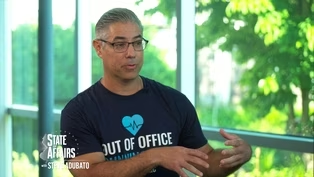
Dr. Michael Goldstein walks through organ donation
Video has Closed Captions
Clip: S10 Ep17 | 10m 45s | Dr. Michael Goldstein walks through organ donation (10m 45s)
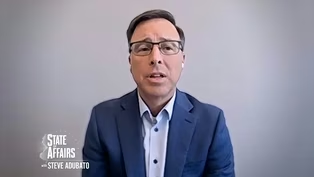
Dr. Sarkees explores the financial planning workforce
Video has Closed Captions
Clip: S10 Ep17 | 7m 40s | Dr. Sarkees explores the financial planning workforce (7m 40s)
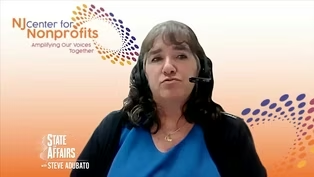
The rising demand for nonprofit services in NJ
Video has Closed Captions
Clip: S10 Ep17 | 9m 11s | The rising demand for nonprofit services in NJ (9m 11s)
Providing Support for PBS.org
Learn Moreabout PBS online sponsorship New Episode
- News and Public Affairs

Top journalists deliver compelling original analysis of the hour's headlines.
 New Episode
- News and Public Affairs

Today's top journalists discuss Washington's current political events and public affairs.
 New Season


 New Episode
 New Episode
 New Episode

 New Episode
 New Episode
Support for PBS provided by:
State of Affairs with Steve Adubato is a local public television program presented by NJ PBS